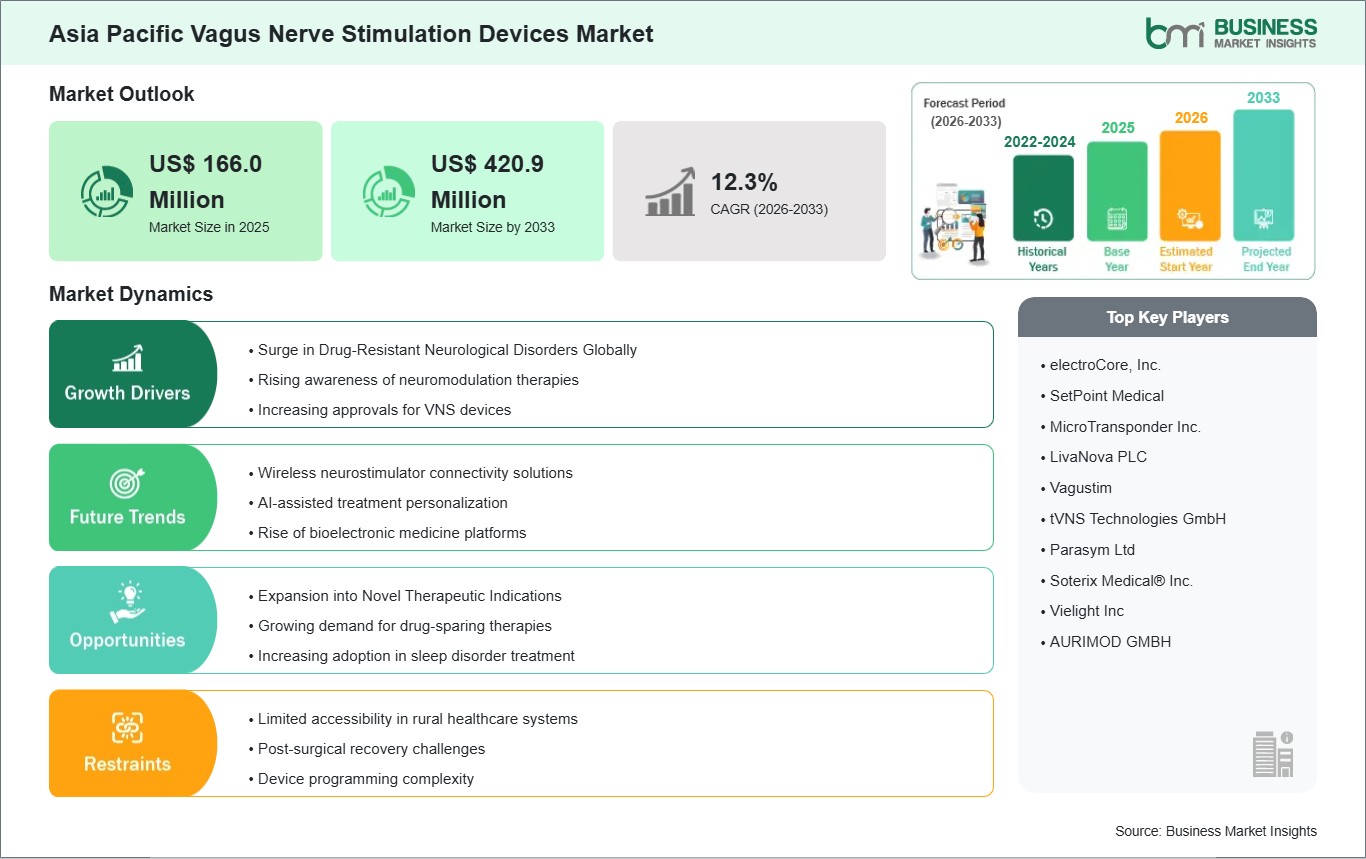
The Asia Pacific vagus nerve stimulation devices market size is expected to reach US$ 420.9 million by 2033 from US$ 166.0 million in 2025. The market is estimated to record a CAGR of 12.3% from 2026 to 2033.
The Asia Pacific Vagus Nerve Stimulation Devices Market witness consistent structural growth, as there is a greater emphasis on neurological treatment in regional health modernization initiatives. Increased cases of epilepsy, drug-resistant depression, migraines, and other neuro-psychiatric disorders have spurred demand for neuro-modulation devices among developed and developing healthcare infrastructures alike. The use of vagus nerve stimulation devices as part of the treatment path for patients suffering from the aforementioned disorders has gained momentum, especially among patients unresponsive to pharmacotherapy. The acceptance of device-based neuro-treatment is further boosted by enhancements in diagnostic technologies and expansion in neuroscience departments of tertiary care centers.
A major factor that will drive growth within this region includes the fast progress being made by the medical technology ecosystem within these nations, which are characterized by having efficient domestic medtech manufacturing and digitized healthcare environments. The increasing use of devices for minimally invasive and non-invasive neuromodulation is set to change the treatment options even more, especially among urban health facilities where awareness regarding advanced neurological treatments tends to be higher. The growing presence of private hospitals and neurological centers has made it possible for the adoption of technologies for vagus nerve stimulation in several applications, such as mental and rehabilitative care. Nonetheless, the market faces restrictions such as unequal healthcare coverage among rural and semi-urban locations, variability in clinical knowledge about neuromodulation procedures, and inconsistencies in reimbursement policies. Regulatory differences among countries in the Asia Pacific region represent additional barriers to success. Nonetheless, there is an immense opportunity for the future, considering the rising awareness of neurological diseases and improving healthcare infrastructures.

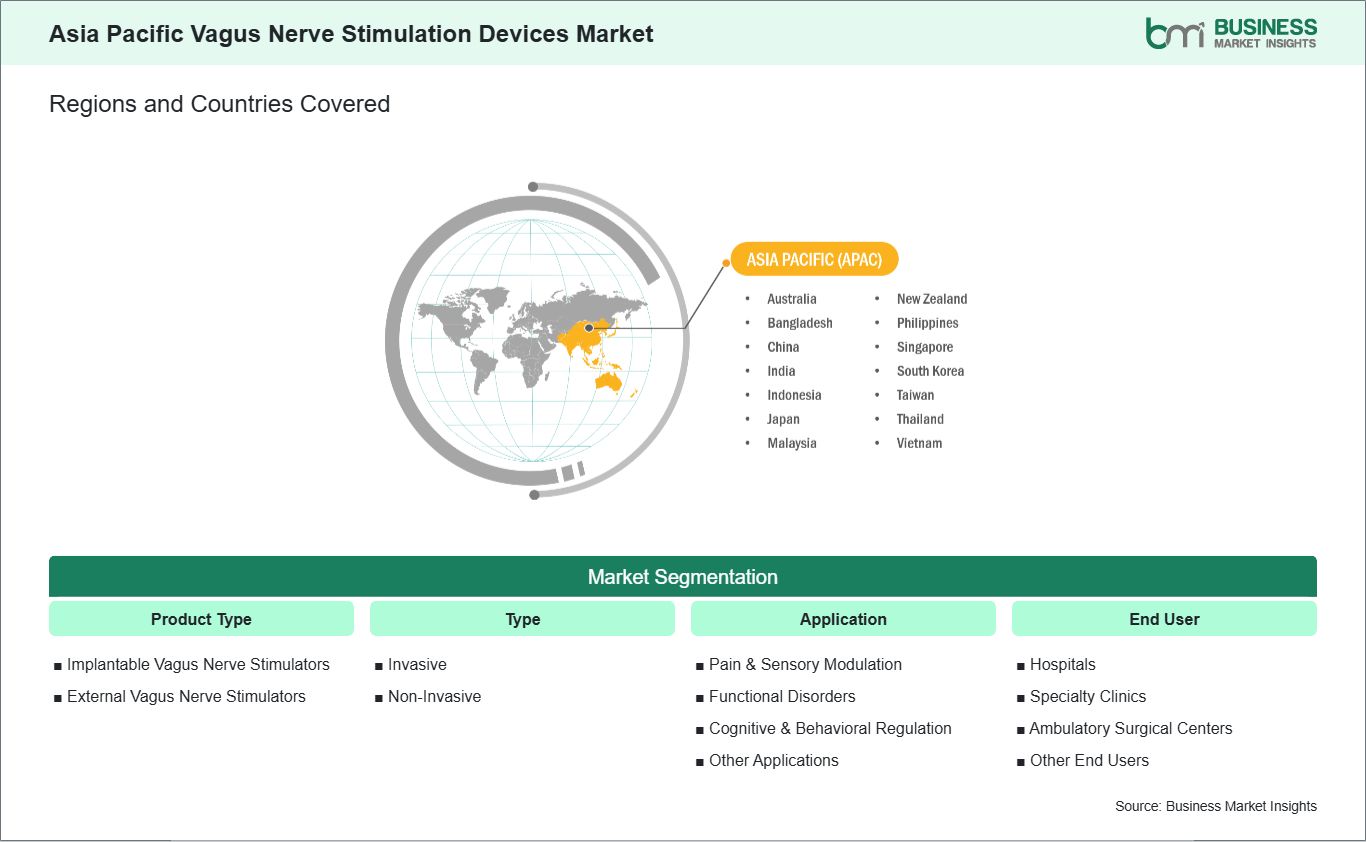
Key segments that contributed to the derivation of the Asia Pacific vagus nerve stimulation devices market analysis are product type, type, application, and end user.
The Asia Pacific VNS devices market is increasingly shaped by the complex and regionally diverse burden of drug-resistant neurological disorders, particularly epilepsy cases that remain uncontrolled despite multi-drug regimens. In India and China, large patient populations combined with disparities in rural healthcare access lead to delayed escalation to advanced therapies, resulting in a higher pool of chronic refractory epilepsy cases managed in urban tertiary hospitals. This concentration of complex neurological cases in metropolitan centers is gradually increasing clinical exposure to neuromodulation approaches such as VNS.
Whereas the problem in low- and middle-income countries is mainly that of access, high-income nations within the Asia-Pacific region face issues of disease management in their aging population. Late-onset epileptic syndromes, seizures after stroke, and neurodegenerative co-morbidity are now being seen in patients who become unresponsive to drug therapies, and physicians have started thinking along the lines of devising an alternate modality earlier on in the therapeutic course. Australia, too, shows the same trends in its neurology referral networks.
Across Southeast Asia, particularly in countries such as Indonesia and Vietnam, drug-resistant neurological disorders are often compounded by infectious disease-related brain complications, including neuroinfections that result in chronic seizure disorders. Limited continuity of care and interruptions in medication supply further increase the likelihood of treatment resistance. This uneven clinical landscape is gradually strengthening interest in neuromodulation solutions, though adoption remains limited to select private and university-affiliated hospitals.
In the Asia Pacific region, vagus nerve stimulation is gradually extending into novel clinical domains beyond its traditional neurological applications, particularly in countries with advanced biomedical research ecosystems such as Japan, Australia, and South Korea. Here, VNS is being explored in experimental neurorehabilitation protocols focused on post-stroke motor recovery, where clinicians are integrating stimulation techniques with robotic-assisted physiotherapy to enhance neuroplastic responses.
The increased focus on chronic pain syndromes as well as refractory migraines in both China and India provides more avenues to explore VNS technology, as the patients who exhaust their chances using medication opt for alternative routes. Hospitals and neurological centers in large urban areas have been investigating the use of medication-free solutions to pain problems as part of their holistic approach to pain management.
In Southeast Asia, particularly in Thailand, Malaysia, and the Philippines, the expansion into psychiatric and autonomic nervous system-related disorders is gaining traction in private healthcare settings. Conditions such as anxiety disorders, stress-related somatic syndromes, and treatment-resistant mood disorders are driving clinicians to explore neuromodulation approaches as adjunct therapies. While still at an early stage, this trend reflects growing openness to device-based interventions in regions where mental health services are rapidly modernizing and diversifying.

The Asia Pacific vagus nerve stimulation devices market demonstrates steady growth, with size and share analysis highlighting evolving trends and competitive dynamics among key players. The report evaluates important subsegments categorized within product type, type, application, and end user, highlighting their respective contributions to overall market performance.
By product type, the implantable vagus nerve stimulators subsegment dominated the market in 2025, driven by their established clinical efficacy and widespread adoption in the treatment of neurological and psychiatric disorders such as epilepsy and treatment-resistant depression. These devices provide continuous and targeted nerve stimulation, making them a preferred long-term therapeutic option for chronic conditions.
Based on type, the invasive subsegment dominated the market in 2025, owing to its higher clinical effectiveness and stronger therapeutic outcomes in managing severe and refractory conditions. Invasive vagus nerve stimulation systems are widely preferred in hospital-based settings due to their proven long-term benefits and consistent symptom control.
In terms of application, the functional disorders subsegment dominated the market in 2025, propelled by the increasing prevalence of conditions such as epilepsy and depression, along with growing clinical adoption of vagus nerve stimulation as an adjunct therapy for patients who are unresponsive to conventional treatments.
On the basis of end user, the hospitals subsegment dominated the market in 2025 due to the availability of advanced neurology infrastructure, specialized neurosurgical expertise, and comprehensive postoperative care required for implantation and management of vagus nerve stimulation devices.
| Report Attribute | Details |
|---|---|
| Market size in 2025 | US$ 166.0 Million |
| Market Size by 2033 | US$ 420.9 Million |
| CAGR (2026 - 2033) | 12.3% |
| Historical Data | 2022-2024 |
| Forecast period | 2026-2033 |
| Segments Covered | By Product Type
|
|
Regions and Countries Covered
| |
| Asia Pacific | China, Japan, South Korea, India, Australia, New Zealand, Indonesia, Malaysia, Philippines, Singapore, Thailand, Vietnam, Taiwan, Bangladesh |
| Market leaders and key company profiles |
|
The "Asia Pacific Vagus Nerve Stimulation Devices Market Size and Forecast (2022-2033)" report provides a detailed analysis of the market covering below areas:
The geographical scope of the Asia Pacific vagus nerve stimulation devices market report is divided into: China, Japan, South Korea, India, Australia, New Zealand, Indonesia, Malaysia, the Philippines, Singapore, Thailand, Vietnam, Taiwan, Bangladesh, and Rest of Asia. China held the largest share in 2025.
China is the major player within the Asia Pacific Vagus Nerve Stimulation Devices industry owing to the country‘s highly sophisticated ecosystem in medical devices and technologies, high level of research in the clinical field, and integration of innovative neuro-modulation techniques into dedicated hospitals. China has been developing its neurological care infrastructure actively in recent years, and major tertiary hospitals and medical facilities have started using vagus nerve stimulation for treating various neurological diseases like epilepsy and depression.
An important element that stimulates the growth of the market in China is the synergy between local medical device producers and research institutions in relation to the rapid innovation of invasive and non-invasive vagus nerve stimulation devices. In addition, the increasing interest in brain science research and technology innovations stimulates the process of experimenting and adopting new neuromodulation techniques. Urban healthcare centers in large cities such as Beijing, Shanghai, and Guangzhou represent important adoption areas because of patients' awareness and the presence of skilled neurological staff in this region. Moreover, increasing insurance coverage for advanced medicine contributes to increasing adoption rates. Nevertheless, differences in the level of the healthcare infrastructure, as well as in the degree of experience of different hospitals, still have an impact on adoption consistency. China dominates the regional vagus nerve stimulation devices market due to its advanced innovation processes and fast-growing environment of neurological care.

The Asia Pacific Vagus Nerve Stimulation Devices market is evaluated by gathering qualitative and quantitative data post primary and secondary research, which includes important corporate publications, association data, and databases. A few of the key developments in the Asia Pacific Vagus Nerve Stimulation Devices market are:
The Asia Pacific Vagus Nerve Stimulation Devices Market is valued at US$ 166.0 Million in 2025, it is projected to reach US$ 420.9 Million by 2033.
As per our report Asia Pacific Vagus Nerve Stimulation Devices Market, the market size is valued at US$ 166.0 Million in 2025, projecting it to reach US$ 420.9 Million by 2033. This translates to a CAGR of approximately 12.3% during the forecast period.
The Asia Pacific Vagus Nerve Stimulation Devices Market report typically cover these key segments-
The historic period, base year, and forecast period can vary slightly depending on the specific market research report. However, for the Asia Pacific Vagus Nerve Stimulation Devices Market report:
The Asia Pacific Vagus Nerve Stimulation Devices Market is populated by several key players, each contributing to its growth and innovation. Some of the major players include:
The Asia Pacific Vagus Nerve Stimulation Devices Market report is valuable for diverse stakeholders, including:
Essentially, anyone involved in or considering involvement in the Asia Pacific Vagus Nerve Stimulation Devices Market value chain can benefit from the information contained in a comprehensive market report.
Please tell us your area of interest
(Market Segments/ Regions and Countries/ Companies)