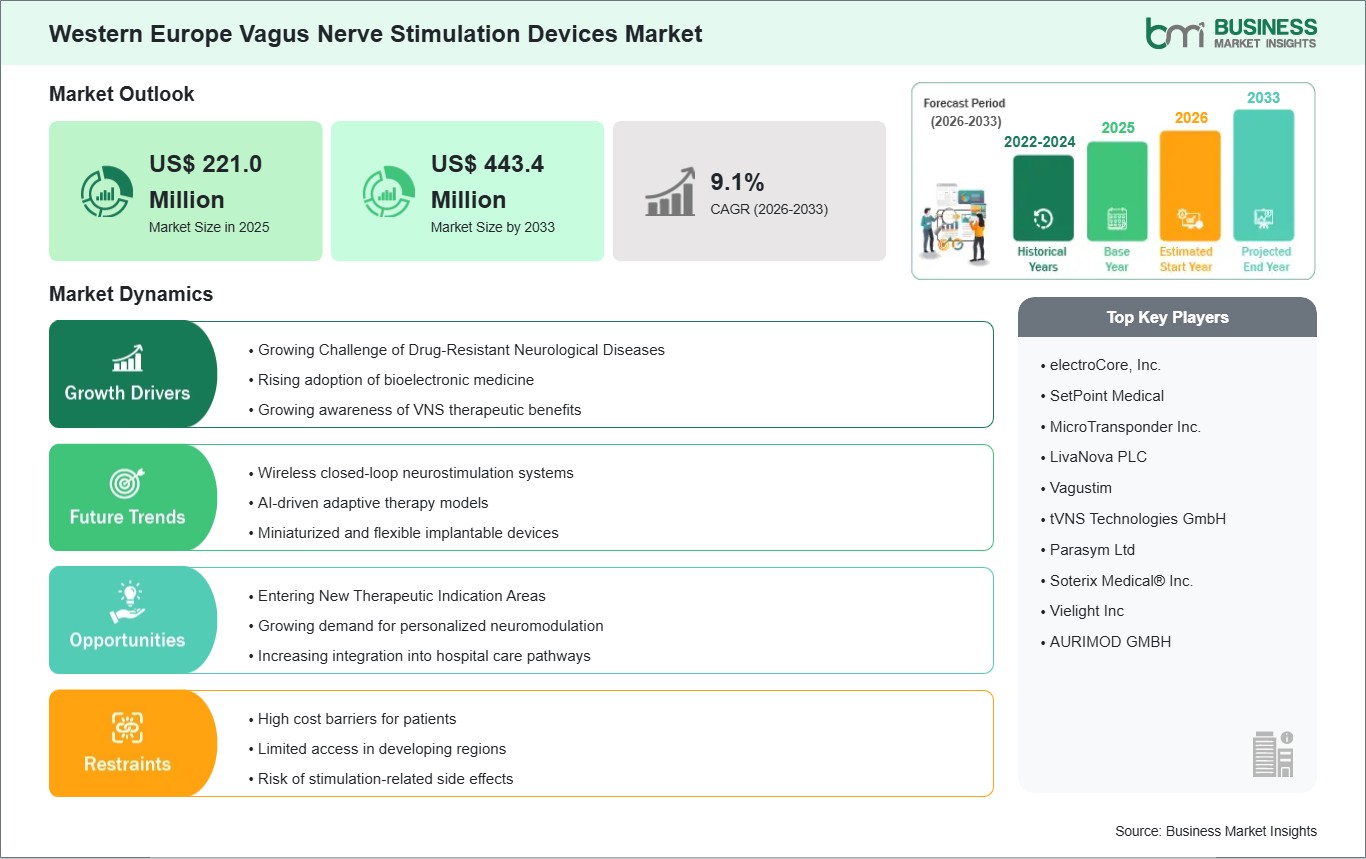
The Western Europe vagus nerve stimulation devices market size is expected to reach US$ 443.4 million by 2033 from US$ 221.0 million in 2025. The market is estimated to register a CAGR of 9.1% during 2026 to 2033.
The Western Europe market for VNS devices exhibits the characteristic nature of an organized neurological care delivery environment, strict clinical oversight and governance, as well as conservative but progressive uptake of innovative neuromodulation technologies. The region shows advanced knowledge of the potential applications of VNS in treating difficult cases such as drug-resistant epilepsy and selected instances of resistant depression, with growing exploration of other neurological and psychiatric conditions. Treatment protocol adoption follows a rigorous process in which VNS becomes a second- or third-line treatment choice.
One of the key factors driving the market is the existence of a well-developed system of public healthcare that ensures long-term neurological disease management and stimulates the evidence-based use of implantable devices. The cooperation between academic hospitals and medical device developers promotes the conduct of controlled clinical studies and the collection of real-life data, which drives the gradual expansion of applications of VNS. The rising focus on decreasing long-term dependence on drugs in the treatment of chronic neurological conditions is fostering interest in neuromodulation approaches. However, the conservative approach to technology evaluations and health technology assessment limits the potential growth of the market due to the slow adoption of innovative VNS technologies. Nevertheless, the development of budget priorities at public healthcare facilities, where implantable devices need to demonstrate long-term clinical benefit, remains one of the important factors affecting adoption.

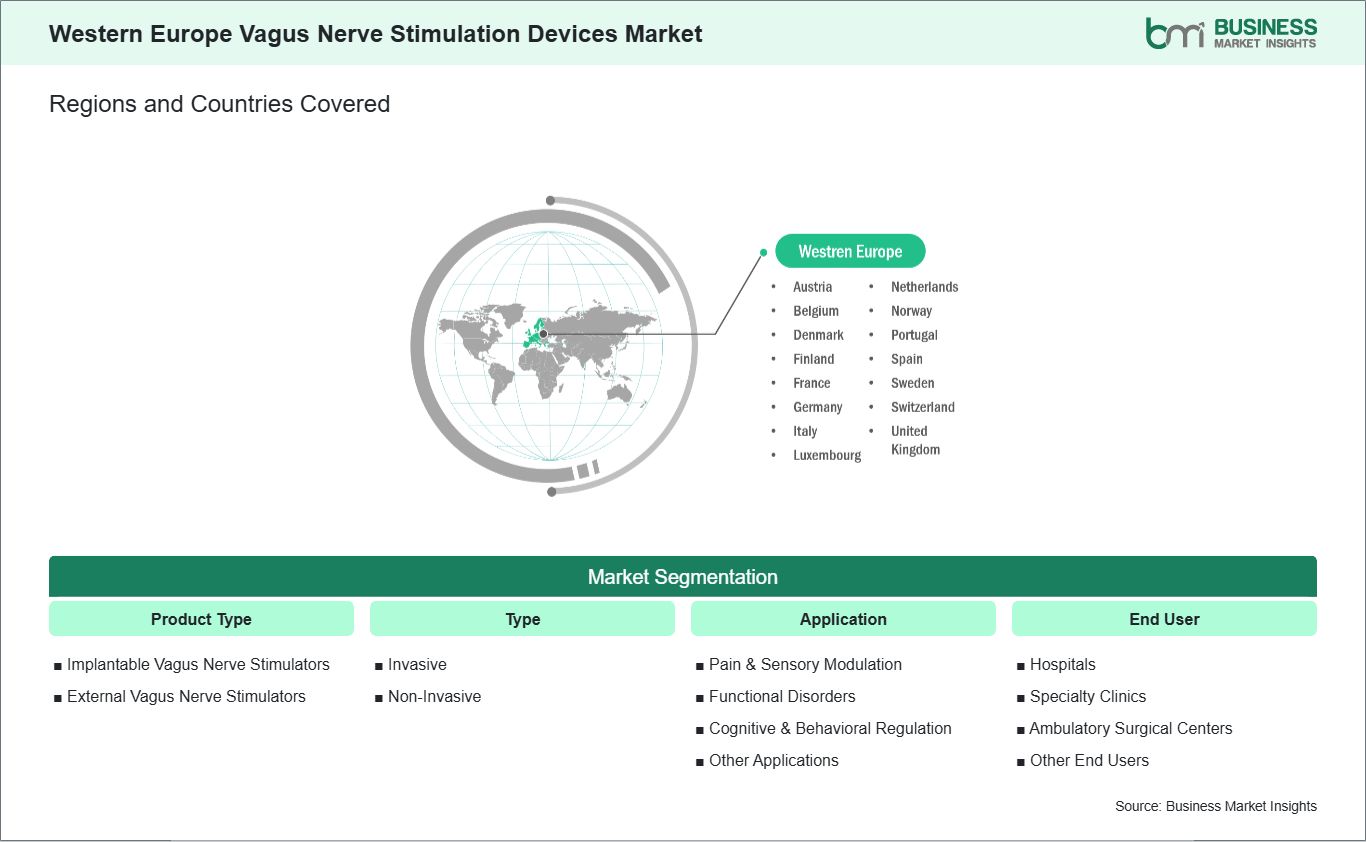
Key segments that contributed to the derivation of the Western Europe vagus nerve stimulation devices market analysis are product type, type, application, and end user.
Western Europe is experiencing an increase in drug-resistant neurological disorders, particularly refractory epilepsy, which drives the adoption of vagus nerve stimulation devices. Countries such as Germany, France, the UK, Italy, and Spain report large epilepsy patient populations, with a consistent subset remaining uncontrolled despite optimized anti-epileptic drug regimens. This persistent treatment gap has strengthened the role of neuromodulation therapies, including VNS, within established neurological care pathways.
Highly organized healthcare systems and advanced epilepsy care delivery chains allow for the early diagnosis of patients with potential candidacy for device-based therapies. University hospitals and specialized epilepsy centers based in London, Paris, Berlin, Milan, and Barcelona serve as major hubs for the evaluation and treatment of patients with drug-resistant epilepsy. The adoption of clinical guidelines for effective treatment allows for a prompt transition from pharmacotherapy to more advanced therapeutic approaches, including neuromodulation therapy.
A range of neurological disorders related to population aging is becoming prevalent in Western Europe. These include Parkinson's and Alzheimer's diseases, stroke-related conditions, chronic migraines, and drug-resistant depression. As healthcare organizations in Europe focus on long-term disease management and improving patient outcomes, the need for non-pharmacologic neuro-modulatory approaches, including VNS therapy, is rising.
The market for vagus nerve stimulation devices in Western Europe is growing from its initial focus on epilepsy to a wider range of applications for these technologies. Neurologists in Germany, the UK, France, and the Nordics are turning to vagus nerve stimulation to treat major depressive disorder, chronic migraine, and anxiety, owing to the efficacy of this treatment and the region‘s comprehensive mental health care services.
Noninvasive vagal nerve stimulators have gained considerable prominence in Western European nations as they fit seamlessly into outpatient care and digital health care frameworks. Nations such as the UK and the Netherlands have been embracing the concept of remote monitoring of patients and tele-neurology more often than not, fitting well within the wearable technologies category. Externally powered vagal nerve stimulators offer great value in healthcare settings where minimizing hospitalization costs is paramount.
Western Europe‘s strong research and innovation ecosystem is driving the expansion of VNS applications into emerging therapeutic areas. Academic institutions and neuroscience centers in Germany, France, and Switzerland are conducting studies on vagus nerve stimulation for stroke rehabilitation, inflammatory disorders, and cognitive dysfunction. Continuous clinical research, combined with supportive regulatory frameworks and early technology adoption, is reinforcing the region‘s leadership in expanding the therapeutic scope of vagus nerve stimulation devices.

The Western Europe vagus nerve stimulation devices market demonstrates consistent growth, with market size and share analysis reflecting evolving treatment preferences and competitive dynamics among leading players. The report evaluates important subsegments categorized within product type, type, application, and end user, highlighting their respective contributions to overall market performance.
By product type, the implantable vagus nerve stimulators subsegment dominated the market in 2025, driven by their established clinical efficacy and widespread adoption in the treatment of neurological and psychiatric disorders such as epilepsy and treatment-resistant depression. These devices provide continuous and targeted nerve stimulation, making them a preferred long-term therapeutic option for chronic conditions.
Based on type, the invasive subsegment dominated the market in 2025, owing to its higher clinical effectiveness and stronger therapeutic outcomes in managing severe and refractory conditions. Invasive vagus nerve stimulation systems are preferred in hospital-based settings due to their proven long-term benefits and consistent symptom control.
In terms of application, the functional disorders subsegment dominated the market in 2025, propelled by the increasing prevalence of conditions such as epilepsy and depression, with growing clinical adoption of vagus nerve stimulation as an adjunct therapy for patients who are unresponsive to conventional treatments.
On the basis of end user, the hospitals subsegment dominated the market in 2025 due to the availability of advanced neurology infrastructure, specialized neurosurgical expertise, and comprehensive postoperative care required for implantation and management of vagus nerve stimulation devices.
| Report Attribute | Details |
|---|---|
| Market size in 2025 | US$ 221.0 Million |
| Market Size by 2033 | US$ 443.4 Million |
| CAGR (2026 - 2033) | 9.1% |
| Historical Data | 2022-2024 |
| Forecast period | 2026-2033 |
| Segments Covered | By Product Type
|
|
Regions and Countries Covered
| |
| Western Europe | Belgium, Netherlands, Luxembourg, Germany, France, Italy, Spain, Switzerland, Sweden, Austria, United Kingdom, Denmark, Portugal, Norway, Finland |
| Market leaders and key company profiles |
|
The "Western Europe Vagus Nerve Stimulation Devices Market Size and Forecast (2022-2033)" report provides a detailed analysis of the market covering below areas:
The geographical scope of the Western Europe Vagus Nerve Stimulation Devices market report is divided into: Belgium, the Netherlands, Luxembourg, Germany, France, Italy, Spain, Switzerland, Sweden, Austria, the UK, Denmark, Portugal, Norway, and Finland. Germany held the largest share in 2025.
Germany is one of the leading countries for VNS devices in the region of Western Europe as a result of its sophisticated hospital infrastructure, specialization in the neurology field, and the way in which medical devices are adopted in the context of its national healthcare system. The nation boasts numerous university hospitals and special clinics for treating epilepsy.
The German health care system facilitates the process of systematic use of technology, in which the clinical utility and economic viability of VNS therapy are evaluated prior to implementation. This guarantees that VNS devices will be implemented among those patients whose response to therapy has been proven to be resistant. The availability of strong clinical research facilities helps in developing appropriate patient selection techniques with the optimization of stimulation parameters. In spite of having an advanced system in place, the adoption of VNS remains specialized, owing to the technical complexity involved in the process of implantation of the device. The reimbursement process in the country can also be very stringent. Germany continues to be an important center for innovations within Western Europe.

The Western Europe vagus nerve stimulation devices market is evaluated by gathering qualitative and quantitative data post primary and secondary research, which includes corporate publications, association data, and databases. A few of the key developments in the Western Europe vagus nerve stimulation devices market are:
The Western Europe Vagus Nerve Stimulation Devices Market is valued at US$ 221.0 Million in 2025, it is projected to reach US$ 443.4 Million by 2033.
As per our report Western Europe Vagus Nerve Stimulation Devices Market, the market size is valued at US$ 221.0 Million in 2025, projecting it to reach US$ 443.4 Million by 2033. This translates to a CAGR of approximately 9.1% during the forecast period.
The Western Europe Vagus Nerve Stimulation Devices Market report typically cover these key segments-
The historic period, base year, and forecast period can vary slightly depending on the specific market research report. However, for the Western Europe Vagus Nerve Stimulation Devices Market report:
The Western Europe Vagus Nerve Stimulation Devices Market is populated by several key players, each contributing to its growth and innovation. Some of the major players include:
The Western Europe Vagus Nerve Stimulation Devices Market report is valuable for diverse stakeholders, including:
Essentially, anyone involved in or considering involvement in the Western Europe Vagus Nerve Stimulation Devices Market value chain can benefit from the information contained in a comprehensive market report.
Please tell us your area of interest
(Market Segments/ Regions and Countries/ Companies)