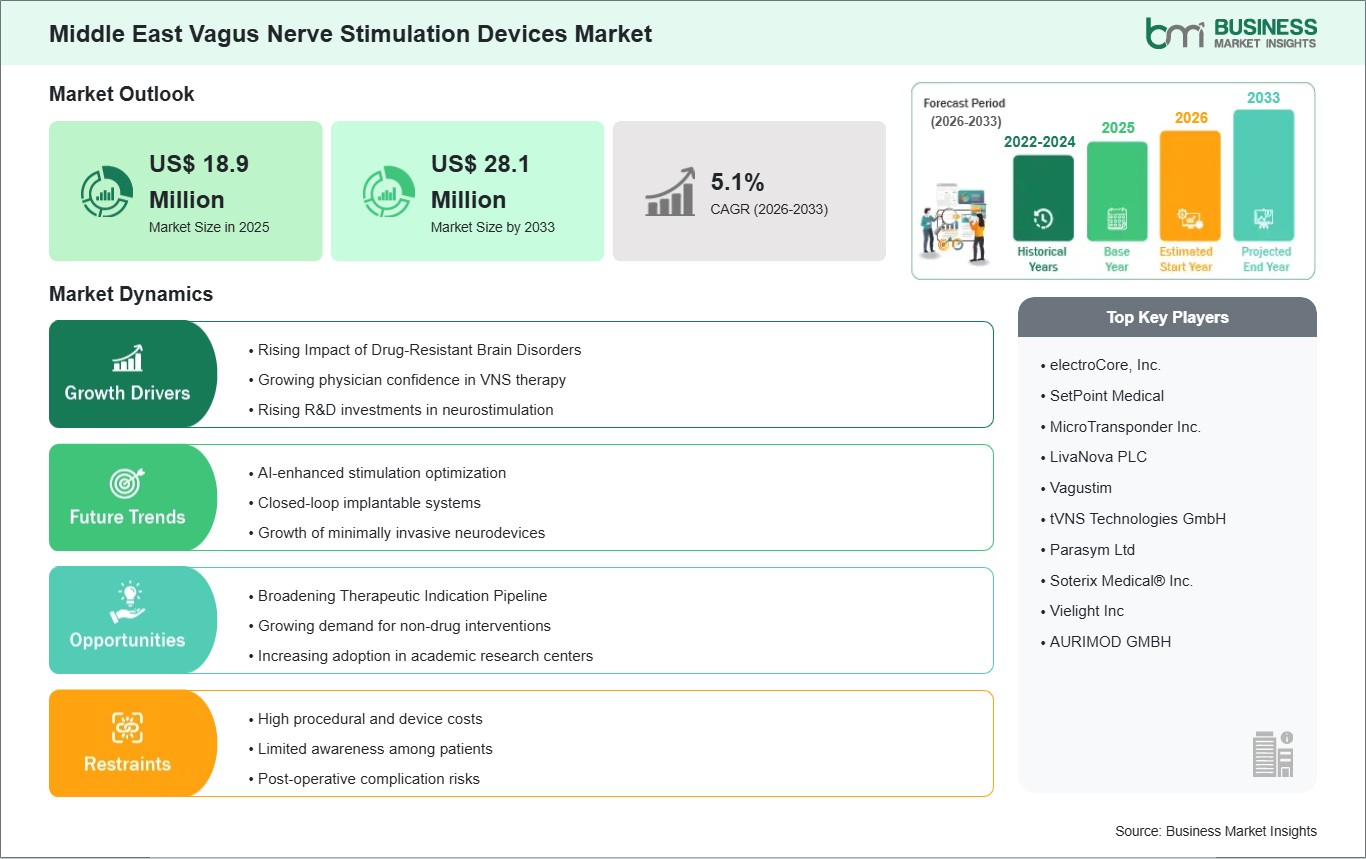
The Middle East deep brain stimulation devices market size is expected to reach US$ 28.1 million by 2033 from US$ 18.9 million in 2025. The market is estimated to record a CAGR of 5.1% from 2026 to 2033.
The vagus nerve stimulation (VNS) Devices Middle East market is distinguished by high selectivity in terms of clinical usage, which is restricted to a small number of neurosurgical referral environments rather than spread out among the wider spectrum of neurology practice. Rather than a separate segment within neuromodulation, the vagus nerve stimulation market exists almost as an appendage to epilepsy surgery centers that operate at a higher level of technology. Vagus nerve stimulation is applied either when surgical removal is not possible or when the epileptic focus is multifocal and inoperable.
An important driver of the market dynamics is the growing tendency for the establishment of "epilepsy decision pathways" at leading government hospitals, where multidisciplinary boards decide upon whether a patient is eligible for an invasive procedure. At that point, VNS is considered more as an adjunct or bridging treatment rather than a primary neuromodulation approach, thus affecting market dynamics. One of the important new drivers may become the incorporation of various neuromodulatory approaches into protocol treatment in children with severe developmental epilepsy syndromes, specifically in facilities equipped with child neurology units. The structural limitations of the market stem from the uneven development of sub-specialties in neurology across the region. In certain countries, treatment for epilepsy remains pharmacologically focused, and neurosurgery consultation occurs only after late-stage disease progression, decreasing the number of eligible candidates for VNS treatment. Moreover, varying levels of expertise of hospitals in terms of titration and optimizing the stimulation program may prevent some centers from broader use of VNS as a treatment modality.

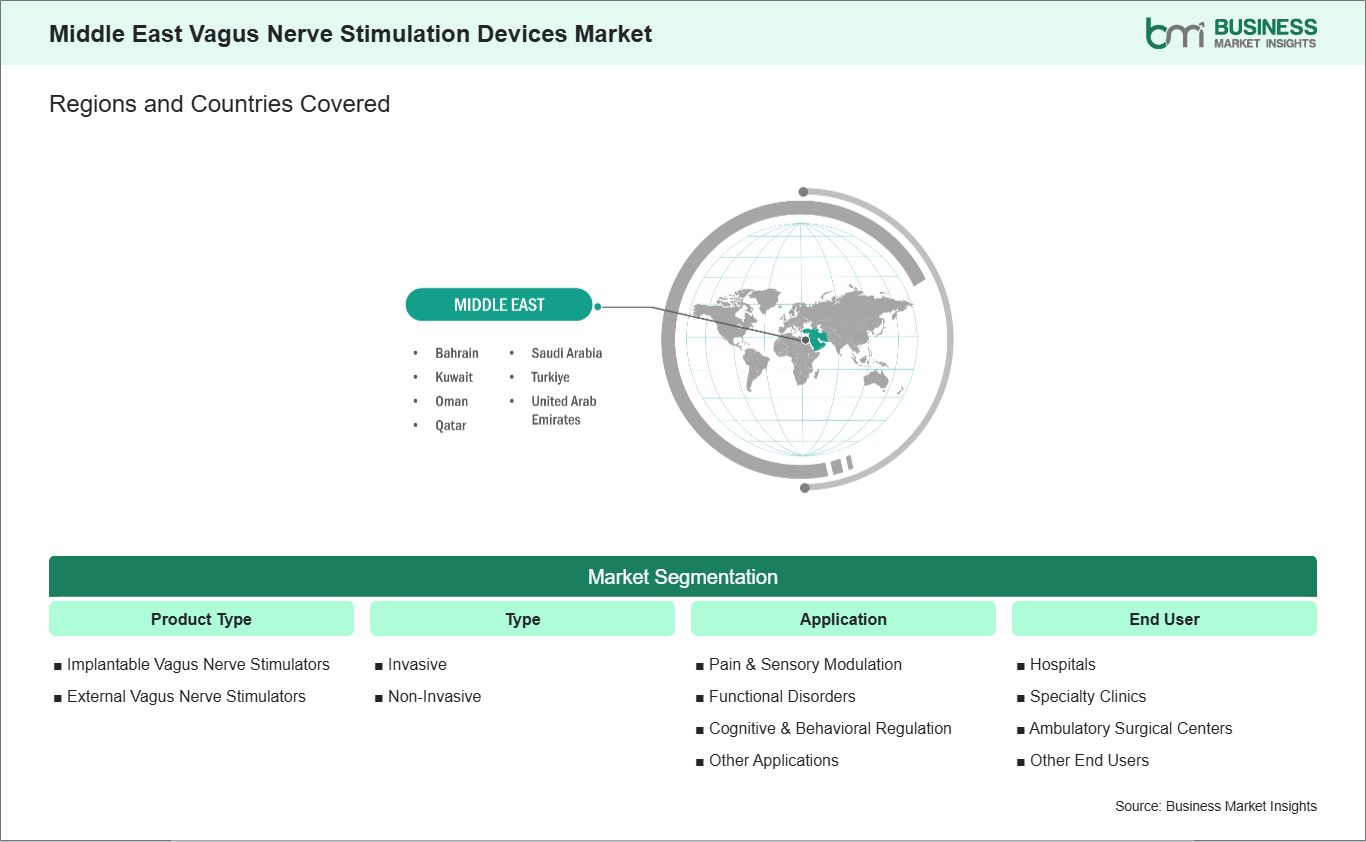
Key segments that contributed to the derivation of the Middle East Deep Brain Stimulation Devices market analysis are product type, type, application, and end user.
The Middle East is experiencing a growing clinical burden of drug-resistant neurological disorders, particularly refractory epilepsy, which is increasing interest in vagus nerve stimulation devices. Countries such as Saudi Arabia, the UAE, Israel, and Kuwait report expanding neurological case detection due to improved access to advanced imaging, EEG monitoring, and specialist care. A significant proportion of epilepsy patients continue to remain uncontrolled on medication alone, prompting neurologists to explore adjunctive neuromodulation therapies for long-term seizure reduction and quality-of-life improvement.
The neurology setup of most healthcare systems in the Middle East region is rapidly developing. There are huge developments in the area of tertiary hospitals and specialty neuroscience centers within the Middle East. The growing number of comprehensive epilepsy programs in Saudi Arabia, as well as the technologically advanced hospital networks in Dubai and Abu Dhabi in the United Arab Emirates, makes it possible for more patients to gain access to surgical treatments and medical devices.
In parallel, the region is witnessing an increase in neurological complications associated with diabetes, aging populations, and traumatic brain injuries from road accidents and occupational hazards. Chronic migraine, neuropathic pain, and post-stroke neurological impairments are becoming more prominent in urban populations. As clinicians seek alternatives to long-term pharmacotherapy, vagus nerve stimulation devices are gaining attention as a viable option for managing refractory neurological conditions in specialized care settings.
The market for vagus nerve stimulation devices in Middle East region is growing from epilepsy to other therapeutic applications such as depression, anxiety, and chronic migraine. More doctors in Saudi Arabia, UAE, and Israel are considering the application of vagus nerve stimulation for difficult-to-treat forms of depression, anxiety disorders, and chronic migraine because of increasing awareness about various mental conditions. There is also increased adoption of psychogeriatrics in neurological hospitals.
There is an increasing interest in non-invasive vagus nerve stimulation devices because of their applicability in outpatients and digitally assisted medical practices. This kind of technology is more important in Gulf nations that have begun to incorporate digital technologies into their health care system. Non-invasive stimulation devices eliminate the necessity for surgeries and are thus increasingly seen as potential candidates even for patients who do not qualify for stimulators.
Furthermore, increasing collaboration between regional hospitals and international research institutions is accelerating the exploration of new clinical applications for vagus nerve stimulation. Academic and specialty centers in Israel and Saudi Arabia are actively involved in neuromodulation research focusing on stroke recovery, inflammatory conditions, and cognitive dysfunction. As physician training expands and clinical evidence continues to grow, the Middle East market is expected to see steady diversification of vagus nerve stimulation applications across neurological and psychiatric care pathways.

The Middle East Deep Brain Stimulation Devices market demonstrates steady growth, with size and share analysis highlighting evolving trends and competitive dynamics among key players. The report evaluates important subsegments categorized within product type, type, application, and end user, highlighting their respective contributions to overall market performance.
By product type, the implantable vagus nerve stimulators subsegment dominated the market in 2025, driven by their established clinical efficacy and widespread adoption in the treatment of neurological and psychiatric disorders such as epilepsy and treatment-resistant depression. These devices provide continuous and targeted nerve stimulation, making them a preferred long-term therapeutic option for chronic conditions.
Based on type, the invasive subsegment dominated the market in 2025, owing to its higher clinical effectiveness and stronger therapeutic outcomes in managing severe and refractory conditions. Invasive vagus nerve stimulation systems are widely preferred in hospital-based settings due to their proven long-term benefits and consistent symptom control.
In terms of application, the functional disorders subsegment dominated the market in 2025, propelled by the increasing prevalence of conditions such as epilepsy and depression, along with growing clinical adoption of vagus nerve stimulation as an adjunct therapy for patients who are unresponsive to conventional treatments.
On the basis of end user, the hospitals subsegment dominated the market in 2025 due to the availability of advanced neurology infrastructure, specialized neurosurgical expertise, and comprehensive postoperative care required for implantation and management of vagus nerve stimulation devices.
| Report Attribute | Details |
|---|---|
| Market size in 2025 | US$ 18.9 Million |
| Market Size by 2033 | US$ 28.1 Million |
| CAGR (2026 - 2033) | 5.1% |
| Historical Data | 2022-2024 |
| Forecast period | 2026-2033 |
| Segments Covered | By Product Type
|
|
Regions and Countries Covered
| |
| Middle East | UAE, Saudi Arabia, Bahrain, Oman, Kuwait, Qatar, Turkiye |
| Market leaders and key company profiles |
|
The "Middle East Deep Brain Stimulation Devices Market Size and Forecast (2022-2033)" report provides a detailed analysis of the market covering below areas:
The geographical scope of the Middle East Deep Brain Stimulation Devices market report is divided into: the UAE, Saudi Arabia, Bahrain, Oman, Kuwait, Qatar, and Turkiye. Turkiye held the largest share in 2025.
Turkiye's presence in the Middle Eastern VNS Devices Market is characterized not by volume but by a process-oriented approach and clinical management procedures for epilepsy treatments. While a majority of Turkiye's neighbors do not possess such systems, Turkey manages to integrate neuromodulation into a comprehensive system of clinical audit procedures where the treatment options for drug-resistant cases are being reviewed in systematic institutional mechanisms. The main characteristic of Turkiye's environment for VNS devices lies in the high level of continuity between neurology diagnostics and surgical treatment facilities. Patients suffering from complicated forms of epilepsy are systematically directed into comprehensive treatment paths with the support of specialized neurophysiology laboratories, functional imaging centers and surgical departments of unified hospital structures. This leads to higher efficiency in making treatment decisions and earlier inclusion of the VNS device treatment option.
A further distinguishing feature is the availability of hospital-based device programming capabilities; whereby post-implant parameter fine-tuning is done within the same clinical framework that implants the devices. The closed-loop approach reduces the dependence of the country on an elaborate external infrastructure for neuromodulation procedures, which tends to be a restrictive influence in most other regions. Also, there is a clear trend towards developing expertise in the use of VNS specifically for treating epilepsy patients with underlying metabolic and genetic disorders. Nevertheless, even with such a favorable framework, adoption has been restricted to only high-level academic and private hospitals and not the secondary healthcare facilities.

The Middle East Deep Brain Stimulation Devices market is evaluated by gathering qualitative and quantitative data post primary and secondary research, which includes important corporate publications, association data, and databases. A few of the key developments in the Middle East Deep Brain Stimulation Devices market are:
The Middle East Vagus Nerve Stimulation Devices Market is valued at US$ 18.9 Million in 2025, it is projected to reach US$ 28.1 Million by 2033.
As per our report Middle East Vagus Nerve Stimulation Devices Market, the market size is valued at US$ 18.9 Million in 2025, projecting it to reach US$ 28.1 Million by 2033. This translates to a CAGR of approximately 5.1% during the forecast period.
The Middle East Vagus Nerve Stimulation Devices Market report typically cover these key segments-
The historic period, base year, and forecast period can vary slightly depending on the specific market research report. However, for the Middle East Vagus Nerve Stimulation Devices Market report:
The Middle East Vagus Nerve Stimulation Devices Market is populated by several key players, each contributing to its growth and innovation. Some of the major players include:
The Middle East Vagus Nerve Stimulation Devices Market report is valuable for diverse stakeholders, including:
Essentially, anyone involved in or considering involvement in the Middle East Vagus Nerve Stimulation Devices Market value chain can benefit from the information contained in a comprehensive market report.
Please tell us your area of interest
(Market Segments/ Regions and Countries/ Companies)