Market Summary
Executive Summary and Market Analysis
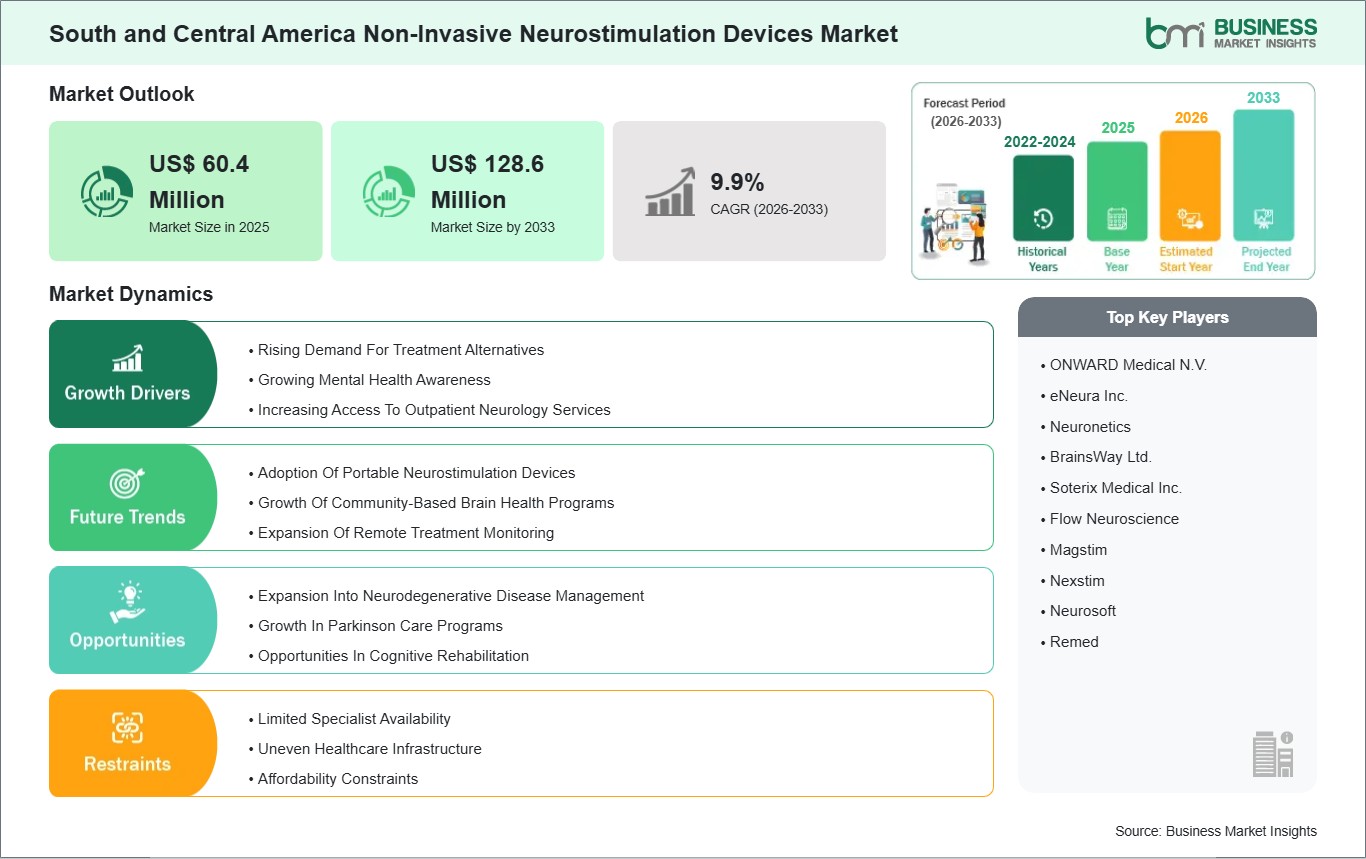
The South and Central America Non-Invasive Neurostimulation Devices Market is shaped by a gradual shift in clinical neurology and psychiatry toward non-pharmacological intervention strategies, particularly for conditions such as treatment-resistant depression, chronic pain syndromes, and post-stroke rehabilitation deficits. Healthcare providers across major economies in the region are increasingly incorporating modalities such as transcranial magnetic stimulation, transcranial direct current stimulation, and cranial electrotherapy systems into multidisciplinary care pathways, reflecting a broader preference for targeted brain modulation techniques that reduce systemic side effects associated with long-term medication use.
A key driver is the rising integration of these devices within psychiatric hospitals, neurorehabilitation centers, and specialized outpatient clinics, where clinicians seek adjunct therapies that enhance patient responsiveness and functional recovery outcomes. Another important driver is the expansion of private healthcare infrastructure and specialized neurology services, which facilitate quicker adoption of advanced neuromodulation technologies, supported by growing clinician familiarity and improvements in device portability and ease of use. Despite these enabling factors, the market faces a significant restraint stemming from reimbursement limitations and uneven funding allocation within public health systems, which restricts widespread access to these devices and slows institutional procurement cycles.
Additionally, variability in regulatory frameworks across countries in South and Central America can delay device approvals and complicate commercialization strategies for manufacturers. Together, these dynamics create a landscape characterized by selective adoption concentrated in urban and private care settings, while broader penetration remains dependent on healthcare financing reforms and continued clinical validation efforts, particularly in tertiary neurocare and academic hospital research networks settings.
Segment Analysis
South and Central America Non-Invasive Neurostimulation Devices Market Segmentation
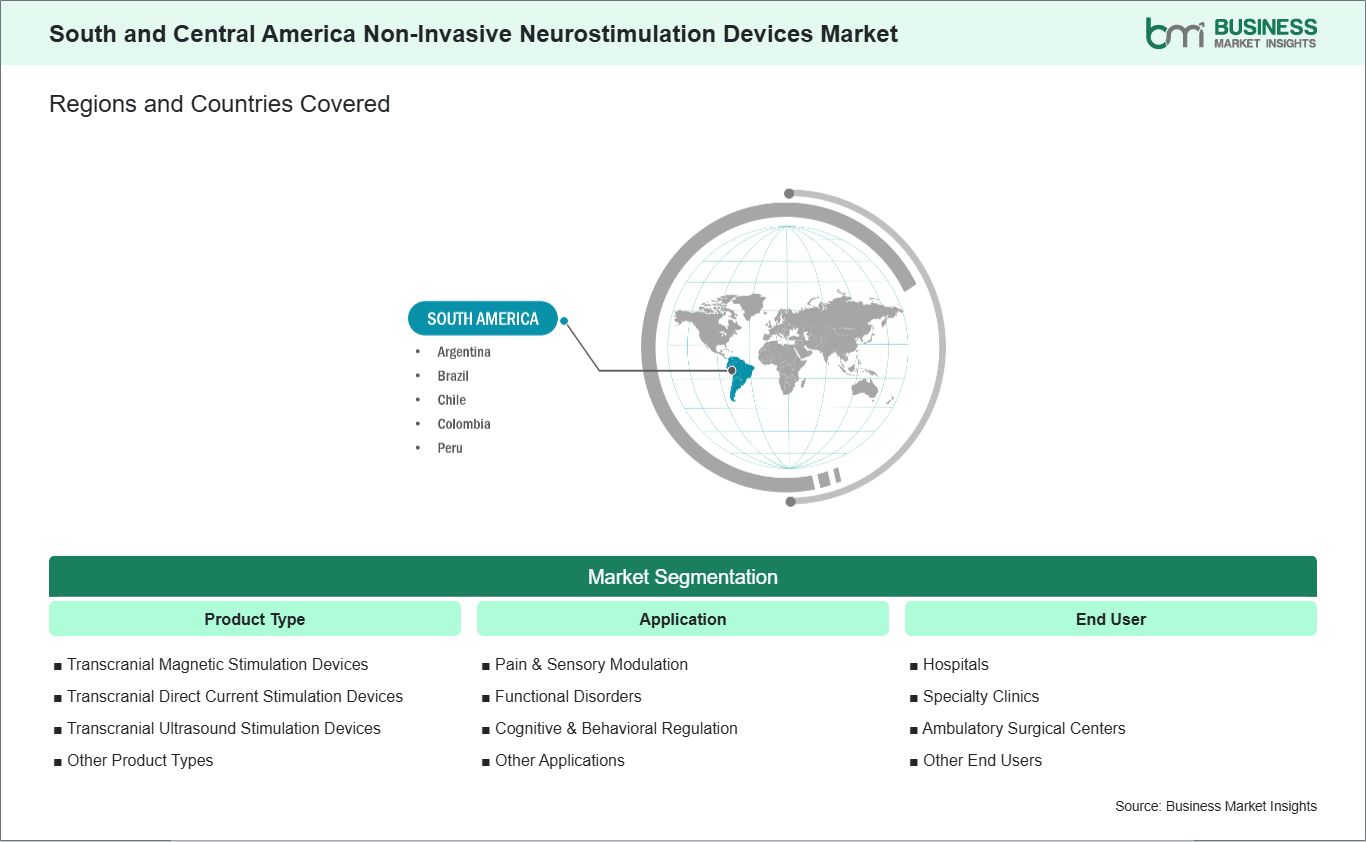
Key segments that contributed to the derivation of the South and Central America non-invasive neurostimulation devices market analysis are product type, application and end user.
- By product type, the non-invasive neurostimulation devices market is segmented into transcranial magnetic stimulation devices, transcranial direct current stimulation devices, transcranial ultrasound stimulation devices, and other product types. The transcranial magnetic stimulation devices segment dominated the market in 2025.
- Based on application, the non-invasive neurostimulation devices market is categorized into pain & sensory modulation, functional disorders, cognitive & behavioral regulation, and other applications. The cognitive & behavioral regulation segment dominated the market in 2025.
- In terms of end user, the non-invasive neurostimulation devices market is categorized into hospitals, specialty clinics, ambulatory surgical centers, and other end users. The hospitals segment dominated the market in 2025.
Market Forces
South and Central America Non-Invasive Neurostimulation Devices Market Drivers and Opportunities
Rising Demand for Treatment Alternatives
In South and Central American clinical settings, neurologists and physiatrists are increasingly integrating non-invasive neurostimulation into treatment planning as a way to reduce dependence on long-term pharmacological regimens. Decision-making often centers on managing side-effect burdens observed in chronic pain, depression, and post-stroke rehabilitation pathways, where medication layering complicates adherence and outcomes.
Public hospitals and private neurology clinics are careful when adopting new devices. They prefer compact, programmable stimulation systems that can be shared between departments. Purchasing teams usually look for devices that work well with their current rehabilitation equipment, so new devices are added gradually to physiotherapy and pain management units instead of replacing everything at once.
For patients, using wearable stimulation devices at home is changing how care is delivered, especially for those with chronic nerve conditions. When it is hard to travel to specialist centers, patients often prefer devices they can use themselves. This has led to designs that are simple, easy to use repeatedly, and require little supervision from doctors.
Expansion into Neurodegenerative Disease Management
Care for neurodegenerative diseases in the region is starting to include non-invasive stimulation devices as extra tools along with cognitive therapy and medication. Clinical teams often use these devices in the early to middle stages of symptoms to help with movement and mental activity, without increasing the amount of medication, especially in outpatient neurology clinics where different specialists work together.
Specialists are cautious about using these devices for neurodegenerative diseases, waiting to see clear improvements before using them more widely. Rehabilitation centers usually add stimulation sessions to existing therapy schedules, matching them with physiotherapy and caregiver routines, instead of running separate neuromodulation programs.
Training programs and international clinical partnerships are shaping how neurostimulation treatments are used for neurodegenerative diseases in South and Central America. Device makers often work with rehabilitation experts to adjust how the devices are used, making sure they fit different patient needs and clinical routines in both city hospitals and more remote care settings.
Size and Share Analysis
South and Central America Non-Invasive Neurostimulation Devices Market Size and Share Analysis
The South and Central America non-invasive neurostimulation devices market demonstrates steady growth, with size and share analysis highlighting evolving trends and competitive dynamics among key players. The report examines subsegments categorized within product type, application and end user, offering insights into their contribution to overall market performance.
By product type, the transcranial magnetic stimulation devices subsegment dominated the market in 2025, driven by its established clinical efficacy, growing adoption for neurological and psychiatric disorders, and increasing availability across healthcare facilities.
Based on application, the cognitive & behavioral regulation subsegment dominated the market in 2025, driven by the rising prevalence of mental health disorders and increasing use of neurostimulation therapies for depression, anxiety, and cognitive enhancement.
In terms of end user, the hospitals subsegment dominated the market in 2025, driven by the availability of advanced neurostimulation technologies, skilled healthcare professionals, and growing patient volumes requiring specialized neurological care.
Report Coverage
South and Central America Non-Invasive Neurostimulation Devices Market Report Coverage and Deliverables
The "South and Central America Non-Invasive Neurostimulation Devices Market Size and Forecast (2022-2033)" report provides a detailed analysis of the market covering below areas:
- Market segments covered under the scope
- Market dynamics such as drivers, restraints, and key opportunities
- Market concentration, heat map analysis, prominent players, and recent developments
- Detailed company profiles, including SWOT analysis
Geographic Insights
South and Central America Non-Invasive Neurostimulation Devices Market Geographic Insights
The geographical scope of the South and Central America Non-Invasive Neurostimulation Devices Market report is divided into Brazil, Argentina, Chile, Colombia, Peru. Brazil held the largest share in 2025.
Brazil remains the dominant market in South and Central America for non-invasive neurostimulation devices, supported by a well-developed hospital network, strong neurology specialist base, and faster uptake of neuromodulation therapies in private healthcare, reinforced by sustained medtech investment and broader availability of advanced neurological treatments. Argentina's growth is driven by established neuroscience research institutions and rehabilitation centers that sustain demand despite economic volatility, with reliance on imported devices shaping selective adoption in tertiary hospitals focused on psychiatric and neurological care. Chile benefits from a structured healthcare system and efficient regulatory processes that support timely introduction of innovative neurostimulation devices, alongside growing integration of digital health tools in outpatient rehabilitation and urban clinical settings. Colombia's expansion is supported by gradual improvements in healthcare access and a growing private sector, with increasing awareness of neurorehabilitation solutions and wider use beyond major cities in pain management and post-stroke recovery. Peru's market is emerging through healthcare modernization and efforts to improve neurological care access across urban and rural regions, with rising recognition of epilepsy, depression, and stroke treatment needs supporting gradual adoption in specialized centers. Overall, the region reflects uneven but steadily diversifying adoption shaped by infrastructure maturity, investment patterns, and evolving neurological care priorities.
Industry Activity
Recent Developments
The South and Central America Non-Invasive Neurostimulation Devices Market is evaluated by gathering qualitative and quantitative data post primary and secondary research, which includes important corporate publications, association data, and databases. A few of the key developments in the South and Central America non-invasive neurostimulation devices market are:
- In April 2025, Nexalin Technology announced that it received Institutional Review Board (IRB) approval in Brazil to initiate a clinical trial of its Gen-2 non-invasive neurostimulation device for anxiety disorders and chronic insomnia at the Instituto de Psiquiatria do Hospital in Sao Paulo.
- In April 2023, Neuspera Medical announced that it received U.S. Food and Drug Administration (FDA) clearance for its next-generation ultra-miniaturized peripheral nerve stimulation (PNS) system, a leadless micro-implant designed to deliver neurostimulation therapy through a wireless platform including a wearable transmitter and clinician programmer.
Trust & Transparency
Research Methodology
The market analysis combines proprietary research with secondary data from government agencies, company disclosures, regulatory filings, industry databases and expert interviews. Market estimates are validated through data triangulation, cross-market benchmarking and analyst
review.
View Full Research Methodology
Key Sources Referred:
U.S. Food and Drug Administration (FDA)National Institutes of Health (NIH)National Institute of Neurological Disorders and Stroke (NINDS)Centers for Medicare & Medicaid Services (CMS)Medical Device Innovation Consortium (MDIC)World Health Organization (WHO)International Organization for Standardization (ISO)International Neuromodulation Society (INS)North American Neuromodulation Society (NANS)Company WebsitesCompany Annual ReportsCompany Investor Presentations