Market Summary
Executive Summary and Global Market Analysis
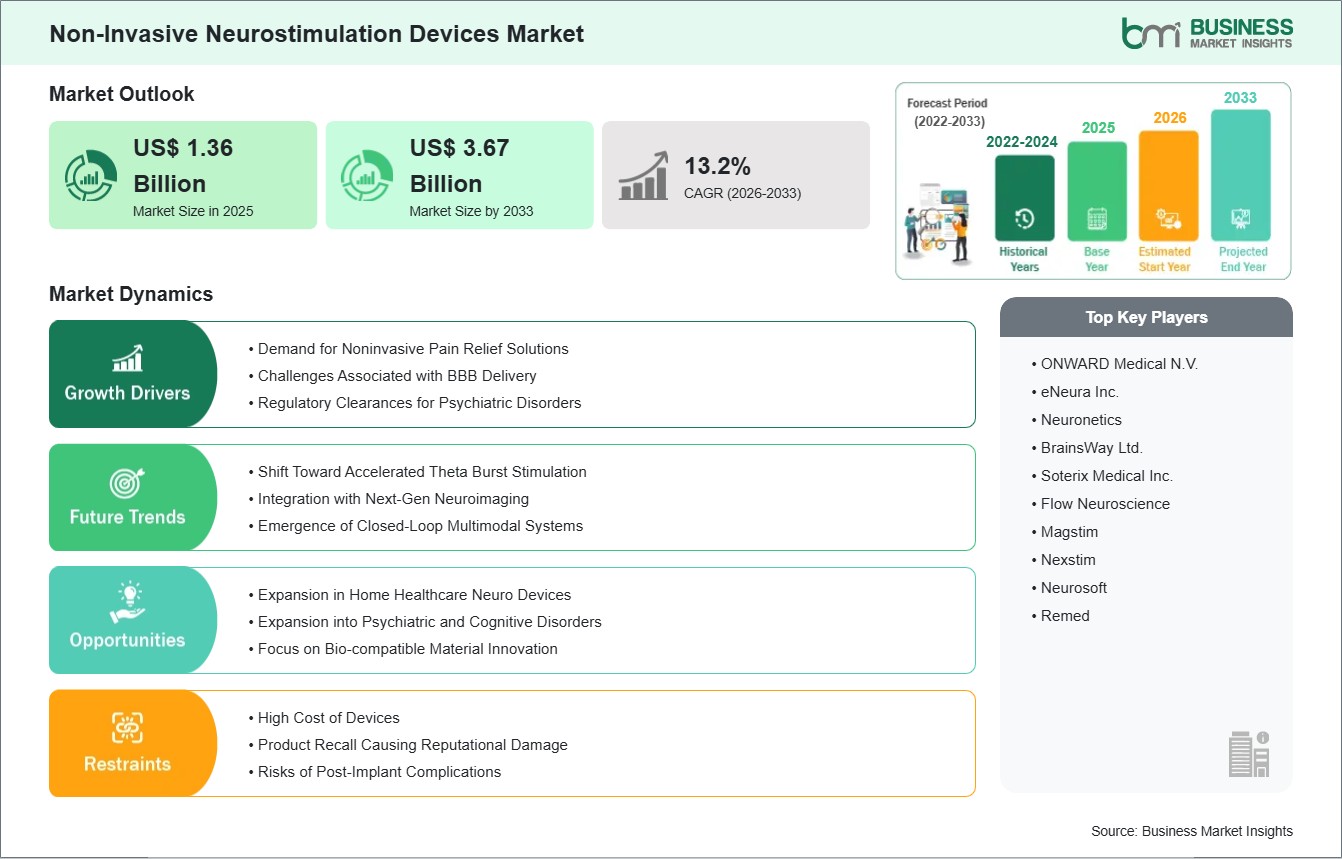
Noninvasive neurostimulation devices are changing our approach toward therapies in neurology and psychiatry by providing choices beyond drugs and implanted technology. Transcranial magnetic stimulation and transcranial direct current stimulation are becoming common in clinics. They help with depression, chronic pain, epilepsy as an add-on therapy, and even post-stroke recovery. These treatments allow doctors to target specific areas of the brain, all while skipping surgery. Many people are getting affected by neuropsychiatric and neurodegenerative disorders, thus there is an increasing need for tailored, do-over treatments that pair well with digital health apps. The latest gadgets are portable and easier to use, allowing therapy to take place outside hospitals, in outpatient clinics and homes as well. The treatments work better due to progress in closed-loop systems and computerized protocols, making it possible to have smarter, patient-specific care at home. Despite these advancements, clinical effectiveness varies between different patients. It is made even worse by inconsistent money systems and a lack of long-term evidence comparing treatments. This slows down adoption in cautious health systems and limits how integrated it can get in regular treatment plans. Moreover, regulatory paths and requirements for clinician training affect how quickly new devices roll out, especially in places where the infrastructure is growing. Manufacturers are making safer and more precise devices. They're also improving compatibility with things such as neuroimaging and wearables. This helps to build trust among clinicians and gets more people accepting therapy options. AI and biomarkers helps patients to choose better and allows doctors to personalize and keep track of treatments over time. This improves outcomes across many neurostimulation uses in real-world clinic
Segment Analysis
Non-Invasive Neurostimulation Devices Market Segmentation
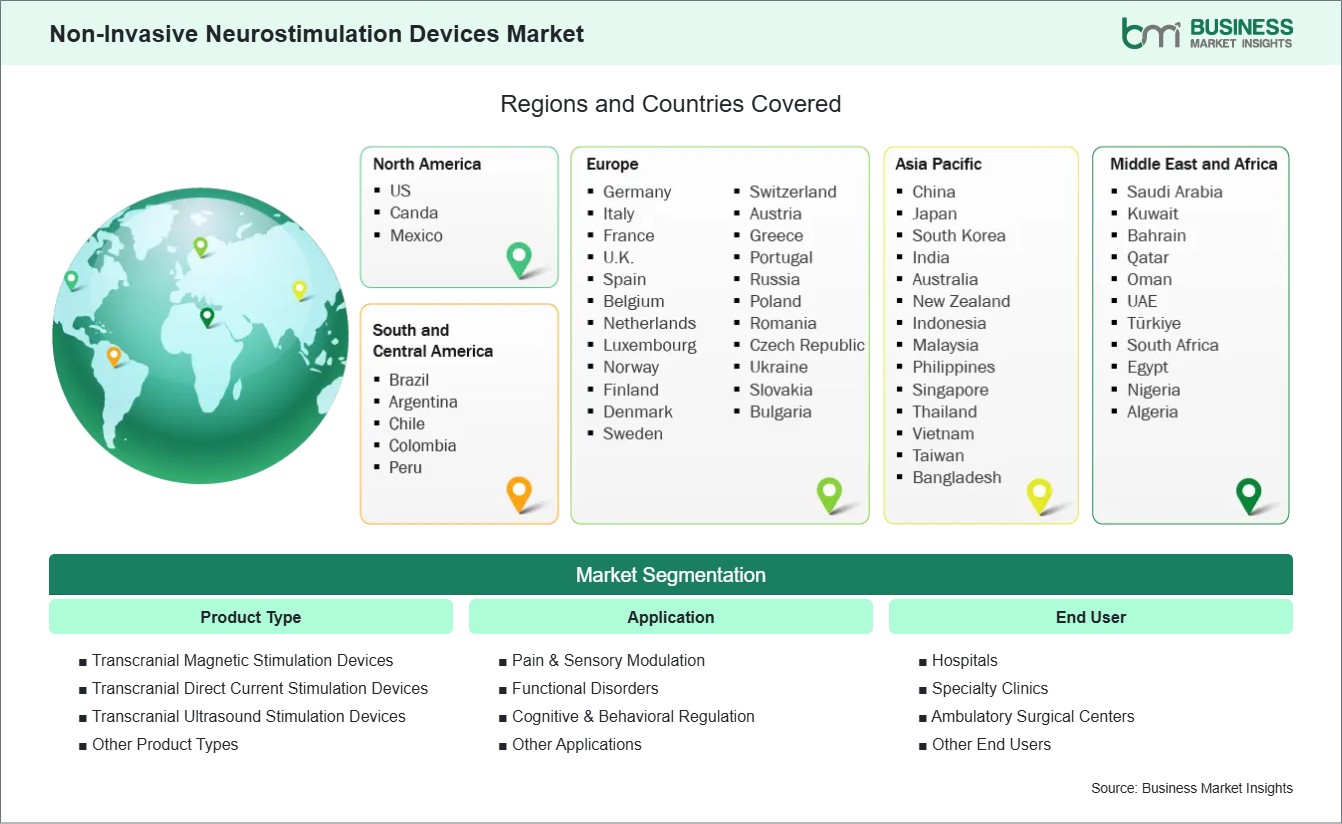
Key segments that contributed to the derivation of the non-invasive neurostimulation devices market analysis are product type, application and end user.
- By product type, the non-invasive neurostimulation devices market is segmented into transcranial magnetic stimulation devices, transcranial direct current stimulation devices, transcranial ultrasound stimulation devices, and other product types. The transcranial magnetic stimulation devices segment dominated the market in 2025.
- Based on application, the non-invasive neurostimulation devices market is categorized into pain & sensory modulation, functional disorders, cognitive & behavioral regulation, and other applications. The cognitive & behavioral regulation segment dominated the market in 2025.
- In terms of end user, the non-invasive neurostimulation devices market is categorized into hospitals, specialty clinics, ambulatory surgical centers, and other end users. The hospitals segment dominated the market in 2025.
Market Forces
Non-Invasive Neurostimulation Devices Market Drivers and Opportunities
Demand for Noninvasive Pain Relief Solutions
In pain management, doctors are seeing more patients hesitant about becoming dependent on drugs. This accelerates a growing move toward external stimulation techniques in neurological care. Pain clinics are using wearables and other neuromodulation tools. These gadgets help control pain without poking into tissues, which ticks the box for folks who want low-risk treatments that can be easily repeated.
Doctors suggest noninvasive nerve stimulation early on, especially when dealing with issues such as sore muscles or painful nerves. Pills might help at first, but many patients eventually get used to them or forget to take them consistently. That's why therapies that don't require constant filling prescriptions or sticking around hospitals make sense for many people.
Gear makers are building devices that can tailor their effects based on each person's pain and sometimes zap different body areas at once. Some of these toys even talk to phones or computers for easier adjustments at home or in the hospital. The goal is shifting from one-size-fits-all solutions to more customizable options that work with someone over time.
Expansion in Home Healthcare Neuro Devices
Care delivery is moving toward decentralized models where neurological therapies are administered outside traditional clinical environments. Portable neurostimulation units are designed with simplified electrode placement and automated calibration features, enabling patients to self-administer sessions with minimal clinical supervision. This aligns with broader home-based chronic care management approaches.
Manufacturers are prioritizing ergonomic design and user-centric interfaces, recognizing that sustained use depends on comfort, intuitive controls, and minimal setup complexity. Devices incorporate guided therapy sessions, preset stimulation modes, and safety lockouts, which reduce dependency on trained technicians while maintaining treatment consistency in domestic environments.
Distribution ecosystems are also evolving, with telehealth platforms and remote monitoring systems supporting clinician oversight of home-based neurostimulation therapy. Feedback loops generated through connected devices allow healthcare providers to adjust parameters without in-person visits, reinforcing continuity of care. This integration of connectivity and therapy delivery is reshaping how neurological conditions are managed over long treatment horizons.
Size and Share Analysis
Non-Invasive Neurostimulation Devices Market Size and Share Analysis
The non-invasive neurostimulation devices market demonstrates steady growth, with size and share analysis highlighting evolving trends and competitive dynamics among key players. The report examines subsegments categorized within product type, application and end user, offering insights into their contribution to overall market performance.
By product type, the transcranial magnetic stimulation devices subsegment dominated the market in 2025, driven by its established clinical efficacy, growing adoption for neurological and psychiatric disorders, and increasing availability across healthcare facilities.
Based on application, the cognitive & behavioral regulation subsegment dominated the market in 2025, driven by the rising prevalence of mental health disorders and increasing use of neurostimulation therapies for depression, anxiety, and cognitive enhancement.
In terms of end user, the hospitals subsegment dominated the market in 2025, driven by the availability of advanced neurostimulation technologies, skilled healthcare professionals, and growing patient volumes requiring specialized neurological care.
Report Coverage
Non-Invasive Neurostimulation Devices Market Report Coverage and Deliverables
The "Non-Invasive Neurostimulation Devices Market Size and Forecast (2022-2033)" report provides a detailed analysis of the market covering below areas:
- Market size and forecast at global, regional, and country levels for all key market segments covered under the scope
- Market trends, along with market dynamics such as drivers, restraints, and key opportunities
- Market analysis covering key trends, global and regional frameworks, major players, regulations, and recent developments
- Market concentration, heat map analysis, prominent players, and recent developments
- Detailed company profiles, including SWOT analysis
Geographic Insights
Non-Invasive Neurostimulation Devices Market Geographic Insights
The geographical scope of the Non-Invasive Neurostimulation Devices Market report is divided into North America, Asia Pacific, Europe, Middle East & Africa, and South & Central America. North America held the largest share in 2025.
North America dominates the global non-invasive neurostimulation devices market, backed by a mature neurotechnology setup, early use of neuromodulation therapies, and deep integration in clinical neurology and pain management. Reimbursement ease and a hub of top device makers also bolster its standing, seen in mental health settings and used at home more often. In Asia Pacific, the market grows due to expanded healthcare setups, increased recognition of neurological and psychiatric disorders, and an increasing need for affordable, surgery-avoiding treatments among many people. The market growth is also driven by fast urbanization and digital health advancements, helped by government projects and growing local production. Europe's uptake is steady owing to a focus on evidence-based care, solid rehabilitation programs, and an aging population that prefers noninvasive choices. Backed by joined-up clinical study teams, they concentrate on post-stroke recovery and aligning rules across countries. In the Middle East and Africa, the healthcare field is expanding slowly. This growth comes from modernizing healthcare, investing more money into special care places, and tackling chronic pain and neurological issues. These problems are common in big cities and are resolved by telehealth and better medical access across borders. In South and Central America, people are inclining more toward the use of new healthcare methods. Private healthcare is becoming stronger, and doctors there accept neuromodulation more as a supportive treatment for pain and mental health. Even though costs are high, awareness campaigns and better training for neurologists are pushing adoption forward.
Industry Activity
Recent Developments
The Non-Invasive Neurostimulation Devices Market is evaluated by gathering qualitative and quantitative data post primary and secondary research, which includes important corporate publications, association data, and databases. A few of the key developments in the non-invasive neurostimulation devices market are:
- In June 2024, electroCore, Inc. announced the launch of TAC-STIM, a next-generation noninvasive vagus nerve stimulation (nVNS) device, expanding its bioelectronic medicine portfolio into performance and wellness applications using its proprietary handheld neuromodulation platform.
- In January 2024, BrainsWay Ltd. announced the inititation of clinical evaluation of its next-generation Deep TMS 360 degree rotational field technology, designed to enhance stimulation efficiency by improving activation of broader neuronal networks in non-invasive transcranial magnetic stimulation therapy..
Trust & Transparency
Research Methodology
The market analysis combines proprietary research with secondary data from government agencies, company disclosures, regulatory filings, industry databases and expert interviews. Market estimates are validated through data triangulation, cross-market benchmarking and analyst
review.
View Full Research Methodology
Key Sources Referred:
U.S. Food and Drug Administration (FDA) National Institutes of Health (NIH) National Institute of Neurological Disorders and Stroke (NINDS) Centers for Medicare & Medicaid Services (CMS) Medical Device Innovation Consortium (MDIC) World Health Organization (WHO) International Organization for Standardization (ISO) International Neuromodulation Society (INS) North American Neuromodulation Society (NANS) Company Websites Company Annual Reports Company Investor Presentations