Market Summary
Executive Summary and Market Analysis
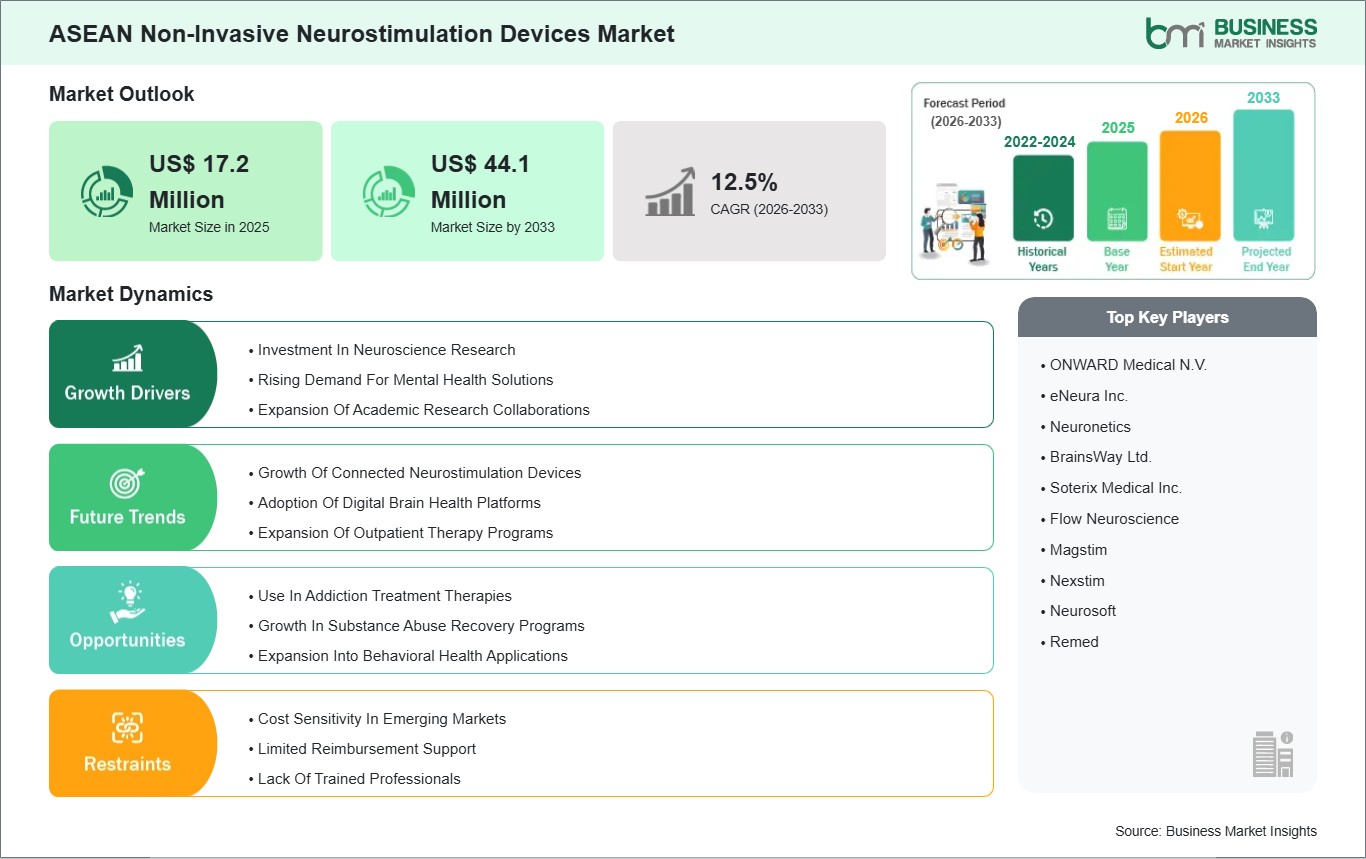
In ASEAN, the use of non-invasive neurostimulation devices is growing due to the popularity of therapies like transcranial magnetic stimulation, transcranial direct current stimulation, and new wearable systems for brain modulation. Clinicians increasingly prefer these methods in treating conditions like epilepsy, depression, and post-stroke impairments because they work well alongside traditional drugs and lower the chances of side effects. At the same time, more money is pouring into rehab infrastructure, allowing hospitals to integrate digital health tools. This lets doctors do remote check-ups and set up customized treatment plans. Yet, inconsistent regulations and a lack of reimbursement in some ASEAN nations hold back the widespread use of these devices, keeping them mostly confined to big city hospitals. The industry itself is getting smaller devices that are easier to carry around. As a result, outpatient clinics and specialized mental health facilities are giving these portable units a closer look. So, there's growth in how these technologies are assessed and used throughout major ASEAN economies. At the same time, adoption is slowed by limited clinician familiarity with advanced neuromodulation protocols, the need for specialized training in device calibration and treatment planning, and cautious hospital procurement practices. These practices prioritize proven neurotherapeutic outcomes, especially in cost-sensitive public health systems. Meanwhile, patient awareness of non-invasive brain stimulation is improving in urban areas due to expanding exposure to digital mental health tools and physician-led awareness campaigns in tertiary care networks. Adjunct neuromodulation therapies are becoming more accepted in clinical settings regionwide.
Segment Analysis
ASEAN Non-Invasive Neurostimulation Devices Market Segmentation
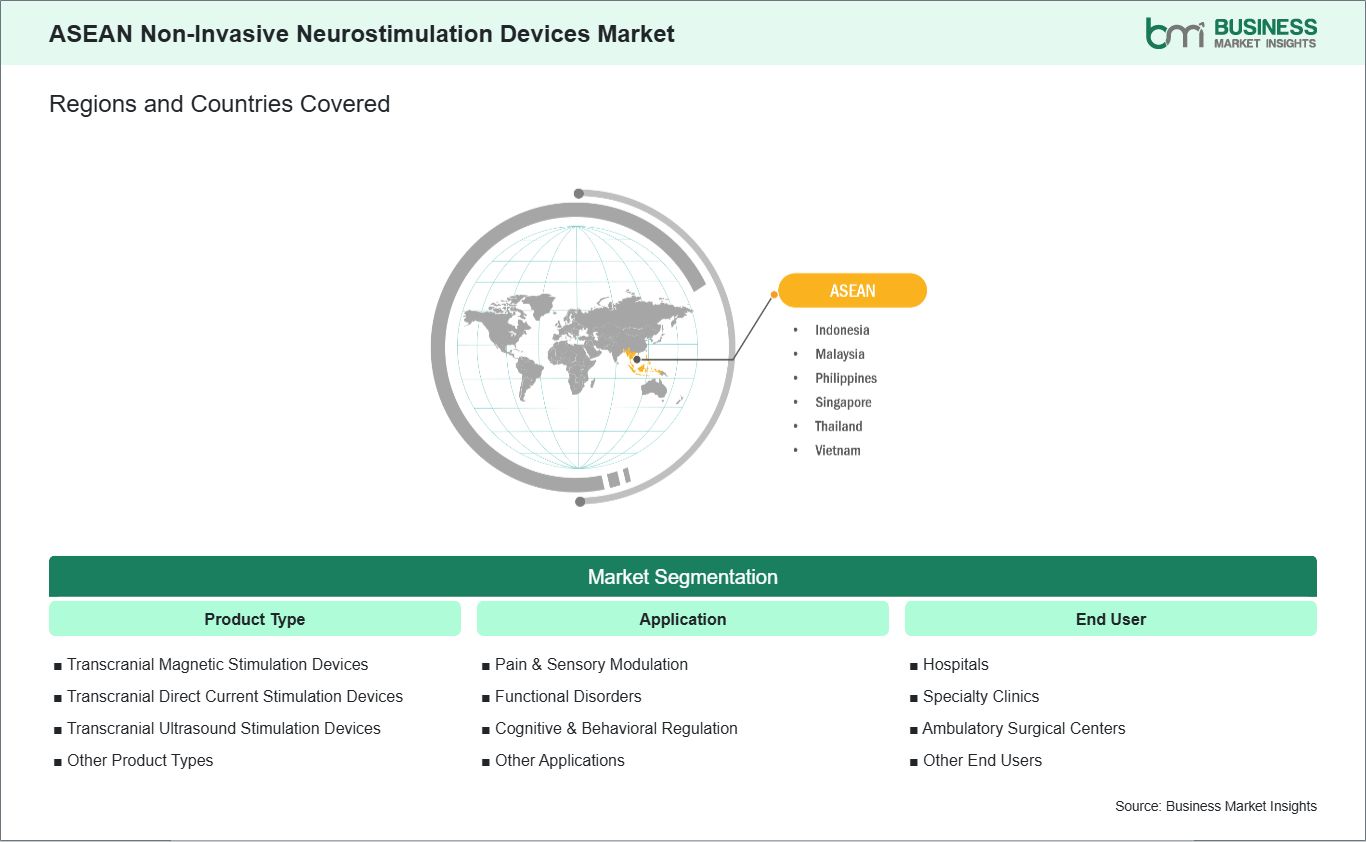
Key segments that contributed to the derivation of the ASEAN non-invasive neurostimulation devices market analysis are product type, application and end user.
- By product type, the non-invasive neurostimulation devices market is segmented into transcranial magnetic stimulation devices, transcranial direct current stimulation devices, transcranial ultrasound stimulation devices, and other product types. The transcranial magnetic stimulation devices segment dominated the market in 2025.
- Based on application, the non-invasive neurostimulation devices market is categorized into pain & sensory modulation, functional disorders, cognitive & behavioral regulation, and other applications. The cognitive & behavioral regulation segment dominated the market in 2025.
- In terms of end user, the non-invasive neurostimulation devices market is categorized into hospitals, specialty clinics, ambulatory surgical centers, and other end users. The hospitals segment dominated the market in 2025.
Market Forces
ASEAN Non-Invasive Neurostimulation Devices Market Drivers and Opportunities
Investment in Neuroscience Research
In ASEAN markets, neuroscience researchers are now often using non-invasive neurostimulation gadgets in their work. This happens mostly at university hospitals and clinical engineering labs. Companies that make these devices team up with schools to improve how the gadgets work. They do this based on local brain stuff, making tests better as they keep tweaking prototypes.
At the same time, hospitals in Southeast Asia are signing deals for checking out these neurostimulation tools over the long term. They focus more on getting input from doctors to make the tech better fit their needs, not just rushing into big-time use right away. Because of this, companies are quicker to fix software issues and redesign user interfaces based on local doctor feedback.
Doctors' take-up of the tech is changing where money goes for studies. Now, they look at how well the gadgets blend with existing rehab routines, not only what they can do in theory. This means engineers and med pros design together, making sure the equipment works with care routines from the get-go. So, in ASEAN clinics, neurostimulation gear evolves along with care plans.
Use in Addiction Treatment Therapies
Across ASEAN addiction treatment programs, non-invasive neurostimulation devices are being incorporated into behavioral therapy settings where clinicians target neural pathways associated with craving regulation and impulse control rather than relying solely on pharmacological substitution approaches. Outpatient clinics in urban centers experiment with protocol-based stimulation sessions aligned to counseling schedules to improve adherence patterns over time.
Shifting clinical protocols toward integrated care models, rehabilitation specialists in the region are embedding neurostimulation sessions within multi-modal addiction recovery pathways so that neuromodulation becomes a reinforcing layer rather than a standalone intervention. Training modules for counselors now include device operation literacy and patient response monitoring protocols across community clinics and hospitals in ASEAN systems.
Patient engagement dynamics in addiction recovery are influencing device design priorities, with manufacturers emphasizing comfort-driven form factors and simplified control interfaces to reduce therapy fatigue. Clinicians report that predictable stimulation schedules improve participation in counseling sessions and reduce dropout during early rehabilitation phases. This has prompted regional pilot programs in coordinated care ecosystems trial networks.
Size and Share Analysis
ASEAN Non-Invasive Neurostimulation Devices Market Size and Share Analysis
The ASEAN non-invasive neurostimulation devices market demonstrates steady growth, with size and share analysis highlighting evolving trends and competitive dynamics among key players. The report examines subsegments categorized within product type, application and end user, offering insights into their contribution to overall market performance.
By product type, the transcranial magnetic stimulation devices subsegment dominated the market in 2025, driven by its established clinical efficacy, growing adoption for neurological and psychiatric disorders, and increasing availability across healthcare facilities.
Based on application, the cognitive & behavioral regulation subsegment dominated the market in 2025, driven by the rising prevalence of mental health disorders and increasing use of neurostimulation therapies for depression, anxiety, and cognitive enhancement.
In terms of end user, the hospitals subsegment dominated the market in 2025, driven by the availability of advanced neurostimulation technologies, skilled healthcare professionals, and growing patient volumes requiring specialized neurological care.
Report Coverage
ASEAN Non-Invasive Neurostimulation Devices Market Report Coverage and Deliverables
The "ASEAN Non-Invasive Neurostimulation Devices Market Size and Forecast (2022-2033)" report provides a detailed analysis of the market covering below areas:
- Market segments covered under the scope
- Market dynamics such as drivers, restraints, and key opportunities
- Market concentration, heat map analysis, prominent players, and recent developments
- Detailed company profiles, including SWOT analysis
Geographic Insights
ASEAN Non-Invasive Neurostimulation Devices Market Geographic Insights
The geographical scope of the ASEAN Non-Invasive Neurostimulation Devices Market report is divided into Indonesia, Malaysia, Philippines, Singapore, Thailand, Vietnam. Indonesia held the largest share in 2025.
In ASEAN, Indonesia leads in the non-invasive neurostimulation device market. This is due to a big patient population, more neurological and psychiatric issues, and the expanding urban hospital systems, along with private health investments. These factors increase tech use for neurorehabilitation and pain management. Malaysia shows steady progress owing to its advanced hospitals, more neuromodulation therapies at specialist clinics, and a healthcare system that supports new treatments for chronic pain and mood disorders. The Philippines sees rising demand because of the great need for better neurological care, and its geography favors portable devices. There's also more money being spent in cities on health due to a swelling middle class. Singapore is at the forefront of using these innovations because of robust biomedical research, participation in clinical trials, and its precise approach to healthcare. They integrate neurotech seamlessly into their medical practices. Thailand benefits from its well-established medical tourism sector. They're expanding rehabilitation services for strokes and spinal conditions, and they have public health initiatives supporting their aging population. Vietnam is quickly catching up due to healthcare modernization, the growth of private hospitals, and more awareness of non-invasive brain stimulation therapies. Still, costs affect how quickly people adopt these services, and insurance coverage is changing gradually. Overall, the region shows different speeds of progress based on how developed their health infrastructures are, doctors' knowledge, and service affordability in both public and private systems. Digital health tools and cooperation between countries make medical devices easier to access and help train clinicians across ASEAN, which should support long-term growth. Expect that regulations will get more aligned over time, making it easier for private investments to flow in and speed up the use of new technologies in various clinical settings throughout the region.
Industry Activity
Recent Developments
The ASEAN Non-Invasive Neurostimulation Devices Market is evaluated by gathering qualitative and quantitative data post primary and secondary research, which includes important corporate publications, association data, and databases. A few of the key developments in the ASEAN non-invasive neurostimulation devices market are:
- In August 2023, BrainsWay Ltd. announced that it has expanded availability of its Deep TMS non-invasive brain stimulation systems in Taiwan through additional system installations, strengthening its footprint across the Asia-Pacific region, including key ASEAN neuropsychiatric care networks.
- In February 2023, Nexstim Plc announced that it has received an order for its NBS 5 navigated transcranial magnetic stimulation (nTMS) system from Hong Kong through distributor Ampere Medical, supporting neuroscience and brain mapping applications using non-invasive neurostimulation technology.
Trust & Transparency
Research Methodology
The market analysis combines proprietary research with secondary data from government agencies, company disclosures, regulatory filings, industry databases and expert interviews. Market estimates are validated through data triangulation, cross-market benchmarking and analyst
review.
View Full Research Methodology
Key Sources Referred:
U.S. Food and Drug Administration (FDA)National Institutes of Health (NIH)National Institute of Neurological Disorders and Stroke (NINDS)Centers for Medicare & Medicaid Services (CMS)Medical Device Innovation Consortium (MDIC)World Health Organization (WHO)International Organization for Standardization (ISO)International Neuromodulation Society (INS)North American Neuromodulation Society (NANS)Company WebsitesCompany Annual ReportsCompany Investor Presentations