Market Summary
Executive Summary and Market Analysis
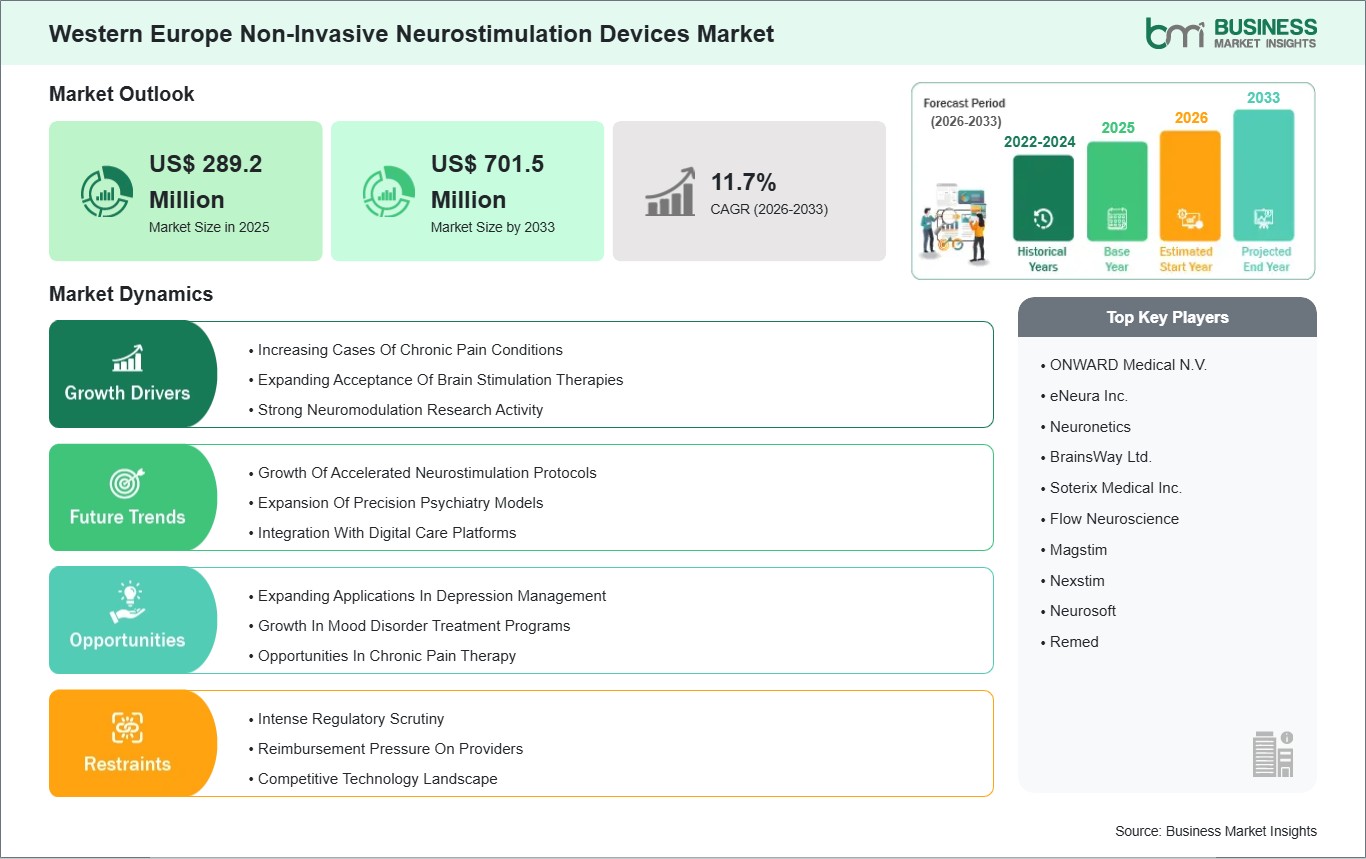
Western Europe's non-invasive neurostimulation devices market stands out due to its robust healthcare system, intense clinical research, and the increasing use of neuromodulation tech for managing various disorders. There is a rising need for these devices as more people are suffering from chronic pain, depression, migraines, and sleep issues. This pushes healthcare providers to look for alternatives to drugs. One factor boosting this trend is growing clinician support for neurostimulation methods, validated by a rising number of studies showing they can improve results and lower risks. Another big push comes from technological advancements such as better portability, simpler user interfaces, and easier digital linking. These make it possible for the gadgets to be used more in hospitals, clinics, and even at home. Market players are pouring funds into innovating products and getting clinical validations to stand out and secure approvals in healthcare settings. They are speeding up the move of new neurostimulation uses into regular clinical care through partnerships with academic institutions and healthcare providers. However, differing reimbursement rates and patchy coverage across Western Europe slow things down, making it difficult for wider use and affecting what healthcare groups and patients choose. The tough regulatory needs, push for real-world data, and proving long-term benefits also ratchet up competition. With both practitioners and patients learning more about neuromodulation, there is a shift toward personalized treatments. This shift is driven by ongoing innovation and growing clinical approval.
Segment Analysis
Western Europe Non-Invasive Neurostimulation Devices Market Segmentation
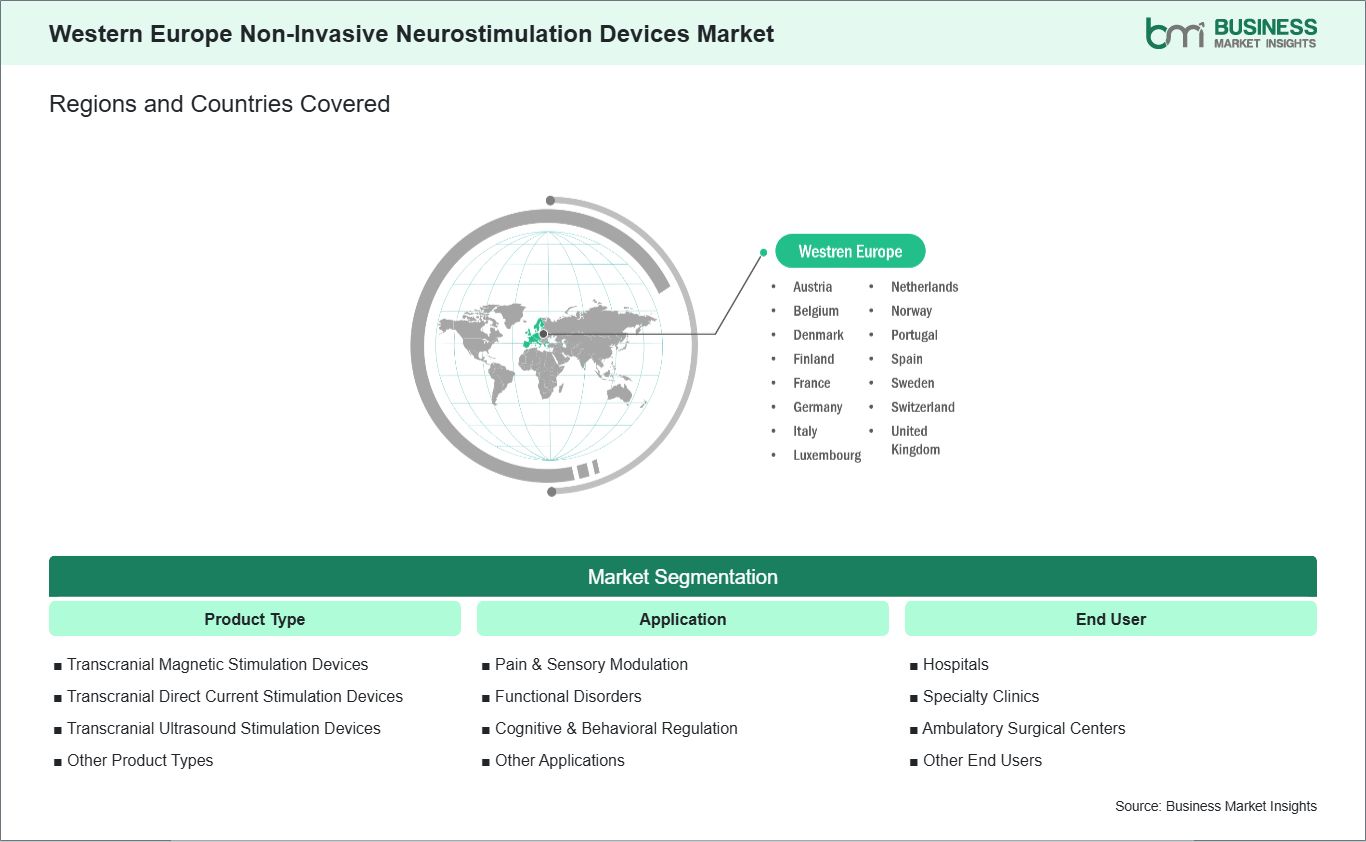
Key segments that contributed to the derivation of the Western Europe non-invasive neurostimulation devices market analysis are product type, application and end user.
- By product type, the non-invasive neurostimulation devices market is segmented into transcranial magnetic stimulation devices, transcranial direct current stimulation devices, transcranial ultrasound stimulation devices, and other product types. The transcranial magnetic stimulation devices segment dominated the market in 2025.
- Based on application, the non-invasive neurostimulation devices market is categorized into pain & sensory modulation, functional disorders, cognitive & behavioral regulation, and other applications. The cognitive & behavioral regulation segment dominated the market in 2025.
- In terms of end user, the non-invasive neurostimulation devices market is categorized into hospitals, specialty clinics, ambulatory surgical centers, and other end users. The hospitals segment dominated the market in 2025.
Market Forces
Western Europe Non-Invasive Neurostimulation Devices Market Drivers and Opportunities
Increasing Cases of Chronic Pain Conditions
Pain clinics and physiotherapy networks throughout Western Europe are starting to use noninvasive neurostimulation devices more often in their initial treatment plans for chronic musculoskeletal and neuropathic issues. These tools are seen as additions to drug treatments, especially when patients struggle with medications over the long term. The use of these devices rises after updates to internal guidelines, not because patients request them more.
In neurology and rehab settings, doctors adjust stimulation settings based on how patients feel and whether their movement improves. This process forms a loop where the information from patients affects the next therapy session and how the device is set up. It supports personalized care in outpatient settings, fitting into the overall plan for more advanced treatments in specialized clinics.
For pain management teams that include experts, choosing to use these devices depends on how easily they fit into the overall treatment plan. These plans mix physical therapy, behavioral strategies, and other procedures. The choice to buy and use these devices usually comes down to what clinicians prefer, opting for adjustable, safe options that can be started early on without messing up the usual order of treatments that the institution allows.
Expanding Applications in Depression Management
In psychiatric care environments across Western Europe, noninvasive neurostimulation devices are integrated into structured treatment pathways for individuals with depression who do not respond adequately to first-line pharmacological interventions. Clinicians often position these modalities with psychotherapy rather than as replacements, emphasizing staged escalation models within specialist mental health services under multidisciplinary review protocols teams.
Home-use neurostimulation platforms for depressive disorders are deployed with digital adherence tracking, allowing clinicians to monitor session frequency and symptom feedback remotely. Patients tend to engage with these devices in structured daily routines, often linking usage to prescribed behavioral activation schedules coordinated through mental health applications supporting sustained engagement beyond clinic visit settings.
Reimbursement frameworks for neurostimulation in depressive disorders remain uneven across Western European healthcare systems, influencing how quickly psychiatric providers incorporate these technologies into routine care. Clinical adoption is often shaped by institutional evidence thresholds and cautious interpretation of long-term outcomes, leading to gradual protocol embedding rather than rapid substitution of existing therapies within governance structures.
Size and Share Analysis
Western Europe Non-Invasive Neurostimulation Devices Market Size and Share Analysis
The Western Europe non-invasive neurostimulation devices market demonstrates steady growth, with size and share analysis highlighting evolving trends and competitive dynamics among key players. The report examines subsegments categorized within product type, application and end user, offering insights into their contribution to overall market performance.
By product type, the transcranial magnetic stimulation devices subsegment dominated the market in 2025, driven by its established clinical efficacy, growing adoption for neurological and psychiatric disorders, and increasing availability across healthcare facilities.
Based on application, the cognitive & behavioral regulation subsegment dominated the market in 2025, driven by the rising prevalence of mental health disorders and increasing use of neurostimulation therapies for depression, anxiety, and cognitive enhancement.
In terms of end user, the hospitals subsegment dominated the market in 2025, driven by the availability of advanced neurostimulation technologies, skilled healthcare professionals, and growing patient volumes requiring specialized neurological care.
Report Coverage
Western Europe Non-Invasive Neurostimulation Devices Market Report Coverage and Deliverables
The "Western Europe Non-Invasive Neurostimulation Devices Market Size and Forecast (2022-2033)" report provides a detailed analysis of the market covering below areas:
- Market segments covered under the scope
- Market dynamics such as drivers, restraints, and key opportunities
- Market concentration, heat map analysis, prominent players, and recent developments
- Detailed company profiles, including SWOT analysis
Geographic Insights
Western Europe Non-Invasive Neurostimulation Devices Market Geographic Insights
The geographical scope of the Western Europe Non-Invasive Neurostimulation Devices Market report is divided into Belgium, the Netherlands, Luxembourg, Germany, France, Italy, Spain, Switzerland, Sweden, Austria, the UK, Denmark, Portugal, Norway, and Finland. Germany held the largest share in 2025.
The Western Europe non-invasive neurostimulation devices market shows different growth rates across the region. Germany leads the market owing to its advanced neurological care, high use of new technology in clinics, and deep integration of these tools in treatment plans. In the UK, the market continues to grow due to a greater focus on drug-free methods for managing neurological and mental health issues within existing healthcare systems. France is benefiting from growing partnerships between research groups and technological companies, which bring in more cutting-edge neurostimulation techniques. In Italy, there is a stronger demand as services for neurological rehabilitation become more modern, and these therapies are more accepted. Spain sees its market grow as more patients gain access to outpatient neurological care, and awareness of minimally invasive therapeutic alternatives increases. The Netherlands is pushing forward adoption through its tech-savvy healthcare system and patient-first innovations. In Belgium, they're gaining steam from their busy clinical research and top-tier neuroscience work. Luxembourg is benefiting from investing money into special healthcare services and cooperation across borders. In Switzerland, the support comes from developing pricey but precise medical technology. In Sweden, new therapy devices are integrated into their forward-thinking healthcare plans. Austria's uptake is growing as they're focusing more on fixing neurological issues and handling chronic conditions. Denmark has a leg up on digitizing healthcare and buying medical stuff that supports new ideas. Portugal's expansion is slow but steady, as they improve care and doctors get savvy about fresh treatment options. In Norway, steady health care spending and interest in the latest advanced technology keep their growth going. Finland's got a solid environment for new ideas and is looking more into neurotech to help with long-term care issues.
Industry Activity
Recent Developments
The Western Europe Non-Invasive Neurostimulation Devices Market is evaluated by gathering qualitative and quantitative data post primary and secondary research, which includes important corporate publications, association data, and databases. A few of the key developments in the Western Europe non-invasive neurostimulation devices market are:
- In May 2023, Nexstim Plc (Finland) announced that it received EU MDR certification for its NBS 6 system, enabling commercial rollout of its upgraded non-invasive TMS-based neurostimulation platform for major depressive disorder and chronic neuropathic pain across European markets.
- In June 2024, electroCore, Inc. (operating across Europe and global markets) announced the commercial availability of its next-generation TAC-STIM non-invasive vagus nerve stimulation (nVNS) device, designed to enhance cognitive performance, focus, and human readiness using handheld cervical nerve stimulation technology.
Trust & Transparency
Research Methodology
The market analysis combines proprietary research with secondary data from government agencies, company disclosures, regulatory filings, industry databases and expert interviews. Market estimates are validated through data triangulation, cross-market benchmarking and analyst
review.
View Full Research Methodology
Key Sources Referred:
U.S. Food and Drug Administration (FDA)National Institutes of Health (NIH)National Institute of Neurological Disorders and Stroke (NINDS)Centers for Medicare & Medicaid Services (CMS)Medical Device Innovation Consortium (MDIC)World Health Organization (WHO)International Organization for Standardization (ISO)International Neuromodulation Society (INS)North American Neuromodulation Society (NANS)Company WebsitesCompany Annual ReportsCompany Investor Presentations