Market Summary
Executive Summary and Market Analysis
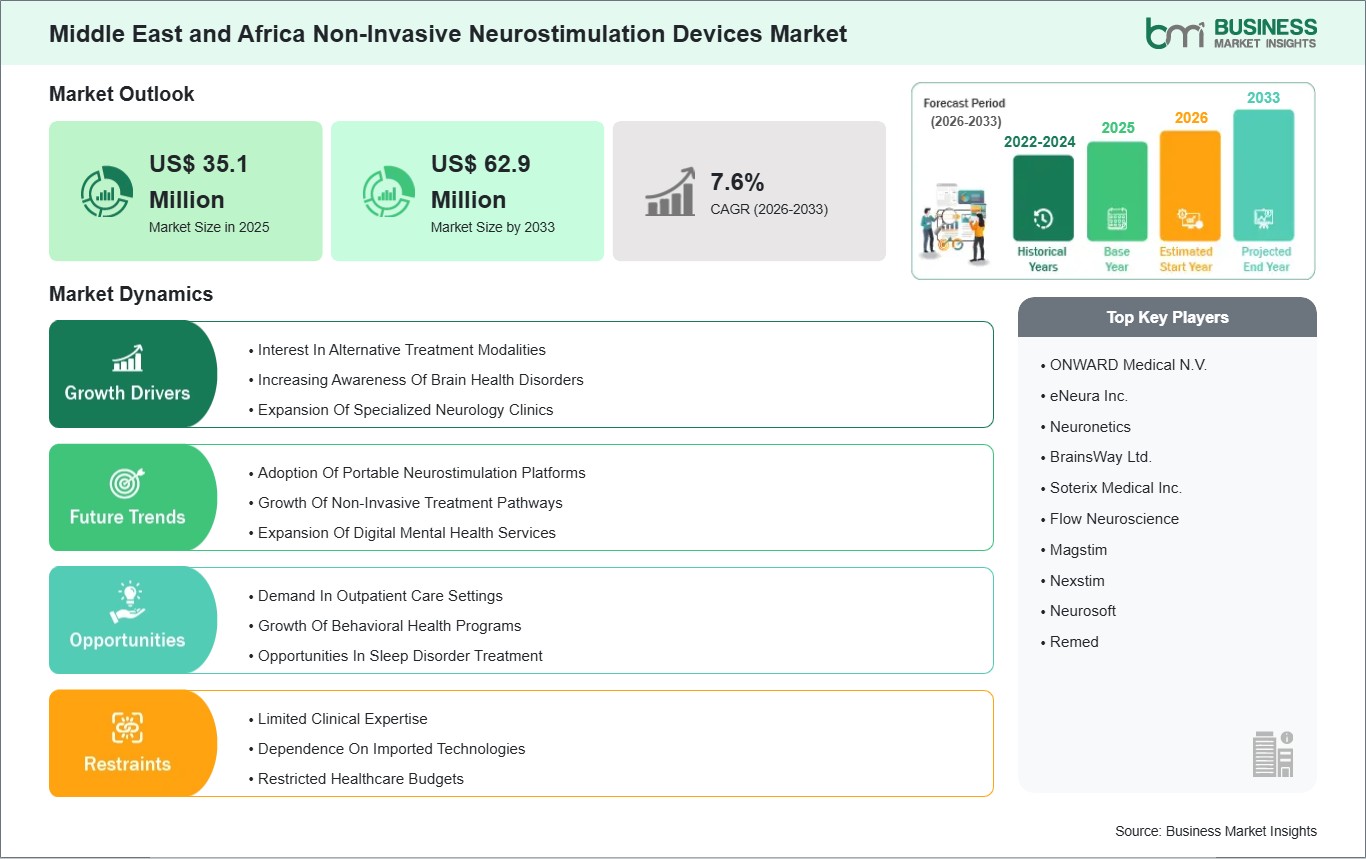
In the Middle East and Africa, the market for non-invasive neurostimulation devices is changing as healthcare providers adopt more technology-based treatments for neurological conditions. More people are being diagnosed with issues like depression, epilepsy, and chronic pain, which is leading doctors to use neuromodulation techniques that can reduce the need for medication. At the same time, better hospital facilities, more neurology clinics, and increased familiarity with these devices are helping them become more common in both cities and smaller communities. Still, challenges like limited insurance coverage, high device costs, and not enough trained specialists are slowing wider use, especially in countries with complex regulations. To address these issues, manufacturers are focusing on making portable devices, easier outpatient use, and digital monitoring features that fit the needs of cost-conscious healthcare systems. There is also more interest in non-drug pain management, especially in rehab centers and mental health clinics, which is boosting the use of transcranial and peripheral stimulation devices. Telemedicine and home-based therapies are slowly making these treatments available in remote areas where specialists are scarce. However, delays in buying equipment and uneven distribution between public and private hospitals are slowing progress in some regions. Because of this, device makers and healthcare leaders are investing in training, education, and local service models to build confidence and encourage long-term use of these technologies across different healthcare settings in the Middle East and Africa.
Segment Analysis
Middle East and Africa Non-Invasive Neurostimulation Devices Market Segmentation
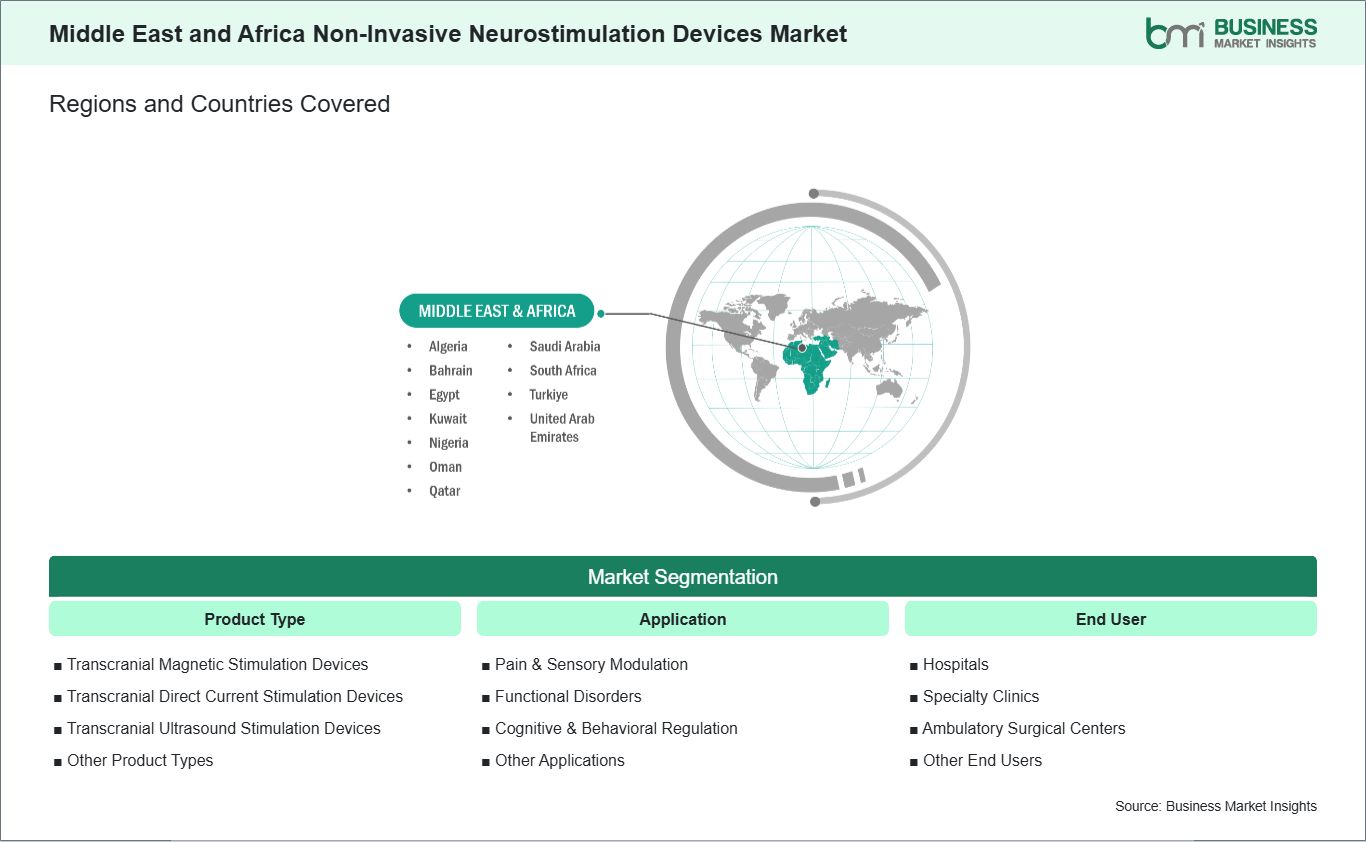
Key segments that contributed to the derivation of the Middle East and Africa non-invasive neurostimulation devices market analysis are product type, application and end user.
- By product type, the non-invasive neurostimulation devices market is segmented into transcranial magnetic stimulation devices, transcranial direct current stimulation devices, transcranial ultrasound stimulation devices, and other product types. The transcranial magnetic stimulation devices segment dominated the market in 2025.
- Based on application, the non-invasive neurostimulation devices market is categorized into pain & sensory modulation, functional disorders, cognitive & behavioral regulation, and other applications. The cognitive & behavioral regulation segment dominated the market in 2025.
- In terms of end user, the non-invasive neurostimulation devices market is categorized into hospitals, specialty clinics, ambulatory surgical centers, and other end users. The hospitals segment dominated the market in 2025.
Market Forces
Middle East and Africa Non-Invasive Neurostimulation Devices Market Drivers and Opportunities
Interest in Alternative Treatment Modalities
In Middle East and Africa healthcare systems, doctors are using non-invasive neurostimulation devices more often when medications do not work well or take too long to help. Neurologists and psychiatrists are trying these devices as extra tools, especially for conditions that need ongoing symptom management instead of quick fixes.
Healthcare providers and decision-makers are rethinking the order of treatments as more neurological and psychiatric cases appear in outpatient clinics. In city hospitals and growing specialty centers, there is a clear trend toward using device-based neuromodulation for patients who have tried several medications without lasting results, especially for depression, chronic pain, and problems after a stroke.
Medical device companies and specialist clinics are starting pilot programs in neurology departments and rehab centers to introduce neurostimulation systems. These programs focus on doctor-led protocols and adjusting settings for each patient, helping non-invasive stimulation become a regular part of treatment instead of just an experimental or last-resort option.
Demand in Outpatient Care Settings
In outpatient environments across Middle East and Africa, care delivery models are increasingly structured around short, repeatable treatment sessions, making non-invasive neurostimulation devices operationally practical. Clinics prioritize therapies that can be administered without anesthesia, imaging support, or extended post-procedure observation, aligning with constrained staffing patterns and high patient turnover.
Rehabilitation centers and ambulatory neurology units are incorporating portable stimulation systems to maintain continuity of care outside inpatient wards. This approach supports patients recovering from stroke, chronic neuropathic pain, or psychiatric stabilization, where repeated interventions are required but hospital admission is not clinically necessary or economically feasible for providers.
Private specialty practices are further shaping adoption by bundling neuromodulation sessions with cognitive rehabilitation and behavioral therapy programs. This integration allows providers to design structured care pathways focused on functional recovery outcomes while reducing reliance on resource-intensive inpatient procedures and enabling more flexible scheduling within outpatient service frameworks.
Size and Share Analysis
Middle East and Africa Non-Invasive Neurostimulation Devices Market Size and Share Analysis
The Middle East and Africa non-invasive neurostimulation devices market demonstrates steady growth, with size and share analysis highlighting evolving trends and competitive dynamics among key players. The report examines subsegments categorized within product type, application and end user, offering insights into their contribution to overall market performance.
By product type, the transcranial magnetic stimulation devices subsegment dominated the market in 2025, driven by its established clinical efficacy, growing adoption for neurological and psychiatric disorders, and increasing availability across healthcare facilities.
Based on application, the cognitive & behavioral regulation subsegment dominated the market in 2025, driven by the rising prevalence of mental health disorders and increasing use of neurostimulation therapies for depression, anxiety, and cognitive enhancement.
In terms of end user, the hospitals subsegment dominated the market in 2025, driven by the availability of advanced neurostimulation technologies, skilled healthcare professionals, and growing patient volumes requiring specialized neurological care.
Report Coverage
Middle East and Africa Non-Invasive Neurostimulation Devices Market Report Coverage and Deliverables
The "Middle East and Africa Non-Invasive Neurostimulation Devices Market Size and Forecast (2022-2033)" report provides a detailed analysis of the market covering below areas:
- Market segments covered under the scope
- Market dynamics such as drivers, restraints, and key opportunities
- Market concentration, heat map analysis, prominent players, and recent developments
- Detailed company profiles, including SWOT analysis
Geographic Insights
Middle East and Africa Non-Invasive Neurostimulation Devices Market Geographic Insights
The geographical scope of the Middle East and Africa Non-Invasive Neurostimulation Devices Market report is divided into Turkiye, the UAE, Saudi Arabia, Bahrain, Oman, Egypt, South Africa and Africa, Algeria, Nigeria, Kuwait, and Qatar. Turkiye held the largest share in 2025.
Turkiye remains the dominant market for non-invasive neurostimulation devices in the Middle East and Africa, driven by strong neurology infrastructure, local manufacturing, and integrated rehabilitation systems supporting clinical adoption and outpatient neurotherapy expansion. UAE demonstrates growth driven by innovation-focused healthcare infrastructure, rapid neuromodulation adoption in private hospitals, and medical tourism positioning across specialized neurological centers. Saudi Arabia shows expanding demand fueled by healthcare transformation initiatives, investment in neurorehabilitation services, and non-pharmacological pain management in urban hospitals. Bahrain records uptake supported by centralized healthcare system, growing insurance coverage, and pilot programs for advanced neurological treatment technologies enhancing early intervention services. Oman experiences expansion as public healthcare facilities invest in chronic pain management solutions and rehabilitation services for neurological disorders increasing patient access steadily. Egypt benefits from patient base, increasing awareness of neurological conditions, and rising demand for cost-effective non-invasive therapeutic options within outpatient neurology clinics. South Africa leads adoption through advanced private healthcare sector, while broader African markets expand access via telemedicine and NGO-supported neurocare initiatives improving community-based care models. Algeria's growth is shaped by hospital modernization programs and increasing import of specialized neurological equipment improving hospital capacity. Nigeria expands through rising private clinic investments, high epilepsy prevalence, and formalization of advanced neurological care services expanding outreach programs. Kuwait sees adoption supported by high healthcare spending, specialty neuro clinics, and uptake of pain modulation technologies in tertiary hospitals. Qatar advances through premium healthcare institutions, research-driven hospitals, and participation in global neurotechnology trials supporting advanced clinical research growth expansion driving regional innovation.
Industry Activity
Recent Developments
The Middle East and Africa Non-Invasive Neurostimulation Devices Market is evaluated by gathering qualitative and quantitative data post primary and secondary research, which includes important corporate publications, association data, and databases. A few of the key developments in the Middle East and Africa non-invasive neurostimulation devices market are:
- In February 2025, Nyxoah announced that it had commercially launched its Genio hypoglossal neurostimulation system in the Middle East, marked by the first successful patient implant at Saudi German Hospital in Dubai, United Arab Emirates, expanding access to its non-invasive sleep apnea neuromodulation therapy across the region.
- In March 2024, Nexalin Technology announced that it had commenced sales and clinical deployment of its Gen-2 non-invasive neurostimulation device at a newly established mental health center in Oman, marking one of its first operational expansions into the Middle East for brain stimulation-based addiction and mental health treatment.
Trust & Transparency
Research Methodology
The market analysis combines proprietary research with secondary data from government agencies, company disclosures, regulatory filings, industry databases and expert interviews. Market estimates are validated through data triangulation, cross-market benchmarking and analyst
review.
View Full Research Methodology
Key Sources Referred:
U.S. Food and Drug Administration (FDA)National Institutes of Health (NIH)National Institute of Neurological Disorders and Stroke (NINDS)Centers for Medicare & Medicaid Services (CMS)Medical Device Innovation Consortium (MDIC)World Health Organization (WHO)International Organization for Standardization (ISO)International Neuromodulation Society (INS)North American Neuromodulation Society (NANS)Company WebsitesCompany Annual ReportsCompany Investor Presentations