Market Summary
Executive Summary and Market Analysis
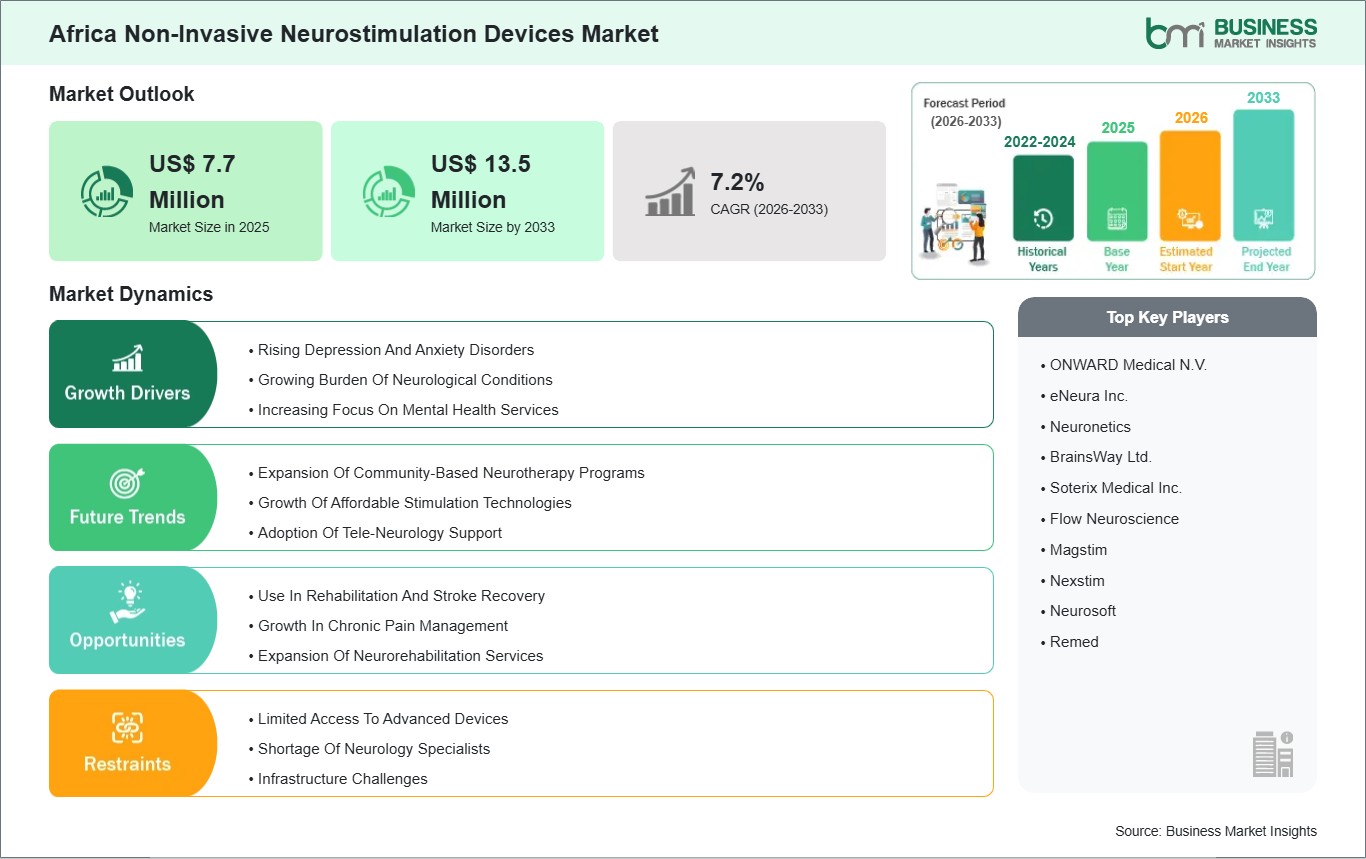
Mobile and user-friendly gadgets are changing treatment options, enabling doctors to intervene earlier and offer more noninvasive care. The shift toward tech-assisted neurological and psychiatric care shapes the Africa non-invasive neurostimulation devices market. More clinicians are leaning toward nonsurgical options such as transcranial magnetic stimulation and transcutaneous electrical nerve stimulation for conditions such as pain management, depression, and rehabilitation support. There is an increasing number of people with neurological and mental health issues, driven by aging populations in cities, more stroke cases, and a greater need for chronic pain solutions that aren't opioids. Moreover, there is an increase in private healthcare networks and specialty clinics. These places are purchasing modern neuromodulation equipment to stand out in the market. Additionally, training programs and international partnerships are spreading advanced therapies to new hospitals. Despite these enablers, adoption is hindered by affordability issues in public health systems and for patients. High capital costs and maintenance needs limit new equipment purchases, confining them mostly to urban areas. Also, the lack of standard reimbursement plans makes clinicians hesitant. Inconsistent regulatory pathways add another layer of complication, and a shortage of trained neurophysiology professionals creates more roadblocks. Experimentation with home treatments under doctor oversight and through digital tracking looks promising.
Segment Analysis
Africa Non-Invasive Neurostimulation Devices Market Segmentation
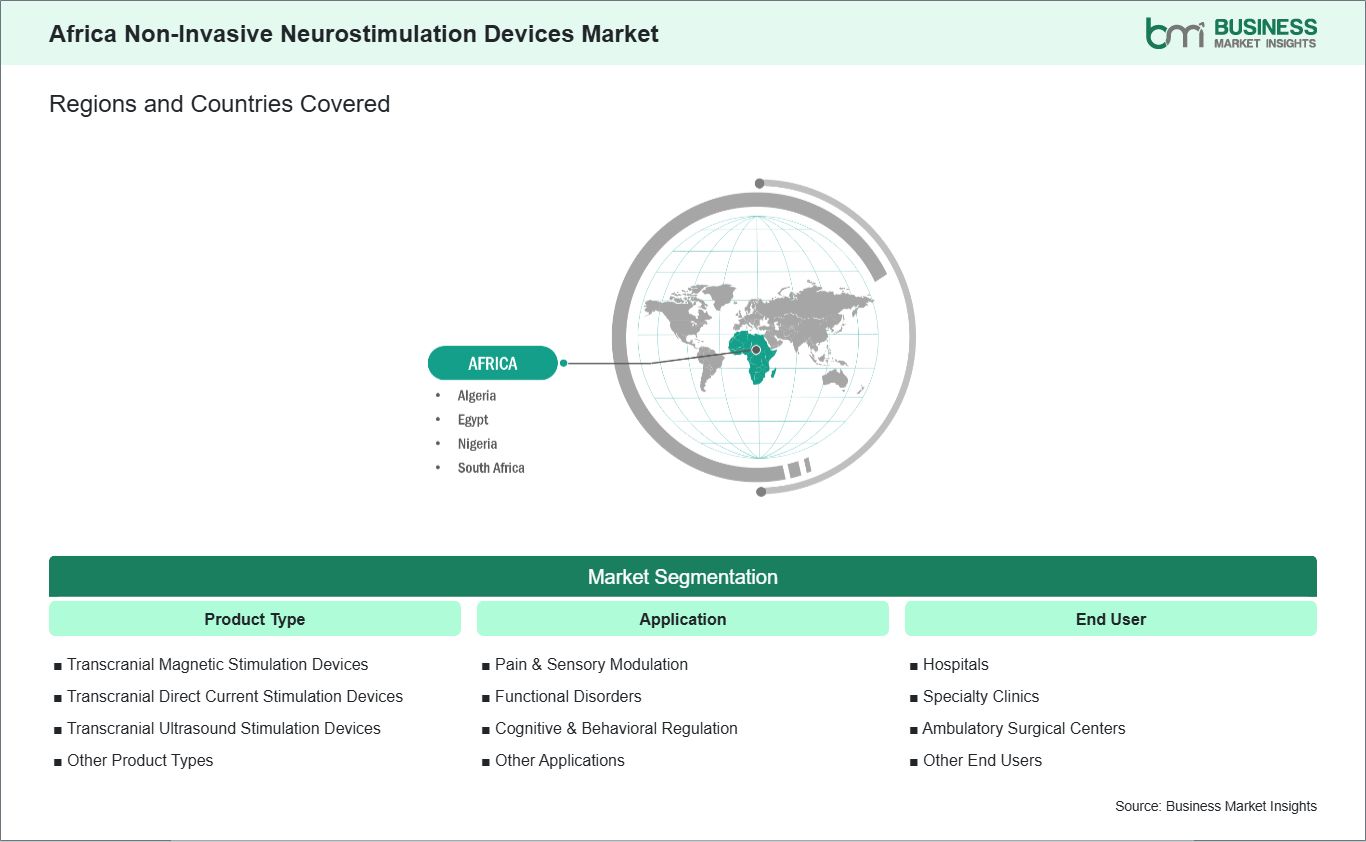
Key segments that contributed to the derivation of the Africa non-invasive neurostimulation devices market analysis are product type, application and end user.
- By product type, the non-invasive neurostimulation devices market is segmented into transcranial magnetic stimulation devices, transcranial direct current stimulation devices, transcranial ultrasound stimulation devices, and other product types. The transcranial magnetic stimulation devices segment dominated the market in 2025.
- Based on application, the non-invasive neurostimulation devices market is categorized into pain & sensory modulation, functional disorders, cognitive & behavioral regulation, and other applications. The cognitive & behavioral regulation segment dominated the market in 2025.
- In terms of end user, the non-invasive neurostimulation devices market is categorized into hospitals, specialty clinics, ambulatory surgical centers, and other end users. The hospitals segment dominated the market in 2025.
Market Forces
Africa Non-Invasive Neurostimulation Devices Market Drivers and Opportunities
Rising Depression and Anxiety Disorders
In urban psychiatric clinics in Africa, noninvasive neurostimulation devices are slowly being used more for patients with ongoing depression and anxiety. Doctors recommend these devices when medications aren't working well or patients can't tolerate them. With more training in neuromodulation, private healthcare providers are testing brain stimulation techniques in outpatient settings. They learn from individual cases and tweak the treatments based on what works best for each person's unique anxiety or stubborn depressive symptoms. This adoption is driven by specialists recommending these methods, not by strict rules from hospitals.
Within the mental health community, neurostimulation is seen as an add-on to therapy and drugs, not something that replaces other forms of treatment. Even though some doctors are hesitant, others combine stimulation with other therapies, focusing on making patients feel better with fewer side effects. This approach especially makes sense in big city hospitals and influences what equipment these places buy.
Use in Rehabilitation and Stroke Recovery
In neuro-rehabilitation units, noninvasive neurostimulation devices are embedded into structured stroke recovery programs that combine physical therapy with targeted cortical activation. Therapists often schedule stimulation sessions before motor training exercises, aiming to prime neural pathways and improve patient engagement during repetitive movement retraining tasks. This sequencing is favored in hospital-based rehab protocols.
As stroke survival rates improve and rehabilitation durations extend, clinicians are exploring adjunct technologies that can sustain neuroplasticity beyond conventional therapy windows. Noninvasive stimulation is used intermittently to reinforce motor learning, particularly when patient fatigue limits intensive physiotherapy sessions, creating a more distributed recovery rhythm. Clinics adapt dosing schedules based on tolerance and response patterns.
Within rehabilitation centers, adoption patterns vary between high-resource urban hospitals and smaller facilities where equipment sharing is more common. Even so, neurostimulation is positioned as a complementary layer to occupational and speech therapy, supporting functional recovery goals through coordinated multidisciplinary planning. This integration depends heavily on clinician familiarity and training exposure.
Size and Share Analysis
Africa Non-Invasive Neurostimulation Devices Market Size and Share Analysis
The Africa non-invasive neurostimulation devices market demonstrates steady growth, with size and share analysis highlighting evolving trends and competitive dynamics among key players. The report examines subsegments categorized within product type, application and end user, offering insights into their contribution to overall market performance.
By product type, the transcranial magnetic stimulation devices subsegment dominated the market in 2025, driven by its established clinical efficacy, growing adoption for neurological and psychiatric disorders, and increasing availability across healthcare facilities.
Based on application, the cognitive & behavioral regulation subsegment dominated the market in 2025, driven by the rising prevalence of mental health disorders and increasing use of neurostimulation therapies for depression, anxiety, and cognitive enhancement.
In terms of end user, the hospitals subsegment dominated the market in 2025, driven by the availability of advanced neurostimulation technologies, skilled healthcare professionals, and growing patient volumes requiring specialized neurological care.
Report Coverage
Africa Non-Invasive Neurostimulation Devices Market Report Coverage and Deliverables
The "Africa Non-Invasive Neurostimulation Devices Market Size and Forecast (2022-2033)" report provides a detailed analysis of the market covering below areas:
- Market segments covered under the scope
- Market dynamics such as drivers, restraints, and key opportunities
- Market concentration, heat map analysis, prominent players, and recent developments
- Detailed company profiles, including SWOT analysis
Geographic Insights
Africa Non-Invasive Neurostimulation Devices Market Geographic Insights
The geographical scope of the Africa Non-Invasive Neurostimulation Devices Market report is divided into Nigeria, Egypt, South Africa, and Algeria. South Africa held the largest share in 2025.
South Africa leads in the non-invasive neurostimulation device market in Africa. It boasts a solid private healthcare system, advanced neurology departments, and was one of the first to adopt neuromodulation for pain and mental health issues. Hospitals in big cities and easy reimbursements through private insurance help keep device use up. There are many rehabilitation centers and medical schools where clinicians get trained, which keeps demand going in both cities and top medical facilities. Nigeria is emerging as a high-potential market due to the increasing need for neurological treatments and increasing money investments into the private healthcare sector. People there are becoming aware of these treatment options, and more outpatient services are expanding in cities, but the infrastructure faces issues as specialists aren't spread evenly yet. Over in Egypt, they're using their spot as a healthcare hub to expand public hospitals and improve their healthcare rules. This, along with solid academic neurology placements, helps introduce neurostimulation gadgets. Local assembly and imports make these devices more available, and both the public and private sectors that require more chronic pain and rehab care can boost their use. In Algeria, the government spends more on modernizing hospitals with help from oil money, making advanced devices easier to get. There is a growing attention toward treating stroke and chronic pain patients, with improving regulations. This leads to steady adoption of non-invasive neurostimulation technologies in top hospitals in major cities, while also expanding across regions.
Industry Activity
Recent Developments
The Africa Non-Invasive Neurostimulation Devices Market is evaluated by gathering qualitative and quantitative data post primary and secondary research, which includes important corporate publications, association data, and databases. A few of the key developments in the Africa non-invasive neurostimulation devices market are:
- In February 2023, electroCore, Inc. announced the signing of an exclusive distribution agreement with Byond Healthcare Pty Ltd. to commercialize its gammaCore non-invasive vagus nerve stimulation (nVNS) therapy in South Africa and Namibia, expanding access to bioelectronic medicine across African healthcare markets.
- In July 2025, ZAP Surgical Systems announced that Ibn Sina Medical Center in Morocco will become the first facility in Africa to adopt the ZAP-X Gyroscopic Radiosurgery platform, a fully noninvasive stereotactic radiosurgery system for brain tumor treatment, marking a major expansion of advanced non-invasive neurotechnology infrastructure in Africa.
Trust & Transparency
Research Methodology
The market analysis combines proprietary research with secondary data from government agencies, company disclosures, regulatory filings, industry databases and expert interviews. Market estimates are validated through data triangulation, cross-market benchmarking and analyst
review.
View Full Research Methodology
Key Sources Referred:
U.S. Food and Drug Administration (FDA)National Institutes of Health (NIH)National Institute of Neurological Disorders and Stroke (NINDS)Centers for Medicare & Medicaid Services (CMS)Medical Device Innovation Consortium (MDIC)World Health Organization (WHO)International Organization for Standardization (ISO)International Neuromodulation Society (INS)North American Neuromodulation Society (NANS)Company WebsitesCompany Annual ReportsCompany Investor Presentations