Asia Pacific Non-Invasive Neurostimulation Devices Market Outlook: Size, Share, Trends, Growth Analysis, Competitive Landscape & Forecast, 2026-2033

Historic Data: 2022-2024   |   Base Year: 2025   |   Forecast Period: 2026-2033
Report Content: Market Scope, Market Segmentation, Market Dynamics, and Competitive Analysis

Report Coverage:
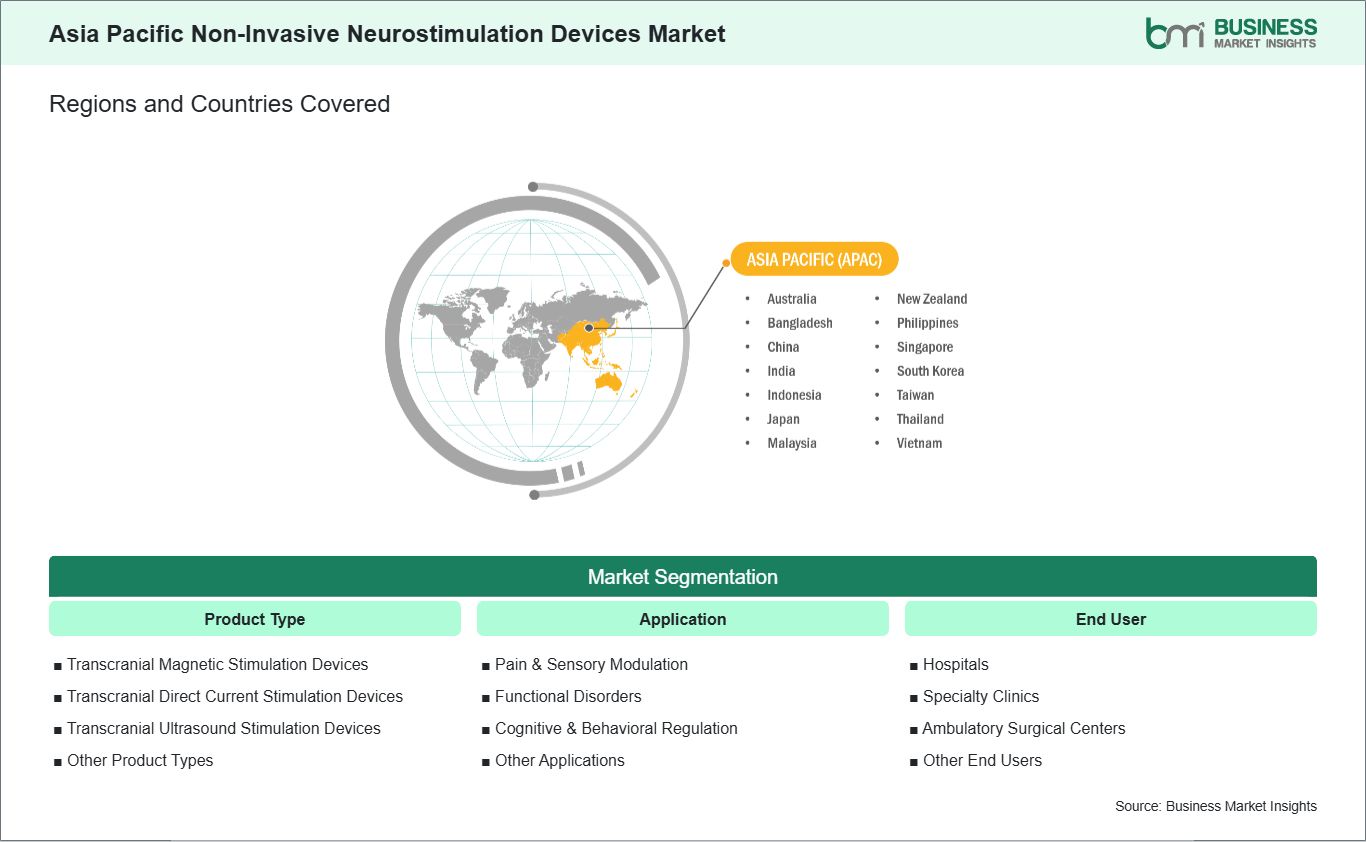
  • Product Type (Transcranial Magnetic Stimulation Devices, Transcranial Direct Current Stimulation Devices, Transcranial Ultrasound Stimulation Devices, Other Product Types)
  • Application (Pain & Sensory Modulation, Functional Disorders, Cognitive & Behavioral Regulation, Other Applications)
  • End User (Hospitals, Specialty Clinics, Ambulatory Surgical Centers, Other End Users)

No. of Pages: 150
Report Code: BMIPUB00036000
Category: Life Sciences
Asia Pacific Non-Invasive Neurostimulation Devices Market

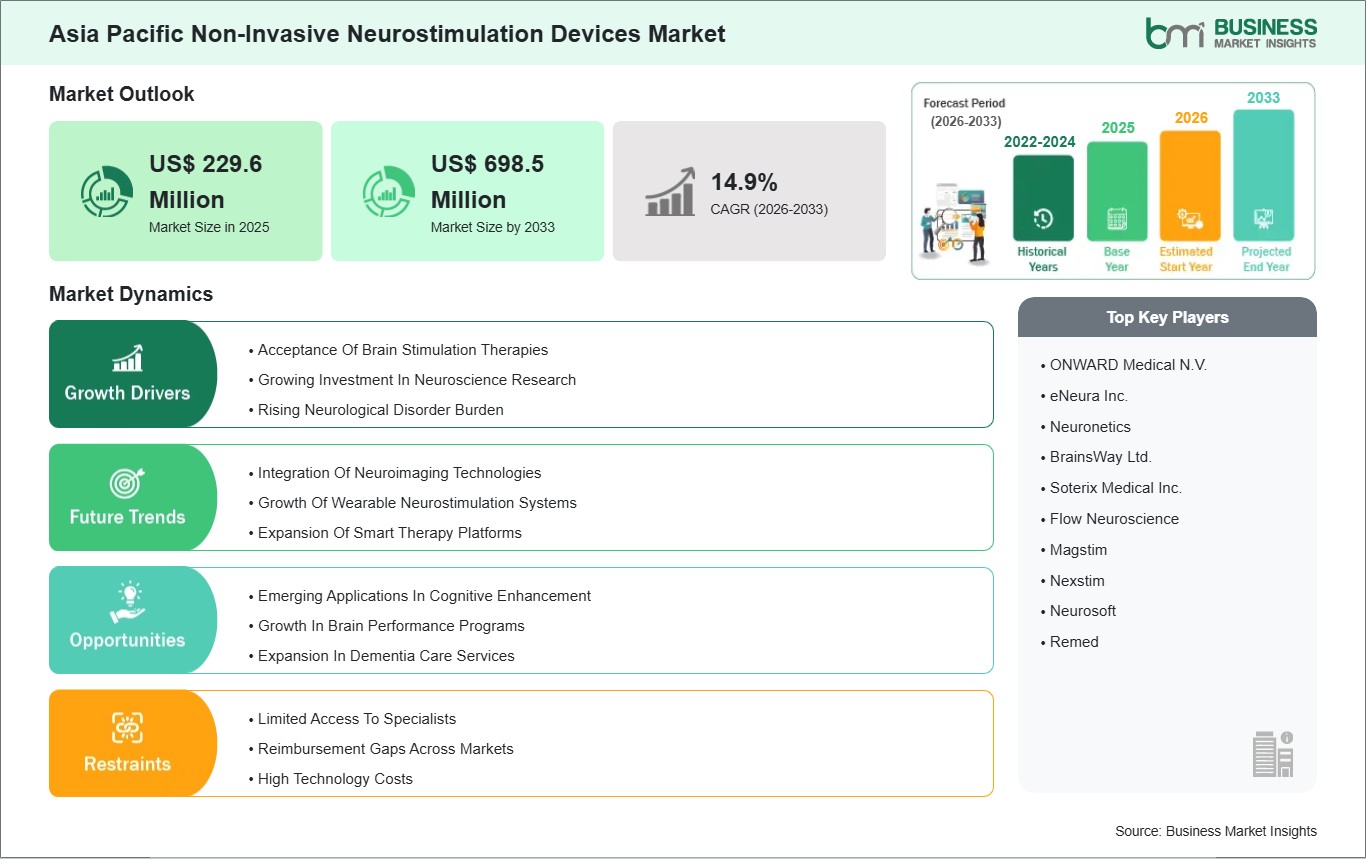
The Asia Pacific non-invasive neurostimulation devices market size is expected to reach US$ 698.5 million by 2033 from US$ 229.6 million in 2025. The market is estimated to register a CAGR of 14.9% from 2026 to 2033.

Executive Summary and Asia Pacific Non-Invasive Neurostimulation Devices Market Analysis:

In the Asia Pacific for non-invasive neurostimulation devices, the shape of demand reflects changing views on neurological care - moving towards treatments that target brain activity safely and without surgery. As we see more cases of mental health issues and neurological diseases, hospitals and outpatient clinics, especially in cities, incorporate techniques like transcranial magnetic stimulation and transcranial direct current stimulation. They're also helped by growing digital health initiatives; these efforts boost the use of both mobile and fixed neuromodulation tools through greater clinician knowledge and patient comfort with these procedures. Despite this progress, pricey equipment, differing insurance coverage rules, and unclear regulations slow down how fast these technologies become part of regular care routines. In Japan and India, hospitals and research centers are increasingly investing in non-invasive brain stimulation to help stroke victims, manage depression, and ease chronic pain. They're working on standardizing treatments through clinical trials and partnerships with universities. Companies are blending hospital care with at-home therapies using wearable devices and apps that track health improvements over time. These digital tools link up to the internet to adjust treatments and keep tabs on patients. Tech developers are getting better at making smaller gadgets that target the right spots in the brain and are using AI to tailor therapies more accurately. By teaming up across borders and offering more training, they're boosting medical staff skills and spreading these innovations to more places throughout Asia. This is all leading to more varied uses of these advanced treatments in clinics.

Asia Pacific Non-Invasive Neurostimulation Devices Market - Strategic Insights:

global-market-strategic-framework
Get more information on this report

Asia Pacific Non-Invasive Neurostimulation Devices Market Segmentation Analysis:

Key segments that contributed to the derivation of the Asia Pacific non-invasive neurostimulation devices market analysis are product type, application and end user.

  • By product type, the non-invasive neurostimulation devices market is segmented into transcranial magnetic stimulation devices, transcranial direct current stimulation devices, transcranial ultrasound stimulation devices, and other product types. The transcranial magnetic stimulation devices segment dominated the market in 2025.
  • Based on application, the non-invasive neurostimulation devices market is categorized into pain & sensory modulation, functional disorders, cognitive & behavioral regulation, and other applications. The cognitive & behavioral regulation segment dominated the market in 2025.
  • In terms of end user, the non-invasive neurostimulation devices market is categorized into hospitals, specialty clinics, ambulatory surgical centers, and other end users. The hospitals segment dominated the market in 2025.

Asia Pacific Non-Invasive Neurostimulation Devices Market Drivers and Opportunities:

Acceptance of Brain Stimulation Therapies

In the Asia Pacific region, clinics dealing with neurology and psychiatry are starting to use non-invasive neurostimulation more and more, especially when drugs aren't always effective. Doctors prefer standardized sessions because this lets them offer consistent treatment outside of hospitals, which is great for patients and works well in busy city centers.

When buying new equipment, hospital managers look for devices that don't require operators to go through rigorous, specialized training. This way, services using neurostimulation can reach departments beyond just mental health, like those focused on rehab and pain relief. Because of this, the folks who make the machines are adjusting how they train staff and provide after-sales support.

To make their devices fit better with clinical workflows, manufacturers work closely with hospitals and research centers. Together, they gather data from patients to tweak the gadgets and come up with new protocols. These joint efforts help both in getting things approved by regulators and making sure the products improve based on real-world use.

Emerging Applications in Cognitive Enhancement

Use-case expansion in non-invasive neurostimulation is increasingly visible in cognitive training environments where structured brain modulation sessions are being incorporated alongside attention and memory exercises. Wellness-oriented neurotech providers are embedding these protocols into supervised programs that combine behavioral tasks with stimulation cycles tailored to user responsiveness. This integration is often positioned within structured cognitive development plans rather than standalone device usage.

Educational and corporate learning environments are exploring neurostimulation-assisted cognitive tools to support sustained attention during high-load information processing tasks. Device usage patterns in these settings tend to be structured around short, repeatable sessions integrated into training modules rather than continuous exposure. Program designers emphasize adaptability across cognitive skill levels.

Consumer-facing neurotechnology platforms are experimenting with non-invasive stimulation features intended to complement digital cognitive training applications. These features are often integrated into app-based ecosystems where performance feedback guides session intensity and duration. Market behavior indicates a preference for modular systems that allow users to adjust stimulation parameters in line with personal cognitive goals.

Asia Pacific Non-Invasive Neurostimulation Devices Market Size and Share Analysis:

The Asia Pacific non-invasive neurostimulation devices market demonstrates steady growth, with size and share analysis highlighting evolving trends and competitive dynamics among key players. The report examines subsegments categorized within product type, application and end user, offering insights into their contribution to overall market performance.

By product type, the transcranial magnetic stimulation devices subsegment dominated the market in 2025, driven by its established clinical efficacy, growing adoption for neurological and psychiatric disorders, and increasing availability across healthcare facilities.

Based on application, the cognitive & behavioral regulation subsegment dominated the market in 2025, driven by the rising prevalence of mental health disorders and increasing use of neurostimulation therapies for depression, anxiety, and cognitive enhancement.

In terms of end user, the hospitals subsegment dominated the market in 2025, driven by the availability of advanced neurostimulation technologies, skilled healthcare professionals, and growing patient volumes requiring specialized neurological care.

Asia Pacific Non-Invasive Neurostimulation Devices Market Report Highlights:

Report Attribute Details
Market size in 2025 US$ 229.6 Million
Market Size by 2033 US$ 698.5 Million
CAGR (2026 - 2033)14.9%
Historical Data 2022-2024
Forecast period 2026-2033
Segments Covered By Product Type
  • Transcranial Magnetic Stimulation Devices
  • Transcranial Direct Current Stimulation Devices
  • Transcranial Ultrasound Stimulation Devices
  • Other Product Types
By Application
  • Pain & Sensory Modulation
  • Functional Disorders
  • Cognitive & Behavioral Regulation
  • Other Applications
By End User
  • Hospitals
  • Specialty Clinics
  • Ambulatory Surgical Centers
  • Other End Users
Regions and Countries Covered
Asia Pacific China, Japan, South Korea, India, Australia, New Zealand, Indonesia, Malaysia, Philippines, Singapore, Thailand, Vietnam, Taiwan, Bangladesh
Market leaders and key company profiles
  • ONWARD Medical N.V.
  • eNeura Inc.
  • Neuronetics
  • BrainsWay Ltd.
  • Soterix Medical Inc.
  • Flow Neuroscience
  • Magstim
  • Nexstim
  • Neurosoft
  • Remed
Get more information on this report

Asia Pacific Non-Invasive Neurostimulation Devices Market Report Coverage and Deliverables:

The "Asia Pacific Non-Invasive Neurostimulation Devices Market Size and Forecast (2022-2033)" report provides a detailed analysis of the market covering below areas:

  • Market segments covered under the scope
  • Market dynamics such as drivers, restraints, and key opportunities
  • Market concentration, heat map analysis, prominent players, and recent developments
  • Detailed company profiles, including SWOT analysis

Asia Pacific Non-Invasive Neurostimulation Devices Market Geographic Insights:

The geographical scope of the Asia Pacific Non-Invasive Neurostimulation Devices Market report is divided into China, Japan, South Korea, India, Australia, New Zealand, Indonesia, Malaysia, Philippines, Singapore, Thailand, Vietnam, Taiwan, Bangladesh. China held the largest share in 2025.

China dominates the Asia Pacific non-invasive neurostimulation devices market because of its huge hospital networks, robust manufacturing, and rapid uptake of cutting-edge neuro tech. The government fuels this growth through health care initiatives. Japan's market grows steadily, owing to its aging population and push for precise rehab therapies. South Korea is advancing by blending digital health with neuro gadgets and vigorous medical tech research. In India, the sector expands due to increasing neurological issues, affordable demands, and fast-growing private health care. Australia thrives from its solid clinical ties, early use of brain-modulating treatments, and organized ways to cover costs. New Zealand sees steady growth, due to expanding telehealth, better rural care access, and a shortage of specialists. Indonesia's growth is fueled by more urban hospitals, upgraded health infrastructures, and increased awareness about neurological care. In Malaysia, they benefit from medical tourists, modernizing healthcare led by the government, and more advanced devices being used. The Philippines sees growth due to bigger private hospital networks, greater mental health awareness, and healthcare spending funded by remittances. Singapore is advancing as a top medtech hub in the region - they have efficient regulations, an innovative healthcare scene, and early tech adopters. Thailand grows through its strength in medical tourism, new rehab centers, and the rising need for neuro care after strokes. Vietnam is seeing healthcare expand because of fast-growing infrastructure, a youthful population, and more neurological issues popping up. In Taiwan, the medtech industry is booming due to its strong chip-making abilities, high-tech device production, and firms that export healthcare tech. Finally, Bangladesh is showing potential demand despite major affordability issues, with more basic health access and support from NGOs for neurorehabilitation.

global-market-geography
Get more information on this report

Asia Pacific Non-Invasive Neurostimulation Devices Market Research Report Guidance:

  • The report includes qualitative and quantitative data in the Asia Pacific non-invasive neurostimulation devices market across product type, application, end user, and geography.
  • The report starts with the key takeaways (chapter 2), highlighting the key trends and outlook of the Asia Pacific market.
  • Chapter 3 focuses on the research methodology of the study.
  • Chapter 4 includes ecosystem analysis.
  • Chapter 5 highlights the major industry dynamics in the Asia Pacific market, including factors that are driving the market, prevailing deterrents, potential opportunities, as well as future trends. Impact analysis of these drivers and restraints is also covered in this section.
  • Chapter 6 discusses the Asia Pacific market scenario, in terms of historical market revenues, and forecast till the year 2033.
  • Chapters 7 to 10 cover the Asia Pacific market segments by product type, application, end user, and geography across China, Japan, South Korea, India, Australia, New Zealand, Indonesia, Malaysia, Philippines, Singapore, Thailand, Vietnam, Taiwan, Bangladesh. They cover the market revenue, forecast, and factors driving the market.
  • Chapter 11 describes the competitive analysis along with the heat map analysis for the key players operating in the market.
  • Chapter 12 describes the industry landscape analysis. It provides detailed descriptions of business activities such as market initiatives, new developments, mergers, and joint ventures globally, along with a competitive landscape.
  • Chapter 13 provides detailed profiles of the major companies operating in the Asia Pacific market. Companies have been profiled on the basis of their key facts, business descriptions, products, financial overview, SWOT analysis, and key developments.
  • Chapter 14, i.e., the appendix, is inclusive of a brief overview of the company, list of abbreviations, and a disclaimer.

Asia Pacific Non-Invasive Neurostimulation Devices Market News and Key Development:

The Asia Pacific Non-Invasive Neurostimulation Devices Market is evaluated by gathering qualitative and quantitative data post primary and secondary research, which includes important corporate publications, association data, and databases. A few of the key developments in the Asia Pacific non-invasive neurostimulation devices market are:

  • In August 2023, BrainsWay Ltd. announced that it has expanded availability of its Deep TMS non-invasive brain stimulation systems in Taiwan through additional system installations, strengthening its footprint across the Asia-Pacific region, including key Asia Pacific neuropsychiatric care networks.
  • In June 2023, Nexalin Technology, Inc. announced a joint venture with Wider Come Limited to commercialize its transcranial alternating current stimulation (tACS) devices across China and the broader Asia Pacific region, including planned clinical trials for insomnia and depression using non-invasive neurostimulation therapy.

Key Sources Referred:

U.S. Food and Drug Administration (FDA)National Institutes of Health (NIH)National Institute of Neurological Disorders and Stroke (NINDS)Centers for Medicare & Medicaid Services (CMS)Medical Device Innovation Consortium (MDIC)World Health Organization (WHO)International Organization for Standardization (ISO)International Neuromodulation Society (INS)North American Neuromodulation Society (NANS)Company WebsitesCompany Annual ReportsCompany Investor Presentations
The List of Companies - Asia Pacific Non-Invasive Neurostimulation Devices Market
  • ONWARD Medical N.V.
  • eNeura Inc.
  • Neuronetics
  • BrainsWay Ltd.
  • Soterix Medical Inc.
  • Flow Neuroscience
  • Magstim
  • Nexstim
  • Neurosoft
  • Remed
About Author — Life Sciences Research Team

Krishna is a Market Research Analyst with over 4 years of experience across Life Sciences and Materials & Chemicals industries. He holds a Bachelor's degree in Pharmacy (B.Pharm.) and a Master's degree in Pharmaceutical Medicinal Chemistry (M.Pharm.). His expertise spans market intelligence, competitive benchmarking, market sizing and forecasting, primary and secondary research, and strategic consulting.

Krishna has successfully contributed to numerous syndicated and custom research engagements, delivering industry reports, market assessments, competitive analyses, and business proposals for clients across diverse sectors. With .. Show More

Frequently Asked Questions
How big is the Asia Pacific Non-Invasive Neurostimulation Devices Market?

The Asia Pacific Non-Invasive Neurostimulation Devices Market is valued at US$ 229.6 Million in 2025, it is projected to reach US$ 698.5 Million by 2033.

What is the CAGR for Asia Pacific Non-Invasive Neurostimulation Devices Market by (2026 - 2033)?

As per our report Asia Pacific Non-Invasive Neurostimulation Devices Market, the market size is valued at US$ 229.6 Million in 2025, projecting it to reach US$ 698.5 Million by 2033. This translates to a CAGR of approximately 14.9% during the forecast period.

What segments are covered in this report?

The Asia Pacific Non-Invasive Neurostimulation Devices Market report typically cover these key segments-

  • Product Type (Transcranial Magnetic Stimulation Devices, Transcranial Direct Current Stimulation Devices, Transcranial Ultrasound Stimulation Devices, Other Product Types)
  • Application (Pain & Sensory Modulation, Functional Disorders, Cognitive & Behavioral Regulation, Other Applications)
  • End User (Hospitals, Specialty Clinics, Ambulatory Surgical Centers, Other End Users)

What is the historic period, base year, and forecast period taken for Asia Pacific Non-Invasive Neurostimulation Devices Market?

The historic period, base year, and forecast period can vary slightly depending on the specific market research report. However, for the Asia Pacific Non-Invasive Neurostimulation Devices Market report:

  • Historic Period : 2022-2024
  • Base Year : 2025
  • Forecast Period : 2026-2033
  • Who are the major players in Asia Pacific Non-Invasive Neurostimulation Devices Market?

    The Asia Pacific Non-Invasive Neurostimulation Devices Market is populated by several key players, each contributing to its growth and innovation. Some of the major players include:

  • ONWARD Medical N.V.
  • eNeura Inc.
  • Neuronetics
  • BrainsWay Ltd.
  • Soterix Medical Inc.
  • Flow Neuroscience
  • Magstim
  • Nexstim
  • Neurosoft
  • Remed
  • Who should buy this report?

    The Asia Pacific Non-Invasive Neurostimulation Devices Market report is valuable for diverse stakeholders, including:

    • Investors: Provides insights for investment decisions pertaining to market growth, companies, or industry insights. Helps assess market attractiveness and potential returns.
    • Industry Players: Offers competitive intelligence, market sizing, and trend analysis to inform strategic planning, product development, and sales strategies.
    • Suppliers and Manufacturers: Helps understand market demand for components, materials, and services related to concerned industry.
    • Researchers and Consultants: Provides data and analysis for academic research, consulting projects, and market studies.
    • Financial Institutions: Helps assess risks and opportunities associated with financing or investing in the concerned market.

    Essentially, anyone involved in or considering involvement in the Asia Pacific Non-Invasive Neurostimulation Devices Market value chain can benefit from the information contained in a comprehensive market report.

    Available Report Formats

    pdf-format excel-format pptx-format
    Buy Now
    Sales Assistance
    +1 646 791 7070 (US & UK)
    Customization Form

    Please tell us your area of interest
    (Market Segments/ Regions and Countries/ Companies)