Market Summary
Executive Summary and Market Analysis
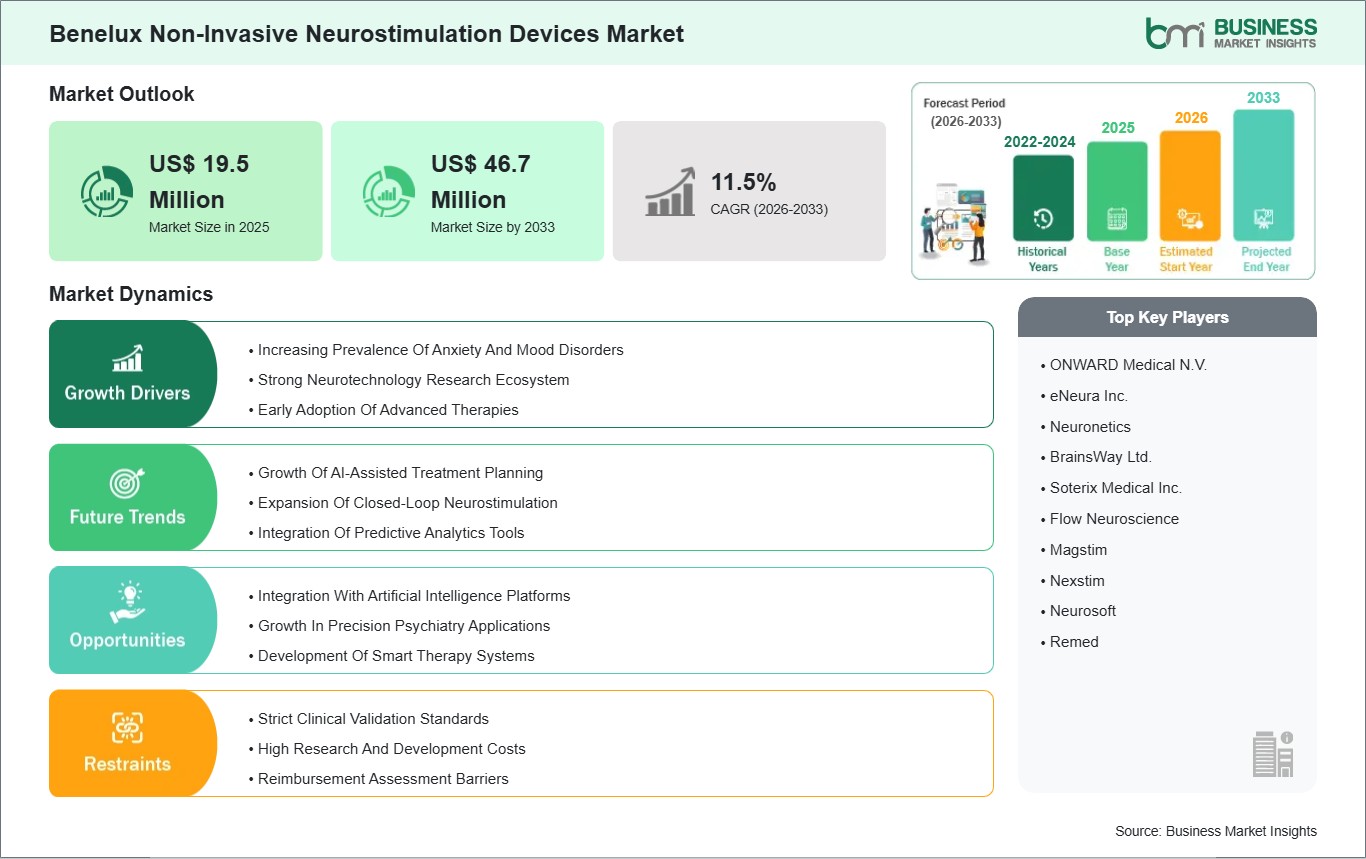
The Benelux non-invasive neurostimulation devices market is defined by the blend of advanced neurological care and the rising need for drug-free treatments in various medical settings. Clinicians in this area lean heavily on evidence-based practices due to the region's solid focus on medical research and its well-integrated healthcare systems. These factors promote early involvement in treating neurological and psychiatric issues. One big push comes from the increasing toll of neurodegenerative diseases, chronic pain, and tough-to-treat depression. This has sparked a desire for new methods like transcranial magnetic and direct current stimulations as either add-ons or alternatives to existing therapies. Additionally, technological improvements in making devices more portable and user-friendly have made home treatments more viable. That fits neatly into more spread-out care networks, taking some strain off specialty clinics. Also boosting the scene is the growing comfort of healthcare providers with these devices and closer cooperation among experts in neurology, psychiatry, and rehab medicine. All this helps integrate these techniques into regular procedures more smoothly. There's also the big issue of high upfront device costs and inconsistent reimbursement processes. This limits use outside top hospitals and specialized clinics. Longer-term clinical testing inconsistencies and the requirement for skilled staff slow down the spread, especially in smaller healthcare settings. In Belgium, the Netherlands, and Luxembourg, regional innovation hubs back up clinical research collaborations. Academic hospitals and med tech makers team up to improve device protocols, boost safety, and enhance patient compliance. Meanwhile, the gradual integration of digital health and remote monitoring is slowly strengthening care continuity in neurological treatment pathways.
Segment Analysis
Benelux Non-Invasive Neurostimulation Devices Market Segmentation
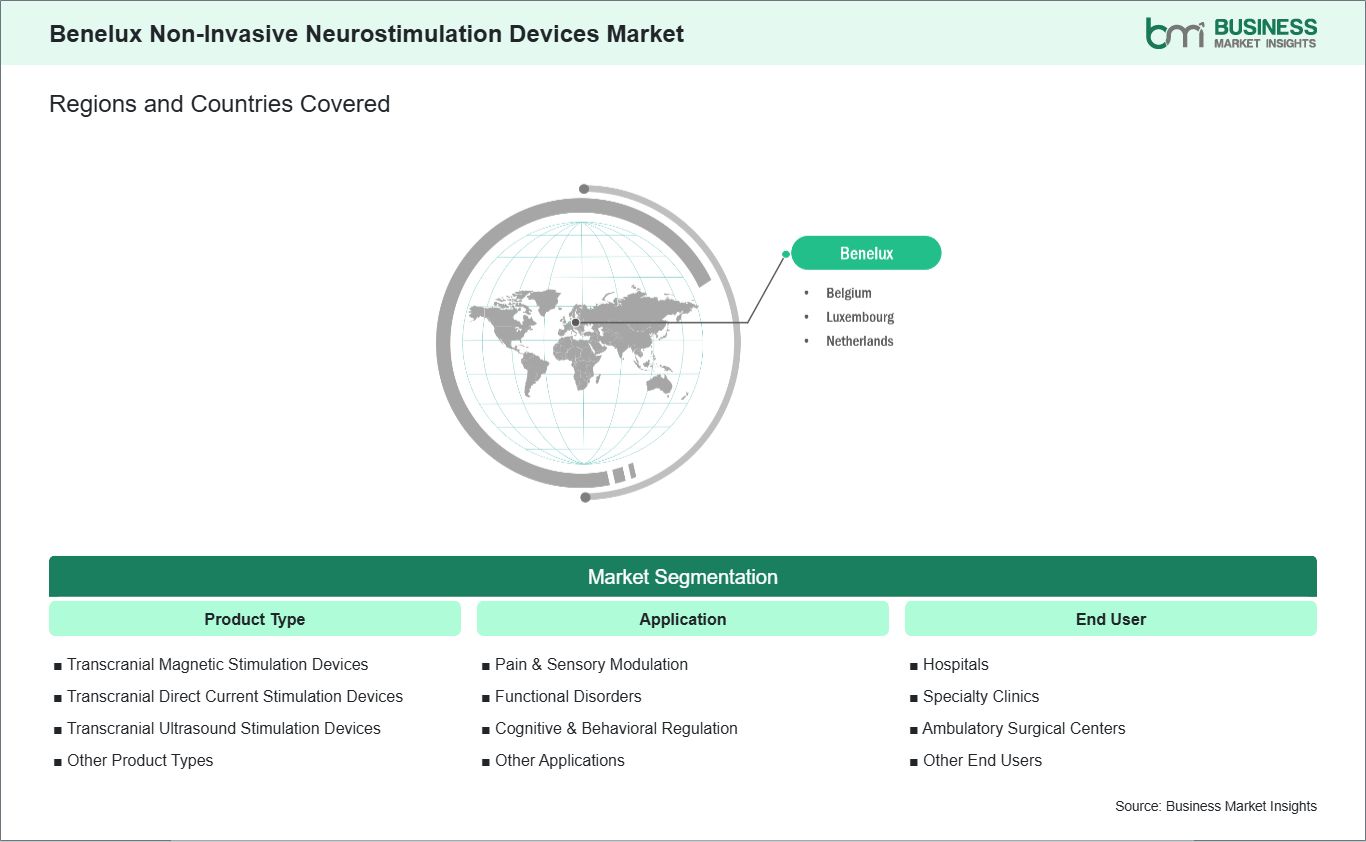
Key segments that contributed to the derivation of the Benelux non-invasive neurostimulation devices market analysis are product type, application and end user.
- By product type, the non-invasive neurostimulation devices market is segmented into transcranial magnetic stimulation devices, transcranial direct current stimulation devices, transcranial ultrasound stimulation devices, and other product types. The transcranial magnetic stimulation devices segment dominated the market in 2025.
- Based on application, the non-invasive neurostimulation devices market is categorized into pain & sensory modulation, functional disorders, cognitive & behavioral regulation, and other applications. The cognitive & behavioral regulation segment dominated the market in 2025.
- In terms of end user, the non-invasive neurostimulation devices market is categorized into hospitals, specialty clinics, ambulatory surgical centers, and other end users. The hospitals segment dominated the market in 2025.
Market Forces
Benelux Non-Invasive Neurostimulation Devices Market Drivers and Opportunities
Increasing Prevalence of Anxiety and Mood Disorders
In clinical settings throughout the Benelux region, non-invasive neurostimulation is becoming more common for treating persistent anxiety and mood issues. However, it's not used alone; doctors usually turn to it when patients have only had a limited response to other treatments like drugs and therapy.
How hospitals use these devices varies between countries. In the Netherlands, there's a more standardized approach involving lots of different professionals. Belgium leans towards private and public clinics working together. Luxembourg, because of its smaller size, often sends patients across borders for these types of treatments.
Doctors are getting better at fitting neurostimulation into treatment plans alongside medication and talk therapy. Before suggesting neurostimulation, they take a detailed look at each patient's medical history, things like what other conditions the person might have, previous treatments that didn't work, and their general tolerance for different therapies. All of this helps decide when and how neurostimulation can be added to their long-term care.
Integration with Artificial Intelligence Platforms
In the Benelux neurostimulation landscape, artificial intelligence is increasingly embedded in systems that guide stimulation parameter selection based on patient response patterns. Clinicians use algorithm-supported tools to interpret symptom tracking and prior treatment history, enabling more precise adjustment of non-invasive neuromodulation sessions within structured psychiatric care.
Connected device ecosystems are developing feedback loops that aggregate session data and outpatient monitoring inputs to refine subsequent therapy configurations. This integration allows clinicians to adjust treatment pathways between visits, supporting more continuous personalization of neurostimulation without relying solely on episodic clinical assessments.
Healthcare providers adopt AI-enabled platforms cautiously, prioritizing solutions that integrate with existing electronic records and provide transparent, explainable recommendations. Procurement decisions often emphasize clinician override control, ensuring that algorithmic outputs support rather than replace psychiatric judgment in regulated treatment environments.
Size and Share Analysis
Benelux Non-Invasive Neurostimulation Devices Market Size and Share Analysis
The Benelux non-invasive neurostimulation devices market demonstrates steady growth, with size and share analysis highlighting evolving trends and competitive dynamics among key players. The report examines subsegments categorized within product type, application and end user, offering insights into their contribution to overall market performance.
By product type, the transcranial magnetic stimulation devices subsegment dominated the market in 2025, driven by its established clinical efficacy, growing adoption for neurological and psychiatric disorders, and increasing availability across healthcare facilities.
Based on application, the cognitive & behavioral regulation subsegment dominated the market in 2025, driven by the rising prevalence of mental health disorders and increasing use of neurostimulation therapies for depression, anxiety, and cognitive enhancement.
In terms of end user, the hospitals subsegment dominated the market in 2025, driven by the availability of advanced neurostimulation technologies, skilled healthcare professionals, and growing patient volumes requiring specialized neurological care.
Report Coverage
Benelux Non-Invasive Neurostimulation Devices Market Report Coverage and Deliverables
The "Benelux Non-Invasive Neurostimulation Devices Market Size and Forecast (2022-2033)" report provides a detailed analysis of the market covering below areas:
- Market segments covered under the scope
- Market dynamics such as drivers, restraints, and key opportunities
- Market concentration, heat map analysis, prominent players, and recent developments
- Detailed company profiles, including SWOT analysis
Geographic Insights
Benelux Non-Invasive Neurostimulation Devices Market Geographic Insights
The geographical scope of the Benelux Non-Invasive Neurostimulation Devices Market report is divided into Belgium, Netherlands, Luxembourg. Netherlands held the largest share in 2025.
In the Benelux non-invasive neurostimulation devices market, the Netherlands takes the lead. This dominance is due to its advanced digital healthcare, early use of neuromodulation therapies, and a strong tie between university hospitals and medical tech creators. These factors speed up device adoption in both neurological and psychiatric areas. Belgium shows consistent growth from its many neurology and rehab centers, an active role in international clinical trials, and its favorable healthcare environment, shaped by cross-border patient flow and proximity to EU institutions. This setup pushes the early testing of new neurostimulation tech. Meanwhile, Luxembourg, despite being smaller, sees distinct growth due to its wealthy patient base and focus on top-tier healthcare services. They rely on nearby countries for some care levels. Because of this, there's a rising need for easy-to-carry and home-use neurostim devices, especially in private clinics and corporate health initiatives. In the region, health systems work together and support new ideas, but each country follows its own path because of distinct driving forces, not a single adoption pattern. The market grows due to how each country handles innovation reimbursement. In the Netherlands, they're more welcoming to digital therapies, while Belgium relies on hospital panels that want solid proof for neurotech. Luxembourg leans on experts from other countries for importing top devices selectively. Overall, Benelux stands out as a united area for spreading non-invasive brain tech, yet with varying paces based on how mature their institutions are and their patient access methods in clinical and outpatient settings.
Industry Activity
Recent Developments
The Benelux Non-Invasive Neurostimulation Devices Market is evaluated by gathering qualitative and quantitative data post primary and secondary research, which includes important corporate publications, association data, and databases. A few of the key developments in the Benelux non-invasive neurostimulation devices market are:
- In December 2025, Nyxoah SA (Belgium) announced the commercial launch of its Genio system in the Netherlands, with first successful implants performed at major hospitals in Amsterdam and Heerlen, expanding access to a non-invasive hypoglossal nerve stimulation therapy platform for obstructive sleep apnea across the Benelux region.
- In December 2023, Nexstim Plc (Finland) announced that it received an order for its NBS 6 navigated transcranial magnetic stimulation (nTMS) system from a European distributor serving multiple EU markets, supporting continued adoption of non-invasive brain stimulation systems across clinical neurophysiology and neurosurgical mapping networks in Western Europe, including Benelux hospital pathways.
Trust & Transparency
Research Methodology
The market analysis combines proprietary research with secondary data from government agencies, company disclosures, regulatory filings, industry databases and expert interviews. Market estimates are validated through data triangulation, cross-market benchmarking and analyst
review.
View Full Research Methodology
Key Sources Referred:
U.S. Food and Drug Administration (FDA)National Institutes of Health (NIH)National Institute of Neurological Disorders and Stroke (NINDS)Centers for Medicare & Medicaid Services (CMS)Medical Device Innovation Consortium (MDIC)World Health Organization (WHO)International Organization for Standardization (ISO)International Neuromodulation Society (INS)North American Neuromodulation Society (NANS)Company WebsitesCompany Annual ReportsCompany Investor Presentations