Market Summary
Executive Summary and Market Analysis
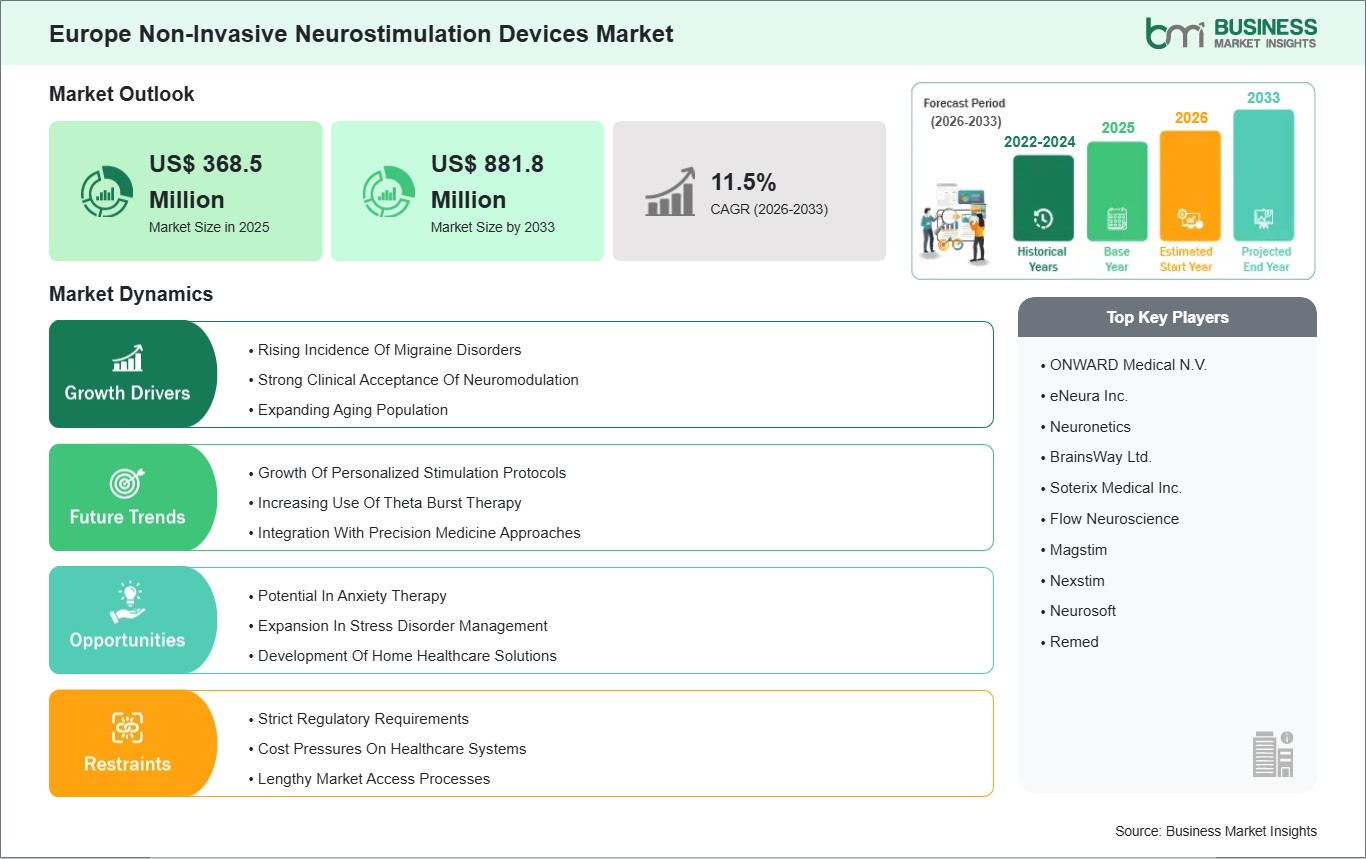
The European Non-Invasive Neurostimulation Devices Market is driven by the growing use of neuromodulation tech in treating neurological and psychiatric issues, where patient-centered and minimally invasive approaches are favored. This demand is boosted by the expanding use of methods like transcranial magnetic stimulation, transcranial direct current stimulation, and vagus nerve stimulation for ailments such as depression, chronic pain, and migraines. Plus, there's a rise in neurological and mental health disorders throughout Europe, heightening the need for effective treatment options that can either supplement or replace pharmaceutical remedies. Additional growth is supported by technological advancements, including improved device portability, greater stimulation precision, digital connectivity, and the adoption of personalized treatment protocols, facilitating broader use in hospitals, specialty clinics, and outpatient settings.
The market further benefits from active academic research collaborations and an innovation ecosystem that supports the development and validation of next-generation neurostimulation platforms. However, variability in reimbursement frameworks and regulatory requirements across European countries presents a significant restraint, complicating commercialization and limiting uniform access to treatment. Competitive strategies in the neurotech world center on making products unique, gathering clinical evidence, and expanding therapeutic uses. Healthcare providers are adding non-invasive neurostimulation more often to their care plans. With rising awareness, both from clinicians and patients, manufacturers stress ease of use and treatment effectiveness, supported by solid evidence, to get an edge in this ever-changing field.
Segment Analysis
Europe Non-Invasive Neurostimulation Devices Market Segmentation
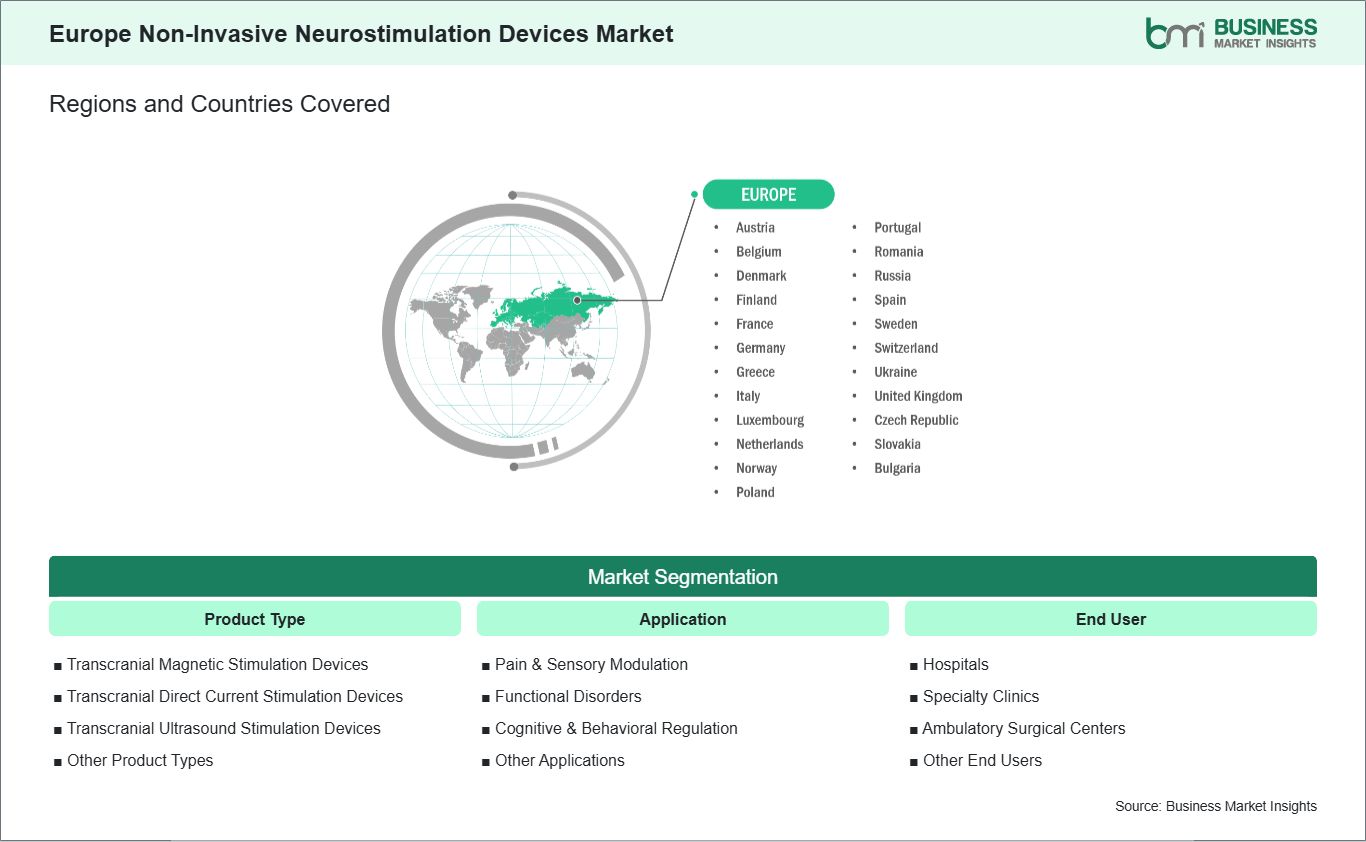
Key segments that contributed to the derivation of the Europe non-invasive neurostimulation devices market analysis are product type, application and end user.
- By product type, the non-invasive neurostimulation devices market is segmented into transcranial magnetic stimulation devices, transcranial direct current stimulation devices, transcranial ultrasound stimulation devices, and other product types. The transcranial magnetic stimulation devices segment dominated the market in 2025.
- Based on application, the non-invasive neurostimulation devices market is categorized into pain & sensory modulation, functional disorders, cognitive & behavioral regulation, and other applications. The cognitive & behavioral regulation segment dominated the market in 2025.
- In terms of end user, the non-invasive neurostimulation devices market is categorized into hospitals, specialty clinics, ambulatory surgical centers, and other end users. The hospitals segment dominated the market in 2025.
Market Forces
Europe Non-Invasive Neurostimulation Devices Market Drivers and Opportunities
Rising Incidence of Migraine Disorders
Migraine management across Europe is undergoing a notable shift as clinicians increasingly evaluate non-invasive neurostimulation devices for patients who encounter limitations with conventional pharmacological regimens. Many migraine sufferers experience fluctuating symptom patterns that require adaptable treatment approaches, encouraging healthcare providers to integrate neuromodulation technologies into broader care pathways. The ability of these devices to target neurological activity without invasive procedures aligns with the preference for therapies that can be administered repeatedly over extended periods.
Another key market influence is the rise in personalized migraine care. Neurologists now focus more on how treatments fit into patients daily lives, checking adherence and long-term ease. Non-invasive neurostimulation gadgets match this trend by easily integrating into normal routines without hassle. Plus, they work well for at-home therapy, letting folks manage symptoms from the comfort of their own homes.
The market's also shaped by growing awareness that migraines hurt productivity, brain performance, and overall quality of life. With that, more healthcare folks want interventions that support prevention and acute treatments alike. As providers and patients learn more about how neuromodulation works, device makers can grow their influence. They can do this by educating health pros, beefing up product lines, and tying into digital health tracking tools.
Potential in Anxiety Therapy
The use of non-invasive neurostimulation devices in anxiety disorder therapy is gaining attention as mental health treatment approaches diversify. There has been increasing research into new technologies that can mechanically alter neural circuits associated with emotional regulation for patients requiring additional therapy options beyond or instead of medications. Opportunities exist for device manufacturers to develop these products for broader usage than originally intended because the treatment market continues to evolve and grow rapidly.
Healthcare providers are now using treatment plans that mix therapy, behavior changes, and brain stimulation methods to boost patient results. Non-invasive neurostimulation fits well in these programs. It's especially useful for keeping up continuous care and boosting patient involvement, which are key to managing anxiety long-term.
Market expansion is also supported by ongoing innovation focused on usability, treatment customization, and patient experience. Manufacturers are developing systems with enhanced portability and user-friendly interfaces that facilitate broader adoption across outpatient and community-based environments. As mental health services continue to prioritize individualized care pathways, non-invasive neurostimulation technologies are expected to secure a more defined position within anxiety disorder treatment strategies throughout Europe.
Size and Share Analysis
Europe Non-Invasive Neurostimulation Devices Market Size and Share Analysis
Th e Europe non-invasive neurostimulation devices market demonstrates steady growth, with size and share analysis highlighting evolving trends and competitive dynamics among key players. The report examines subsegments categorized within product type, application and end user, offering insights into their contribution to overall market performance.
By product type, the transcranial magnetic stimulation devices subsegment dominated the market in 2025, driven by its established clinical efficacy, growing adoption for neurological and psychiatric disorders, and increasing availability across healthcare facilities.
Based on application, the cognitive & behavioral regulation subsegment dominated the market in 2025, driven by the rising prevalence of mental health disorders and increasing use of neurostimulation therapies for depression, anxiety, and cognitive enhancement.
In terms of end user, the hospitals subsegment dominated the market in 2025, driven by the availability of advanced neurostimulation technologies, skilled healthcare professionals, and growing patient volumes requiring specialized neurological care.
Report Coverage
Europe Non-Invasive Neurostimulation Devices Market Report Coverage and Deliverables
The "Europe Non-Invasive Neurostimulation Devices Market Size and Forecast (2022-2033)" report provides a detailed analysis of the market covering below areas:
- Market segments covered under the scope
- Market dynamics such as drivers, restraints, and key opportunities
- Market concentration, heat map analysis, prominent players, and recent developments
- Detailed company profiles, including SWOT analysis
Geographic Insights
Europe Non-Invasive Neurostimulation Devices Market Geographic Insights
The geographical scope of the Europe Non-Invasive Neurostimulation Devices Market report is divided into Germany, Italy, France, U.K., Spain, Belgium, Netherlands, Luxembourg, Norway, Finland, Denmark, Sweden, Switzerland, Austria, Greece, Portugal, Russia, Poland, Romania, Czech Republic, Ukraine, Slovakia, Bulgaria. Germany held the largest share in 2025.
The Europe Non-Invasive Neurostimulation Devices Market demonstrates varied regional dynamics shaped by distinct healthcare priorities, research capabilities, reimbursement environments, and neurological care strategies. Germany remains the dominant market, supported by its advanced medical technology ecosystem, strong clinical adoption of neurostimulation therapies, and extensive integration of innovative neurological treatment pathways across healthcare institutions. France benefits from sustained investment in neuroscience research and growing emphasis on non-pharmacological interventions for chronic neurological conditions. The U.K. experiences expansion through increasing acceptance of home-based neurostimulation solutions and active collaboration between healthcare providers and technology developers. Italy is witnessing market development due to rising awareness of neurorehabilitation techniques and broader utilization of device-assisted therapeutic approaches. Spain's growth is supported by modernization of neurological care services and increasing focus on patient-centered treatment alternatives. Belgium gains momentum from its concentration of medical research centers and cross-border healthcare collaborations. The Netherlands advances through strong digital health adoption and early incorporation of innovative therapeutic technologies. Luxembourg benefits from healthcare infrastructure modernization and access to specialized neurological services. Norway's market is driven by investments in advanced patient care technologies, while Finland leverages its expertise in neurotechnology innovation. Denmark experiences growth through integrated healthcare delivery models supporting novel therapeutic devices. Sweden benefits from strong academic-industry partnerships accelerating clinical implementation. Switzerland strengthens its position through a highly developed medical device sector and precision healthcare initiatives. Austria gains traction from expanding neurological rehabilitation programs, while Greece benefits from increasing attention to treatment options for neurological disorders. Portugal advances through healthcare digitization efforts. Russia shows growth driven by expanding access to neurological care technologies. Poland benefits from healthcare capacity expansion, Romania from improving specialist treatment availability, the Czech Republic from clinical innovation initiatives, Ukraine from ongoing healthcare system adaptation, Slovakia from growing adoption of modern therapeutic equipment, and Bulgaria from increasing investment in neurological healthcare services.
Industry Activity
Recent Developments
The Europe Non-Invasive Neurostimulation Devices Market is evaluated by gathering qualitative and quantitative data post primary and secondary research, which includes important corporate publications, association data, and databases. A few of the key developments in the Europe non-invasive neurostimulation devices market are:
- In June 2025, Magstim announced that its Horizon 3.0 with StimGuide Pro system received MDR approval and that the first European installations were underway in the Netherlands. The milestone expanded the availability of Magstim's transcranial magnetic stimulation (TMS) technology across the European Union and supported its use in clinical and research applications for neurological rehabilitation.
- In June 2024, Nexstim announced that a distributor had ordered its NBS System 5 for a European hospital. The system combines navigated transcranial magnetic stimulation (nTMS) for pre-surgical brain mapping with CE-marked therapy capabilities for major depression and chronic neuropathic pain, supporting the expansion of non-invasive neurostimulation adoption across European healthcare facilities.
Trust & Transparency
Research Methodology
The market analysis combines proprietary research with secondary data from government agencies, company disclosures, regulatory filings, industry databases and expert interviews. Market estimates are validated through data triangulation, cross-market benchmarking and analyst
review.
View Full Research Methodology
Key Sources Referred:
U.S. Food and Drug Administration (FDA)National Institutes of Health (NIH)National Institute of Neurological Disorders and Stroke (NINDS)Centers for Medicare & Medicaid Services (CMS)Medical Device Innovation Consortium (MDIC)World Health Organization (WHO)International Organization for Standardization (ISO)International Neuromodulation Society (INS)North American Neuromodulation Society (NANS)Company WebsitesCompany Annual ReportsCompany Investor Presentations