Market Summary
Executive Summary and Market Analysis
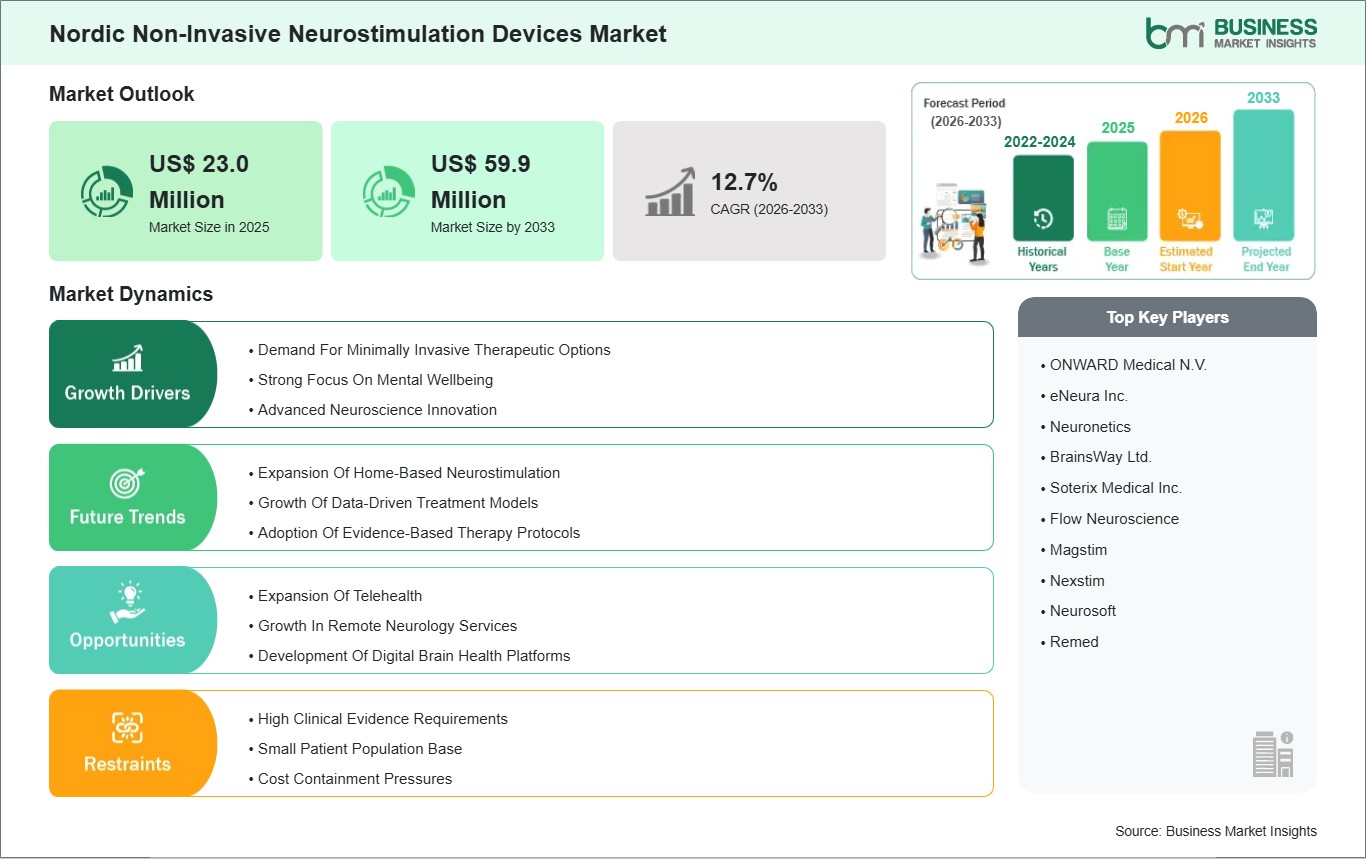
In the Nordic countries, which include Sweden, Norway, Denmark, and Finland, use of neurostimulation is favored because of a focus on early treatment and minimal invasion. With more people aging, there's a higher rate of neurological issues like Parkinson's, chronic pain, and post-stroke recovery needs. This pushes doctors to use non-drug methods such as neurostimulation, suitable for patients at home or in outpatient settings. Devices are getting smaller, electrodes are more wearable, and new algorithms allow better control. These changes fit well with how Nordic public health services operate, looking to prove that neurostimulation can save money while helping those with depression, migraines, and those needing rehab.
Still, strict procurement rules in hospitals, long clinical tests, and careful approval processes for reimbursement slow down the adoption of new stimulation methods, especially at smaller clinics with limited funds. Digital health platforms and remote patient monitoring tools are changing how neuromodulation therapies get prescribed. More clinicians now pair stimulation treatments with behavioral therapy via connected care systems. But weak cross-border standards for device testing and different procurement processes in Nordic countries make things complicated for manufacturers looking for clear entry routes into these markets.
Meanwhile, growing collaboration between academic neuroscience centers and medtech companies accelerates clinical validation studies and refines indications for transcranial and peripheral stimulation applications. These dynamics position the region as a sophisticated but selective environment where clinical evidence, workflow integration, and reimbursement alignment determine technology uptake across neurological and psychiatric care pathways and outpatient neurorehabilitation service model expansion with increasing emphasis on clinical outcomes.
Segment Analysis
Nordic Non-Invasive Neurostimulation Devices Market Segmentation
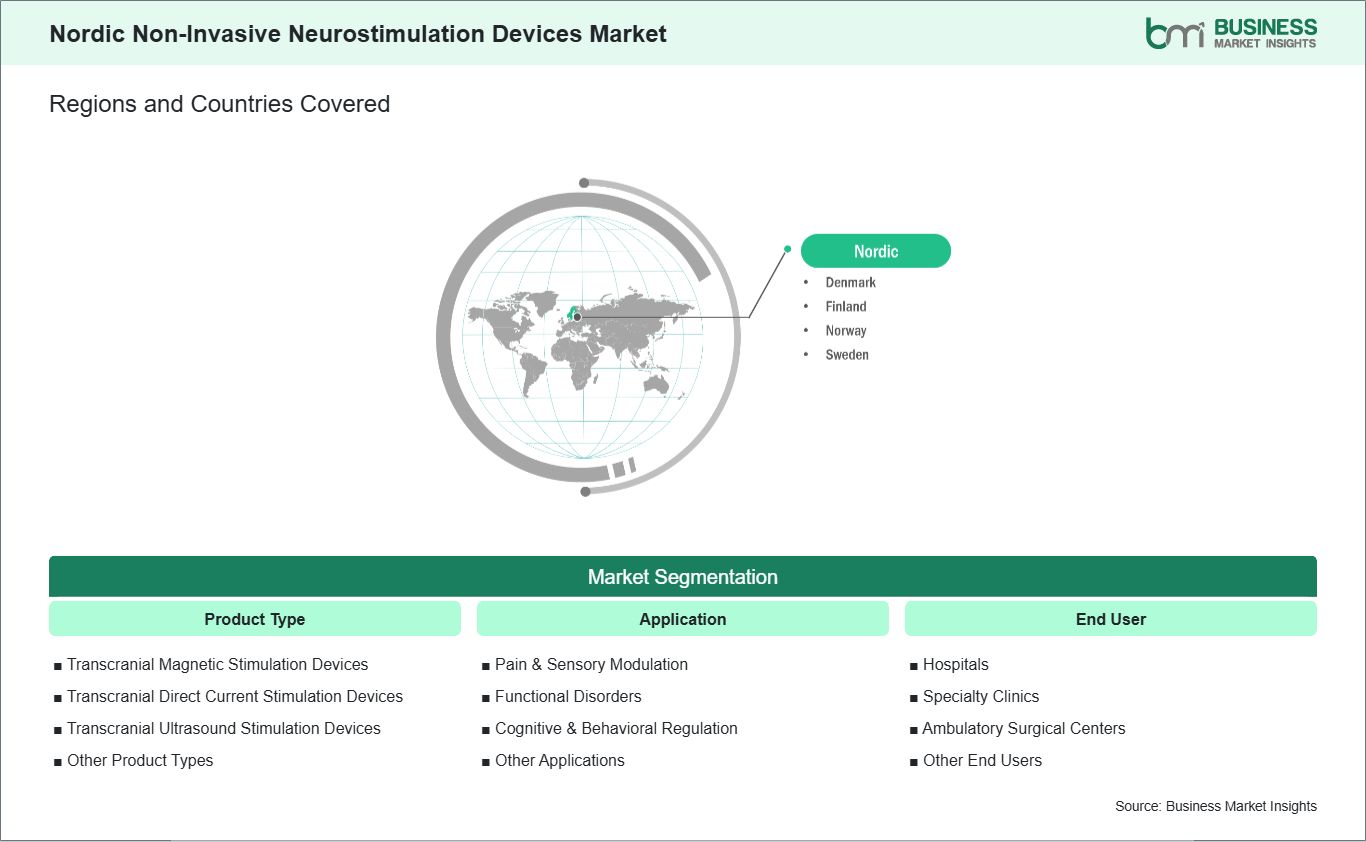
Key segments that contributed to the derivation of the Nordic non-invasive neurostimulation devices market analysis are product type, application and end user.
- By product type, the non-invasive neurostimulation devices market is segmented into transcranial magnetic stimulation devices, transcranial direct current stimulation devices, transcranial ultrasound stimulation devices, and other product types. The transcranial magnetic stimulation devices segment dominated the market in 2025.
- Based on application, the non-invasive neurostimulation devices market is categorized into pain & sensory modulation, functional disorders, cognitive & behavioral regulation, and other applications. The cognitive & behavioral regulation segment dominated the market in 2025.
- In terms of end user, the non-invasive neurostimulation devices market is categorized into hospitals, specialty clinics, ambulatory surgical centers, and other end users. The hospitals segment dominated the market in 2025.
Market Forces
Nordic Non-Invasive Neurostimulation Devices Market Drivers and Opportunities
Rising Demand for Minimally Invasive Therapeutic Options
In Nordic clinical settings, neurologists and psychiatrists are increasingly steering treatment pathways toward non-invasive neurostimulation as a complement to pharmacological escalation. This shift is shaped by patient intolerance to long-term medication side effects and preference for interventions that avoid surgical risk. Multidisciplinary care teams integrate these devices into structured treatment algorithms across hospital networks.
Rehabilitation centers and outpatient neuro clinics across Nordic healthcare systems are embedding stimulation technologies within post-stroke recovery and chronic pain programs. Device utilization is often guided by protocolized sessions delivered alongside physiotherapy. Clinical staff value the ability to adjust stimulation parameters without invasive procedures, enabling iterative treatment optimization within supervised environments.
Home-based neurostimulation, like wearables and transcranial direct current stimulation, is gaining attention. Clinicians can track use and responses via approved plans, reducing the need for in-person checks. In Nordic regions, strict safety checks and cautious funding guidelines slow but steadily guide their inclusion in personal health regimens within primary care.
Expansion of Telehealth
Telehealth platforms in Nordic healthcare ecosystems are increasingly linked with neurostimulation therapies, enabling clinicians to supervise treatment cycles beyond traditional clinic walls. Device-generated data streams feed into digital dashboards where neurologists adjust protocols in near real time. This model supports continuity of care for patients managing neurological and psychiatric conditions remotely.
In practice, patients using non-invasive stimulation devices are participating in hybrid care journeys where scheduled clinic visits are supplemented by virtual check-ins. Clinicians use teleconsultations to fine-tune stimulation parameters based on self-reported outcomes and device logs. This interaction pattern reduces dependence on physical infrastructure while preserving clinical oversight.
Nordic health systems place strong emphasis on interoperability and data privacy when linking neurostimulation devices with telehealth services. Integration with electronic health records ensures treatment continuity across providers. Developers design platforms to comply with strict security frameworks while maintaining usability for clinicians. This alignment supports scalable remote neurotherapy delivery models across regions in Nordic care networks.
Size and Share Analysis
Nordic Non-Invasive Neurostimulation Devices Market Size and Share Analysis
The Nordic non-invasive neurostimulation devices market demonstrates steady growth, with size and share analysis highlighting evolving trends and competitive dynamics among key players. The report examines subsegments categorized within product type, application and end user, offering insights into their contribution to overall market performance.
By product type, the transcranial magnetic stimulation devices subsegment dominated the market in 2025, driven by its established clinical efficacy, growing adoption for neurological and psychiatric disorders, and increasing availability across healthcare facilities.
Based on application, the cognitive & behavioral regulation subsegment dominated the market in 2025, driven by the rising prevalence of mental health disorders and increasing use of neurostimulation therapies for depression, anxiety, and cognitive enhancement.
In terms of end user, the hospitals subsegment dominated the market in 2025, driven by the availability of advanced neurostimulation technologies, skilled healthcare professionals, and growing patient volumes requiring specialized neurological care.
Report Coverage
Nordic Non-Invasive Neurostimulation Devices Market Report Coverage and Deliverables
The "Nordic Non-Invasive Neurostimulation Devices Market Size and Forecast (2022-2033)" report provides a detailed analysis of the market covering below areas:
- Market segments covered under the scope
- Market dynamics such as drivers, restraints, and key opportunities
- Market concentration, heat map analysis, prominent players, and recent developments
- Detailed company profiles, including SWOT analysis
Geographic Insights
Nordic Non-Invasive Neurostimulation Devices Market Geographic Insights
The geographical scope of the Nordic Non-Invasive Neurostimulation Devices Market report is divided into Sweden, Denmark, Norway, Finland. Sweden held the largest share in 2025.
Within the Nordic non-invasive neurostimulation devices market, Sweden stands as the dominant hub, supported by a mature neurotechnology ecosystem, strong clinical adoption across tertiary hospitals, and a well-integrated collaboration between academic neuroscience centers and medical device developers that accelerates early uptake of non-invasive brain and peripheral stimulation therapies. In Denmark, growth is shaped by the rapid integration of digital health pathways and rehabilitation-focused outpatient models, where non-invasive neurostimulation is increasingly incorporated into pain management, migraine care, and post-stroke recovery programs within community-based healthcare settings. In Norway, expansion is driven by investments in equitable healthcare access across dispersed populations, encouraging the use of portable and remotely supported neurostimulation solutions, alongside rising attention to neurological and musculoskeletal conditions within aging communities. In Finland, momentum comes from a strong innovation culture in health technology, a growing emphasis on mental well-being interventions, and the adoption of wearable neurostimulation devices within both clinical trials and consumer wellness applications, supported by an increasingly tech-savvy population and research-driven hospitals. In addition, cross-border collaboration across the Nordic region reinforces technology diffusion, with shared regulatory alignment, hospital procurement networks, and joint research initiatives further supporting steady market maturation and diversification of non-invasive neurostimulation applications in neurology, psychiatry, and rehabilitation care, while also encouraging balanced adoption between hospital-based interventions and emerging home-use solutions. Sweden's leadership further anchors regional standard-setting and early commercialization pathways. Denmark advances clinical integration in rehabilitation services, Norway prioritizes access across remote geographies, and Finland accelerates consumer-driven innovation in neuro-wellness technologies across clinical and home settings increasingly.
Industry Activity
Recent Developments
The Nordic Non-Invasive Neurostimulation Devices Market is evaluated by gathering qualitative and quantitative data post primary and secondary research, which includes important corporate publications, association data, and databases. A few of the key developments in the Nordic non-invasive neurostimulation devices market are:
- In September 2023, Nexstim Plc announced that it had received a new order for its NBS 5 non-invasive brain stimulation system from a neuroscience center in Sweden, expanding adoption of its TMS-based diagnostic neurostimulation platform within Nordic hospital networks.
- In January 2024, BrainsWay announced that it had initiated a clinical evaluation of its next-generation Rotational Field Deep TMS 360 degree technology, advancing its non-invasive brain stimulation platform and strengthening its clinical research footprint across global markets.
Trust & Transparency
Research Methodology
The market analysis combines proprietary research with secondary data from government agencies, company disclosures, regulatory filings, industry databases and expert interviews. Market estimates are validated through data triangulation, cross-market benchmarking and analyst
review.
View Full Research Methodology
Key Sources Referred:
U.S. Food and Drug Administration (FDA)National Institutes of Health (NIH)National Institute of Neurological Disorders and Stroke (NINDS)Centers for Medicare & Medicaid Services (CMS)Medical Device Innovation Consortium (MDIC)World Health Organization (WHO)International Organization for Standardization (ISO)International Neuromodulation Society (INS)North American Neuromodulation Society (NANS)Company WebsitesCompany Annual ReportsCompany Investor Presentations