Market Summary
Executive Summary and Market Analysis
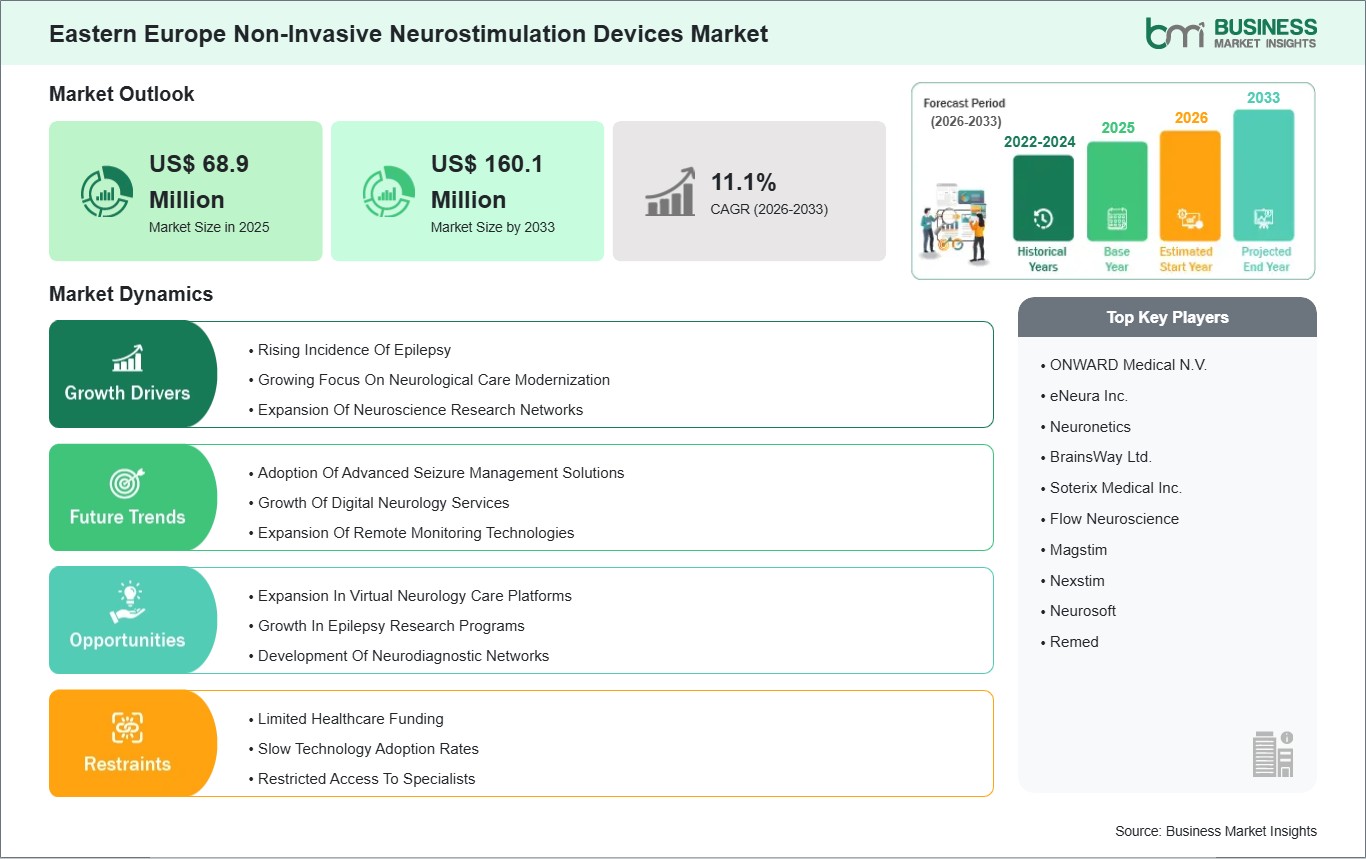
The landscape for non-invasive neurostimulation devices in Eastern Europe is changing as more healthcare providers turn to neuromodulation in neurology, psychiatry, and rehab. Clinicians are starting to use techniques like transcranial stimulation and its alternatives more often in their care plans. These methods are helpful for chronic pain, depression, and recovering from strokes. A major reason for this shift is doctors' growing preference for treatments that need fewer drugs. This works especially well for hard-to-treat cases. As a result, hospitals and clinics are adopting these tech-driven methods more frequently. They like that the protocols can be adjusted and used repeatedly without causing systemic side effects. Another driving force is the spread of neurorehabilitation units and outpatient centers in urban areas. The portable devices are easy to use and great for home treatments, lessening the load on inpatient facilities. Still, there are roadblocks. Inconsistent reimbursement policies and budget constraints in public health systems slow down the adoption of new tech. Because conventional drug and surgical options are prioritized, getting these advanced devices becomes slower and less widespread. Operational challenges pop up because of inconsistent regulations between countries and a lack of trained specialists. This impacts clinical results and slows down protocol standardization. Device makers focus on training programs for clinicians, modular design, and collaborating with rehab centers. These efforts help the devices fit into current care plans and get more acceptance from doctors. Plus, manufacturers invest in building evidence, working with local clinics, and supporting their products after sales. All this boosts doc confidence and aids integration into hospitals around the region.
Segment Analysis
Eastern Europe Non-Invasive Neurostimulation Devices Market Segmentation
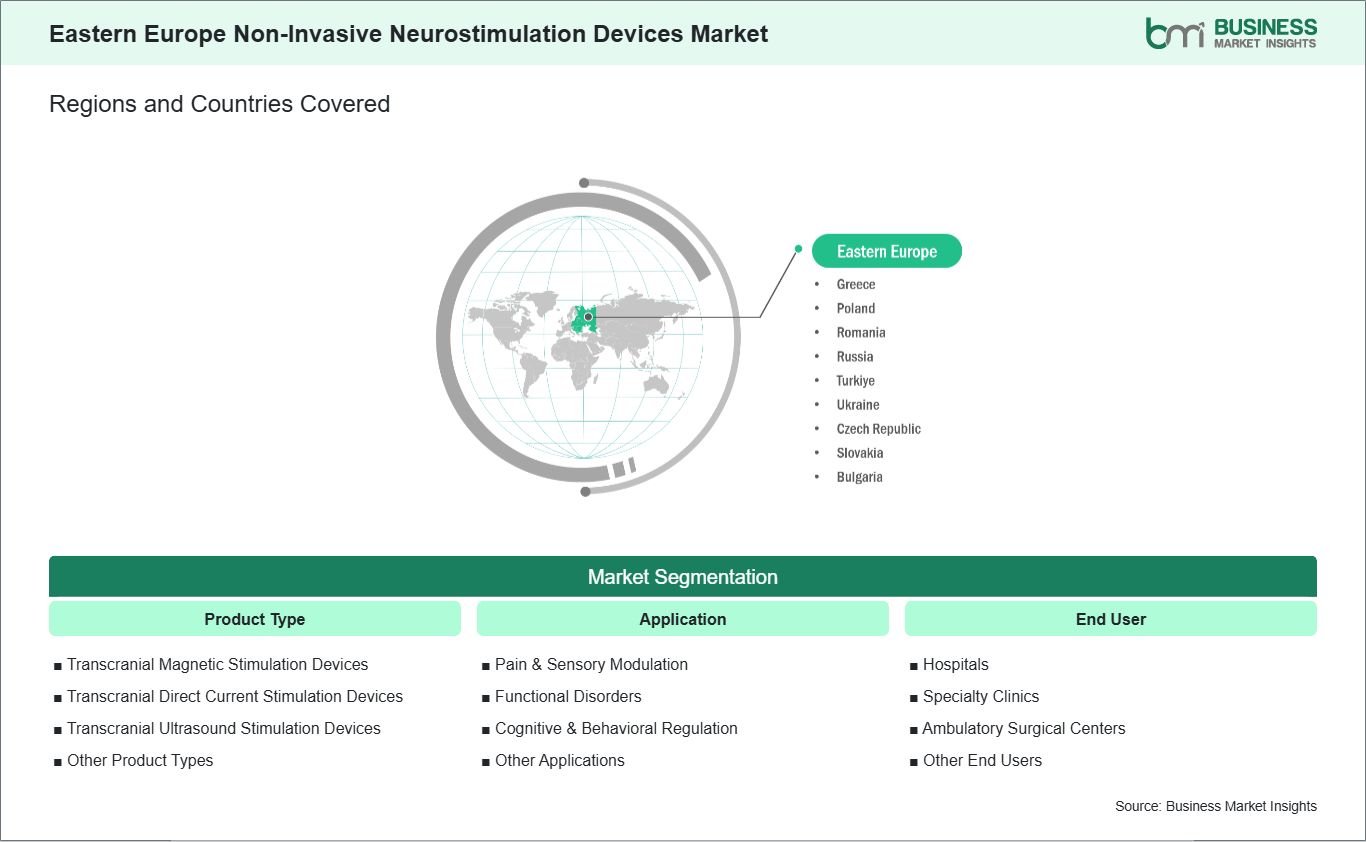
Key segments that contributed to the derivation of the Eastern Europe non-invasive neurostimulation devices market analysis are product type, application and end user.
- By product type, the non-invasive neurostimulation devices market is segmented into transcranial magnetic stimulation devices, transcranial direct current stimulation devices, transcranial ultrasound stimulation devices, and other product types. The transcranial magnetic stimulation devices segment dominated the market in 2025.
- Based on application, the non-invasive neurostimulation devices market is categorized into pain & sensory modulation, functional disorders, cognitive & behavioral regulation, and other applications. The cognitive & behavioral regulation segment dominated the market in 2025.
- In terms of end user, the non-invasive neurostimulation devices market is categorized into hospitals, specialty clinics, ambulatory surgical centers, and other end users. The hospitals segment dominated the market in 2025.
Market Forces
Eastern Europe Non-Invasive Neurostimulation Devices Market Drivers and Opportunities
Rising Incidence of Epilepsy
In clinical neurology units throughout Eastern Europe, epilepsy cases are getting more tricky. Patients now show all sorts of different triggers and resist standard treatments. Because of this, doctors have turned their focus towards using additional non-invasive neurostimulation gadgets. They're trying these out earlier on, especially for those not doing well with drugs alone. It's becoming common to use several methods together for managing seizures, rather than waiting till everything else fails.
Hospitals are leaning more towards gear that doesn't need fancy surgical setups. Public hospitals, which work with smaller budgets, prefer portable stuff that cuts down on needing patients to stay in. These places want tech that standardizes care across the board, without the need for special brain surgeons.
Families caring for someone with epilepsy for the long haul are pushing for treatments that don't mess with everyday life. So doctors are fitting neurostimulation into outpatient programs more. Patients now get to tweak their devices and even check in remotely with docs, avoiding lengthy hospital stays.
Expansion in Virtual Neurology Care Platforms
Neurology service providers in Eastern Europe are restructuring care delivery around digital consultation environments that support chronic condition monitoring. Within this shift, non-invasive neurostimulation devices are increasingly being prescribed alongside virtual assessments, allowing clinicians to evaluate response patterns without requiring repeated physical visits. This integration is reshaping how treatment continuity is maintained across geographically dispersed populations.
Technology vendors are aligning device interfaces with tele-neurology platforms, enabling clinicians to adjust stimulation parameters through secured dashboards during remote consultations. This interoperability reduces dependency on in-person titration sessions and supports more flexible therapeutic scheduling. Healthcare providers are prioritizing systems that synchronize patient-reported outcomes with device usage logs in real time.
From a service delivery perspective, neurology clinics are adopting hybrid operating models where virtual care becomes the primary coordination layer. Patients are onboarded digitally, and neurostimulation therapy is managed through periodic remote reviews rather than continuous hospital supervision. This structure is encouraging a more distributed care ecosystem, where device management and neurological oversight function as interconnected but physically separated processes.
Size and Share Analysis
Eastern Europe Non-Invasive Neurostimulation Devices Market Size and Share Analysis
The Eastern Europe non-invasive neurostimulation devices market demonstrates steady growth, with size and share analysis highlighting evolving trends and competitive dynamics among key players. The report examines subsegments categorized within product type, application and end user, offering insights into their contribution to overall market performance.
By product type, the transcranial magnetic stimulation devices subsegment dominated the market in 2025, driven by its established clinical efficacy, growing adoption for neurological and psychiatric disorders, and increasing availability across healthcare facilities.
Based on application, the cognitive & behavioral regulation subsegment dominated the market in 2025, driven by the rising prevalence of mental health disorders and increasing use of neurostimulation therapies for depression, anxiety, and cognitive enhancement.
In terms of end user, the hospitals subsegment dominated the market in 2025, driven by the availability of advanced neurostimulation technologies, skilled healthcare professionals, and growing patient volumes requiring specialized neurological care.
Report Coverage
Eastern Europe Non-Invasive Neurostimulation Devices Market Report Coverage and Deliverables
The "Eastern Europe Non-Invasive Neurostimulation Devices Market Size and Forecast (2022-2033)" report provides a detailed analysis of the market covering below areas:
- Market segments covered under the scope
- Market dynamics such as drivers, restraints, and key opportunities
- Market concentration, heat map analysis, prominent players, and recent developments
- Detailed company profiles, including SWOT analysis
Geographic Insights
Eastern Europe Non-Invasive Neurostimulation Devices Market Geographic Insights
The geographical scope of the Eastern Europe Non-Invasive Neurostimulation Devices Market report is divided into Russia, Poland, Romania, Czech Republic, Greece, Ukraine, Slovakia, Bulgaria. Russia held the largest share in 2025.
Russia leads in the Eastern European market for non-invasive neurostimulation devices. This dominance is due to its big neurological care network, strong institutional buying, and focus on rehab tech for issues like stroke, chronic pain, and mental health. In Poland, steady growth happens because of the quick rise of private healthcare and clinicians becoming more accepting of advanced neuromodulation treatments. Plus, changes in reimbursement make it easier for people to get these devices outside of hospitals. In Romania, modernizing healthcare drives the market. As affordability improves, urban private clinics and special neurology centers are using these devices more. Over in the Czech Republic, their solid clinical setup and push for research mean they're early adopters of these devices, too. They're big into rehab and pain management. Greece sees more demand due to its older population and higher rates of neurodegenerative diseases. Private neurological care is getting renewed support as the healthcare system restructures. So each country faces unique drivers influencing its neurostimulation device markets. Ukraine demonstrates resilience in demand despite infrastructural challenges, focusing on portable and non-invasive solutions for trauma recovery, PTSD management, and decentralized rehab support. Slovakia's growth comes from gradually digitalizing healthcare and integrating more with EU medical sourcing, which helps outpatients get better treatment. In Bulgaria, advances come from cost-sensitive adoption, EU-backed funding, and expanding physiotherapy networks. Public hospitals there get incremental upgrades too, pushing non-invasive neurostimulation tech across different care settings. Overall, these market trends show uneven but steadily converging clinical adoption across regions.
Industry Activity
Recent Developments
The Eastern Europe Non-Invasive Neurostimulation Devices Market is evaluated by gathering qualitative and quantitative data post primary and secondary research, which includes important corporate publications, association data, and databases. A few of the key developments in the Eastern Europe non-invasive neurostimulation devices market are:
- In November 2024, Nexstim announced that a new German neurosurgery customer had ordered its NBS System 5, a navigated transcranial magnetic stimulation (nTMS) system used for non-invasive brain mapping and therapy applications, supporting continued expansion of its distributor-led European market footprint that includes Eastern European clinical supply chains.
- In June 2024, electroCore announced the commercial launch of TAC-STIM, a next-generation non-invasive vagus nerve stimulation (nVNS) device. The product was developed using the company's proprietary bioelectronic medicine platform and broadened electroCore's portfolio of non-invasive neurostimulation solutions.
Trust & Transparency
Research Methodology
The market analysis combines proprietary research with secondary data from government agencies, company disclosures, regulatory filings, industry databases and expert interviews. Market estimates are validated through data triangulation, cross-market benchmarking and analyst
review.
View Full Research Methodology
Key Sources Referred:
U.S. Food and Drug Administration (FDA)National Institutes of Health (NIH)National Institute of Neurological Disorders and Stroke (NINDS)Centers for Medicare & Medicaid Services (CMS)Medical Device Innovation Consortium (MDIC)World Health Organization (WHO)International Organization for Standardization (ISO)International Neuromodulation Society (INS)North American Neuromodulation Society (NANS)Company WebsitesCompany Annual ReportsCompany Investor Presentations