Market Summary
Executive Summary and Market Analysis
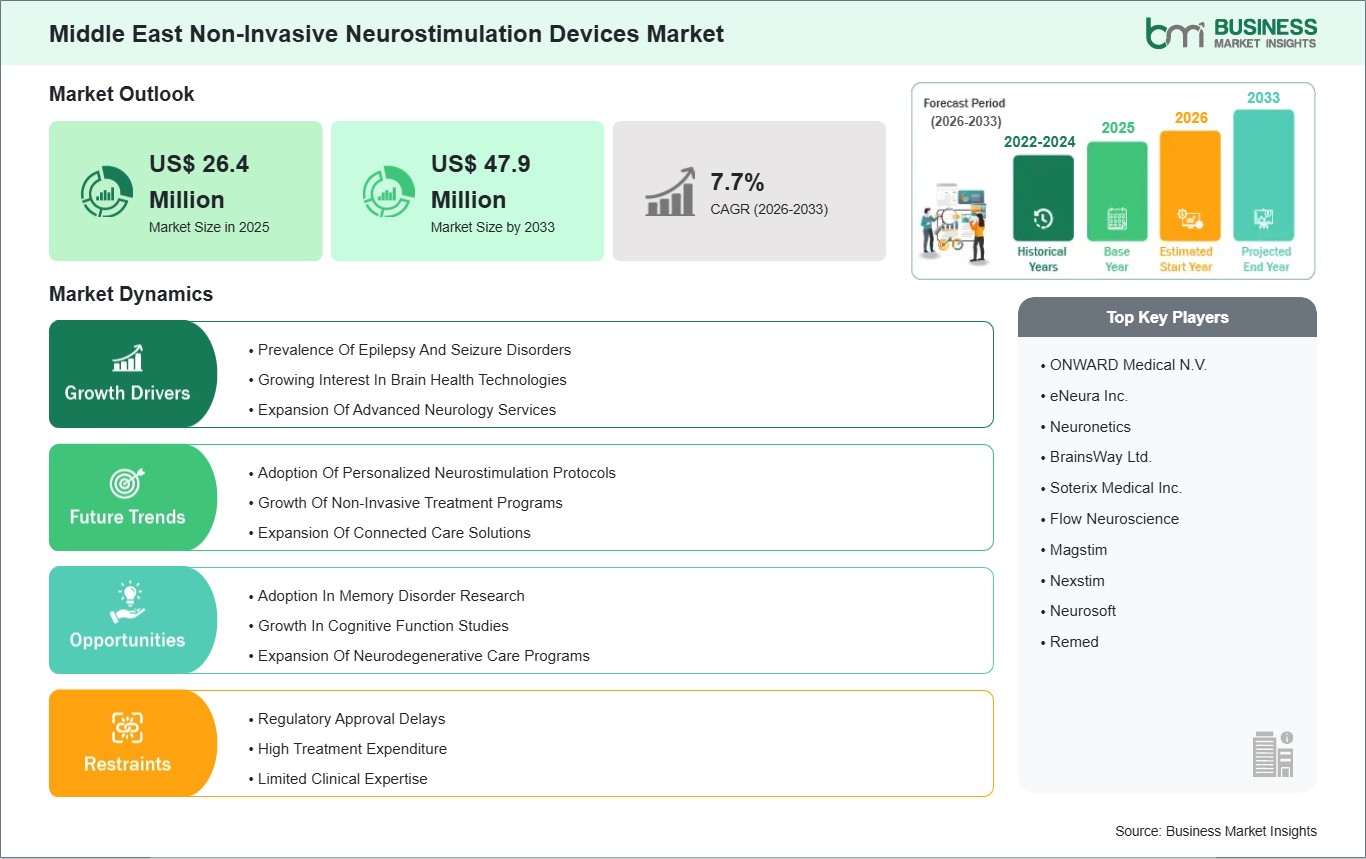
The Middle East non-invasive neurostimulation devices landscape is shaped by accelerating clinical interest in neuromodulation techniques for managing neurological and psychiatric conditions without surgical intervention. Rising incidence of neurological disorders such as depression, epilepsy, Parkinson's disease, chronic pain syndromes, and sleep disturbances is pushing clinicians and healthcare systems toward non-invasive brain stimulation modalities that reduce reliance on pharmacological management. At the same time, ongoing healthcare infrastructure upgrades, expansion of specialized neurology and rehabilitation centers, and increasing availability of technologies such as transcranial magnetic stimulation and transcranial direct current stimulation are reinforcing clinical adoption, particularly in urban medical hubs and medical tourism destinations across Gulf countries. However, limited reimbursement frameworks, uneven insurance penetration, and high acquisition and maintenance costs of advanced neurostimulation equipment continue to restrict broader adoption across smaller healthcare facilities. Private healthcare providers and tertiary hospitals are increasingly integrating neuromodulation services into multidisciplinary treatment pathways that combine neurology, psychiatry, and rehabilitation care, reflecting a shift toward more personalized and device-assisted therapy planning. Regulatory authorities across several Middle Eastern countries are gradually refining device approval pathways and clinical guidelines for non-invasive brain stimulation, while hospitals and research institutions invest in clinician training programs to improve procedural standardization and patient selection, supporting safer deployment and broader clinical acceptance across both public and private sectors. Additionally, growing cross-border patient flows for advanced neurological care and sustained collaboration between global device manufacturers and regional healthcare networks are expected to influence technology diffusion and procurement strategies across the region in coming years ahead further.
Segment Analysis
Middle East Non-Invasive Neurostimulation Devices Market Segmentation
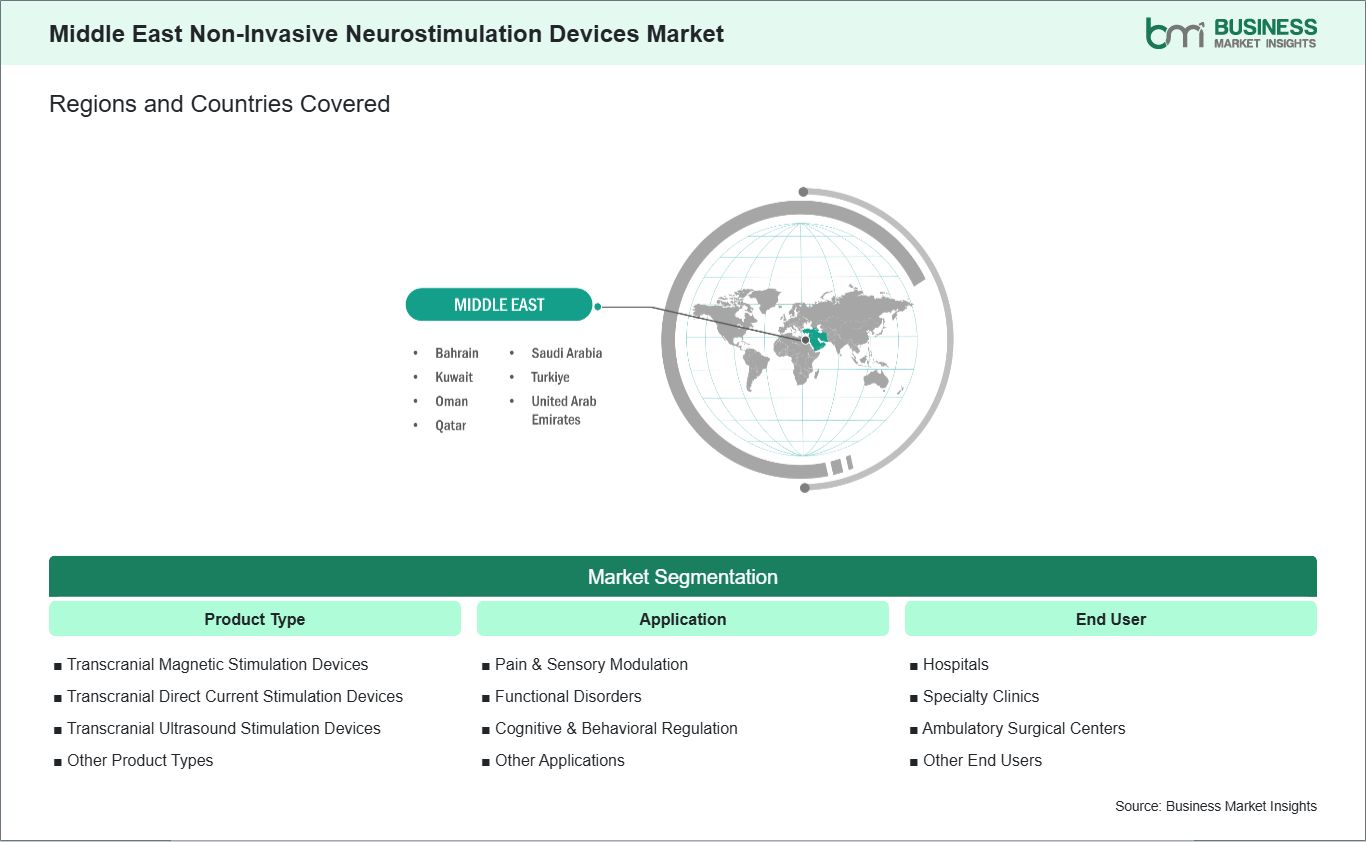
Key segments that contributed to the derivation of the Middle East non-invasive neurostimulation devices market analysis are product type, application and end user.
- By product type, the non-invasive neurostimulation devices market is segmented into transcranial magnetic stimulation devices, transcranial direct current stimulation devices, transcranial ultrasound stimulation devices, and other product types. The transcranial magnetic stimulation devices segment dominated the market in 2025.
- Based on application, the non-invasive neurostimulation devices market is categorized into pain & sensory modulation, functional disorders, cognitive & behavioral regulation, and other applications. The cognitive & behavioral regulation segment dominated the market in 2025.
- In terms of end user, the non-invasive neurostimulation devices market is categorized into hospitals, specialty clinics, ambulatory surgical centers, and other end users. The hospitals segment dominated the market in 2025.
Market Forces
Middle East Non-Invasive Neurostimulation Devices Market Drivers and Opportunities
Prevalence of Epilepsy and Seizure Disorders
In major Middle Eastern hospitals, neurology departments use non-invasive neurostimulation more and more to manage hard-to-treat epilepsy and seizures. When medicine stops helping, clinicians often add these systems, which work alongside drug treatments. Adjustments are made in outpatient or closely watched settings, targeting neuromodulation pathways.
Procurement decisions in tertiary hospitals and specialized epilepsy clinics often follow multidisciplinary review cycles, where neurologists, biomedical engineers, and pharmacy committees evaluate device compatibility with existing treatment pathways. Emphasis is placed on workflow integration, patient tolerability, and alignment with long-term neurocare strategies rather than standalone performance metrics.
Device manufacturers operating in the region increasingly structure engagement through clinical training partnerships with neurology departments, ensuring clinicians can calibrate stimulation parameters for diverse seizure profiles. This ecosystem approach extends into protocol customization, where hospitals request device adjustments that reflect patient variability, follow-up constraints, and institutional safety frameworks for neuromodulation use.
Adoption in Memory Disorder Research
In academic and clinical research settings across the Middle East, non-invasive neurostimulation devices are being incorporated into memory disorder studies exploring cognitive mapping and neuroplasticity in conditions such as dementia and mild cognitive impairment. Research teams often position these tools as experimental modulators to observe changes in recall, attention, and cortical connectivity patterns during structured trials.
Collaborative frameworks between neuroscience institutes and hospital-based research units are expanding, with neurostimulation devices used as controllable variables in memory consolidation experiments; investigators adjust stimulation timing and intensity to examine encoding and retrieval behaviors under clinically monitored environments. This setup supports protocol standardization efforts across research hospitals seeking reproducible cognitive outcomes.
Technology providers increasingly align with cognitive research agendas by offering configurable stimulation platforms tailored for memory studies, enabling researchers to modify waveforms and session structures. Ethics committees within regional research institutions play a defining role in shaping usage boundaries, particularly when devices are applied to vulnerable patient groups or early-stage cognitive decline cohorts.
Size and Share Analysis
Middle East Non-Invasive Neurostimulation Devices Market Size and Share Analysis
The Middle East non-invasive neurostimulation devices market demonstrates steady growth, with size and share analysis highlighting evolving trends and competitive dynamics among key players. The report examines subsegments categorized within product type, application and end user, offering insights into their contribution to overall market performance.
By product type, the transcranial magnetic stimulation devices subsegment dominated the market in 2025, driven by its established clinical efficacy, growing adoption for neurological and psychiatric disorders, and increasing availability across healthcare facilities.
Based on application, the cognitive & behavioral regulation subsegment dominated the market in 2025, driven by the rising prevalence of mental health disorders and increasing use of neurostimulation therapies for depression, anxiety, and cognitive enhancement.
In terms of end user, the hospitals subsegment dominated the market in 2025, driven by the availability of advanced neurostimulation technologies, skilled healthcare professionals, and growing patient volumes requiring specialized neurological care.
Report Coverage
Middle East Non-Invasive Neurostimulation Devices Market Report Coverage and Deliverables
The "Middle East Non-Invasive Neurostimulation Devices Market Size and Forecast (2022-2033)" report provides a detailed analysis of the market covering below areas:
- Market segments covered under the scope
- Market dynamics such as drivers, restraints, and key opportunities
- Market concentration, heat map analysis, prominent players, and recent developments
- Detailed company profiles, including SWOT analysis
Geographic Insights
Middle East Non-Invasive Neurostimulation Devices Market Geographic Insights
The geographical scope of the Middle East Non-Invasive Neurostimulation Devices Market report is divided into UAE, Saudi Arabia, Bahrain, Oman, Kuwait, Qatar, Turkiye. Turkiye held the largest share in 2025.
Turkey emerges as the dominant market for non-invasive neurostimulation devices in the Middle East region, driven by its strong domestic manufacturing ecosystem, rapidly advancing neurology research centers, and widespread clinical integration of neurorehabilitation technologies within both public and private healthcare networks. UAE demonstrates strong momentum through its position as a medical tourism hub, where premium hospitals and digitally enabled care environments accelerate early adoption of advanced neurostimulation therapies and encourage integration with AI-assisted treatment pathways. Saudi Arabia is witnessing robust uptake fueled by large-scale healthcare transformation initiatives, rising neurological disorder management needs, and modernization of rehabilitation units across tertiary hospitals. Bahrain shows gradual expansion supported by flexible regulatory pathways and its role as a regional testing and pilot destination for emerging medical technologies within smaller but agile healthcare settings. Oman's growth is shaped by ongoing improvements in healthcare accessibility, with emphasis on expanding rehabilitation services in referral hospitals and strengthening post-operative neurological care in underserved areas. Kuwait benefits from high healthcare expenditure and strong demand for specialized post-stroke recovery solutions, with increasing reliance on imported advanced neurotechnology in flagship hospitals. Qatar is advancing through high-quality healthcare infrastructure investments, with neurostimulation devices gaining traction in sports medicine, elite rehabilitation programs, and research-driven clinical environments aligned with precision healthcare goals. Across the region, demand is further supported by rising preference for non-pharmacological neurological interventions, expansion of outpatient rehabilitation services, and increasing collaboration between hospitals and device innovators, reinforcing long-term adoption across diverse clinical settings while Turkey continues to anchor regional supply leadership.
Industry Activity
Recent Developments
The Middle East Non-Invasive Neurostimulation Devices Market is evaluated by gathering qualitative and quantitative data post primary and secondary research, which includes important corporate publications, association data, and databases. A few of the key developments in the Middle East non-invasive neurostimulation devices market are:
- In September 2025, Nyxoah announced that it had expanded its Middle East commercial footprint by establishing new treatment centers in Abu Dhabi, Dubai, and Kuwait, following additional Genio implants in the region, strengthening its neuromodulation network across key Gulf healthcare markets.
- In February 2024, Nexalin Technology announced that it had received regulatory approval in Oman for its Gen-2 non-invasive neurostimulation device, enabling commercial entry into the Middle East market for its frequency-based brain stimulation therapy targeting mental health disorders.
Trust & Transparency
Research Methodology
The market analysis combines proprietary research with secondary data from government agencies, company disclosures, regulatory filings, industry databases and expert interviews. Market estimates are validated through data triangulation, cross-market benchmarking and analyst
review.
View Full Research Methodology
Key Sources Referred:
U.S. Food and Drug Administration (FDA)National Institutes of Health (NIH)National Institute of Neurological Disorders and Stroke (NINDS)Centers for Medicare & Medicaid Services (CMS)Medical Device Innovation Consortium (MDIC)World Health Organization (WHO)International Organization for Standardization (ISO)International Neuromodulation Society (INS)North American Neuromodulation Society (NANS)Company WebsitesCompany Annual ReportsCompany Investor Presentations