Market Summary
Executive Summary and Market Analysis
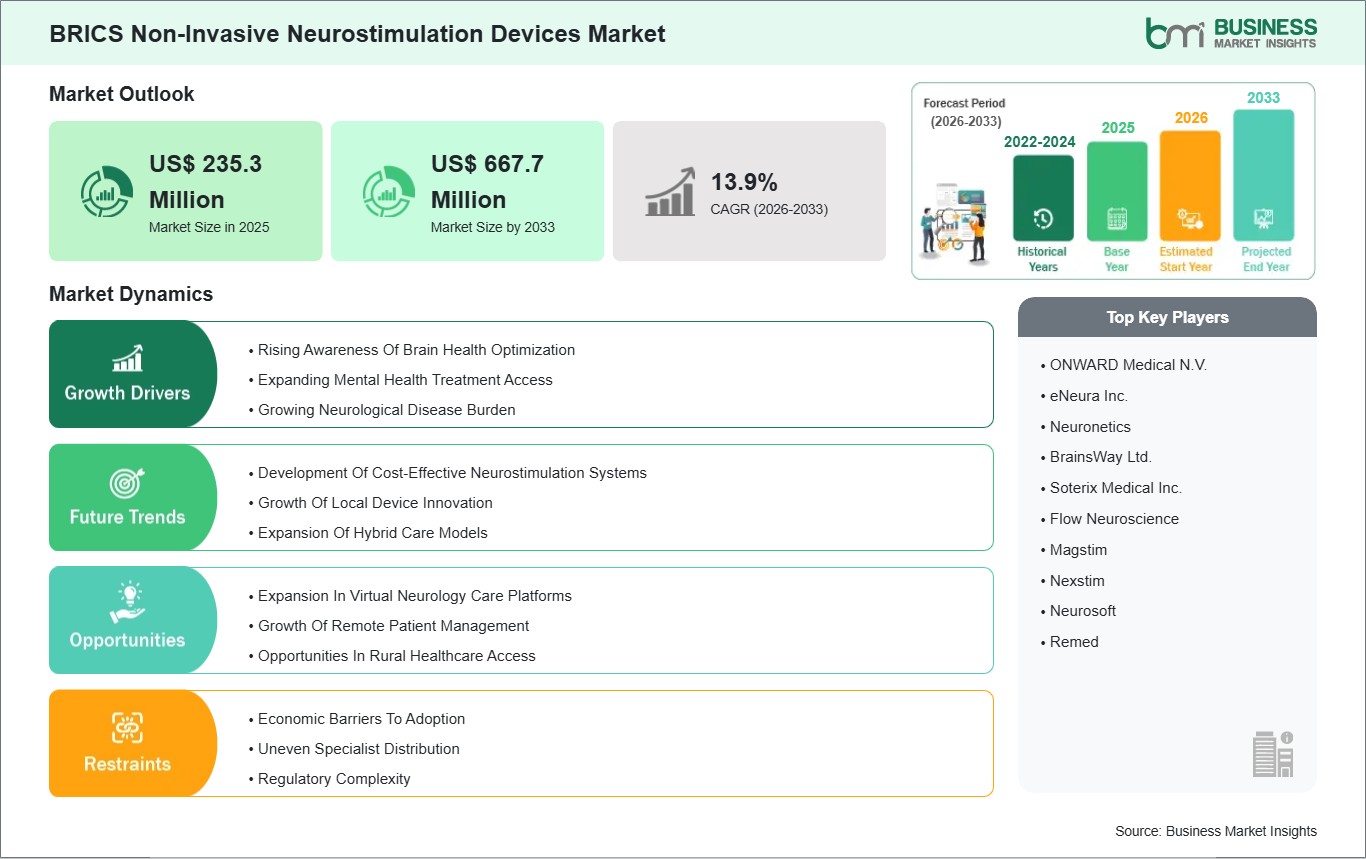
In BRICS economies, the field of non-invasive neurostimulation devices is really taking off. Clinicians are leaning more toward neuromodulation techniques for treating neurological, psychiatric, and pain-related issues. Things like transcranial magnetic stimulation, transcranial direct current stimulation, and new wearable gadgets are getting popular in specialized clinics. A big reason for this is the rising rate of depression, epilepsy, migraine cases, and the need for post-stroke rehab. This is spurring doctors to use brain stimulation methods outside of pharmacology. These non-drug approaches come with fewer side effects and can be done easily in outpatient settings. Also, there's a huge push to expand neurology and rehab facilities. With more money from private investors, digital treatments, and doctors familiarizing themselves with device-based protocols, these options are spreading to places beyond the big city hospitals. Additionally, local production in China and India is making these devices more accessible and affordable. Initiatives focused on cost-effective development mean patients who might otherwise struggle to pay are able to get treated. A major issue is the disjointed reimbursement process and inconsistent regulation in Brazil, Russia, India, China, and South Africa. This slows down standardization and restricts patients from accessing advanced neurostimulation treatments, especially in public health systems with tight budgets. Besides, cooperative research projects and growing curiosity in home-use devices affect how companies operate. They try to stand out by making their devices more portable, easier to use, and compatible with telehealth services. Along with these changes, efforts to align regulations and train healthcare providers aim to boost safe and consistent use of these therapies across BRICS nations' healthcare systems.
Segment Analysis
BRICS Non-Invasive Neurostimulation Devices Market Segmentation
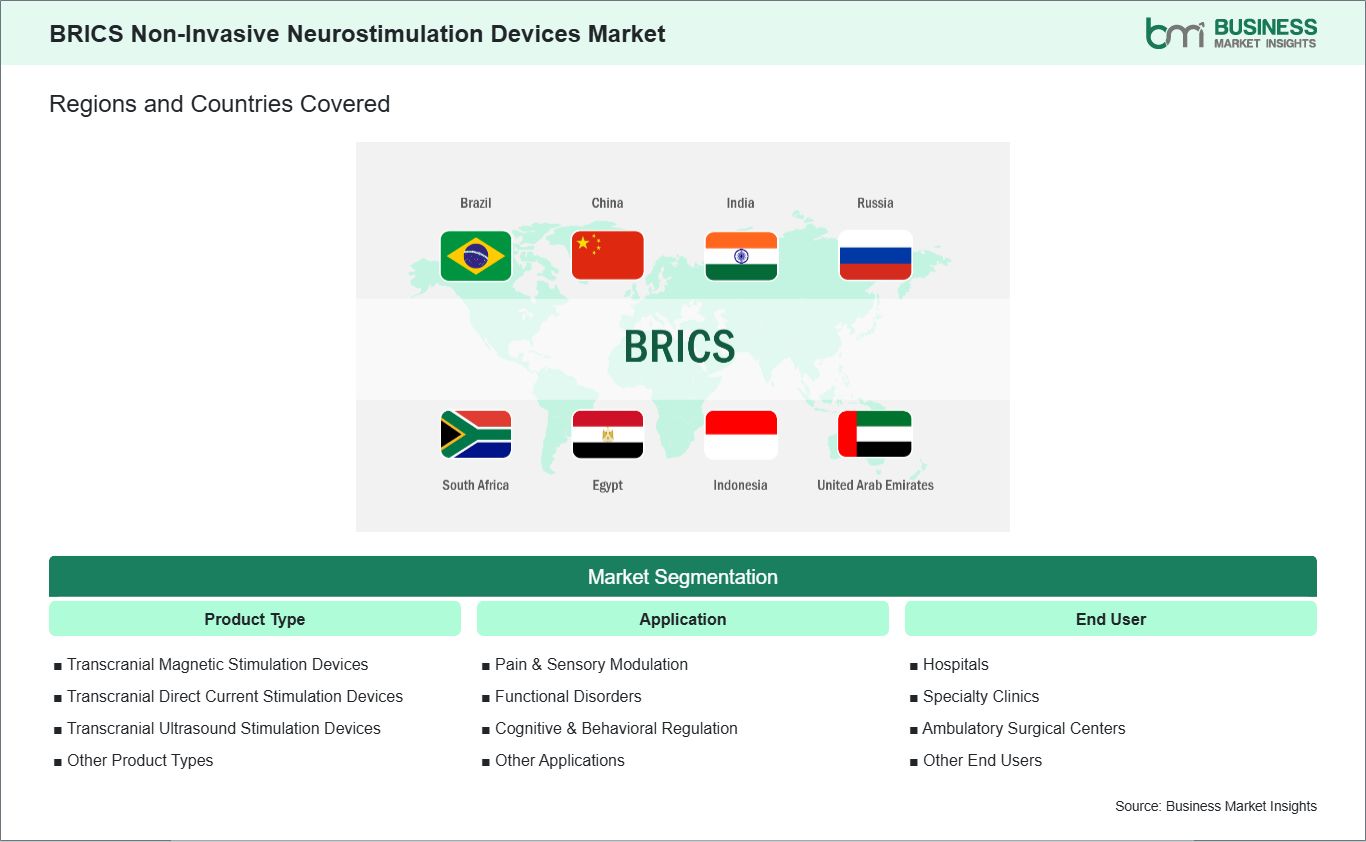
Key segments that contributed to the derivation of the BRICS non-invasive neurostimulation devices market analysis are product type, application and end user.
- By product type, the non-invasive neurostimulation devices market is segmented into transcranial magnetic stimulation devices, transcranial direct current stimulation devices, transcranial ultrasound stimulation devices, and other product types. The transcranial magnetic stimulation devices segment dominated the market in 2025.
- Based on application, the non-invasive neurostimulation devices market is categorized into pain & sensory modulation, functional disorders, cognitive & behavioral regulation, and other applications. The cognitive & behavioral regulation segment dominated the market in 2025.
- In terms of end user, the non-invasive neurostimulation devices market is categorized into hospitals, specialty clinics, ambulatory surgical centers, and other end users. The hospitals segment dominated the market in 2025.
Market Forces
BRICS Non-Invasive Neurostimulation Devices Market Drivers and Opportunities
Rising Awareness of Brain Health Optimization
In urban BRICS healthcare settings, conversations around cognitive maintenance are increasingly framed through productivity and aging resilience, pushing neurostimulation devices into wellness-adjacent clinics and private neurology practices where patients arrive with self-researched expectations shaped by digital content and workplace cognitive performance pressures. This shift is visible in how screening consultations now prioritize subjective focus and fatigue narratives over clinical deficits.
The change is clear in how screening talks now center on personal focus problems and tiredness instead of clinical issues. Among BRICS neuromodulation suppliers, the way their products are shown is tilted towards tweaking cognition bit by bit rather than as treatments. As a result, clinics add short stimulation sessions in executive health checkups and sleep optimization plans that mix advice on living better with tech help.
Often, people try these devices after friends recommend them, not because a doctor prescribed them. But when it comes to buying these things, folks in BRICS markets like having small, easy-to-use gadgets that fit into daily life. So companies work on making electrodes comfy and guiding users via apps to use less formal guidance while still keeping doctors' nods of approval as proof that these tools work. They do this to stay trustworthy in care setups across cities and towns.
Expansion in Virtual Neurology Care Platforms
In BRICS healthcare systems, virtual neurology platforms are being used as coordination layers for neurostimulation workflows, allowing clinicians to adjust treatment parameters remotely while patients log cognitive feedback through mobile interfaces that translate subjective symptoms into structured data streams for longitudinal monitoring. This configuration reduces reliance on in-person titration visits and shifts responsibility toward patient-driven reporting discipline.
Platform providers in India, China, and Brazil are increasingly embedding neurostimulation modules into tele-neurology suites, where device data is synchronized with clinician dashboards, enabling iterative protocol adjustments that mirror software updates rather than static prescription models. Clinicians increasingly rely on algorithmic suggestions to fine-tune stimulation intensity across follow-up cycles within remote care loops continuously evolving.
In more decentralized BRICS healthcare environments, virtual neurology ecosystems are shaping patient engagement patterns by normalizing asynchronous consultations for neurostimulation therapy tracking, particularly among younger urban users accustomed to app-based health management behaviors. This encourages continuous self-reporting loops and reduces dependency on episodic hospital visits. Data integration also supports physician review between scheduled sessions cycles.
Size and Share Analysis
BRICS Non-Invasive Neurostimulation Devices Market Size and Share Analysis
The BRICS non-invasive neurostimulation devices market demonstrates steady growth, with size and share analysis highlighting evolving trends and competitive dynamics among key players. The report examines subsegments categorized within product type, application and end user, offering insights into their contribution to overall market performance.
By product type, the transcranial magnetic stimulation devices subsegment dominated the market in 2025, driven by its established clinical efficacy, growing adoption for neurological and psychiatric disorders, and increasing availability across healthcare facilities.
Based on application, the cognitive & behavioral regulation subsegment dominated the market in 2025, driven by the rising prevalence of mental health disorders and increasing use of neurostimulation therapies for depression, anxiety, and cognitive enhancement.
In terms of end user, the hospitals subsegment dominated the market in 2025, driven by the availability of advanced neurostimulation technologies, skilled healthcare professionals, and growing patient volumes requiring specialized neurological care.
Report Coverage
BRICS Non-Invasive Neurostimulation Devices Market Report Coverage and Deliverables
The "BRICS Non-Invasive Neurostimulation Devices Market Size and Forecast (2022-2033)" report provides a detailed analysis of the market covering below areas:
- Market segments covered under the scope
- Market dynamics such as drivers, restraints, and key opportunities
- Market concentration, heat map analysis, prominent players, and recent developments
- Detailed company profiles, including SWOT analysis
Geographic Insights
BRICS Non-Invasive Neurostimulation Devices Market Geographic Insights
The geographical scope of the BRICS Non-Invasive Neurostimulation Devices Market report is divided into Russia, Brazil, South Africa, India, China, Egypt, Indonesia, Saudi Arabia, and the UAE. China held the largest share in 2025.
China stays at the forefront in the BRICS non-invasive neurostimulation market. They've got solid neurotech manufacturing hubs, big hospitals that use these techniques, and treatments that blend AI into brain therapies. In Russia, special policies that cut down on imports have boosted homegrown neurostimulation tech, especially in stroke care and rehab. Over in Brazil, the rise comes from the growth of private clinics and athletes seeking an edge in recovery. South Africa is catching up, too, but mainly in city hospitals and via joint health projects to deal with brain disorders. Meanwhile, India pushes forward with cheap yet innovative devices and their spread into mental health apps. So each country has its unique angle on bringing these neuro gadgets into regular use. Egypt is pushing forward with its uptake due to modernizing hospital programs and expanding neurology departments in big city hospitals. In Indonesia, things are driven by the need to manage stroke and epilepsy in a vast archipelago. This leads to more portable solutions to deal with the geographic spread. Over in Saudi Arabia, national health transformations and investments in top-notch neurorehab facilities drive progress there. The UAE really shines with quick adoption in fancy medical tourism spots and high-end clinics that use AI and advanced neuromodulation therapies. Across these places, the increased use of non-invasive care, greater access to rehab services, and doctors warming up to brain stimulation tech are making a big difference.
Industry Activity
Recent Developments
The BRICS Non-Invasive Neurostimulation Devices Market is evaluated by gathering qualitative and quantitative data post primary and secondary research, which includes important corporate publications, association data, and databases. A few of the key developments in the BRICS non-invasive neurostimulation devices market are:
- In December 2025, Nyxoah SA (Belgium) announced the commercial launch of its Genio system in the Netherlands, with first successful implants performed at major hospitals in Amsterdam and Heerlen, expanding access to a non-invasive hypoglossal nerve stimulation therapy platform for obstructive sleep apnea across the global markets.
- In December 2023, Nexstim Plc (Finland) announced that it received an order for its NBS 6 navigated transcranial magnetic stimulation (nTMS) system from a European distributor serving multiple EU markets, supporting continued adoption of non-invasive brain stimulation systems across clinical neurophysiology and neurosurgical mapping networks.
Trust & Transparency
Research Methodology
The market analysis combines proprietary research with secondary data from government agencies, company disclosures, regulatory filings, industry databases and expert interviews. Market estimates are validated through data triangulation, cross-market benchmarking and analyst
review.
View Full Research Methodology
Key Sources Referred:
U.S. Food and Drug Administration (FDA)National Institutes of Health (NIH)National Institute of Neurological Disorders and Stroke (NINDS)Centers for Medicare & Medicaid Services (CMS)Medical Device Innovation Consortium (MDIC)World Health Organization (WHO)International Organization for Standardization (ISO)International Neuromodulation Society (INS)North American Neuromodulation Society (NANS)Company WebsitesCompany Annual ReportsCompany Investor Presentations