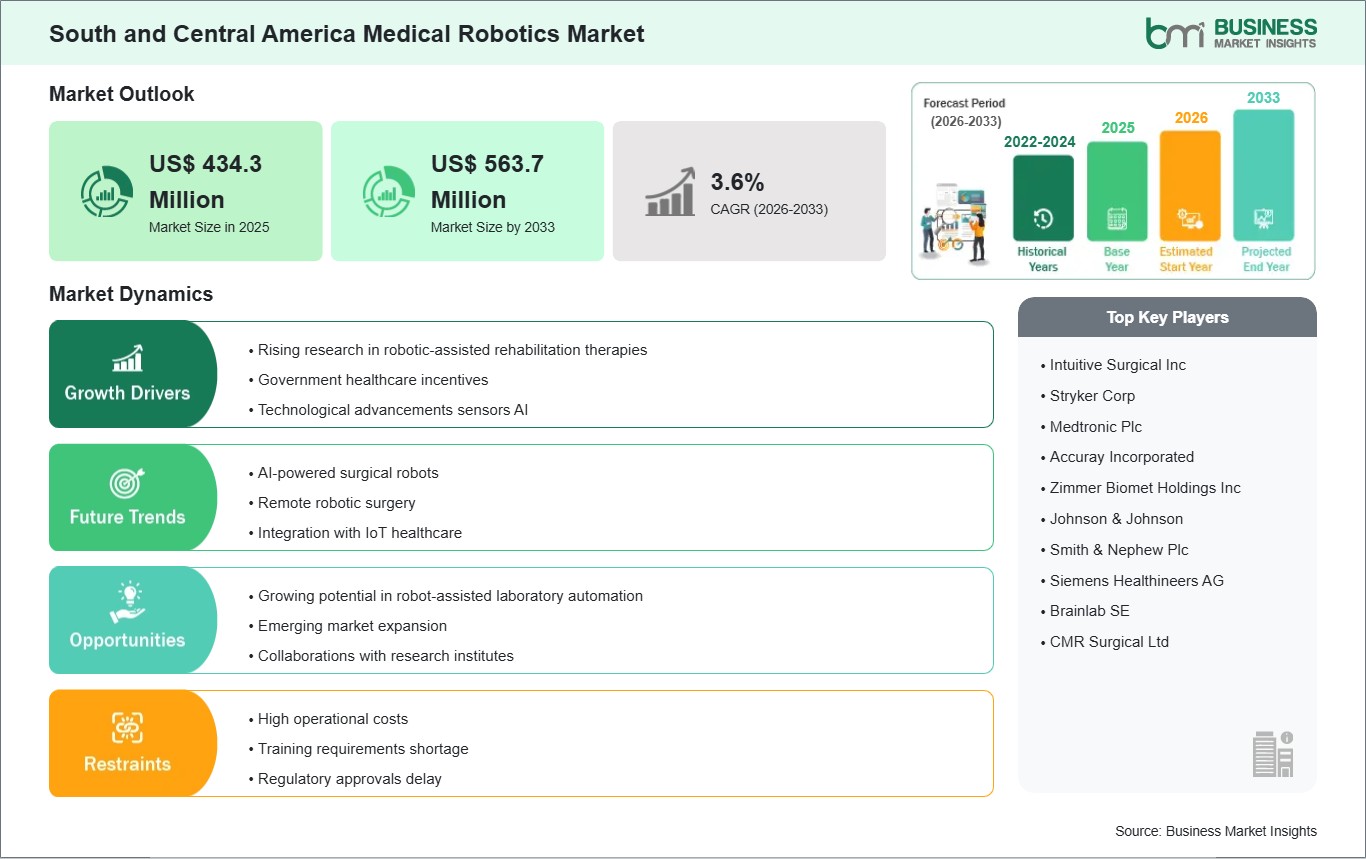
The South and Central America medical robotics market size is expected to reach US$ 563.7 million by 2033 from US$ 434.3 million in 2025. The market is estimated to record a CAGR of 3.6% from 2026 to 2033.
The South and Central America medical robotics market is witnessing progressive adoption as healthcare systems across the region focus on enhancing procedural precision, clinical outcomes, and patient-centric services. Major countries, including Brazil, Mexico, Argentina, Chile, Colombia, and Peru, are investing strategically in robotic-assisted surgery to address growing demand for minimally invasive procedures and high-complexity care. Robotic systems are particularly utilized in urology, gynecology, orthopedics, and oncology, where procedural accuracy and reduced recovery times directly impact clinical outcomes. Private hospitals are leading adoption due to their ability to absorb high capital costs, while select public institutions in metropolitan areas are introducing robotics through pilot programs and government-supported healthcare modernization initiatives. Market dynamics are strongly influenced by a combination of international partnerships and local innovation efforts. Hospitals collaborate with global robotics manufacturers and academic institutions to implement training programs, conduct clinical trials, and generate region-specific evidence supporting the efficacy of robotics. The integration of advanced imaging technologies and electronic medical records enhances the efficiency of robotic-assisted procedures, enabling hospitals to optimize workflows and patient throughput. Additionally, medical tourism is emerging as a key driver in countries such as Brazil and Mexico, where hospitals differentiate themselves by offering state-of-the-art robotic services to attract regional patients. Challenges persist in the form of high acquisition costs, limited insurance reimbursement frameworks, and disparities in healthcare infrastructure between urban and rural regions. To mitigate these barriers, healthcare providers are increasingly exploring alternative acquisition models such as robotics-as-a-service, leasing programs, and shared-platform initiatives that allow multiple institutions to maximize utilization while controlling costs. Regulatory heterogeneity across countries also requires tailored compliance strategies to ensure timely deployment. Overall, the South and Central America Medical Robotics Market reflects a region-specific convergence of clinical demand, private sector investment, and international collaboration, signaling a gradual but meaningful shift toward advanced, technology-enabled healthcare delivery.

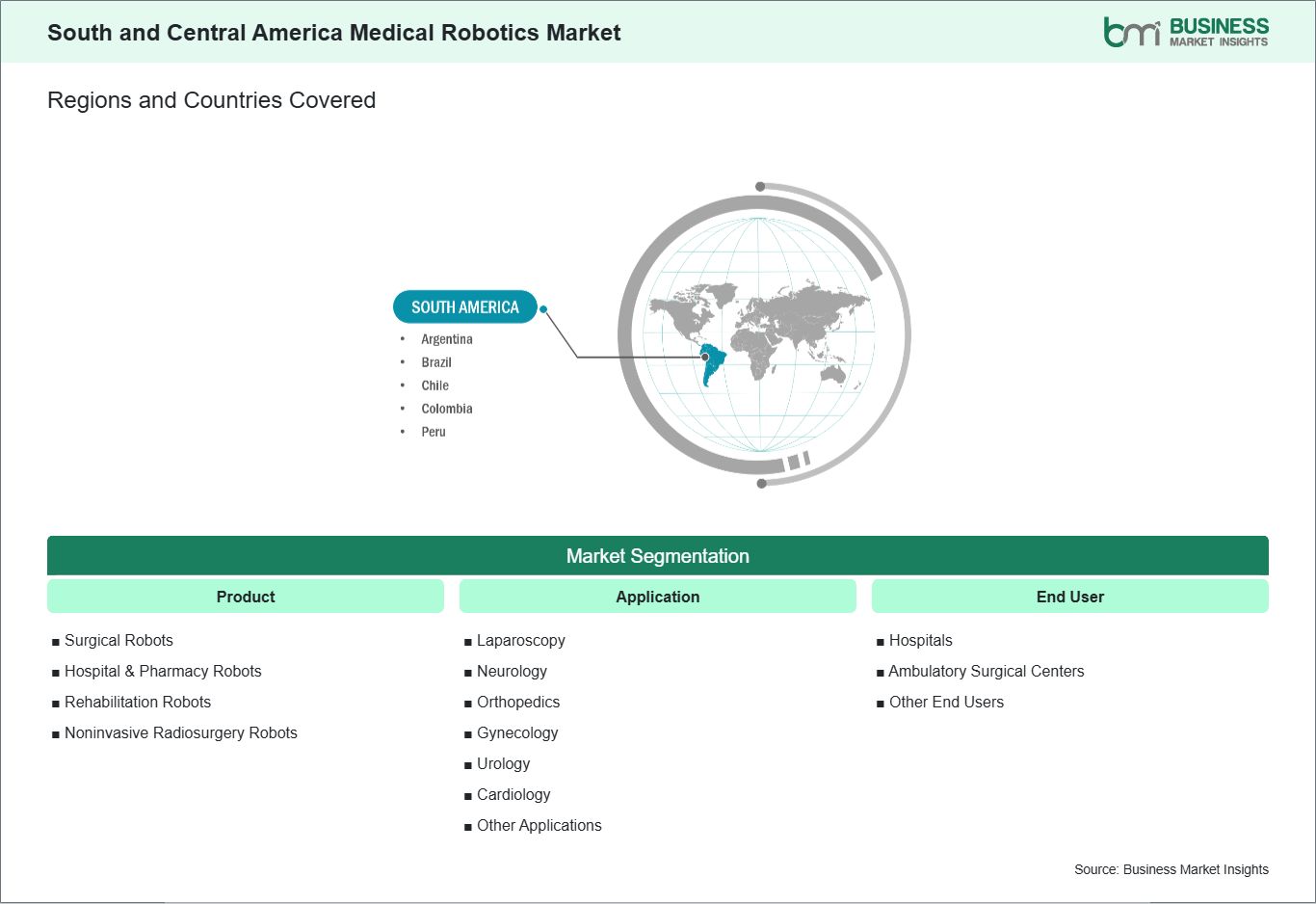
Key segments that contributed to the derivation of the South and Central America Medical Robotics Market analysis are product, application, and end user.
Robotic-assisted rehabilitation therapies are emerging as a key focus in South and Central America, driven by increasing research and development efforts across the region. Hospitals, research centers, and universities are exploring innovative robotic solutions to support recovery for patients with neurological, orthopedic, or musculoskeletal conditions. These systems enhance traditional physiotherapy by providing controlled, repetitive motion exercises, improving precision in rehabilitation, and allowing for better tracking of patient progress. The growing research focus is also shaping clinical adoption of robotic rehabilitation devices. Clinicians are collaborating with researchers to evaluate the effectiveness of robotics in supporting recovery, including improving mobility, strength, and coordination. By studying patient outcomes and refining robotic-assisted therapy protocols, healthcare providers are able to implement evidence-based practices that maximize therapeutic benefits and support individualized treatment plans. Furthermore, robotic rehabilitation systems are fostering the development of new care models in the region. By integrating robotics into outpatient clinics, therapy centers, and home-based care programs, patients can access continuous support beyond traditional hospital settings. This expansion not only improves the efficiency of rehabilitation programs but also promotes patient independence and faster functional recovery. As research continues to advance and awareness grows, robotic-assisted rehabilitation is expected to become a widely adopted component of post-operative and long-term care across South and Central America.
Robot-assisted laboratory automation is gaining attention in South and Central America as laboratories seek greater efficiency, precision, and reliability in medical testing and research. Robotic systems can perform repetitive tasks, handle delicate samples, and manage high-throughput processes with minimal human intervention. This automation improves the accuracy of laboratory results, reduces the potential for errors, and enhances the overall speed of diagnostic workflows. The adoption of robotics in laboratories also supports more standardized and consistent procedures. By automating sample handling, testing, and data recording, laboratories can improve reproducibility across experiments and reduce variability between operators. This is particularly valuable in clinical diagnostics, pharmaceutical research, and specialized testing, where precision and reliability are critical to patient care and scientific outcomes. In addition, robot-assisted laboratory automation opens opportunities for healthcare innovation and operational efficiency. Laboratories can handle larger volumes of samples, integrate with digital data systems, and reduce the manual workload for staff, allowing skilled personnel to focus on analysis and interpretation. As awareness of these benefits grows, South and Central American laboratories are expected to increasingly adopt robotic solutions, expanding the region’s capacity for advanced diagnostics, research, and high-quality laboratory services.
The South and Central America medical robotics market demonstrates steady growth, with size and share analysis highlighting evolving trends and competitive dynamics among key players. The report examines subsegments categorized within product, application, and end user, offering insights into their contribution to overall market performance.
By product, the surgical robots segment dominated the market in 2025, driven by the increasing adoption of robotic systems for precision and complex surgical procedures.
In terms of application, the laparoscopy segment dominated the market in 2025, driven by the growing preference for minimally invasive surgeries that reduce recovery time and complications.
Based on end user, the hospitals segment dominated the market in 2025, driven by expanding healthcare infrastructure and rising investments in advanced medical technologies.
| Report Attribute | Details |
|---|---|
| Market size in 2025 | US$ 434.3 Million |
| Market Size by 2033 | US$ 563.7 Million |
| CAGR (2026 - 2033) | 3.6% |
| Historical Data | 2022-2024 |
| Forecast period | 2026-2033 |
| Segments Covered | By Product
|
|
Regions and Countries Covered
| |
| South and Central America | Brazil, Argentina, Peru, Chile, Colombia |
| Market leaders and key company profiles |
|
The "South and Central America Medical Robotics Market Size and Forecast (2022–2033)" report provides a detailed analysis of the market covering below areas:
The geographical scope of the South and Central America Medical Robotics Market report is divided into into Brazil, Argentina, Peru, Chile, and Colombia. Brazil held the largest share in 2025.
Country-level insights into the South and Central America Medical Robotics Market highlight differentiated adoption trends across Brazil, Argentina, Chile, Colombia, and Peru, reflecting variations in healthcare infrastructure, investment priorities, and policy frameworks. Brazil emerges as the dominant market, with hospitals in São Paulo, Rio de Janeiro, and Brasília spearheading the deployment of robotic-assisted surgical systems. The focus is on high-complexity specialties such as urology, orthopedics, oncology, and cardiothoracic procedures. Brazil benefits from strong private sector investment, partnerships with global robotics manufacturers, and local academic collaborations that support clinical validation, workforce training, and scalable adoption. Argentina demonstrates growing adoption within urban tertiary hospitals, where robotics is leveraged to enhance precision in surgical procedures and optimize patient recovery. Clinical training programs and collaborative initiatives with international technology providers help strengthen workforce expertise, making Argentina a regional center for procedural innovation. Chile is advancing robotics adoption in metropolitan hospitals and specialty centers, with an emphasis on improving patient outcomes, operational efficiency, and integrating robotics into broader hospital digital health infrastructures. Pilot programs and evidence-based clinical studies play a significant role in shaping adoption strategies. Colombia represents an emerging market, where robotics is being selectively deployed in private and university hospitals to enhance procedural accuracy, particularly in high-demand surgical areas. Investment is focused on clinical excellence, efficiency optimization, and workforce development, ensuring adoption aligns with national healthcare priorities. Peru exhibits incremental adoption, concentrated in flagship urban hospitals and teaching institutions that aim to build clinical capacity and establish centers of excellence for high-precision surgeries. Collectively, the South and Central America Medical Robotics Market demonstrates a heterogeneous landscape. Brazil leads in scale, infrastructure, and strategic investment, while Argentina, Chile, Colombia, and Peru are advancing adoption at measured paces, focusing on clinical outcomes, training, and operational efficiency. Public-private partnerships, international collaborations, and technology transfer initiatives remain critical drivers for expanding robotics integration across the region, reflecting a gradual but meaningful transformation toward technology-enabled, high-quality healthcare delivery in South and Central America.

The South and Central America Medical Robotics Market is evaluated by gathering qualitative and quantitative data post primary and secondary research, which includes important corporate publications, association data, and databases. A few of the key developments in the South and Central America Medical Robotics Market are:
The South and Central America Medical Robotics Market is valued at US$ 434.3 Million in 2025, it is projected to reach US$ 563.7 Million by 2033.
As per our report South and Central America Medical Robotics Market, the market size is valued at US$ 434.3 Million in 2025, projecting it to reach US$ 563.7 Million by 2033. This translates to a CAGR of approximately 3.6% during the forecast period.
The South and Central America Medical Robotics Market report typically cover these key segments-
The historic period, base year, and forecast period can vary slightly depending on the specific market research report. However, for the South and Central America Medical Robotics Market report:
The South and Central America Medical Robotics Market is populated by several key players, each contributing to its growth and innovation. Some of the major players include:
The South and Central America Medical Robotics Market report is valuable for diverse stakeholders, including:
Essentially, anyone involved in or considering involvement in the South and Central America Medical Robotics Market value chain can benefit from the information contained in a comprehensive market report.
Please tell us your area of interest
(Market Segments/ Regions and Countries/ Companies)