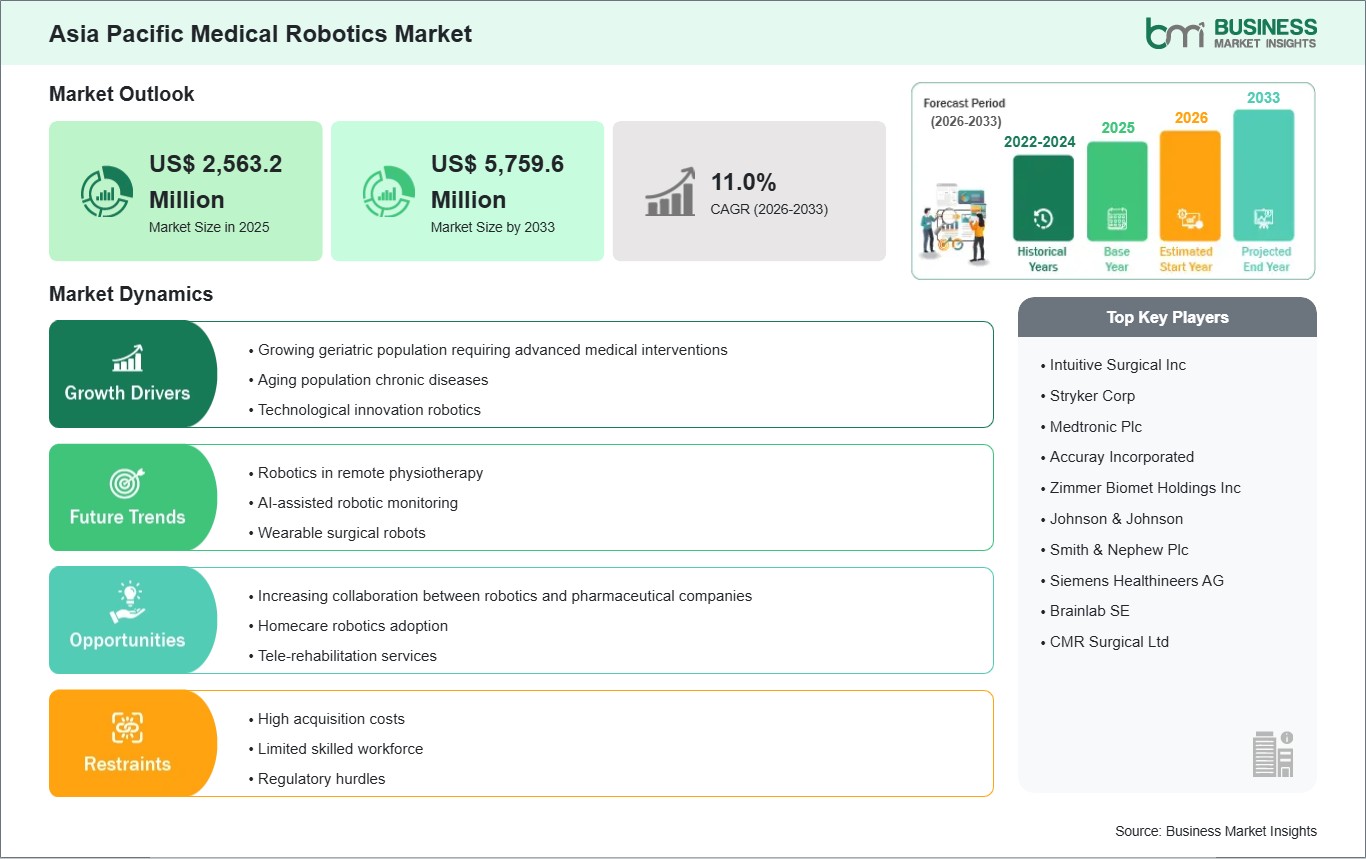
The Asia Pacific medical robotics market size is expected to reach US$ 5,759.6 million by 2033 from US$ 2,563.2 million in 2025. The market is estimated to record a CAGR of 11.0% from 2026 to 2033.
The Asia Pacific medical robotics market is transitioning into a core component of the region’s healthcare modernization strategies, driven by rapid integration of precision automation across clinical environments. Healthcare providers in key markets such as China, Japan, and South Korea are increasingly incorporating robotic platforms across surgical, diagnostic, and rehabilitation workflows to improve clinical outcomes while managing rising procedure volumes and workforce shortages. Strategic investments in artificial intelligence, enhanced imaging, and robotic engineering are expanding the application spectrum of medical robots beyond traditional surgical suites into areas such as non‑invasive neurosurgery, elderly care, and hospital automation. Surgical robotic systems, in particular, dominate regional innovation due to their ability to reduce procedural complications, improve dexterity, and enhance patient recovery pathways in complex interventions like urology and oncology. These systems are being increasingly deployed in tertiary hospitals where quality benchmarks and clinical differentiation are critical. However, market growth dynamics exhibit notable asymmetry. Developed APAC healthcare systems benefit from more structured reimbursement frameworks, rigorous regulatory pathways, and clinician training programs that accelerate adoption, whereas emerging markets face challenges associated with infrastructure constraints, funding limitations, and variable regulatory clarity. These differences are prompting stakeholders to pursue differentiated strategies, including tailored financing solutions, local training collaborations, and ecosystem partnerships to build clinical confidence in robotics‑augmented care. Cross‑sector collaborations between healthcare institutions and MedTech innovators are also catalyzing technology transfer and support frameworks essential for integration at scale. As healthcare systems increasingly prioritize patient‑centric outcomes and operational resilience, medical robotics is being positioned as a strategic enabler of long‑term system efficiency and quality care delivery.

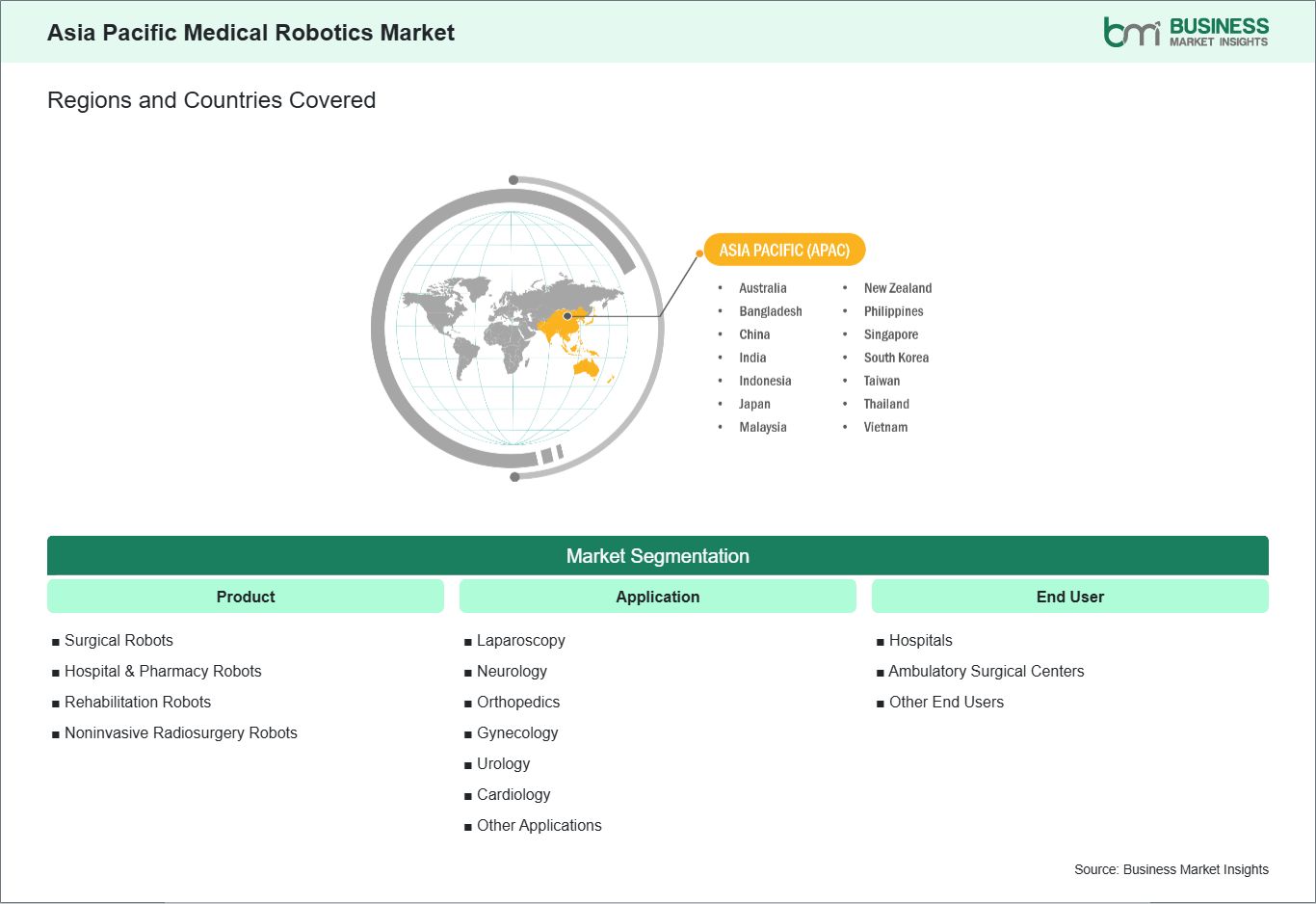
Key segments that contributed to the derivation of the Asia Pacific Medical Robotics Market analysis are product, application, and end user.
The Asia Pacific region is experiencing a significant demographic transition marked by a rapidly increasing elderly population, which directly influences the demand for sophisticated healthcare services, including medical robotics. Projections suggest that by 2050, about one in four people in the Asia Pacific will be over 60 years old, representing more than 1.3 billion older adults. This shift is particularly pronounced in countries such as Japan, China, and South Korea, where the proportion of citizens aged 65 + is high and continuing to rise. In Japan, the elderly segment has expanded substantially, leading to higher surgical volumes for age‑associated conditions like prostate cancer and gastrointestinal disorders that benefit from robotic precision and minimally invasive approaches. Similarly, China’s population segments above 60 are expected to exceed 300 million by 2030, increasing the need for advanced interventions across cardiac, urological, and oncological care where robot‑assisted systems can enhance outcomes. Hospitals across the Asia Pacific are responding to these demographic changes by incorporating more robotic systems into surgical and rehabilitative care pathways. In India, for example, facilities like CK Birla Hospital have installed fourth‑generation robotic surgery platforms to support complex procedures, demonstrating how aging‑related healthcare needs are shaping technology adoption. Other nations such as Singapore and Australia are investing in robotics not only for surgery but also for elderly care, including autonomous delivery and assistive robots to support nursing workflows. These investments help manage the increased procedural demand from older patients while also addressing workforce shortages in caregiving and acute care settings—a dual challenge in aging communities. The demand for robotics in the Asia Pacific is also reinforced by rising chronic diseases that disproportionately affect older adults, such as cardiovascular disease and diabetes, which often require repeat or complex surgeries. As minimally invasive and robot‑assisted techniques become more established, they are increasingly preferred by both clinicians and patients due to benefits like smaller incisions, reduced recovery times, and higher precision. In countries like China and Japan, surgical robots are now routinely used in urology and oncologic procedures, reflecting how demographic trends correlate with technology adoption. With governments and healthcare systems emphasizing improved quality of care for aging populations, investments in both robotic infrastructure and surgeon training are expected to grow throughout the region.
In the Asia Pacific, collaboration between medical robotics developers and pharmaceutical companies is emerging as a transformative trend that enhances capabilities across drug discovery, manufacturing, and clinical care pathways. Pharmaceutical firms and robotics technology providers are partnering to bring automation to complex laboratory and production tasks that were previously labor‑intensive and error‑prone. For instance, collaborations involving automated robotic systems for drug formulation and preparation are increasingly visible in China’s pharmaceutical manufacturing sector, where robots are programmed to mix and prepare chemotherapy drugs with high precision. These joint efforts improve efficiency, boost quality control, and reduce risks associated with manual handling in sterile environments, addressing critical needs in high‑volume drug manufacturing. Robotics collaborations are not limited to production lines; they extend into pharmaceutical R&D workflows. Across the region, there is a growing emphasis on integrating robotic automation and data analytics in laboratories to accelerate compound screening, sample handling, and chemical synthesis. This is particularly relevant in nations such as Japan and South Korea, where pharmaceutical research institutions and robotics firms jointly develop advanced lab‑automation platforms to shorten drug discovery cycles. These collaborations leverage robotics for repetitive tasks, freeing researchers to focus on experiment design and interpretation while improving throughput and reproducibility—a key factor in competitive drug development. Beyond manufacturing and R&D, Asia Pacific collaborations also extend into clinical and pharmaceutical service delivery. Robotics is increasingly utilized in pharmacy automation, with robotics‑assisted prescription filling and AI‑enabled drug interaction alerts enhancing medication safety and operational efficiency in busy pharmacies in China, Indonesia, and the Philippines. These integrated solutions, combining pharmaceutical expertise with robotics precision, help decentralize pharmacy services and support high patient volumes while reducing errors. Additionally, robotics partnerships that focus on hospital logistics, inspection, and quality assurance further demonstrate how multidisciplinary collaboration can streamline the entire lifecycle of pharmaceutical products—from development and production to patient delivery.

The Asia Pacific medical robotics market demonstrates steady growth, with size and share analysis highlighting evolving trends and competitive dynamics among key players. The report examines subsegments categorized within product, application, and end user, offering insights into their contribution to overall market performance.
By product, the surgical robots segment dominated the market in 2025, driven by strong adoption of robotic systems for minimally invasive and complex surgeries across major Asia Pacific healthcare facilities.
In terms of application, the laparoscopy segment dominated the market in 2025, driven by increasing use of robotic‑assisted laparoscopic procedures that offer better precision, reduced trauma, and faster recovery in high‑volume surgical applications.
Based on end user, the hospitals segment dominated the market in 2025, driven by their advanced infrastructure, high surgical workloads and ability to absorb investment in costly robotic technologies.
| Report Attribute | Details |
|---|---|
| Market size in 2025 | US$ 2,563.2 Million |
| Market Size by 2033 | US$ 5,759.6 Million |
| CAGR (2026 - 2033) | 11.0% |
| Historical Data | 2022-2024 |
| Forecast period | 2026-2033 |
| Segments Covered | By Product
|
|
Regions and Countries Covered
| |
| Asia Pacific | China, India, Japan, Australia, Bangladesh, Indonesia, Malaysia, New Zealand, Philippines, Singapore, South Korea, Taiwan, Thailand, Vietnam |
| Market leaders and key company profiles |
|
The "Asia Pacific Medical Robotics Market Size and Forecast (2022–2033)" report provides a detailed analysis of the market covering below areas:
The geographical scope of the Asia Pacific Medical Robotics Market report is divided into China, India, Japan, Australia, Bangladesh, Indonesia, Malaysia, New Zealand, Philippines, Singapore, South Korea, Taiwan, Thailand, and Vietnam. China held the largest share in 2025.
Country‑level insights into the Asia Pacific Medical Robotics Market reflect heterogeneous adoption patterns shaped by healthcare infrastructure maturity, regulatory ecosystems, and strategic priorities across key economies including China, Japan, India, South Korea, and Australia. China stands out as the dominant market in the region, driven by aggressive hospital modernization initiatives, expansive middle‑class healthcare demand, and strong government incentives that support advanced medical equipment deployment. China’s robust domestic manufacturing ecosystem and strategic collaborations with multinational robotics innovators have also accelerated clinical utilization of medical robotic systems in major tertiary care centers, particularly for oncology, laparoscopy, and minimally invasive procedures. In Japan, high healthcare quality standards, a well‑established insurance framework, and an aging demographic have driven early and sustained adoption of robotic-assisted surgery, especially in specialties like urology, orthopedics, and cardiovascular interventions. Japan’s strategic focus on integrating precision technologies has fostered a mature clinical environment for robotics testing and refinement, which in turn attracts supplementary R&D investments. India is emerging as one of the fastest growing markets for medical robotics in APAC, supported by rising healthcare expenditure, medical tourism growth, and hospital investments in surgical automation. While adoption varies by region due to differing regulatory and reimbursement landscapes, leading hospital chains in metropolitan centers are pioneering integration of robotic systems to improve quality and competitiveness. South Korea and Australia also exhibit progressive adoption trends. South Korea’s innovation ecosystem, combined with structured public health initiatives, is enabling earlier integration of robotics amplified by technology export synergies. Australia’s advanced healthcare infrastructure supports strategic deployment in major hospital networks, with a growing focus on robotic rehabilitation and clinical support applications. Across these markets, strategic priorities include clinician training, interoperability standards, and scalable deployment frameworks that align robotics adoption with national health outcomes and long‑term healthcare sustainability goals.

The Asia Pacific Medical Robotics Market is evaluated by gathering qualitative and quantitative data post primary and secondary research, which includes important corporate publications, association data, and databases. A few of the key developments in the Asia Pacific Medical Robotics Market are:
The Asia Pacific Medical Robotics Market is valued at US$ 2,563.2 Million in 2025, it is projected to reach US$ 5,759.6 Million by 2033.
As per our report Asia Pacific Medical Robotics Market, the market size is valued at US$ 2,563.2 Million in 2025, projecting it to reach US$ 5,759.6 Million by 2033. This translates to a CAGR of approximately 11.0% during the forecast period.
The Asia Pacific Medical Robotics Market report typically cover these key segments-
The historic period, base year, and forecast period can vary slightly depending on the specific market research report. However, for the Asia Pacific Medical Robotics Market report:
The Asia Pacific Medical Robotics Market is populated by several key players, each contributing to its growth and innovation. Some of the major players include:
The Asia Pacific Medical Robotics Market report is valuable for diverse stakeholders, including:
Essentially, anyone involved in or considering involvement in the Asia Pacific Medical Robotics Market value chain can benefit from the information contained in a comprehensive market report.
Please tell us your area of interest
(Market Segments/ Regions and Countries/ Companies)