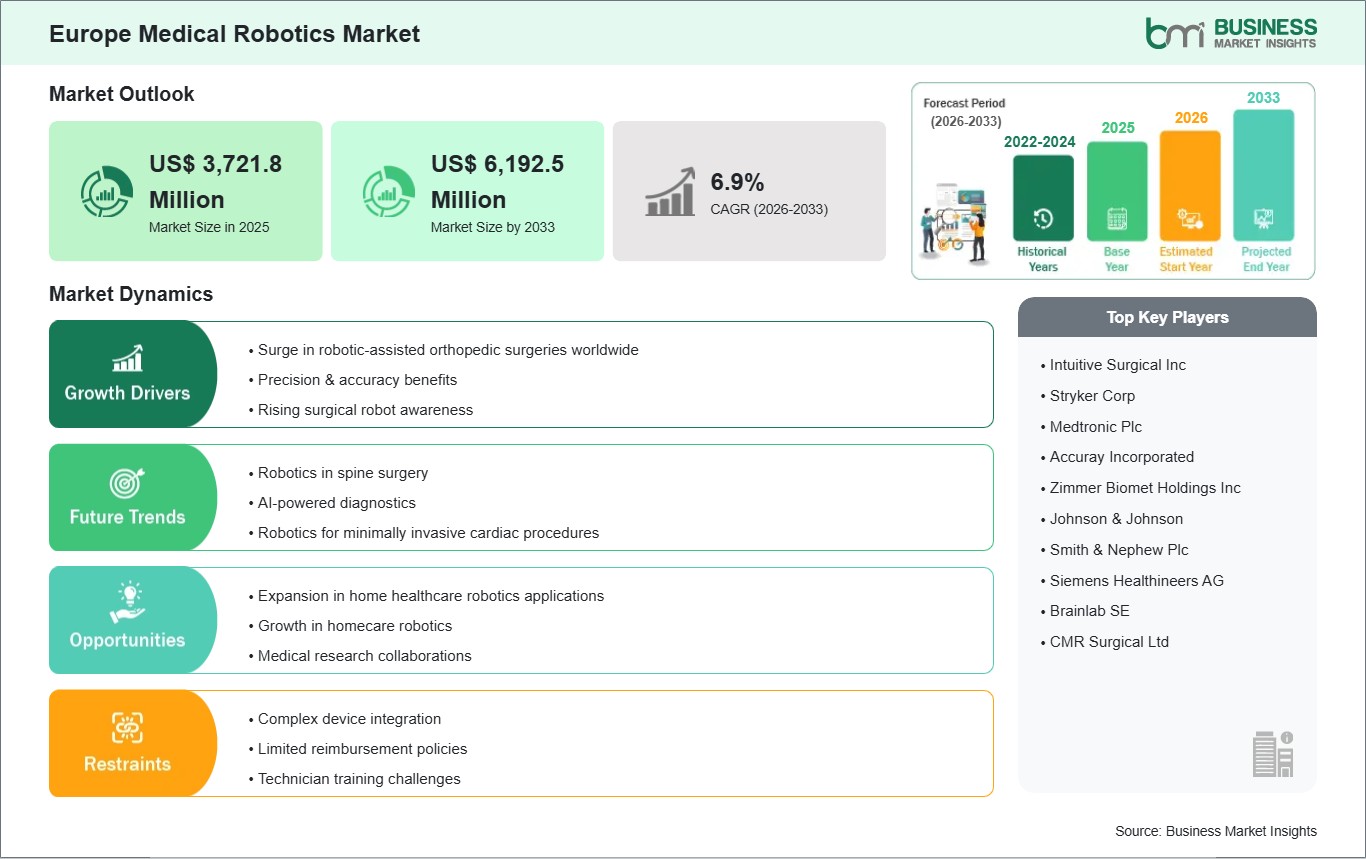
The Europe medical robotics market size is expected to reach US$ 6,192.5 million by 2033 from US$ 3,721.8 million in 2025. The market is estimated to record a CAGR of 6.9% from 2026 to 2033.
The Europe medical robotics market is witnessing a period of accelerated evolution driven by advanced healthcare infrastructure, rising patient demand for minimally invasive procedures, and growing emphasis on precision medicine. Across Western and Central Europe, hospitals and specialty clinics are increasingly integrating robotic-assisted systems to enhance surgical accuracy, reduce procedure times, and improve post-operative recovery. Surgical robotics, particularly in urology, cardiothoracic surgery, and orthopedics, remains the primary adoption area, while ancillary domains such as rehabilitation and hospital logistics are emerging. These trends reflect a broader strategy to improve operational efficiency, enhance patient satisfaction, and maintain competitive differentiation among private and public healthcare providers. Market growth is further propelled by strong collaborations between global robotics manufacturers, European research institutions, and clinical centers, fostering innovation in AI-enabled surgical planning, robotic navigation, and haptic feedback systems. Regulatory frameworks harmonized under EU medical device directives facilitate smoother market entry, ensuring safety and interoperability across multiple countries. Moreover, healthcare payers and insurance providers increasingly evaluate robotics adoption based on demonstrated improvements in clinical outcomes, driving hospitals to invest in systems that provide measurable benefits in efficiency and quality of care. Challenges persist, including high capital investment requirements, the need for extensive clinician training, and integration complexities with legacy hospital IT systems. To mitigate these challenges, healthcare providers are exploring flexible procurement strategies, such as leasing models, outcome-based contracts, and shared-service platforms. Additionally, the adoption of digital twins and simulation-based training is enhancing workforce readiness, ensuring that surgeons and support staff can effectively utilize robotic systems. Overall, Europe’s medical robotics market reflects a mature ecosystem focused on innovation, operational efficiency, and patient-centric care, with sustained growth anticipated as technology integration deepens across surgical and clinical workflows.

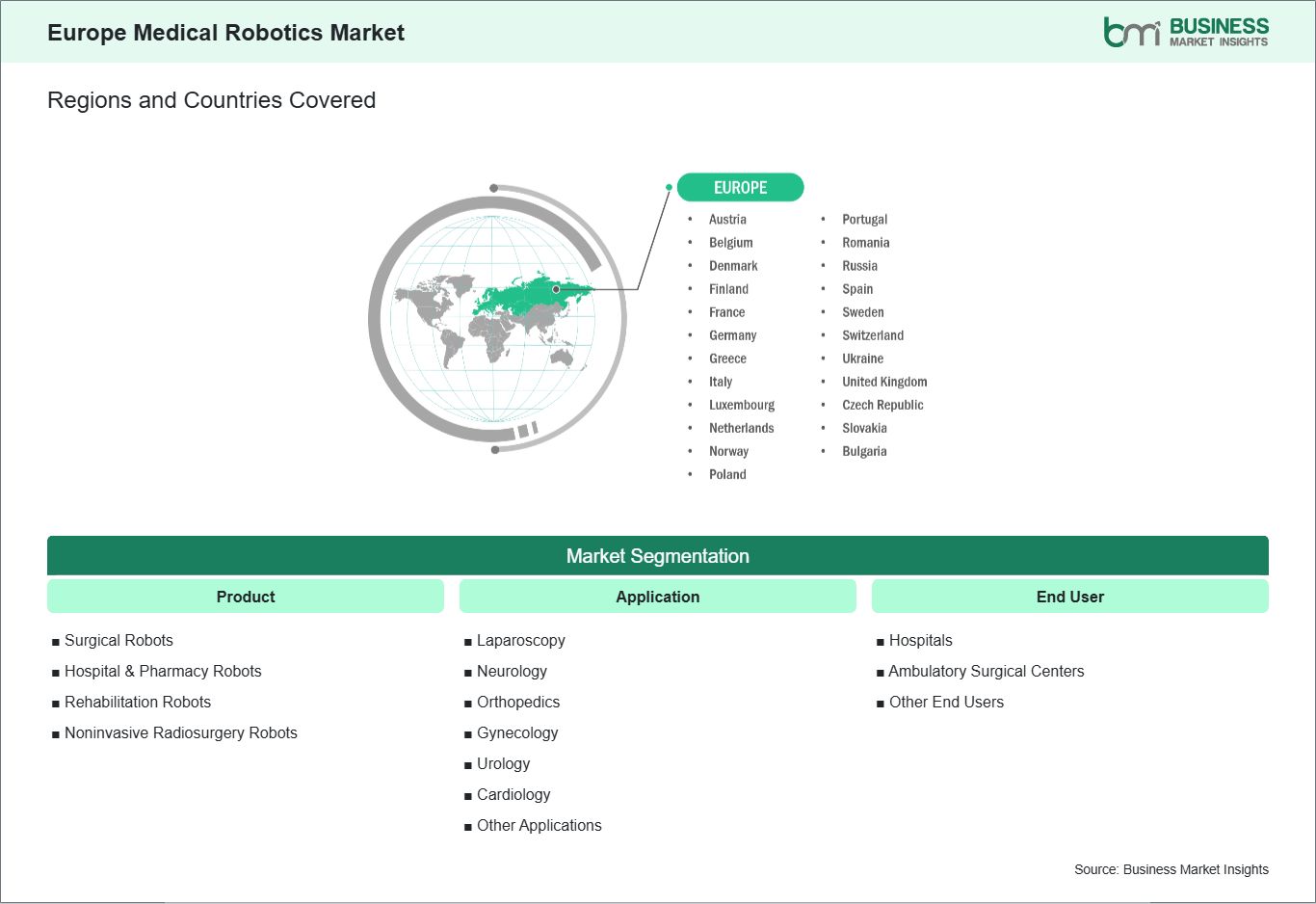
Key segments that contributed to the derivation of the Europe Medical Robotics Market analysis are product, application, and end user.
Robotic-assisted orthopedic surgeries are becoming an integral part of healthcare systems in Europe. Hospitals and surgical centers are increasingly recognizing the value of robotic technology in improving surgical precision and enhancing patient outcomes. Robotic systems allow surgeons to perform complex procedures with higher accuracy, reducing the risk of errors and supporting consistent results. The integration of robotics in orthopedic surgery provides greater control over instrument movements and improves alignment during procedures, which contributes to faster patient recovery and a more efficient surgical workflow. The adoption of robotic systems is also transforming the role of orthopedic surgeons. With the assistance of robotics, surgeons can plan procedures more effectively, simulate surgical steps, and execute operations with minimal variability. This enables them to focus on critical decisions while relying on robotic precision for routine aspects of surgery. As a result, surgical teams can improve overall efficiency and reduce fatigue, allowing healthcare facilities to maintain high-quality care even under increasing patient demand. The emphasis on precision and reliability is gradually reshaping surgical practices in Europe. Furthermore, robotic-assisted orthopedic surgery is supporting the move toward minimally invasive techniques. These systems allow for smaller incisions and more controlled movements, reducing tissue damage and accelerating patient recovery. Hospitals are increasingly viewing robotic surgery as a strategic investment that not only enhances clinical outcomes but also improves patient satisfaction. As technology continues to advance and surgical teams become more familiar with robotic workflows, the use of robotics in orthopedic procedures is expected to expand further, setting a new standard for care in the region.
Home healthcare robotics is emerging as a key growth area in Europe, driven by the need to support patients outside traditional hospital settings. Robotics can assist individuals with daily activities, provide basic medical monitoring, and support mobility, creating a safer and more comfortable environment for home care. These systems are increasingly being integrated with healthcare services to offer practical solutions that reduce the reliance on caregivers while maintaining a high level of patient independence and well-being. The expansion of home healthcare robotics also reflects a broader trend toward personalized care. Robots can be tailored to the needs of individuals, providing support for rehabilitation exercises, medication reminders, or routine health checks. This personalized approach enables patients to maintain a higher level of engagement with their care plans and encourages consistent adherence to treatment recommendations. By combining assistance with monitoring capabilities, home robotics helps bridge the gap between professional healthcare oversight and daily patient needs. In addition, home healthcare robotics supports the efficiency of healthcare systems by reducing unnecessary hospital visits and enabling care to be delivered remotely. Robots can assist patients while allowing healthcare providers to track progress and intervene when necessary, improving the continuity of care. The integration of robotics into home care services also strengthens the overall patient experience by promoting independence, safety, and convenience. As technology develops, home healthcare robotics is expected to become a standard component of care delivery in Europe, complementing traditional healthcare services and supporting patients in living healthier, more independent lives.
The Europe medical robotics market demonstrates steady growth, with size and share analysis highlighting evolving trends and competitive dynamics among key players. The report examines subsegments categorized within product, application, and end user, offering insights into their contribution to overall market performance.
By product, the surgical robots segment dominated the market in 2025, driven by increasing adoption of advanced robotic systems that enhance precision, safety and efficiency across minimally invasive procedures throughout Europe.
In terms of application, the laparoscopy segment dominated the market in 2025, driven by strong preference for robot‑assisted minimally invasive laparoscopic surgeries that deliver better clinical outcomes and faster patient recovery.
Based on end user, the hospitals segment dominated the market in 2025, driven by their advanced infrastructure, high surgical volumes and capacity to invest in costly robotic technologies for improved patient care.
| Report Attribute | Details |
|---|---|
| Market size in 2025 | US$ 3,721.8 Million |
| Market Size by 2033 | US$ 6,192.5 Million |
| CAGR (2026 - 2033) | 6.9% |
| Historical Data | 2022-2024 |
| Forecast period | 2026-2033 |
| Segments Covered | By Product
|
|
Regions and Countries Covered
| |
| Europe | Belgium, Austria, Finland, Denmark, Greece, Poland, Romania, Russia, Ukraine, Czech Republic, Slovakia, Bulgaria, Italy, Luxembourg, Germany, Switzerland, France, Netherlands, Norway, Portugal, Spain, Sweden, United Kingdom |
| Market leaders and key company profiles |
|
The "Europe Medical Robotics Market Size and Forecast (2022–2033)" report provides a detailed analysis of the market covering below areas:
The geographical scope of the Europe Medical Robotics Market report is divided into Belgium, Austria, Finland, Denmark, Greece, Poland, Romania, Russia, Ukraine, the Czech Republic, Slovakia, Bulgaria, Italy, Luxembourg, Germany, Switzerland, France, the Netherlands, Norway, Portugal, Spain, Sweden, and the UK. Germany held the largest share in 2025.
Country-level insights into the Europe Medical Robotics Market reveal diverse adoption dynamics across Germany, France, the United Kingdom, Italy, and Spain, shaped by healthcare infrastructure, regulatory frameworks, and investment priorities. Germany is a leading market, with tertiary hospitals and specialized centers deploying advanced robotic systems for urology, orthopedic, and cardiothoracic surgeries. The country’s strong focus on precision medicine and high R&D expenditure supports the development of AI-integrated surgical platforms and continuous innovation. In France, robotics adoption is supported by a well-structured healthcare system and national strategies for hospital modernization. French hospitals are increasingly utilizing robotic systems to enhance surgical efficiency, improve clinical outcomes, and reduce hospital stays, particularly in urban academic centers. The United Kingdom has seen rapid integration of robotics, particularly in private hospital networks and teaching hospitals. Emphasis is placed on minimally invasive surgery and tele-mentoring platforms, aligning with broader NHS goals of improving care quality while optimizing resource utilization. In Italy, adoption is concentrated in major metropolitan hospitals, focusing on high-complexity surgical procedures such as oncology and cardiovascular interventions. Investments are guided by regional health authorities and university hospital collaborations. Spain demonstrates a balanced approach, combining public and private adoption to expand minimally invasive surgical capabilities while piloting robotics-assisted rehabilitation programs. Collaborative initiatives between hospitals, universities, and robotics manufacturers are enhancing workforce readiness and accelerating clinical integration. Overall, Europe’s country-level landscape reflects a mature, innovation-driven market where adoption strategies are tailored to national healthcare priorities, infrastructure capabilities, and patient demand. Germany and the United Kingdom emerge as leading hubs for robotics deployment, while France, Italy, and Spain are scaling integration through targeted investments, clinical collaborations, and digital health alignment, collectively driving regional growth and technological leadership.

The Europe Medical Robotics Market is evaluated by gathering qualitative and quantitative data post primary and secondary research, which includes important corporate publications, association data, and databases. A few of the key developments in the Europe Medical Robotics Market are:
The Europe Medical Robotics Market is valued at US$ 3,721.8 Million in 2025, it is projected to reach US$ 6,192.5 Million by 2033.
As per our report Europe Medical Robotics Market, the market size is valued at US$ 3,721.8 Million in 2025, projecting it to reach US$ 6,192.5 Million by 2033. This translates to a CAGR of approximately 6.9% during the forecast period.
The Europe Medical Robotics Market report typically cover these key segments-
The historic period, base year, and forecast period can vary slightly depending on the specific market research report. However, for the Europe Medical Robotics Market report:
The Europe Medical Robotics Market is populated by several key players, each contributing to its growth and innovation. Some of the major players include:
The Europe Medical Robotics Market report is valuable for diverse stakeholders, including:
Essentially, anyone involved in or considering involvement in the Europe Medical Robotics Market value chain can benefit from the information contained in a comprehensive market report.
Please tell us your area of interest
(Market Segments/ Regions and Countries/ Companies)