BRICS Medical Robotics Market Outlook (2022-2033)

Historic Data: 2022-2024   |   Base Year: 2025   |   Forecast Period: 2026-2033
Report Content: Market Scope, Market Segmentation, Market Dynamics, and Competitive Analysis

Report Coverage:
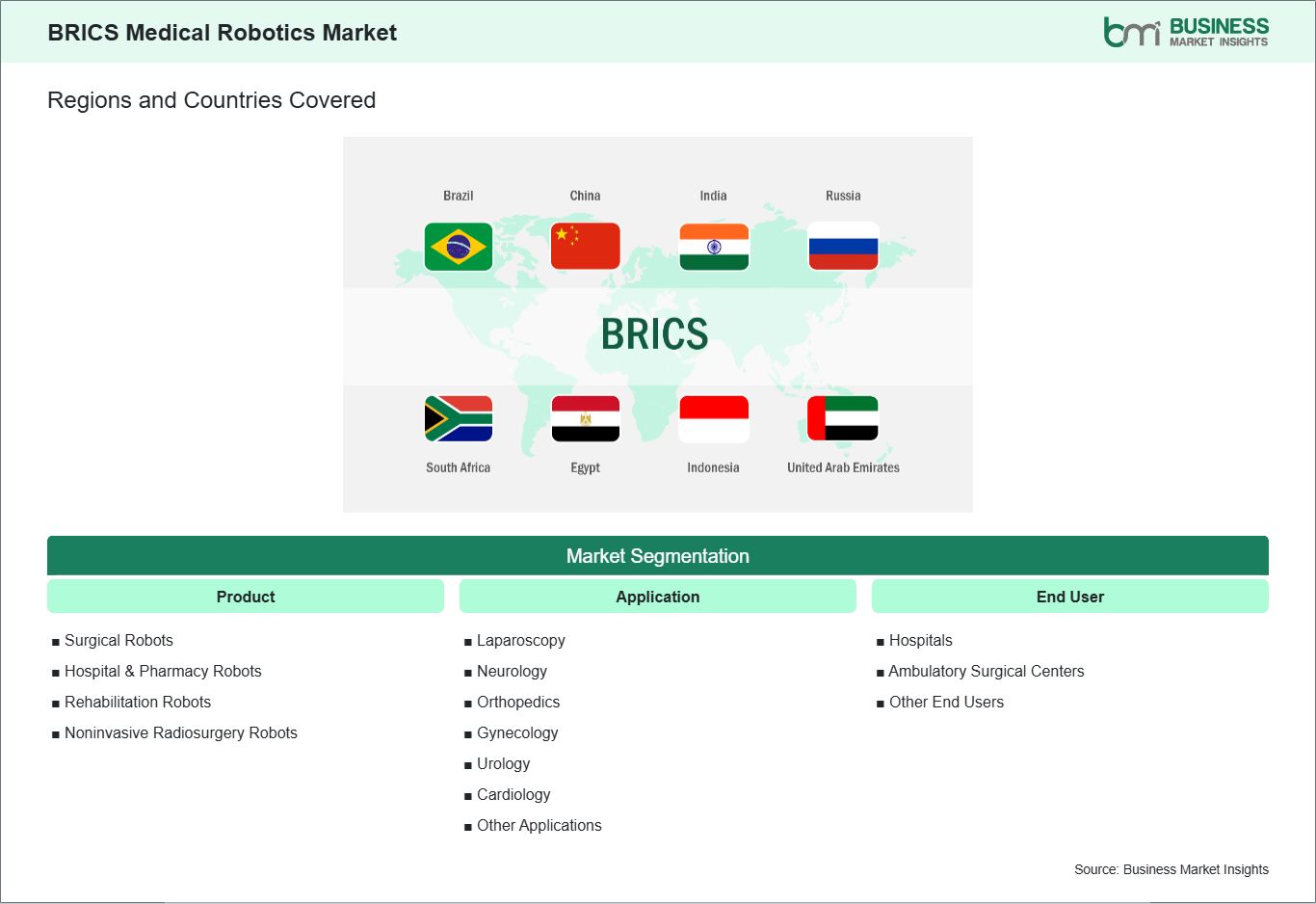
  • Product (Surgical Robots, Hospital & Pharmacy Robots, Rehabilitation Robots, Noninvasive Radiosurgery Robots)
  • Application (Laparoscopy, Neurology, Orthopedics, Gynecology, Urology, Cardiology, Other Applications)
  • End User (Hospitals, Ambulatory Surgical Centers, Other End Users)

No. of Pages: 150
Report Code: BMIPUB00034763
Category: Life Sciences
BRICS Medical Robotics Market

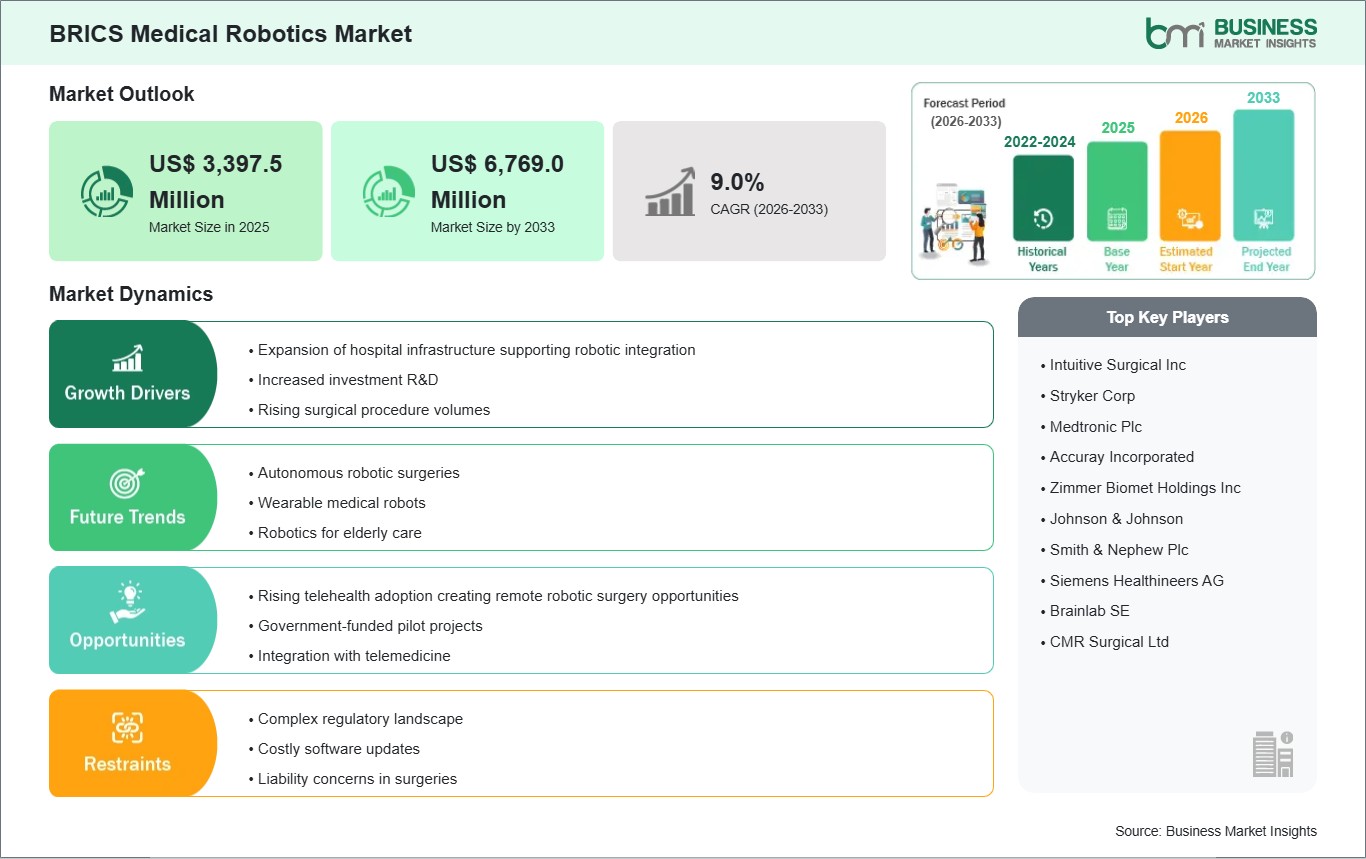
The BRICS medical robotics market size is expected to reach US$ 6,769.0 million by 2033 from US$ 3,397.5 million in 2025. The market is estimated to record a CAGR of 9.0% from 2026 to 2033.

Executive Summary and BRICS Medical Robotics Market Analysis:

The BRICS medical robotics market encompassing Brazil, Russia, India, China, and South BRICS represents a strategically significant growth cluster within the global healthcare automation landscape. The market is characterized by rising institutional demand for precision-driven surgical systems, expanding tertiary care networks, and increasing alignment between healthcare modernization agendas and advanced robotics integration. Rapid urbanization and a growing burden of non-communicable diseases are driving the need for high-accuracy, minimally invasive interventions, prompting leading hospital groups across BRICS nations to invest in robotic-assisted surgery and image-guided platforms. Additionally, government-led healthcare infrastructure upgrades and digital transformation initiatives are creating conducive environments for robotics deployment in large metropolitan centers. From a competitive standpoint, the BRICS region is witnessing intensified participation from both multinational original equipment manufacturers (OEMs) and emerging domestic robotics developers. China and India, in particular, are fostering local manufacturing capabilities and innovation ecosystems that reduce dependency on imports and enhance cost competitiveness. Strategic joint ventures, licensing agreements, and technology transfer partnerships are becoming common market entry pathways. Meanwhile, private hospital chains across Brazil and South BRICS are leveraging robotics as a differentiator to attract medical tourism and premium patient segments. Despite strong momentum, market penetration remains uneven across public and rural healthcare facilities due to capital expenditure constraints and reimbursement variability. Regulatory heterogeneity across BRICS countries further shapes commercialization strategies, requiring vendors to tailor compliance frameworks country by country. Workforce training and maintenance infrastructure also remain critical success factors, as clinical adoption depends heavily on surgeon proficiency and technical support reliability. Overall, the BRICS Medical Robotics Market reflects a dynamic blend of scale-driven opportunity, domestic innovation acceleration, and evolving procurement sophistication, positioning it as a pivotal contributor to the global expansion of robotic healthcare technologies.

BRICS Medical Robotics Market - Strategic Insights:

global-market-strategic-framework
Get more information on this report

BRICS Medical Robotics Market Segmentation Analysis:

Key segments that contributed to the derivation of the BRICS Medical Robotics Market analysis are product, application, and end user.

  • By product, the medical robotics market is segmented into surgical robots, hospital & pharmacy robots, rehabilitation robots, and non-invasive radiosurgery robots. The surgical robots segment dominated the market in 2025.
  • In terms of application, the medical robotics market is categorized into laparoscopy, neurology, orthopedics, gynecology, urology, cardiology, and other applications. The laparoscopy segment dominated the market in 2025.
  • Based on end user, the medical robotics market is classified into hospitals, ambulatory surgical centers, and other end users. The hospitals segment dominated the market in 2025.

BRICS Medical Robotics Market Drivers and Opportunities:

Expansion of hospital infrastructure supporting robotic integration

In the BRICS Medical Robotics Market (Brazil, Russia, India, China, South BRICS), expansion of hospital infrastructure has been a key driver for adopting robotic systems in surgical and therapeutic settings. Across these emerging economies, government and private investments in tertiary care centers have significantly increased the number of facilities capable of supporting advanced robotics. In India, for example, several multi-specialty hospitals such as AIIMS Delhi and Apollo Hospitals Group have installed robotic surgical platforms like da Vinci and Versius to meet the rising demand for minimally invasive procedures. These investments are aligned with broader national healthcare initiatives that emphasize upgrading public and private hospitals to reduce surgical backlogs and improve quality of care. By modernizing operating theaters and building dedicated robotic suites, hospitals are enabling surgeons to leverage the precision and ergonomics of robotic platforms in urology, gynecology, and oncology. Similarly, China’s rapid hospital expansion has created fertile ground for medical robotics. New tertiary hospitals built under national healthcare development plans often include robotics-ready operating rooms with integrated imaging and data infrastructure that support real-time navigation and telepresence. Cities like Shanghai, Beijing, and Guangzhou now feature multiple high-volume robotic surgical centers that handle thousands of robotic procedures annually, with a particular focus on gastrointestinal and thoracic surgery. This infrastructure growth is supported by local manufacturing of robotic arms and ancillary devices, reducing procurement costs and accelerating deployment across mid-tier cities where demand for advanced surgery is rising. In Brazil and South BRICS, hospital upgrades include partnerships with international robotics vendors to bring in both hardware and training programs. In São Paulo, robotic systems have been adopted in private and philanthropic hospitals to perform complex prostatectomies and cardiac procedures, while in South BRICSn academic medical centers, robotics integration is paired with surgeon training fellowships to build long-term technical expertise. Even in Russia, where hospital infrastructure varies widely, major urban hospitals in Moscow and St. Petersburg have invested in surgical robots to improve patient throughput and standardize high-precision surgery. Across BRICS, the strategic expansion of infrastructure underpins broader robotics adoption, addressing historical constraints in access to specialized surgical care and helping hospitals transition from conventional procedures to technology-enabled service delivery.

Rising telehealth adoption creating remote robotic surgery opportunities

The convergence of telehealth adoption and robotic surgery is creating new remote surgical opportunities across BRICS countries, reshaping how advanced care is delivered beyond metropolitan centers. Telehealth platforms gained significant momentum during and after the COVID-19 pandemic, as healthcare systems in Brazil, India, China, Russia, and South BRICS scaled virtual consultations, remote monitoring, and digital follow-ups. This digital maturity has laid the groundwork for exploring remote robotic surgery, where expert surgeons can guide or assist procedures from distant locations, effectively expanding specialist reach into underserved regions. In India, pilot programs have demonstrated remote mentoring of robotic procedures in smaller cities, enabling experienced surgeons in major hubs like Bangalore or Hyderabad to support local teams during complex surgeries via secure telecommunication links. In China, where 5G networks are among the most advanced globally, tele-robotic surgery initiatives have leveraged high-speed connectivity to conduct proof-of-concept demonstrations between urban hospitals and remote community health centers. These trials highlight how real-time low-latency networks can facilitate precise robotic control without perceptible lag, offering a blueprint for scalable remote surgical programs. Similarly, Brazilian health networks are exploring remote robotic support to help specialists in São Paulo or Rio de Janeiro assist surgeons in the Amazon and northeastern states, where access to high-skill surgical care is limited. By coupling telehealth platforms with robotics, these initiatives aim to reduce geographical disparities and enable expert guidance without patient travel. Telehealth-enabled robotic opportunities are also being examined in South BRICS and Russia, where telecommunications infrastructure investments have made remote diagnostics and virtual care more common. In South BRICS, collaborative projects between urban academic hospitals and rural clinics are testing remote coaching and oversight during robotic procedures, strengthening local surgical capacity incrementally. Russian surgical centers, supported by national digital health strategies, are beginning to integrate telepresence tools into robotic suites to support training and remote consultation. Across the BRICS, the fusion of telehealth systems with robotic platforms promises to extend specialty surgical services into wider geographies, democratizing advanced care while optimizing resource utilization and enhancing patient access in regions previously constrained by specialist shortages.

BRICS Medical Robotics Market Size and Share Analysis:

The BRICS medical robotics market demonstrates steady growth, with size and share analysis highlighting evolving trends and competitive dynamics among key players. The report examines subsegments categorized within product, application, and end user, offering insights into their contribution to overall market performance.

By product, the surgical robots segment dominated the market in 2025, driven by major healthcare facilities in BRICS investing in advanced robotic platforms as core systems for a wide range of complex surgical procedures.

In terms of application, the laparoscopy segment dominated the market in 2025, driven by the high utilization of robot-assisted minimally invasive laparoscopic procedures that improve precision, reduce tissue trauma and enhance recovery outcomes.

Based on end user, the hospitals segment dominated the market in 2025, driven by their comprehensive surgical infrastructure, higher procedural volumes and capacity to invest in costly robotic technologies for enhanced patient care.

BRICS Medical Robotics Market Report Highlights:

Report Attribute Details
Market size in 2025 US$ 3,397.5 Million
Market Size by 2033 US$ 6,769.0 Million
CAGR (2026 - 2033)9.0%
Historical Data 2022-2024
Forecast period 2026-2033
Segments Covered By Product
  • Surgical Robots
  • Hospital & Pharmacy Robots
  • Rehabilitation Robots
  • Noninvasive Radiosurgery Robots
By Application
  • Laparoscopy
  • Neurology
  • Orthopedics
  • Gynecology
  • Urology
  • Cardiology
  • Other Applications
By End User
  • Hospitals
  • Ambulatory Surgical Centers
  • Other End Users
Regions and Countries Covered
BRICS Russia, Brazil, South Africa, India, the UAE, China
Market leaders and key company profiles
  • Intuitive Surgical Inc
  • Stryker Corp
  • Medtronic Plc
  • Accuray Incorporated
  • Zimmer Biomet Holdings Inc
  • Johnson & Johnson
  • Smith & Nephew Plc
  • Siemens Healthineers AG
  • Brainlab SE
  • CMR Surgical Ltd
Get more information on this report

BRICS Medical Robotics Market Report Coverage and Deliverables:

The "BRICS Medical Robotics Market Size and Forecast (2022–2033)" report provides a detailed analysis of the market covering below areas:

  • BRICS Medical Robotics Market size and forecast at regional and country levels for all market segments covered under the scope
  • BRICS Medical Robotics Market trends, as well as drivers, restraints, and opportunities
  • BRICS Medical Robotics Market analysis covering key trends, regional framework, major players, regulations, and recent developments
  • Industry landscape and competition analysis covering market concentration, heat map analysis, prominent players, and recent developments for the BRICS Medical Robotics Market
  • Detailed company profiles, including SWOT analysis

BRICS Medical Robotics Market Geographic Insights:

The geographical scope of the BRICS Medical Robotics Market report is divided into Russia, Brazil, South Africa, India, the UAE, and China. China held the largest share in 2025.

Country-level insights into the BRICS Medical Robotics Market reveal diverse adoption dynamics shaped by national healthcare systems, industrial policy frameworks, and innovation maturity. China stands as the dominant market within BRICS, driven by expansive hospital infrastructure, strong state-backed technology programs, and rapidly growing domestic robotics manufacturing capabilities. Large tertiary hospitals in major urban centers are integrating advanced robotic systems across oncology, orthopedics, and neurosurgery, supported by local production incentives and increasing clinical research output. India represents one of the fastest-advancing markets, fueled by private hospital investments, rising medical tourism inflows, and expanding surgical automation in metropolitan healthcare clusters. Adoption remains concentrated in tier-one cities, yet policy initiatives promoting domestic MedTech production are gradually strengthening affordability and supply chain efficiency. In Brazil, robotics integration is largely propelled by private healthcare networks seeking to enhance procedural sophistication and international competitiveness. Public sector adoption progresses more gradually due to budget prioritization processes, though academic hospitals are increasingly participating in robotics trials and training collaborations. Russia demonstrates targeted deployment of medical robotics within specialized federal medical centers, with strategic emphasis on reducing reliance on imported technologies through localized engineering initiatives. Regulatory oversight and centralized procurement mechanisms shape market entry dynamics. South Africa, while comparatively smaller in scale, serves as a gateway to broader African healthcare markets. Advanced private hospitals are early adopters of robotic-assisted surgery, leveraging the technology to support complex procedures and attract cross-border patients. Across BRICS nations, common themes include scaling domestic capability, strengthening technical training infrastructure, and aligning robotics adoption with national healthcare modernization objectives, ensuring sustained long-term integration across diverse healthcare environments.

global-market-geography
Get more information on this report

BRICS Medical Robotics Market Research Report Guidance:

  • The report includes qualitative and quantitative data in the BRICS Medical Robotics Market across product, application, end user, and geography.
  • The report starts with the key takeaways (chapter 2), highlighting key trends and outlook of the BRICS Medical Robotics Market.
  • Chapter 3 focuses on the research methodology of the study.
  • Chapter 4 includes ecosystem analysis.
  • Chapter 5 highlights the major industry dynamics in the BRICS Medical Robotics Market, including factors that are driving the market, prevailing deterrents, potential opportunities, as well as future trends. Impact analysis of these drivers and restraints is also covered in this section.
  • Chapter 6 discusses the BRICS Medical Robotics Market scenario, in terms of historical market revenues, and forecast till the year 2033.
  • Chapters 7 to 10 cover BRICS Medical Robotics Market segments by product, application, end user, and geography across Russia, Brazil, South Africa, India, the UAE, and China. They cover the market revenue forecast and factors driving the market.
  • Chapter 11 describes the competitive analysis along with the heat map analysis for the key players operating in the market.
  • Chapter 12 describes the industry landscape analysis. It provides detailed descriptions of business activities such as market initiatives, new developments, mergers, and joint ventures globally, along with a competitive landscape.
  • Chapter 13 provides detailed profiles of the major companies operating in the BRICS Medical Robotics Market. Companies have been profiled on the basis of their key facts, business descriptions, products, financial overview, SWOT analysis, and key developments.
  • Chapter 14, i.e., the appendix, is inclusive of a brief overview of the company, a list of abbreviations, and a disclaimer.

BRICS Medical Robotics Market News and Key Development:

The BRICS Medical Robotics Market is evaluated by gathering qualitative and quantitative data post primary and secondary research, which includes important corporate publications, association data, and databases. A few of the key developments in the BRICS Medical Robotics Market are:

  • In September 2025, Meril Life Sciences unveiled the Mizzo Endo 4000, an advanced soft-tissue surgical robotic system made in India, representing a landmark innovation in robotic-assisted surgery. The platform integrates AI-powered 3D visualisation and 5G-enabled telesurgery capabilities to support over 100 procedures across specialties such as urology, gynaecology, oncology and more. This launch underscores India’s growing leadership in high-end medical technology and aims to improve surgical precision and accessibility across the region. The system’s open console and versatile design are positioned to enhance operating room integration and surgeon control.
  • In February 2026, AK Medical Holdings Limited received market approval in China for its K3+ Orthopedic Robotic System, a domestically developed total joint surgical robot capable of performing hip, knee and unicompartmental procedures, including revision surgeries. The compact robotic system supports preoperative planning and intraoperative assistance with stable and efficient robotic arm operations, aiming to enhance precision and workflow efficiency in orthopaedic surgery. This product marks a significant expansion of China’s orthopedic robotics capabilities and reflects rapid innovation in surgical robotics technology.

Key Sources Referred:

  • World Health Organization (WHO)
  • Organisation for Economic Cooperation and Development (OECD)
  • The World Bank Group
  • Worldometer
  • The Lancet
  • International Bar Association
  • International Trade Administration
The List of Companies - BRICS Medical Robotics Market
  • Intuitive Surgical Inc
  • Stryker Corp
  • Medtronic Plc
  • Accuray Incorporated
  • Zimmer Biomet Holdings Inc
  • Johnson & Johnson
  • Smith & Nephew Plc
  • Siemens Healthineers AG
  • Brainlab SE
  • CMR Surgical Ltd
Frequently Asked Questions
How big is the BRICS Medical Robotics Market?

The BRICS Medical Robotics Market is valued at US$ 3,397.5 Million in 2025, it is projected to reach US$ 6,769.0 Million by 2033.

What is the CAGR for BRICS Medical Robotics Market by (2026 - 2033)?

As per our report BRICS Medical Robotics Market, the market size is valued at US$ 3,397.5 Million in 2025, projecting it to reach US$ 6,769.0 Million by 2033. This translates to a CAGR of approximately 9.0% during the forecast period.

What segments are covered in this report?

The BRICS Medical Robotics Market report typically cover these key segments-

  • Product (Surgical Robots, Hospital & Pharmacy Robots, Rehabilitation Robots, Noninvasive Radiosurgery Robots)
  • Application (Laparoscopy, Neurology, Orthopedics, Gynecology, Urology, Cardiology, Other Applications)
  • End User (Hospitals, Ambulatory Surgical Centers, Other End Users)

What is the historic period, base year, and forecast period taken for BRICS Medical Robotics Market?

The historic period, base year, and forecast period can vary slightly depending on the specific market research report. However, for the BRICS Medical Robotics Market report:

  • Historic Period : 2022-2024
  • Base Year : 2025
  • Forecast Period : 2026-2033
  • Who are the major players in BRICS Medical Robotics Market?

    The BRICS Medical Robotics Market is populated by several key players, each contributing to its growth and innovation. Some of the major players include:

  • Intuitive Surgical Inc
  • Stryker Corp
  • Medtronic Plc
  • Accuray Incorporated
  • Zimmer Biomet Holdings Inc
  • Johnson & Johnson
  • Smith & Nephew Plc
  • Siemens Healthineers AG
  • Brainlab SE
  • CMR Surgical Ltd
  • Who should buy this report?

    The BRICS Medical Robotics Market report is valuable for diverse stakeholders, including:

    • Investors: Provides insights for investment decisions pertaining to market growth, companies, or industry insights. Helps assess market attractiveness and potential returns.
    • Industry Players: Offers competitive intelligence, market sizing, and trend analysis to inform strategic planning, product development, and sales strategies.
    • Suppliers and Manufacturers: Helps understand market demand for components, materials, and services related to concerned industry.
    • Researchers and Consultants: Provides data and analysis for academic research, consulting projects, and market studies.
    • Financial Institutions: Helps assess risks and opportunities associated with financing or investing in the concerned market.

    Essentially, anyone involved in or considering involvement in the BRICS Medical Robotics Market value chain can benefit from the information contained in a comprehensive market report.

    Available Report Formats

    pdf-format excel-format pptx-format
    Buy Now
    Sales Assistance
    +1 646 791 7070 (US & UK)
    Customization Form

    Please tell us your area of interest
    (Market Segments/ Regions and Countries/ Companies)