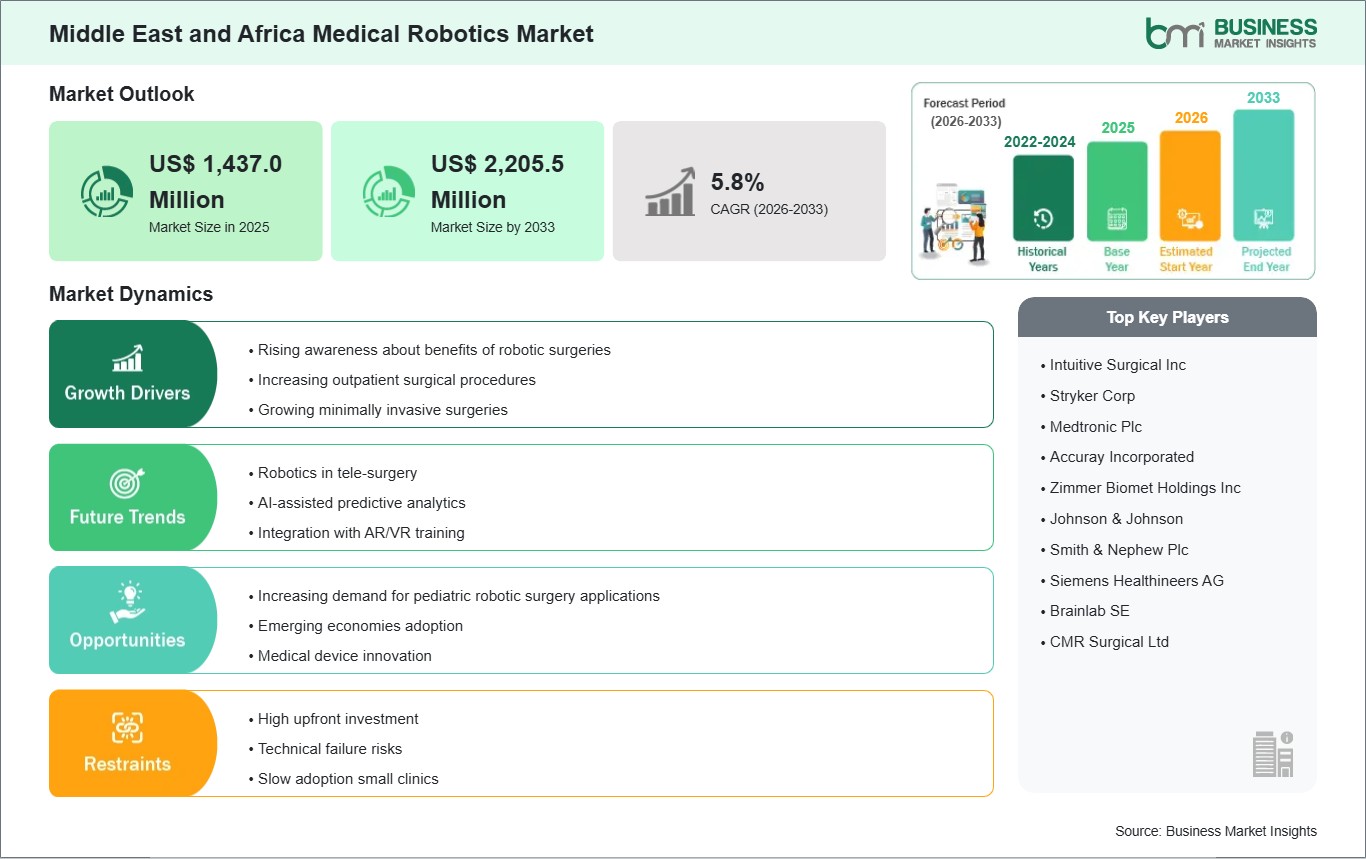
The Middle East and Africa medical robotics market size is expected to reach US$ 2,205.5 million by 2033 from US$ 1,437.0 million in 2025. The market is estimated to record a CAGR of 5.8% from 2026 to 2033.
The Middle East and Africa (MEA) medical robotics market is experiencing gradual yet strategic adoption as healthcare systems across diverse economic landscapes seek to modernize clinical delivery and elevate care quality. In high‑income Gulf Cooperation Council (GCC) countries such as Saudi Arabia, the United Arab Emirates, and Qatar, rapid investment in advanced medical infrastructure and digital health initiatives is creating fertile ground for robotic surgical systems, rehabilitation robotics, and hospital automation technologies. These markets are characterized by deliberate procurement strategies, often tied to national visions aimed at reducing medical outbound travel, enhancing procedural precision, and advancing specialized care services. Private sector hospital networks in major urban centers are particularly active in adopting medical robotics to strengthen their competitive positioning and satisfy increasingly sophisticated patient expectations. In contrast, adoption across many African markets remains nascent, with select urban centers in South Africa, Egypt, and Nigeria emerging as early adopters. In these regions, robotics is often deployed within top‑tier tertiary institutions where capacity for specialist procedures is high and institutional leadership champions technological innovation. A key trend in the MEA region is the growing prevalence of partnership‑based deployment models, involving global robotics manufacturers, local healthcare providers, and clinical training organizations. These alliances are aimed at building clinical evidence, establishing technical support frameworks, and tailoring solutions to regional workflow needs. However, several challenges temper widespread adoption. High capital expenditure requirements, limited reimbursement frameworks, and shortages of trained robotics clinicians and maintenance personnel create barriers, particularly in low‑ and middle‑income markets. Additionally, regulatory heterogeneity across the region requires vendors to navigate complex compliance landscapes, often extending time‑to‑market. In response, stakeholders are exploring flexible procurement mechanisms such as leasing, robotics‑as‑a‑service, and shared clinical hubs that optimize utilization and lower entry barriers. Overall, the MEA Medical Robotics Market reflects a fragmented but opportunity‑rich environment where strategic investments, policy support, and cross‑sector collaboration will be pivotal in realizing the region’s long‑term potential for robotics integration.

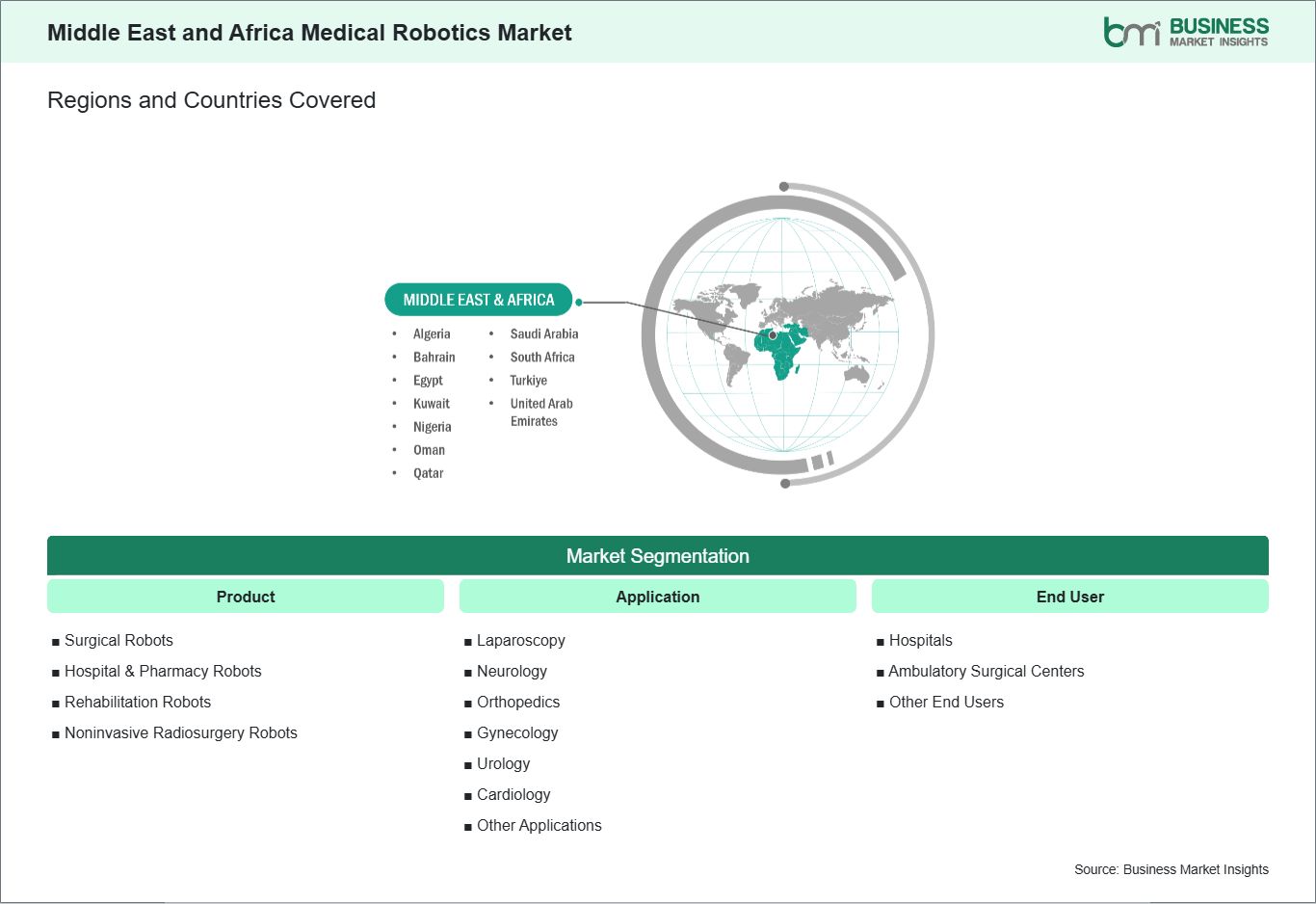
Key segments that contributed to the derivation of the Middle East and Africa Medical Robotics Market analysis are product, application, and end user.
Awareness about the advantages of robotic surgeries is growing rapidly across the Middle East and Africa, driving interest among healthcare providers and patients alike. Medical robotics offers precise control, minimally invasive procedures, and improved post-operative outcomes, which are increasingly recognized as valuable benefits in clinical practice. This rising awareness is encouraging hospitals to explore the integration of robotic systems into their surgical programs, creating opportunities for broader adoption across the region. Healthcare institutions are promoting the benefits of robotic surgery through training programs, patient education, and collaboration with technology providers. Surgeons are learning how robotic platforms enhance their ability to perform complex procedures with accuracy and consistency, while patients are becoming more informed about the reduced recovery times, lower risk of complications, and improved overall experience associated with robotic-assisted operations. This growing knowledge base is fostering trust in robotics as a standard part of modern surgical care. Additionally, the emphasis on awareness is encouraging healthcare systems to invest in infrastructure that supports robotic surgery. Operating rooms are being adapted to accommodate robotic platforms, and medical teams are receiving specialized training to maximize the potential of these technologies. As awareness continues to increase among both clinicians and patients, robotic surgeries are likely to become an integral component of the healthcare landscape in the Middle East and Africa, supporting enhanced outcomes and more efficient surgical workflows.
Pediatric robotic surgery is gaining attention in the Middle East and Africa as healthcare providers seek safer and more precise options for treating children with complex conditions. Robotic systems allow surgeons to perform delicate procedures with improved accuracy and minimal invasiveness, which is particularly important in pediatric care due to smaller anatomical structures and the need for reduced trauma. This growing demand is encouraging hospitals to expand robotic programs to include pediatric surgical applications. The adoption of pediatric robotic surgery is also being driven by the desire to improve clinical outcomes and reduce post-operative complications. Robotic platforms provide stable instrument control and enhanced visualization, enabling surgeons to conduct procedures that would otherwise be challenging with traditional techniques. Parents and caregivers are increasingly aware of the benefits of minimally invasive robotic surgery for children, including shorter recovery periods and less post-surgical discomfort, which contributes to demand growth in this specialized area. Furthermore, investment in pediatric robotic surgery supports the broader development of healthcare capabilities in the region. Hospitals are creating dedicated programs that integrate robotic technology with pediatric care protocols, ensuring that clinical teams have the expertise and resources to perform complex procedures safely. As technology adoption grows and awareness of pediatric robotic applications spreads, healthcare providers in the Middle East and Africa are expected to expand these services, positioning robotic surgery as a preferred option for treating children while enhancing overall surgical quality and patient safety.
The Middle East and Africa medical robotics market demonstrates steady growth, with size and share analysis highlighting evolving trends and competitive dynamics among key players. The report examines subsegments categorized within product, application, and end user, offering insights into their contribution to overall market performance.
By product, the surgical robots segment dominated the market in 2025, driven by the increasing adoption of robotic systems for precision and complex surgeries.
In terms of application, the laparoscopy segment dominated the market in 2025, riven by the growing demand for minimally invasive procedures with quicker patient recovery.
Based on end user, the hospitals segment dominated the market in 2025, driven by rising healthcare investments and expansion of technologically advanced medical facilities.
| Report Attribute | Details |
|---|---|
| Market size in 2025 | US$ 1,437.0 Million |
| Market Size by 2033 | US$ 2,205.5 Million |
| CAGR (2026 - 2033) | 5.8% |
| Historical Data | 2022-2024 |
| Forecast period | 2026-2033 |
| Segments Covered | By Product
|
|
Regions and Countries Covered
| |
| Middle East and Africa | Turkiye, the UAE, Saudi Arabia, Bahrain, Oman, Egypt, South Africa, Algeria, Nigeria, Kuwait, Qatar |
| Market leaders and key company profiles |
|
The "Middle East and Africa Medical Robotics Market Size and Forecast (2022–2033)" report provides a detailed analysis of the market covering below areas:
The geographical scope of the Middle East and Africa Medical Robotics Market report is divided into Turkiye, the UAE, Saudi Arabia, Bahrain, Oman, Egypt, South Africa and Africa, Algeria, Nigeria, Kuwait, and Qatar. Turkiye held the largest share in 2025.
Country‑level insights into the Middle East and Africa Medical Robotics Market reveal a highly differentiated landscape shaped by national healthcare priorities, infrastructure maturity, and investment strategies across Turkiye, the UAE, Saudi Arabia, Bahrain, Oman, Egypt, South Africa, Algeria, Nigeria, Kuwait, and Qatar. Turkiye emerges as the dominant market in the region, driven by a combination of advanced healthcare infrastructure, strong public and private sector investment, and a growing medical technology ecosystem. Major hospitals in Istanbul, Ankara, and Izmir are adopting robotic-assisted surgical systems across urology, oncology, orthopedics, and cardiothoracic procedures. Local manufacturing capabilities, combined with strategic partnerships with global robotics providers, support scalable deployment and enhance workforce training initiatives, positioning Turkiye as a regional hub for medical robotics adoption and clinical innovation. The UAE maintains rapid adoption within metropolitan hospitals and private healthcare networks, particularly in Dubai and Abu Dhabi, where robotics is integrated with advanced imaging and digital health infrastructure. National healthcare strategies and innovation-driven policies encourage investment in robotic surgery, rehabilitation robotics, and telepresence platforms, reinforcing the UAE’s position as a regional innovation leader. Saudi Arabia leverages its Vision 2030 healthcare reform agenda to promote robotics adoption, emphasizing oncology, cardiology, and minimally invasive procedures. Key tertiary hospitals are increasingly implementing robotic systems through public-private collaborations and international technology partnerships, supporting local clinical expertise development. Bahrain and Oman exhibit selective deployment of robotics in specialty hospitals and teaching institutions, focusing on high-precision procedures and workforce skill enhancement. These smaller markets adopt technology strategically to optimize clinical outcomes and support localized centers of excellence. In Egypt, adoption is concentrated within leading urban hospitals, with academic collaborations enabling the integration of surgical robotics and clinical training programs. South Africa focuses on advanced private hospitals in Johannesburg and Cape Town, driven by medical tourism demand and high-complexity procedures. Algeria and Nigeria demonstrate emerging adoption, primarily in metropolitan referral hospitals, while Kuwait and Qatar strategically invest in flagship institutions to elevate care quality and attract regional patients. Across the MEA region, Turkiye leads in scale, ecosystem maturity, and strategic investment, while other countries demonstrate variable adoption influenced by healthcare policy, infrastructure, and funding availability. Overall, these country-level insights reflect a heterogeneous landscape with significant opportunities for robotics expansion, driven by a combination of national priorities, private sector leadership, and regional collaboration initiatives.

The Middle East and Africa Medical Robotics Market is evaluated by gathering qualitative and quantitative data post primary and secondary research, which includes important corporate publications, association data, and databases. A few of the key developments in the Middle East and Africa Medical Robotics Market are:
The Middle East and Africa Medical Robotics Market is valued at US$ 1,437.0 Million in 2025, it is projected to reach US$ 2,205.5 Million by 2033.
As per our report Middle East and Africa Medical Robotics Market, the market size is valued at US$ 1,437.0 Million in 2025, projecting it to reach US$ 2,205.5 Million by 2033. This translates to a CAGR of approximately 5.8% during the forecast period.
The Middle East and Africa Medical Robotics Market report typically cover these key segments-
The historic period, base year, and forecast period can vary slightly depending on the specific market research report. However, for the Middle East and Africa Medical Robotics Market report:
The Middle East and Africa Medical Robotics Market is populated by several key players, each contributing to its growth and innovation. Some of the major players include:
The Middle East and Africa Medical Robotics Market report is valuable for diverse stakeholders, including:
Essentially, anyone involved in or considering involvement in the Middle East and Africa Medical Robotics Market value chain can benefit from the information contained in a comprehensive market report.
Please tell us your area of interest
(Market Segments/ Regions and Countries/ Companies)