Market Summary
Executive Summary and Market Analysis
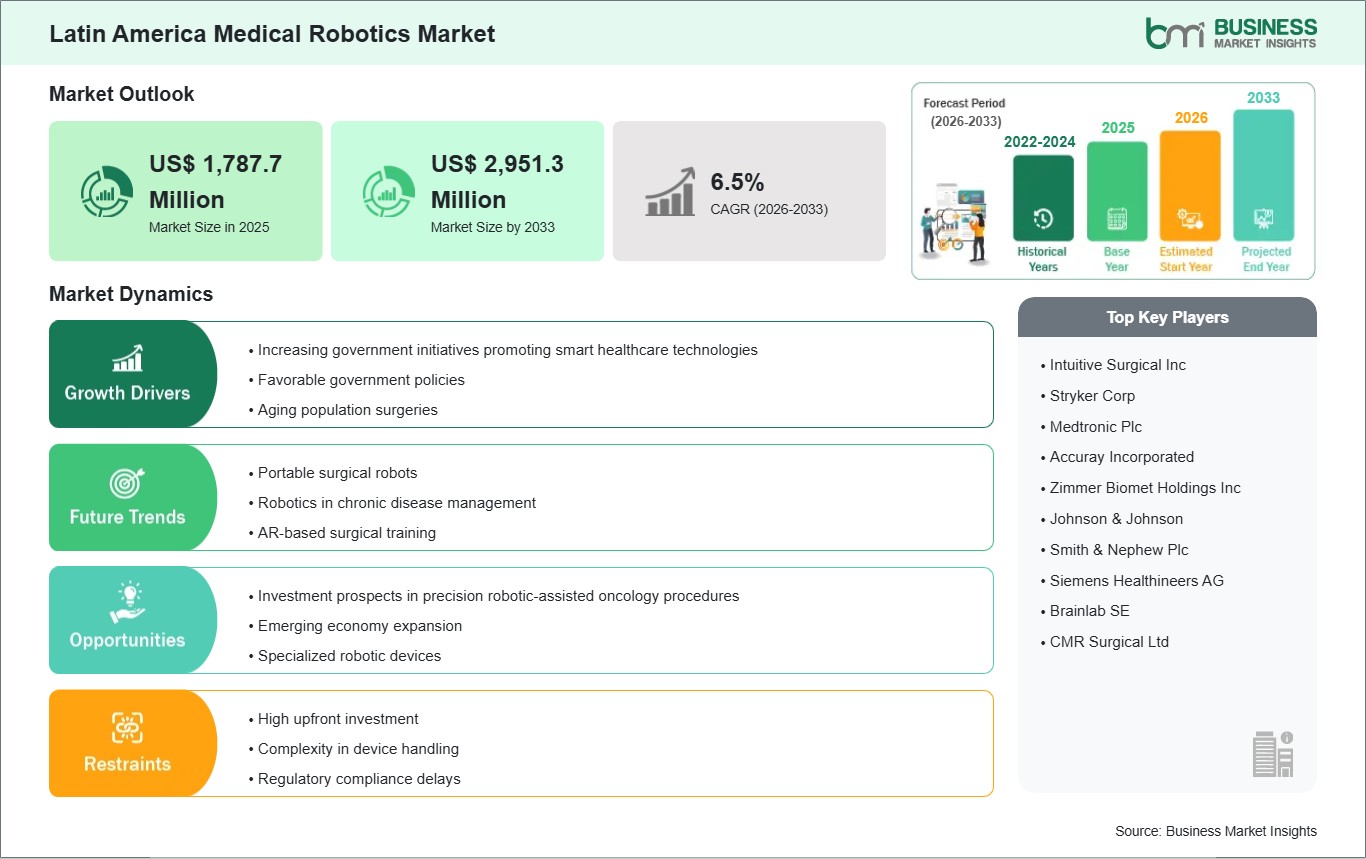
The Latin America medical robotics market is advancing steadily as healthcare systems across the region prioritize quality enhancement, procedural precision, and technological modernization. Key markets such as Brazil, Mexico, Argentina, and Chile are increasingly investing in robotic-assisted solutions particularly for minimally invasive surgery and complex care pathways to address mounting clinical demands and growing expectations for patient outcomes comparable to developed markets. The adoption landscape is marked by a clear bifurcation: private healthcare networks in major urban centers are leading investments, driven by competitive differentiation and a strategic focus on premium care delivery, while public institutions, constrained by budgetary pressures, are adopting robotics more selectively, often through government pilot programs or international collaborations. Brazil stands out as a strategic hub, hosting a significant share of surgical robotics programs in the region and attracting multinational robotics providers seeking market traction. This leadership reflects not only robust clinical adoption in metropolitan hospitals but also an expanding medical tourism segment where advanced procedural technologies bolster institutional reputation. Mexico, similarly, has seen progressive uptake of robotic systems in high‑volume private hospital networks, with an emphasis on urology and gynecological specialties that align with regional disease burden patterns. Meanwhile, Argentina and Chile are gaining momentum through academic‑industry partnerships that support localized clinical trials and evidence generation, helping to mitigate skepticism around efficacy and cost justification. Despite this positive trajectory, adoption challenges persist. High upfront costs, limited reimbursement frameworks, and disparities in healthcare infrastructure across urban and rural areas temper market expansion. Regulatory environments although improving remain heterogenous across countries, requiring vendors to adopt tailored entry strategies that account for local compliance nuances. Workforce readiness is another critical factor; the availability of trained robotic surgeons and technical support personnel directly influences adoption rates and integration success. Overall, the Latin America Medical Robotics Market is characterized by strategic investments in technology‑enabled care, growing clinical acceptance of robotics, and a competitive landscape shaped by public‑private participation and regional clinical priorities.
Segment Analysis
Latin America Medical Robotics Market Segmentation
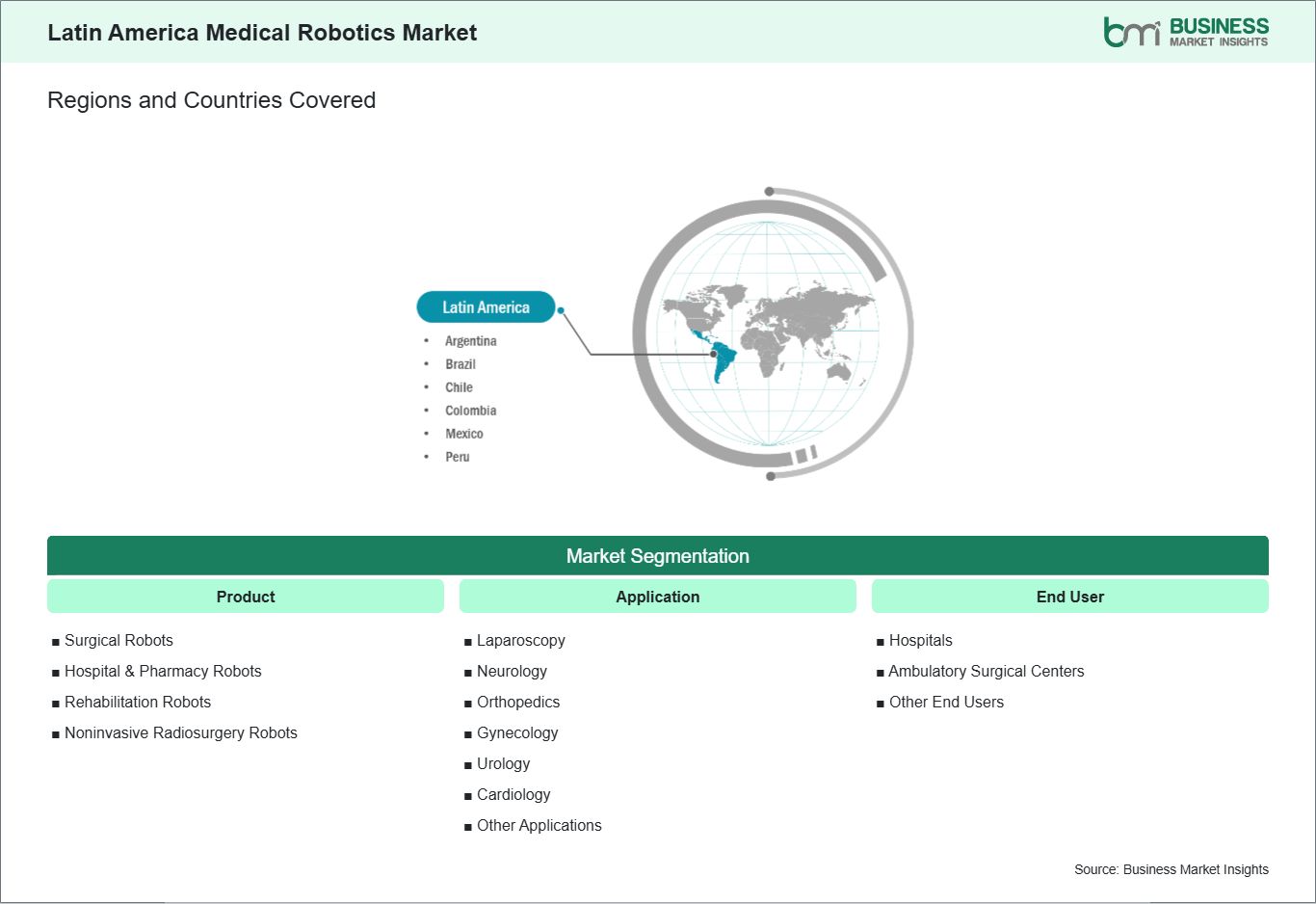
Key segments that contributed to the derivation of the Latin America Medical Robotics Market analysis are product, application, and end user.
- By product, the medical robotics market is segmented into surgical robots, hospital & pharmacy robots, rehabilitation robots, and non-invasive radiosurgery robots. The surgical robots segment dominated the market in 2025.
- In terms of application, the medical robotics market is categorized into laparoscopy, neurology, orthopedics, gynecology, urology, cardiology, and other applications. The laparoscopy segment dominated the market in 2025.
- Based on end user, the medical robotics market is classified into hospitals, ambulatory surgical centers, and other end users. The hospitals segment dominated the market in 2025.
Market Forces
Latin America Medical Robotics Market Drivers and Opportunities
Increasing government initiatives promoting smart healthcare technologies
Government initiatives in Latin America are playing a key role in promoting smart healthcare technologies, creating favorable conditions for the adoption of medical robotics. Policymakers are increasingly prioritizing digital transformation in healthcare systems, emphasizing the integration of advanced technologies to improve patient care, operational efficiency, and overall clinical outcomes. These initiatives encourage hospitals and healthcare providers to explore robotics as a means to modernize surgical procedures and streamline workflows. The focus on smart healthcare encompasses the deployment of robotic systems that enhance surgical precision, assist in patient monitoring, and support data-driven decision-making. Healthcare authorities are promoting programs that provide guidance, funding, and training for the adoption of these technologies. This fosters an environment where healthcare institutions can implement robotic systems with greater confidence, ensuring that staff are prepared to leverage the full potential of automation in both surgical and clinical care settings. In addition, government support is encouraging the expansion of technology infrastructure, such as digital operating rooms, integrated imaging systems, and connected devices that complement robotic platforms. By aligning healthcare modernization with regulatory frameworks and strategic investment plans, Latin American countries are creating a foundation for sustainable adoption of robotics. These initiatives help accelerate the integration of advanced technologies across both urban and regional healthcare facilities, enabling improved service delivery, enhanced patient safety, and the broader realization of smart healthcare goals throughout the region.
Investment prospects in precision robotic-assisted oncology procedures
Precision robotic-assisted oncology procedures are emerging as a significant investment opportunity in Latin America, driven by the growing demand for minimally invasive cancer treatments. Robotic systems provide enhanced accuracy, improved visualization, and stable instrument control during complex oncological surgeries. This enables surgeons to perform delicate tumor resections and reconstructive procedures with greater confidence, reducing complications and supporting better patient outcomes. The adoption of robotics in oncology also allows hospitals to expand the range of surgical options available to patients, particularly for cancers that require high-precision intervention. By incorporating robotic platforms, healthcare providers can offer less invasive procedures, faster recovery, and improved post-operative care. This focus on precision and efficiency makes robotic-assisted oncology an attractive area for investment, as institutions seek to differentiate their services and deliver high-quality treatment options in a competitive healthcare landscape. Moreover, the growth of robotic-assisted oncology procedures is encouraging collaborations and partnerships within the healthcare sector. Investments are being directed not only toward acquiring advanced robotic systems but also toward training surgeons and integrating technology with hospital workflows. As Latin American healthcare systems continue to prioritize cancer care and precision surgery, the prospects for investment in robotic-assisted oncology are expected to expand steadily. This presents opportunities for both technology providers and healthcare institutions to drive innovation while improving outcomes for patients across the region.
Size and Share Analysis
Latin America Medical Robotics Market Size and Share Analysis
The Latin America medical robotics market demonstrates steady growth, with size and share analysis highlighting evolving trends and competitive dynamics among key players. The report examines subsegments categorized within product, application, and end user, offering insights into their contribution to overall market performance.
By product, the surgical robots segment dominated the market in 2025, driven by the rising adoption of technologically advanced robotic systems for precision surgeries.
In terms of application, the laparoscopy segment dominated the market in 2025, driven by the increasing preference for minimally invasive procedures with faster recovery.
Based on end user, the hospitals segment dominated the market in 2025, driven by growing investments in healthcare infrastructure and advanced surgical technologies.
Report Coverage
Latin America Medical Robotics Market Report Coverage and Deliverables
The "Latin America Medical Robotics Market Size and Forecast (2022–2033)" report provides a detailed analysis of the market covering below areas:
- Latin America Medical Robotics Market size and forecast at regional and country levels for all market segments covered under the scope
- Latin America Medical Robotics Market trends, as well as drivers, restraints, and opportunities
- Latin America Medical Robotics Market analysis covering key trends, regional framework, major players, regulations, and recent developments
- Industry landscape and competition analysis covering market concentration, heat map analysis, prominent players, and recent developments for the Latin America Medical Robotics Market
- Detailed company profiles, including SWOT analysis
Geographic Insights
Latin America Medical Robotics Market Geographic Insights
The geographical scope of the Latin America Medical Robotics Market report is divided into Mexico, Brazil, Argentina, Peru, Chile, and Colombia. Brazil held the largest share in 2025.
Country‑level insights into the Latin America Medical Robotics Market illustrate differentiated adoption patterns shaped by national healthcare priorities, infrastructure maturity, and investment landscapes across Brazil, Mexico, Argentina, Chile, and Colombia. Brazil serves as the dominant market in the region, with tertiary hospitals in Sao Paulo and Rio de Janeiro leading the deployment of advanced robotic systems, particularly in high‑volume specialties such as urology, oncology, and orthopedics. Brazil’s extensive private healthcare network, alongside government‑supported pilot initiatives, has created a robust clinical ecosystem for robotics adoption, establishing the country as a regional hub for procedural innovation and medical tourism. In Mexico, robotics integration is likewise advancing within major private hospital networks, where institutions leverage technology to elevate procedural quality and attract international patients. Mexico’s larger healthcare providers are conducting clinical evidence programs to demonstrate the value of robotics in reducing recovery times and improving long‑term outcomes, which is key to engaging payers and expanding adoption beyond flagship facilities. Argentina exhibits a growing focus on academic‑industry collaborations. Centers of excellence are partnering with robotics manufacturers to conduct localized clinical studies and training programs, which help build clinician confidence and generate region‑specific efficacy data. Similarly, Chile is advancing adoption through strategic investments in metropolitan hospitals, supported by government funding mechanisms aimed at modernizing healthcare infrastructure and improving care quality metrics. Colombia represents an emerging frontier where robotics uptake is gaining traction among private and hybrid public‑private institutions. These facilities are selectively investing in surgical robots for high‑impact procedures as part of broader care quality initiatives, despite budgetary constraints that limit rapid scale. Collectively, these country insights underscore that while Brazil leads in scale and ecosystem maturity, each market presents unique opportunities shaped by clinical priorities, regulatory evolution, and strategic investment choices that influence robotics adoption across the Latin American healthcare landscape.
Industry Activity
Recent Developments
The Latin America Medical Robotics Market is evaluated by gathering qualitative and quantitative data post primary and secondary research, which includes important corporate publications, association data, and databases. A few of the key developments in the Latin America Medical Robotics Market are:
- In December 2024, MicroPort MedBot’s Toumai endoscopic surgical robot received market approval from Brazil’s National Health Surveillance Agency (ANVISA), clearing its commercial use throughout the country. This regulatory milestone marks one of the first dedicated laparoscopic surgical robots authorised in Latin America, expanding access to advanced minimally invasive procedures. The launch event in São Paulo included demonstrations and a remote animal surgery highlighting robotics and telesurgery potential. The approval is expected to drive greater adoption of robot‑assisted surgery across Brazilian hospitals.
- In October 2025, the Toumai surgical robot achieved a global rollout milestone with significant orders and deliveries, including installations in Latin America, where hospitals such as Hospital Nove de Julho in Brazil completed the region’s first commercial remote human surgery. This marks an evolution in deploying advanced robotic platforms capable of telesurgery functions across continents. Hospitals in the region are now better positioned to integrate robotics with remote surgical support and training networks. The milestone reflects rising demand and broader acceptance of robotic‑assisted procedures throughout Latin American healthcare systems.
Trust & Transparency
Research Methodology
The market analysis combines proprietary research with secondary data from government agencies, company disclosures, regulatory filings, industry databases and expert interviews. Market estimates are validated through data triangulation, cross-market benchmarking and analyst
review.
View Full Research Methodology
Key Sources Referred:
World Health Organization (WHO)Organisation for Economic Cooperation and Development (OECD)The World Bank GroupWorldometerThe LancetInternational Bar AssociationInternational Trade Administration