Africa Medical Robotics Market Outlook (2022-2033)

Historic Data: 2022-2024   |   Base Year: 2025   |   Forecast Period: 2026-2033
Report Content: Market Scope, Market Segmentation, Market Dynamics, and Competitive Analysis

Report Coverage:
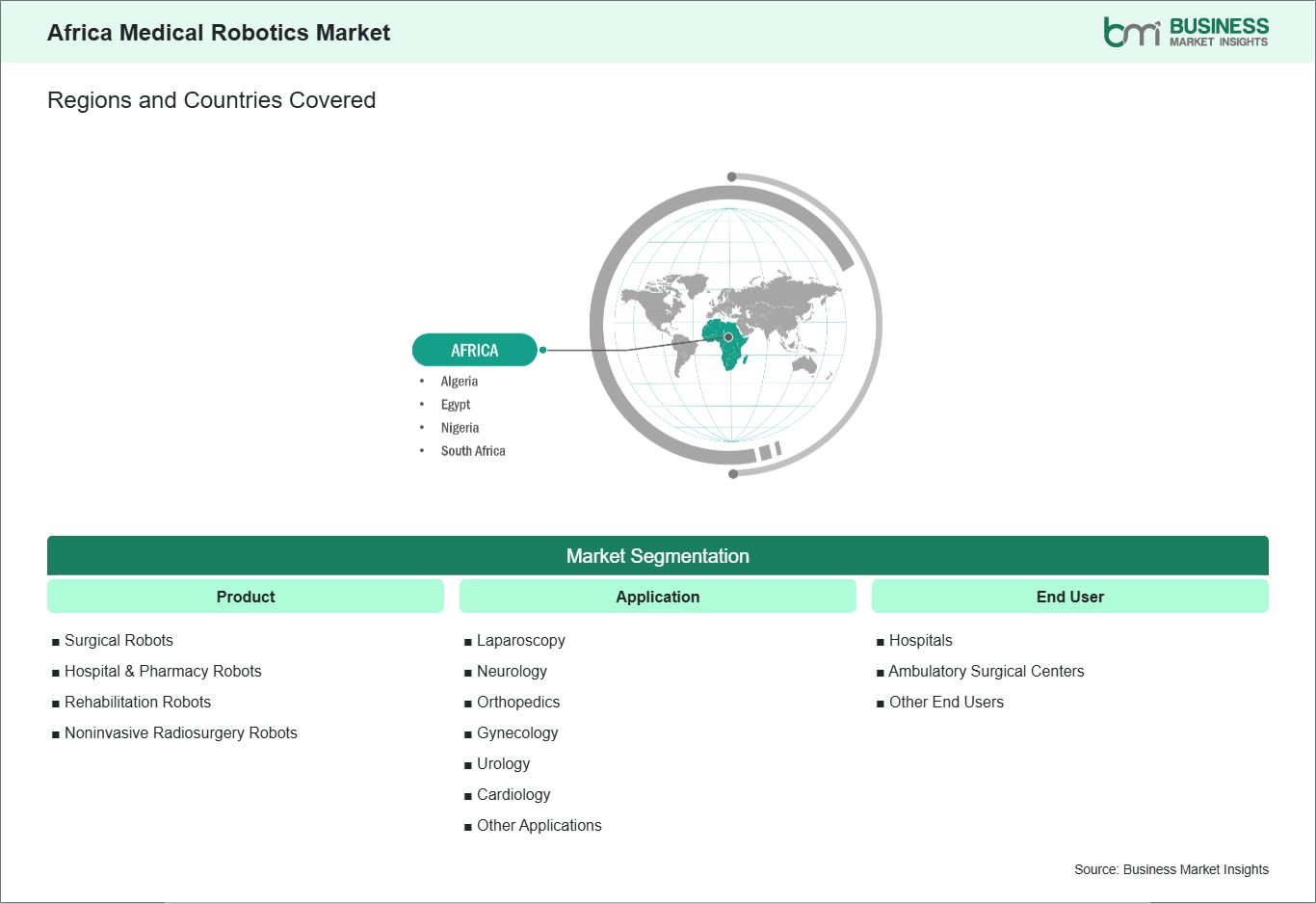
  • Product (Surgical Robots, Hospital & Pharmacy Robots, Rehabilitation Robots, Noninvasive Radiosurgery Robots)
  • Application (Laparoscopy, Neurology, Orthopedics, Gynecology, Urology, Cardiology, Other Applications)
  • End User (Hospitals, Ambulatory Surgical Centers, Other End Users)

No. of Pages: 150
Report Code: BMIPUB00034760
Category: Life Sciences
Africa Medical Robotics Market

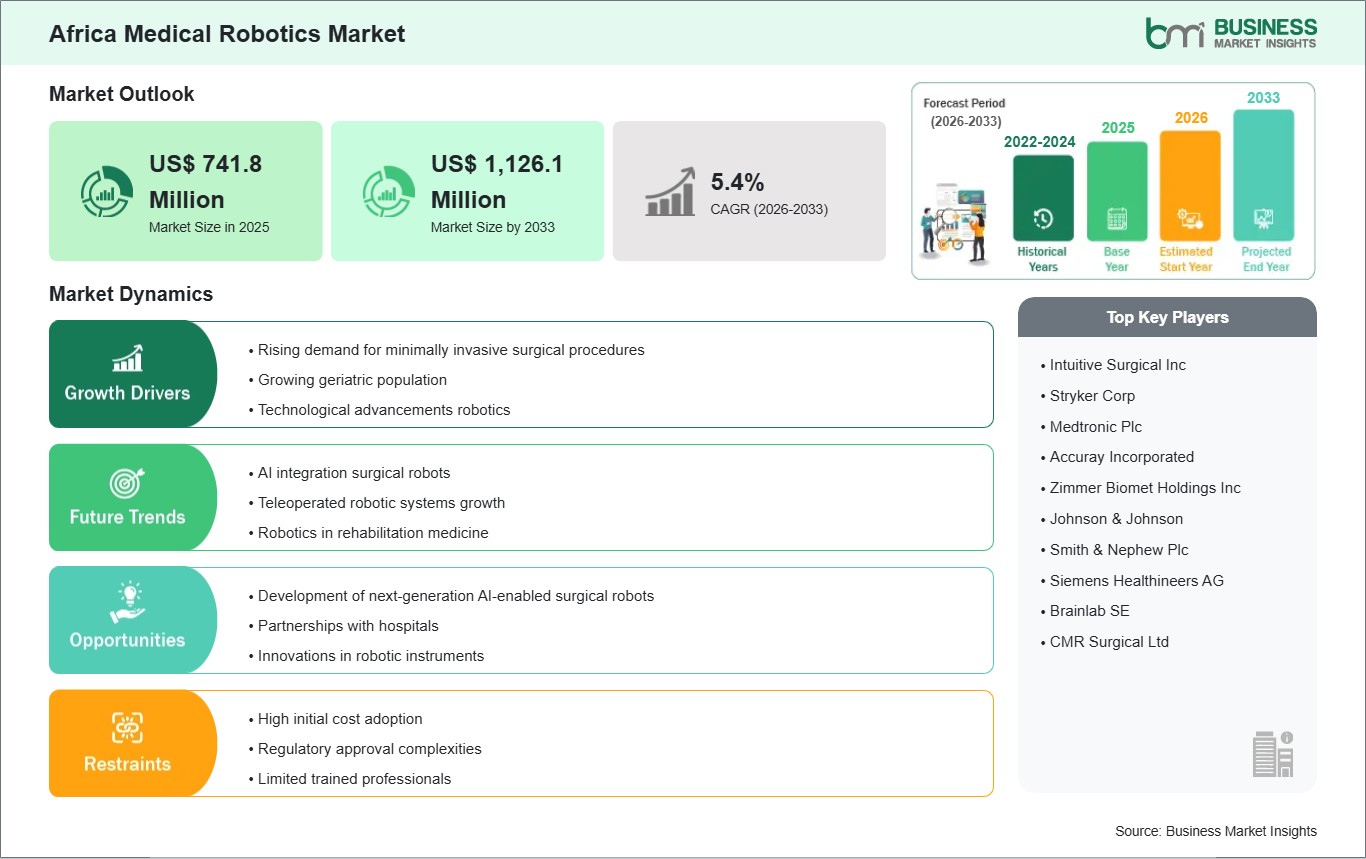
The Africa medical robotics market size is expected to reach US$ 1,126.1 million by 2033 from US$ 741.8 million in 2025. The market is estimated to record a CAGR of 5.4% from 2026 to 2033.

Executive Summary and Africa Medical Robotics Market Analysis:

The Africa medical robotics market is at an inflection point, driven by a convergence of healthcare modernization and rising clinical demands across key regional hubs. While the integration of robotics in healthcare remains nascent compared with mature markets, there is an observable acceleration in the deployment of precision surgical systems, telepresence robots, and rehabilitation automation across both urban and tertiary care facilities. Critical market drivers include an aging population with increasing chronic disease prevalence, rapid adoption of minimally invasive surgical procedures, and substantial investments in healthcare infrastructure, particularly in countries such as South Africa, Nigeria, and Kenya. Stakeholders are responding by forging public‑private collaborations to introduce training programs, in‑hospital simulations, and robotics skill certifications, recognizing that system integration and workforce readiness are essential to market scalability. Strategic partnerships between local healthcare providers and global robotics OEMs are facilitating knowledge transfer and localized technical support, enabling a transition from pilot deployments to scalable clinical applications. Despite these opportunities, market growth is constrained by high capital expenditure requirements, limited reimbursement pathways for robotic procedures, and the uneven development of regulatory frameworks across African nations. A fragmented regulatory landscape affects product approvals and delays commercialization timelines, challenging market entrants to adopt differentiated go‑to‑market strategies. Data security considerations and concerns about integration with legacy healthcare IT systems underscore the need for robust cybersecurity and compliance readiness among adopters. Nevertheless, with the current momentum in AI‑augmented robotics and enhanced intra‑operative imaging capabilities, Africa’s medical robotics landscape is positioned for strong evolution, offering significant competitive advantages for early movers who can navigate regulatory complexity, develop localized talent pipelines, and align technology investments with broader healthcare transformation goals.

Africa Medical Robotics Market - Strategic Insights:

global-market-strategic-framework
Get more information on this report

Africa Medical Robotics Market Segmentation Analysis:

Key segments that contributed to the derivation of the Africa medical robotics market analysis are product, application, and end user.

  • By product, the medical robotics market is segmented into surgical robots, hospital & pharmacy robots, rehabilitation robots, and noninvasive radiosurgery robots. The surgical robots segment dominated the market in 2025.
  • In terms of application, the medical robotics market is categorized into laparoscopy, neurology, orthopedics, gynecology, urology, cardiology, and other applications. The laparoscopy segment dominated the market in 2025.
  • Based on end user, the medical robotics market is classified into hospitals, ambulatory surgical centers, and other end users. The hospitals segment dominated the market in 2025.

Africa Medical Robotics Market Drivers and Opportunities:

Rising demand for minimally invasive surgical procedures

In Africa, the demand for minimally invasive surgical procedures is growing rapidly as healthcare providers strive to improve patient outcomes and reduce hospital stays. Minimally invasive surgeries (MIS) such as laparoscopic, robotic-assisted, and endoscopic procedures are preferred due to their lower risk of infection, smaller incisions, and faster recovery times. In countries such as South Africa, Egypt, and Kenya, leading hospitals have begun integrating robotic systems into urology, gynecology, and general surgeries. For example, the University of Pretoria Academic Hospital in South Africa has reported successful robotic-assisted prostatectomies, demonstrating the efficacy and safety of MIS techniques. Patients view robotic-assisted procedures as offering precision and reduced post-operative complications, which is fueling demand across urban hospitals and private healthcare facilities. There is a rise in chronic conditions and lifestyle-related diseases. Conditions such as cancer, cardiovascular diseases, and obesity-related complications often require complex surgeries, and MIS technologies provide a safer, less invasive option. Additionally, the growing middle class across African nations is becoming more aware of advanced healthcare options, leading to increased willingness to opt for robotic-assisted surgeries. Hospitals are observing operational benefits, including shorter average lengths of stay and quicker turnover of surgical beds, which allow them to treat more patients efficiently. This combination of clinical and operational advantages is creating a positive feedback loop that encourages more institutions to invest in robotic surgical systems. However, access remains uneven across the continent. While urban centers are witnessing steady adoption, rural areas still face infrastructure challenges, including a lack of trained surgical staff, limited electricity and internet connectivity, and high acquisition costs for robotic systems. Training programs and centers of excellence in minimally invasive surgery are emerging in select African countries, helping to expand the skill base of surgeons capable of performing robotic-assisted procedures. As awareness grows and surgical expertise spreads, the continent is likely to see a more widespread adoption of minimally invasive techniques, improving surgical outcomes and making advanced healthcare more accessible to a broader population.

Development of next-generation AI-enabled surgical robots

The development of next-generation AI-enabled surgical robots is transforming the surgical landscape in Africa by enhancing precision, efficiency, and predictive capabilities during complex procedures. These advanced systems use artificial intelligence to assist surgeons in decision-making, optimize surgical trajectories, and provide real-time intraoperative guidance. Hospitals in South Africa, Nigeria, and Egypt are exploring AI-integrated robotics in specialties such as neurosurgery, cardiac surgery, and orthopedic procedures. AI-assisted robotic systems help reduce variability between surgeons, minimize human error, and enhance outcomes in high-risk surgeries, offering advantages in regions where specialist expertise is limited. Surgeons perform intricate operations with more confidence, improving patient safety and satisfaction. Local partnerships are also driving innovation in AI-enabled surgical robotics. Some African hospitals collaborate with universities and technology institutes to adapt robotic systems to regional needs, such as ensuring compatibility with existing surgical instruments or adjusting to lower-resource operating rooms. Remote surgery capabilities are gaining attention as well, allowing specialists to guide procedures in facilities without resident robotic surgeons. Pilot programs in teaching hospitals in Kenya and Egypt have explored remote assistance in robotic surgeries, showing the potential to expand access to specialized surgical care. These innovations not only improve clinical outcomes but also help address the shortage of trained surgeons across the continent. Despite these advancements, significant challenges remain in scaling AI-driven robotics across Africa. High upfront costs, limited technical expertise, and inconsistent regulatory oversight are major hurdles for widespread adoption. Many hospitals rely on traditional surgical techniques due to budgetary constraints or concerns about maintaining and operating AI-enabled systems. Nevertheless, ongoing investments in digital infrastructure, coupled with increasing familiarity among surgeons with robotic platforms, are paving the way for broader deployment. As AI-enabled surgical robots continue to prove their value in precision and efficiency, they are poised to play a pivotal role in elevating surgical standards and bridging gaps in specialized care throughout Africa.

Africa Medical Robotics Market Size and Share Analysis:

The Africa medical robotics market demonstrates steady growth, with size and share analysis highlighting evolving trends and competitive dynamics among key players. The report examines subsegments categorized within product, application, and end user, offering insights into their contribution to overall market performance.

By product, the surgical robots segment dominated the market in 2025, driven by rising adoption of robotic systems for precision and minimally invasive procedures in major healthcare facilities across Africa.

In terms of application, the laparoscopy segment dominated the market in 2025, driven by growing demand for minimally invasive laparoscopic surgeries that improve patient outcomes and reduce recovery times.

Based on end user, the hospitals segment dominated the market in 2025, driven by their superior infrastructure, higher procedural volumes and greater investment capacity to acquire advanced robotic technologies.

Africa Medical Robotics Market Report Highlights:

Report Attribute Details
Market size in 2025 US$ 741.8 Million
Market Size by 2033 US$ 1,126.1 Million
CAGR (2026 - 2033)5.4%
Historical Data 2022-2024
Forecast period 2026-2033
Segments Covered By Product
  • Surgical Robots
  • Hospital & Pharmacy Robots
  • Rehabilitation Robots
  • Noninvasive Radiosurgery Robots
By Application
  • Laparoscopy
  • Neurology
  • Orthopedics
  • Gynecology
  • Urology
  • Cardiology
  • Other Applications
By End User
  • Hospitals
  • Ambulatory Surgical Centers
  • Other End Users
Regions and Countries Covered
Africa Egypt, South Africa, Nigeria, Algeria
Market leaders and key company profiles
  • Intuitive Surgical Inc
  • Stryker Corp
  • Medtronic Plc
  • Accuray Incorporated
  • Zimmer Biomet Holdings Inc
  • Johnson & Johnson
  • Smith & Nephew Plc
  • Siemens Healthineers AG
  • Brainlab SE
  • CMR Surgical Ltd
Get more information on this report

Africa Medical Robotics Market Report Coverage and Deliverables:

The "Africa Medical Robotics Market Size and Forecast (2022–2033)" report provides a detailed analysis of the market covering below areas:

  • Africa Medical Robotics Market size and forecast at regional and country levels for market segments covered under the scope
  • Africa Medical Robotics Market trends, as well as drivers, restraints, and opportunities
  • Africa Medical Robotics Market analysis covering key trends, regional framework, major players, regulations, and recent developments
  • Industry landscape and competition analysis covering market concentration, heat map analysis, prominent players, and recent developments for the Africa Medical Robotics Market
  • Detailed company profiles, including SWOT analysis

Africa Medical Robotics Market Geographic Insights:

The geographical scope of the Africa Medical Robotics Market report is divided into Egypt, South Africa, Nigeria, and Algeria. Nigeria held the largest share in 2025.

Country‑level insights highlight distinct adoption patterns and growth trajectories for medical robotics across Egypt, South Africa, Nigeria, and Algeria, reflecting differences in healthcare infrastructure, policy frameworks, and technology readiness. Among these, Nigeria is the dominating market, driven by its large population, rising demand for specialized healthcare services, and increasing private sector participation. Major urban hospitals in Lagos and Abuja are integrating robotic platforms for minimally invasive surgery, precision procedures, and advanced diagnostics, reflecting a strong focus on efficiency and patient outcomes. Despite its leadership, challenges such as infrastructural gaps, limited trained personnel, and regulatory complexities continue to require strategic mitigation to sustain momentum and expand adoption beyond metropolitan centers. In Egypt, the market is progressing steadily, supported by national initiatives aimed at modernizing healthcare delivery. Key hospitals in Cairo and Alexandria are adopting surgical robotics in specialties such as oncology, urology, and gynecology, often in collaboration with international robotics providers. The integration of robotics with digital health platforms, including AI‑enabled patient records and workflow optimization systems, is strengthening operational efficiency and clinical decision‑making. However, widespread adoption is moderated by budgetary constraints and unequal access between urban and regional medical centers, highlighting the need for targeted public‑private partnerships to expand reach. South Africa represents one of the more mature robotics markets on the continent, benefiting from advanced healthcare infrastructure and structured training programs for robotic surgery. Hospitals in Johannesburg and Cape Town are performing a significant share of the continent’s robotic procedures, particularly in laparoscopic and urological interventions, while the private sector is exploring expansion into medical tourism. South Africa’s regulatory clarity and investment in workforce development make it a strategic hub for robotics suppliers and technology partners seeking to establish a strong foothold in Africa. In Algeria, medical robotics adoption remains nascent, constrained by limited industry maturity, a shortage of skilled clinical operators, and evolving regulatory frameworks. Nevertheless, early initiatives in hospital automation and discussions around innovative deployment models, such as cost‑sharing or “Robots as a Service,” indicate potential for growth if strategic investments and policy support align. While Nigeria leads in scale and demand, each country presents unique opportunities shaped by its healthcare priorities, technology ecosystem, and readiness to integrate advanced robotics into clinical workflows.

global-market-geography
Get more information on this report

Africa Medical Robotics Market Research Report Guidance:

  • The report includes qualitative and quantitative data in the Africa Medical Robotics Market across product, application, end user, and geography.
  • The report starts with the key takeaways (chapter 2), highlighting key trends and outlook of the Africa Medical Robotics Market.
  • Chapter 3 focuses on the research methodology of the study.
  • Chapter 4 includes ecosystem analysis.
  • Chapter 5 highlights the major industry dynamics in the Africa Medical Robotics Market, including factors that are driving the market, prevailing deterrents, potential opportunities, as well as future trends. Impact analysis of these drivers and restraints is also covered in this section.
  • Chapter 6 discusses the Africa Medical Robotics Market scenario, in terms of historical market revenues, and forecast till the year 2033.
  • Chapters 7 to 10 cover Africa Medical Robotics Market segments by product, application, end user and geography across Egypt, South Africa, Nigeria, and Algeria. They cover the market revenue forecast and factors driving the market.
  • Chapter 11 describes the competitive analysis along with the heat map analysis for the key players operating in the market.
  • Chapter 12 describes the industry landscape analysis. It provides detailed descriptions of business activities such as market initiatives, new developments, mergers, and joint ventures globally, along with a competitive landscape.
  • Chapter 13 provides detailed profiles of the major companies operating in the Africa Medical Robotics Market. Companies have been profiled on the basis of their key facts, business descriptions, products, financial overview, SWOT analysis, and key developments.
  • Chapter 14, i.e., the appendix, is inclusive of a brief overview of the company, a list of abbreviations, and a disclaimer.

Africa Medical Robotics Market News and Key Development:

The Africa medical robotics market is evaluated by gathering qualitative and quantitative data post primary and secondary research, which includes important corporate publications, association data, and databases. A few of the key developments in the Africa medical robotics market are:

  • In November 2025, Robomed Global (USA) and Nisa Medical Group officially launched the Toumai robotic surgical platform at Nisa Premier Hospital in Abuja, marking the first deployment of such advanced robotic surgery technology in Nigeria and West Africa. This multi‑specialty system enables robotic‑assisted procedures across urology, gynecology, bariatrics, oncology and general surgery, aiming to improve precision and patient outcomes. The initiative includes training programs for surgeons, nurses and biomedical engineers to build local capacity and reduce medical travel abroad. The launch is seen as a transformative step in elevating surgical care standards and establishing Nigeria as a regional hub for advanced surgical robotics.
  • In December 2025, Nigeria’s National Agency for Food and Drug Administration and Control (NAFDAC) granted regulatory approval for the Toumai robotic surgical system for clinical use the first regulatory clearance of its kind in West Africa. This milestone confirmed the platform’s safety and efficacy after initial procedures and opens access to advanced minimally invasive care for millions in the sub‑ Patients treated earlier showed shorter hospital stays and faster recoveries than with traditional surgery. The approval also paves the way for expanded adoption across African healthcare facilities and the establishment of training academies.

Key Sources Referred:

  • World Health Organization (WHO)
  • Organisation for Economic Cooperation and Development (OECD)
  • The World Bank Group
  • Worldometer
  • The Lancet
  • International Bar Association
  • International Trade Administration
The List of Companies - Africa Medical Robotics Market
  • Intuitive Surgical Inc
  • Stryker Corp
  • Medtronic Plc
  • Accuray Incorporated
  • Zimmer Biomet Holdings Inc
  • Johnson & Johnson
  • Smith & Nephew Plc
  • Siemens Healthineers AG
  • Brainlab SE
  • CMR Surgical Ltd
Frequently Asked Questions
How big is the Africa Medical Robotics Market?

The Africa Medical Robotics Market is valued at US$ 741.8 Million in 2025, it is projected to reach US$ 1,126.1 Million by 2033.

What is the CAGR for Africa Medical Robotics Market by (2026 - 2033)?

As per our report Africa Medical Robotics Market, the market size is valued at US$ 741.8 Million in 2025, projecting it to reach US$ 1,126.1 Million by 2033. This translates to a CAGR of approximately 5.4% during the forecast period.

What segments are covered in this report?

The Africa Medical Robotics Market report typically cover these key segments-

  • Product (Surgical Robots, Hospital & Pharmacy Robots, Rehabilitation Robots, Noninvasive Radiosurgery Robots)
  • Application (Laparoscopy, Neurology, Orthopedics, Gynecology, Urology, Cardiology, Other Applications)
  • End User (Hospitals, Ambulatory Surgical Centers, Other End Users)

What is the historic period, base year, and forecast period taken for Africa Medical Robotics Market?

The historic period, base year, and forecast period can vary slightly depending on the specific market research report. However, for the Africa Medical Robotics Market report:

  • Historic Period : 2022-2024
  • Base Year : 2025
  • Forecast Period : 2026-2033
  • Who are the major players in Africa Medical Robotics Market?

    The Africa Medical Robotics Market is populated by several key players, each contributing to its growth and innovation. Some of the major players include:

  • Intuitive Surgical Inc
  • Stryker Corp
  • Medtronic Plc
  • Accuray Incorporated
  • Zimmer Biomet Holdings Inc
  • Johnson & Johnson
  • Smith & Nephew Plc
  • Siemens Healthineers AG
  • Brainlab SE
  • CMR Surgical Ltd
  • Who should buy this report?

    The Africa Medical Robotics Market report is valuable for diverse stakeholders, including:

    • Investors: Provides insights for investment decisions pertaining to market growth, companies, or industry insights. Helps assess market attractiveness and potential returns.
    • Industry Players: Offers competitive intelligence, market sizing, and trend analysis to inform strategic planning, product development, and sales strategies.
    • Suppliers and Manufacturers: Helps understand market demand for components, materials, and services related to concerned industry.
    • Researchers and Consultants: Provides data and analysis for academic research, consulting projects, and market studies.
    • Financial Institutions: Helps assess risks and opportunities associated with financing or investing in the concerned market.

    Essentially, anyone involved in or considering involvement in the Africa Medical Robotics Market value chain can benefit from the information contained in a comprehensive market report.

    Available Report Formats

    pdf-format excel-format pptx-format
    Buy Now
    Sales Assistance
    +1 646 791 7070 (US & UK)
    Customization Form

    Please tell us your area of interest
    (Market Segments/ Regions and Countries/ Companies)