Market Summary
Executive Summary and Market Analysis
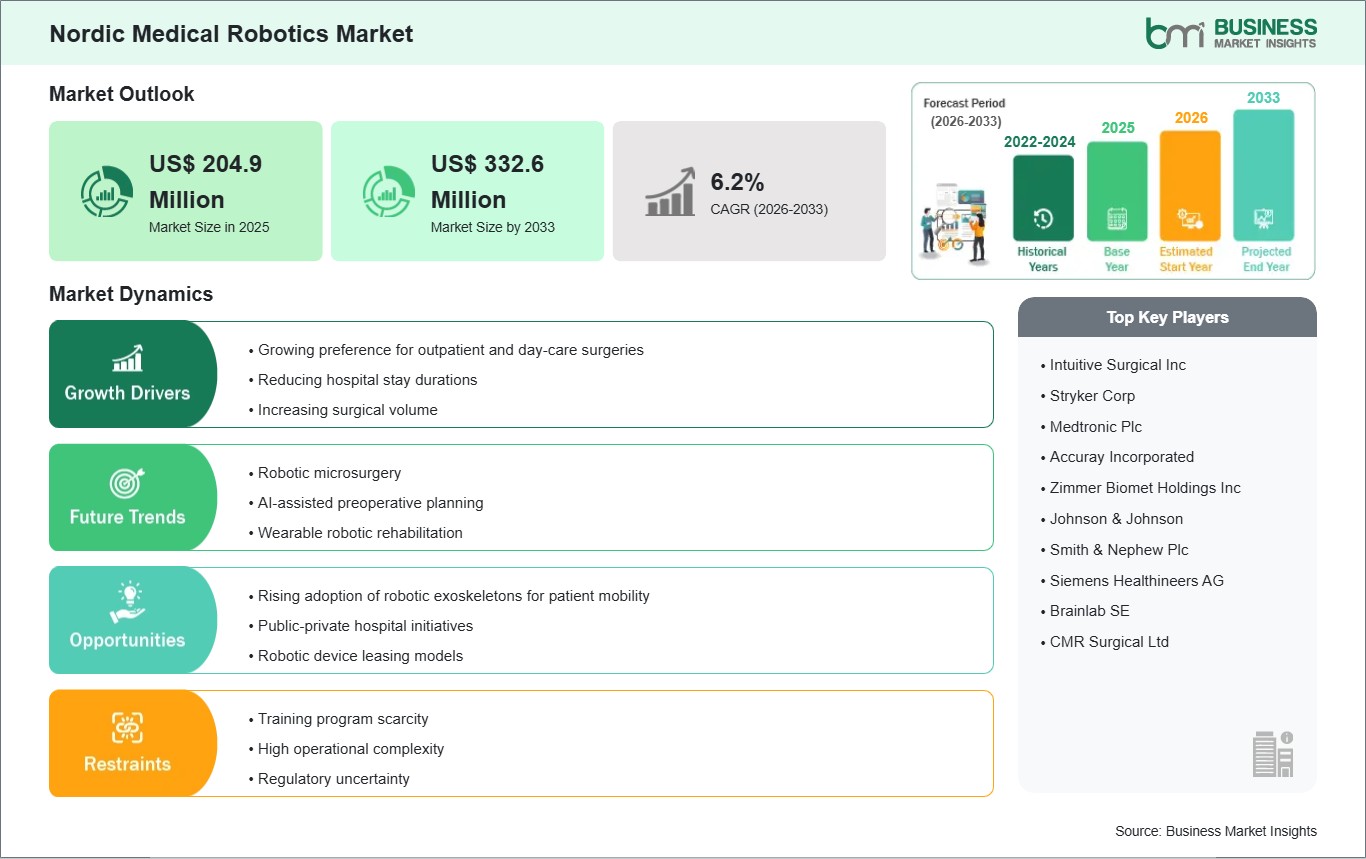
The Nordic medical robotics market is experiencing steady growth, driven by technologically advanced healthcare infrastructure, high healthcare expenditure, and a strong focus on patient-centric care models. Countries such as Sweden, Denmark, Norway, Finland, and Iceland are investing in robotic-assisted surgical systems to enhance procedural precision, minimize invasiveness, and reduce recovery times. Robotics adoption is primarily concentrated in high-complexity surgical specialties including orthopedics, urology, cardiothoracic surgery, and oncology, where precision and repeatability are critical to improving clinical outcomes. Hospitals are increasingly integrating robotics as part of broader digital healthcare initiatives, combining robotic surgery with advanced imaging, telemedicine, and electronic health record systems to create a seamless continuum of care. The market is shaped by a combination of public-sector healthcare funding and private sector innovation. Nordic countries, known for universal healthcare models and high public investment, are able to systematically deploy robotics in leading hospitals and academic medical centers, while private clinics utilize robotic platforms to enhance competitive differentiation and attract medical tourism. The region is also characterized by a high degree of research collaboration, where universities, clinical centers, and technology providers jointly drive innovation in robotics, including AI-assisted navigation, haptic feedback systems, and semi-autonomous surgical platforms. Challenges persist, including high upfront costs, integration with legacy hospital IT systems, and the need for specialized training for surgeons and technical staff. To overcome these barriers, hospitals are exploring flexible acquisition models, including leasing arrangements, shared-service programs, and outcome-based partnerships with technology providers. Regulatory rigor in the Nordic countries, though supportive, requires stringent clinical validation, which can lengthen deployment timelines but ensures safety and performance standards. Overall, the Nordic Medical Robotics Market reflects a mature ecosystem, emphasizing technological innovation, high-quality care delivery, and sustainable integration strategies to enhance patient outcomes and operational efficiency.
Segment Analysis
Nordic Medical Robotics Market Segmentation
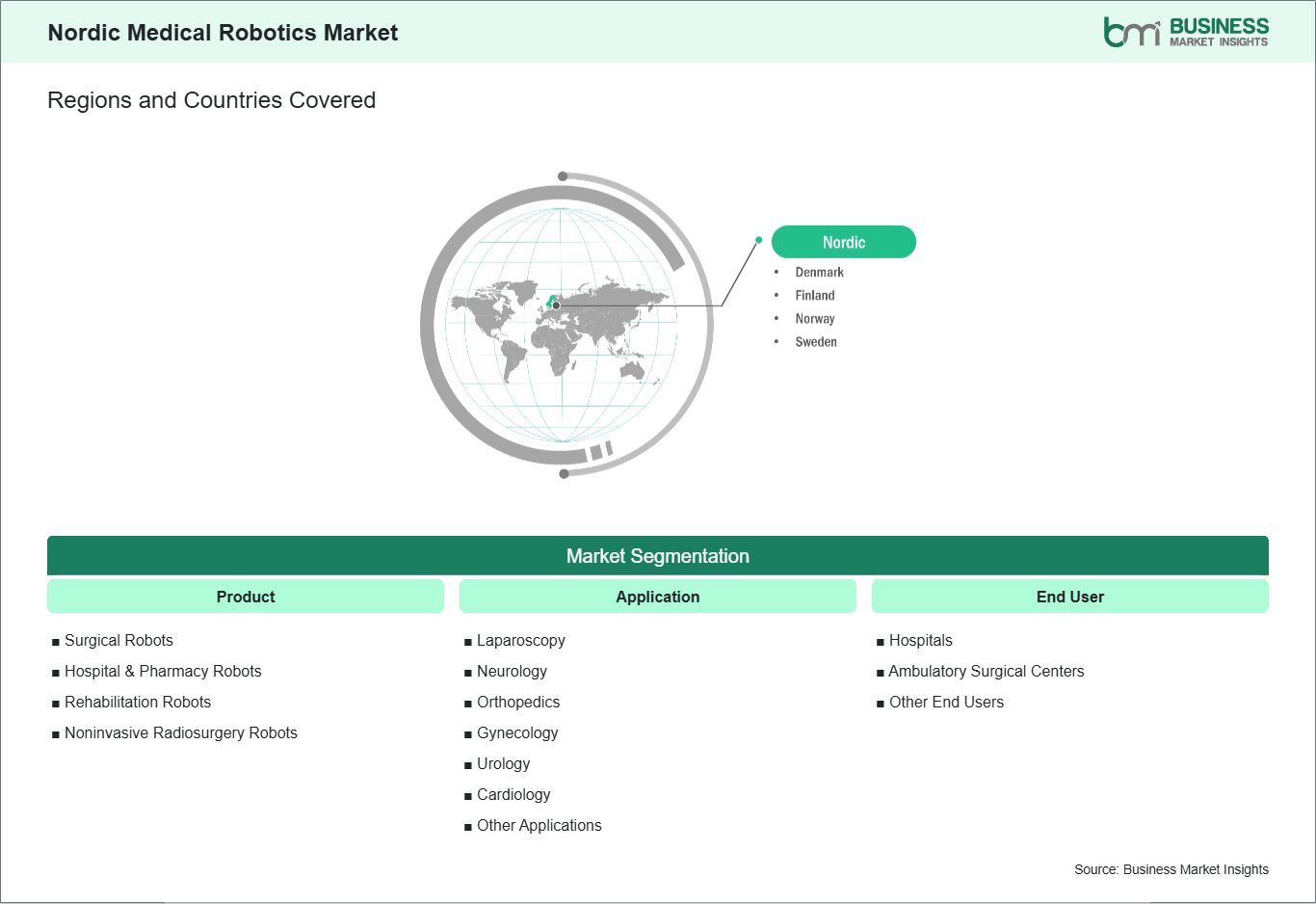
Key segments that contributed to the derivation of the Nordic Medical Robotics Market analysis are product, usability, and application.
- By product, the medical robotics market is segmented into surgical robots, hospital & pharmacy robots, rehabilitation robots, and non-invasive radiosurgery robots. The surgical robots segment dominated the market in 2025.
- In terms of application, the medical robotics market is categorized into laparoscopy, neurology, orthopedics, gynecology, urology, cardiology, and other applications. The laparoscopy segment dominated the market in 2025.
- Based on end user, the medical robotics market is classified into hospitals, ambulatory surgical centers, and other end users. The hospitals segment dominated the market in 2025.
Market Forces
Nordic Medical Robotics Market Drivers and Opportunities
Growing preference for outpatient and day-care surgeries
The Nordic region is experiencing a growing preference for outpatient and day-care surgeries, which is driving interest in medical robotics. Robotic systems enable surgeons to perform minimally invasive procedures with enhanced precision and control, supporting faster recovery and shorter hospital stays. This capability aligns well with the healthcare model in Nordic countries, where efficiency, patient comfort, and streamlined clinical workflows are highly prioritized. Robotics in outpatient surgery also improves procedural consistency and reduces the likelihood of post-operative complications. Surgeons can plan and execute procedures with greater accuracy, benefiting both patients and healthcare providers. Shorter recovery times and reduced need for extended hospitalization make robotic-assisted day-care procedures an attractive option, helping healthcare facilities maintain high patient turnover while delivering high-quality care. Additionally, the adoption of robotics for outpatient procedures supports a more patient-centered approach to healthcare. Patients experience less physical trauma, quicker returns to normal activity, and improved overall satisfaction. As awareness of these benefits grows among clinicians and patients alike, robotic-assisted surgeries are likely to become an integral part of outpatient and day-care services in the Nordic region, supporting efficient, high-quality, and patient-friendly surgical care.
Rising adoption of robotic exoskeletons for patient mobility
Robotic exoskeletons are increasingly being adopted in the Nordic region to support patient mobility and rehabilitation. These systems provide assistance for individuals recovering from injuries, neurological conditions, or surgeries, enabling them to regain strength, coordination, and independence. By complementing traditional physiotherapy, robotic exoskeletons enhance rehabilitation outcomes and promote long-term mobility for patients with varying needs. Healthcare providers are recognizing the advantages of exoskeletons in both clinical and community settings. The technology allows patients to perform guided exercises with consistent support and controlled movement, which improves recovery efficiency and reduces the risk of secondary injuries. Rehabilitation teams can tailor sessions based on patient progress, combining robotics with conventional therapy to maximize functional gains and accelerate recovery timelines. The growing adoption of robotic exoskeletons also reflects a broader focus on innovation and quality of care in the Nordic healthcare system. By investing in advanced rehabilitation technology, hospitals and rehabilitation centers are able to expand service offerings and improve patient outcomes. As familiarity and confidence in these systems increase among clinicians and patients, exoskeleton-assisted rehabilitation is expected to become a standard part of mobility-focused care, enhancing independence, quality of life, and long-term recovery in the region.
Size and Share Analysis
Nordic Medical Robotics Market Size and Share Analysis
The Nordic medical robotics market demonstrates steady growth, with size and share analysis highlighting evolving trends and competitive dynamics among key players. The report examines subsegments categorized within product, application, and end user, offering insights into their contribution to overall market performance.
By product, the surgical robots segment dominated the market in 2025, driven by the high adoption of cutting-edge robotic systems for precision and complex surgical procedures.
In terms of application, the laparoscopy segment dominated the market in 2025, driven by the increasing preference for minimally invasive surgeries that ensure faster recovery and reduced risks.
Based on end user, the hospitals segment dominated the market in 2025, driven by strong healthcare infrastructure and significant investment in advanced medical technologies.
Report Coverage
Nordic Medical Robotics Market Report Coverage and Deliverables
The "Nordic Medical Robotics Market Size and Forecast (2022–2033)" report provides a detailed analysis of the market covering below areas:
- Nordic Medical Robotics Market size and forecast at regional and country levels for all market segments covered under the scope
- Nordic Medical Robotics Market trends, as well as drivers, restraints, and opportunities
- Nordic Medical Robotics Market analysis covering key trends, regional framework, major players, regulations, and recent developments
- Industry landscape and competition analysis covering market concentration, heat map analysis, prominent players, and recent developments for the Nordic Medical Robotics Market
- Detailed company profiles, including SWOT analysis
Geographic Insights
Nordic Medical Robotics Market Geographic Insights
The geographical scope of the Nordic Medical Robotics Market report is divided into Sweden, Denmark, Norway, and Finland. Sweden held the largest share in 2025.
Country-level insights into the Nordic Medical Robotics Market reveal diverse adoption trends across Sweden, Denmark, Norway, Finland, and Iceland, reflecting differences in healthcare infrastructure, policy priorities, and investment capacity. Sweden emerges as the dominant market, with major hospitals in Stockholm, Gothenburg, and Malmö deploying advanced robotic-assisted surgical systems for orthopedics, urology, cardiothoracic, and oncology procedures. Strong public healthcare funding, research collaborations, and local clinical training programs support scalable adoption, positioning Sweden as a regional leader in robotics integration. Denmark exhibits robust adoption in metropolitan hospitals and specialty centers, emphasizing minimally invasive surgery, rehabilitation robotics, and tele-robotic platforms to optimize operational efficiency. Hospitals collaborate closely with technology providers and academic institutions to integrate robotics into national digital health initiatives. In Norway, adoption is concentrated in leading university hospitals and urban referral centers, with robotics applied to high-complexity procedures and combined with telemedicine for remote patient management. Finland demonstrates a growing interest in AI-assisted surgical systems and hospital automation, particularly in densely populated cities such as Helsinki and Tampere. Clinical trials and pilot programs are advancing robotics integration while focusing on workforce training and safety compliance. Iceland, with its smaller population, has a measured approach, primarily deploying robotics in specialized centers to manage high-impact procedures efficiently and support medical tourism initiatives. The country benefits from collaborations with larger Nordic markets for training, technical support, and research partnerships. Collectively, the Nordic market reflects a mature and innovation-driven landscape. Sweden leads in scale and ecosystem development, while Denmark, Norway, Finland, and Iceland demonstrate progressive adoption tailored to national priorities, infrastructure capabilities, and clinical focus areas. The regional focus on research, policy support, and integrated digital health ensures sustained growth and strategic deployment of medical robotics across the Nordic countries.
Industry Activity
Recent Developments
The Nordic Medical Robotics Market is evaluated by gathering qualitative and quantitative data post primary and secondary research, which includes important corporate publications, association data, and databases. A few of the key developments in the Nordic Medical Robotics Market are:
- In February 2024, the CMR Surgical Versius surgical robotic system began clinical use at Norra Älvsborgs Sjukhus (NU‑hospital group) in Sweden marking the first deployment in the Nordic region. Versius’ modular design facilitates use across general and gynaecology surgical procedures, offering hospitals a flexible, space‑efficient robot that integrates into existing OR workflows and expands access to minimally invasive robotic surgery.
- In May 2024, CMR Surgical and distributor Kebomed announced a strategic agreement to bring Versius to Denmark, Norway, and Finland. This partnership aimed to broaden regional access to robotic‑assisted surgery across multiple specialties, helping hospitals adopt the system and support multi‑specialty robotics programmes that reduce hospital stays and operational strain.
Trust & Transparency
Research Methodology
The market analysis combines proprietary research with secondary data from government agencies, company disclosures, regulatory filings, industry databases and expert interviews. Market estimates are validated through data triangulation, cross-market benchmarking and analyst
review.
View Full Research Methodology
Key Sources Referred:
World Health Organization (WHO)Organisation for Economic Cooperation and Development (OECD)The World Bank GroupWorldometerThe LancetInternational Bar AssociationInternational Trade Administration