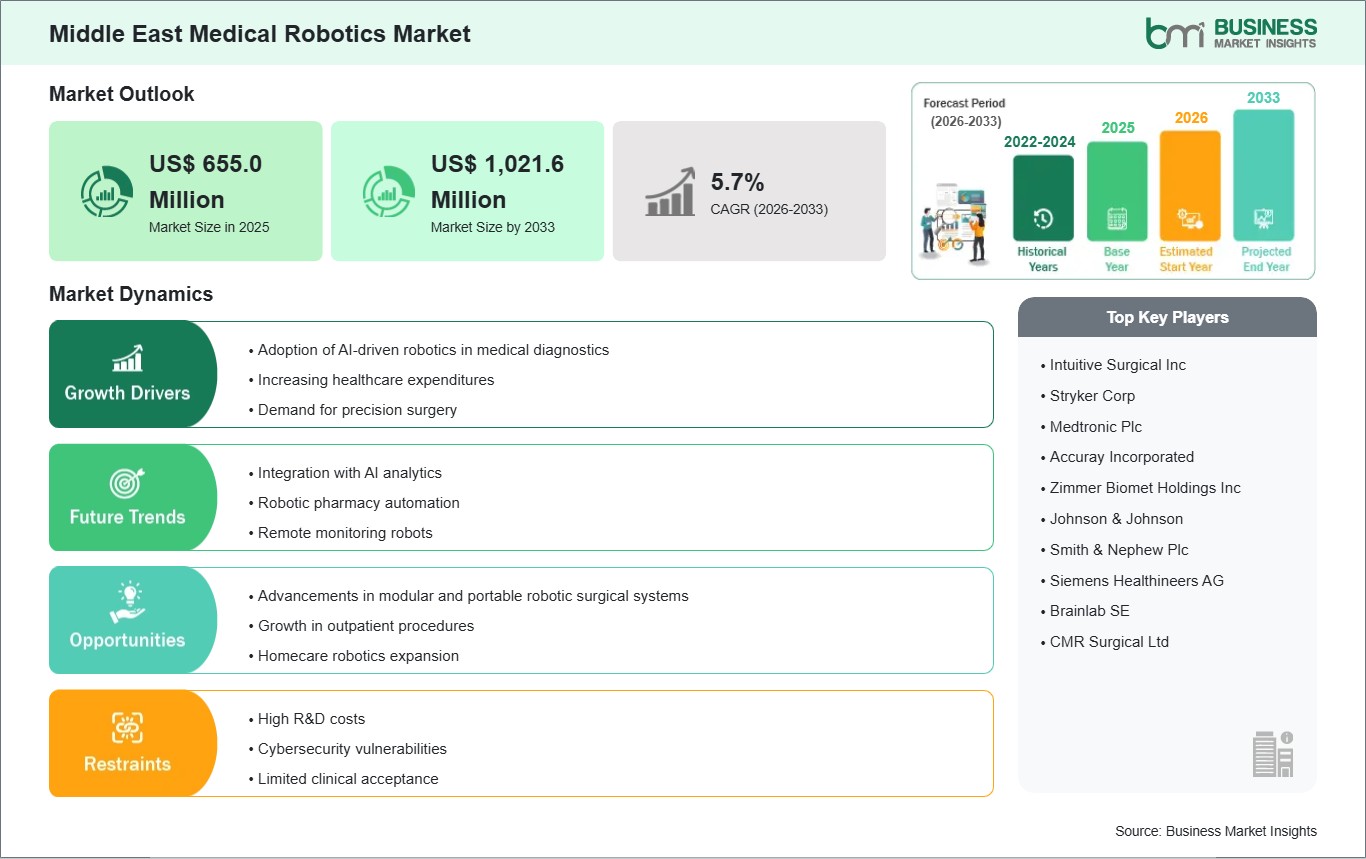
The Middle East medical robotics market size is expected to reach US$ 1,021.6 million by 2033 from US$ 655.0 million in 2025. The market is estimated to record a CAGR of 5.7% from 2026 to 2033./p>
The Middle East medical robotics market is witnessing accelerated growth as regional healthcare systems increasingly prioritize technological innovation, precision medicine, and patient-centric care. Key factors driving this adoption include rising demand for minimally invasive surgeries, expanding tertiary care networks, and the growing emphasis on clinical outcomes aligned with international standards. Robotic-assisted systems are particularly gaining traction in high-complexity procedures such as urology, cardiothoracic surgery, orthopedics, and oncology, where precision, reduced recovery time, and procedural repeatability are critical. Both public and private healthcare providers are investing strategically, with private hospitals leveraging robotics to enhance competitive differentiation and attract regional medical tourism. The market dynamics are shaped by strong governmental support in the Gulf Cooperation Council (GCC) countries, where national healthcare visions emphasize advanced infrastructure development, technology integration, and local workforce training. Countries such as the UAE, Saudi Arabia, and Qatar are actively promoting public-private partnerships and clinical collaborations with international robotics OEMs to facilitate adoption and optimize operational efficiency. Furthermore, these countries are integrating robotics within broader digital health initiatives, combining robotic systems with electronic health records, advanced imaging, and telemedicine platforms, which enhances both clinical decision-making and patient care pathways. Despite robust momentum, adoption challenges persist, particularly relating to high capital expenditure, limited trained personnel, and variable regulatory frameworks across the region. Hospitals are increasingly exploring flexible acquisition models, such as robotics-as-a-service, leasing arrangements, and shared clinical hubs, to mitigate upfront costs and enhance utilization. Integration with existing hospital IT systems remains a critical factor for successful deployment, as seamless interoperability directly impacts clinical efficiency and ROI. Overall, the Middle East Medical Robotics Market reflects a sophisticated ecosystem where technology adoption is driven not only by clinical need but also by strategic positioning, workforce development, and operational excellence, positioning the region as a rapidly emerging hub for medical robotics innovation.

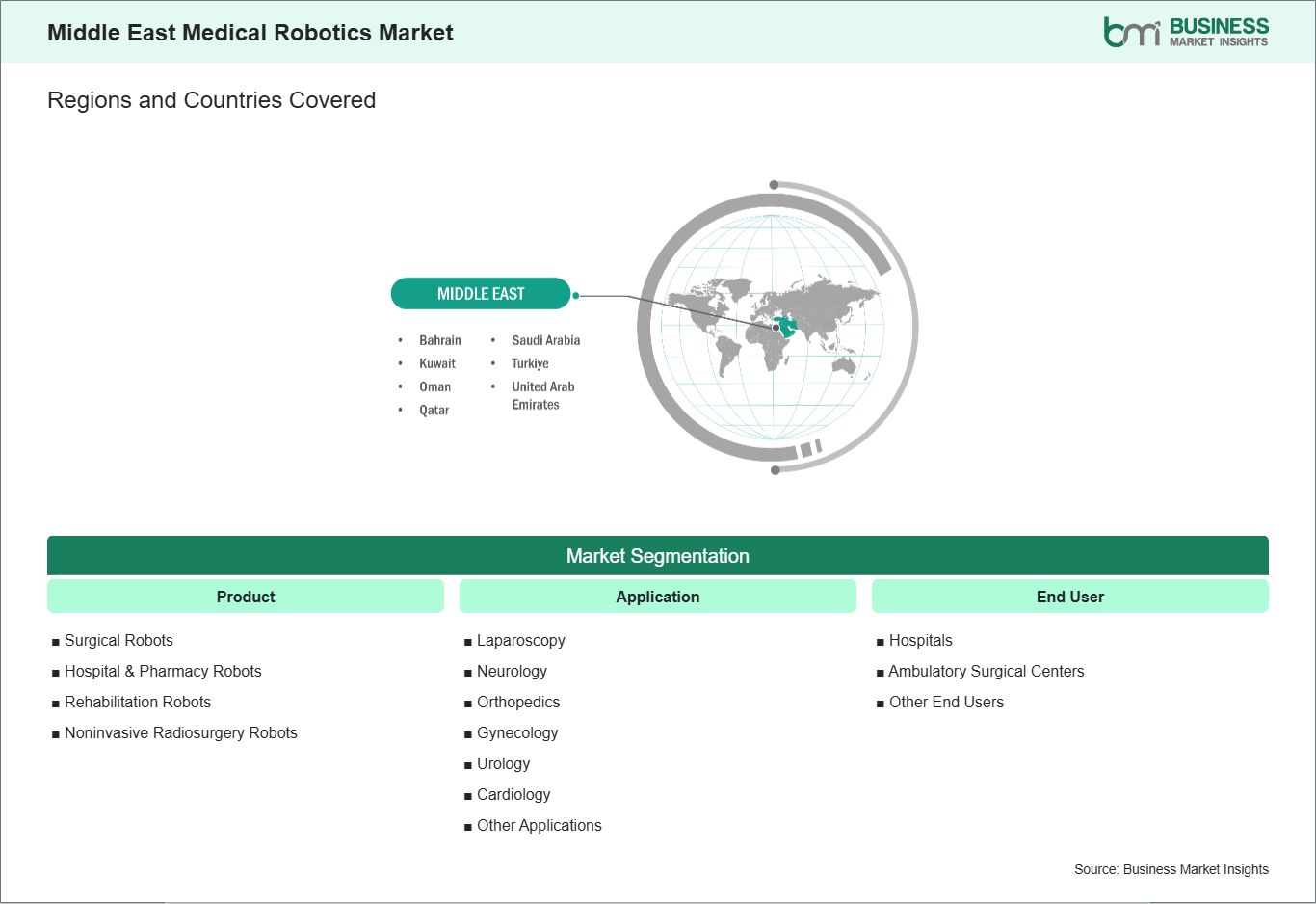
Key segments that contributed to the derivation of the Middle East Medical Robotics Market analysis are product, application, and end user.
The adoption of AI-driven robotics in medical diagnostics is increasingly shaping healthcare delivery across the Middle East. Hospitals and diagnostic centers are exploring robotics integrated with artificial intelligence to enhance accuracy, streamline workflows, and accelerate diagnosis. AI-powered robotic systems can analyze complex medical imaging data, detect anomalies, and support clinicians in making more precise and timely decisions, improving the overall quality of patient care. Healthcare providers in the region are leveraging these technologies to improve operational efficiency in diagnostic procedures. By combining robotics with AI algorithms, clinicians can automate repetitive tasks such as image acquisition, data processing, and preliminary analysis, allowing medical professionals to focus on interpretation and treatment planning. This integration not only enhances accuracy but also reduces human error, which is particularly valuable in high-volume diagnostic environments where consistency is critical. Furthermore, the use of AI-driven robotic diagnostics encourages broader adoption of advanced medical technologies across the Middle East. Investments in training, digital infrastructure, and workflow optimization are helping healthcare institutions implement these systems effectively. As clinicians and administrators become more familiar with AI-enabled robotics, the technology is expected to play a larger role in early detection, personalized treatment planning, and proactive healthcare management, strengthening the region’s capacity to provide high-quality, technology-supported diagnostics.
Modular and portable robotic surgical systems are emerging as a transformative trend in the Middle East medical robotics market. These systems offer flexibility, allowing hospitals to deploy robotic capabilities across multiple operating rooms or smaller surgical centers. Their portability supports a broader range of procedures in diverse clinical settings, including regions where permanent robotic infrastructure may not yet be feasible, expanding access to advanced surgical care. The modular design of these systems enhances adaptability and efficiency in surgical workflows. Hospitals can configure robotic systems to meet specific procedural requirements, integrating different modules for imaging, instrument control, and patient positioning. This flexibility allows surgical teams to customize robotic setups for various specialties, from general surgery to minimally invasive procedures, improving precision while optimizing resource utilization and reducing setup time between cases. Advancements in portable robotics are also supporting the decentralization of surgical services in the Middle East. Healthcare providers can extend robotic capabilities to satellite clinics, smaller hospitals, or mobile surgical units, ensuring that patients in less urbanized areas can access advanced procedures without traveling long distances. As technology continues to evolve, modular and portable robotic surgical systems are expected to become a core component of surgical infrastructure, enabling broader adoption, improving patient outcomes, and strengthening the overall healthcare ecosystem in the region.
The Middle East medical robotics market demonstrates steady growth, with size and share analysis highlighting evolving trends and competitive dynamics among key players. The report examines subsegments categorized within product, application, and end user, offering insights into their contribution to overall market performance.
By product, the surgical robots segment dominated the market in 2025, driven by the increasing adoption of advanced robotic systems for complex and precision surgeries.
In terms of application, the laparoscopy segment dominated the market in 2025, driven by the rising demand for minimally invasive procedures with faster recovery and reduced complications.
Based on end user, the hospitals segment dominated the market in 2025, driven by growing investments in healthcare infrastructure and advanced surgical technologies.
| Report Attribute | Details |
|---|---|
| Market size in 2025 | US$ 655.0 Million |
| Market Size by 2033 | US$ 1,021.6 Million |
| CAGR (2026 - 2033) | 5.7% |
| Historical Data | 2022-2024 |
| Forecast period | 2026-2033 |
| Segments Covered | By Product
|
|
Regions and Countries Covered
| |
| Middle East | UAE, Saudi Arabia, Bahrain, Oman, Kuwait, Qatar, and Turkiye |
| Market leaders and key company profiles |
|
The "Middle East Medical Robotics Market Size and Forecast (2022–2033)" report provides a detailed analysis of the market covering below areas:
The geographical scope of the Middle East Medical Robotics Market report is divided into UAE, Saudi Arabia, Bahrain, Oman, Kuwait, Qatar, and Turkiye. Turkiye held the largest share in 2025.
Country-level insights into the Middle East Medical Robotics Market reveal distinct adoption patterns shaped by healthcare infrastructure, policy frameworks, and investment priorities across Turkiye, the UAE, Saudi Arabia, Bahrain, Oman, Kuwait, Qatar, Egypt, and South Africa. Turkiye emerges as the dominant market, supported by advanced healthcare infrastructure, strong public-private partnerships, and a growing domestic MedTech ecosystem. Major hospitals in Istanbul, Ankara, and Izmir have adopted robotic-assisted systems across oncology, urology, orthopedics, and cardiothoracic procedures. Strategic collaborations with global robotics manufacturers and local research institutions enhance clinical training, validation, and scalable deployment, positioning Turkiye as a regional hub for medical robotics innovation. The UAE has positioned itself as a regional innovation leader, leveraging advanced digital health infrastructure and integrated imaging systems across private hospital networks in Dubai and Abu Dhabi. National policies actively incentivize the adoption of minimally invasive surgery, rehabilitation robotics, and tele-robotic platforms, strengthening the UAE’s technological and clinical sophistication. Saudi Arabia is advancing robotics under its Vision 2030 healthcare reform agenda, which emphasizes centers of excellence, reduction of medical outbound travel, and integration of AI-assisted surgical systems. Flagship hospitals in Riyadh and Jeddah focus on complex oncology, urology, and cardiovascular procedures, often via public-private collaborations and international technology partnerships. Bahrain and Oman exhibit targeted deployment of robotics in specialty hospitals and teaching institutions, concentrating on high-precision interventions and clinician upskilling. Kuwait and Qatar strategically invest in flagship tertiary hospitals, using robotics to enhance procedural quality, optimize patient pathways, and attract regional medical tourism. In Egypt, robotics adoption is emerging primarily in leading urban hospitals, supported by academic collaborations and international partnerships that provide clinician training and operational support. South Africa demonstrates advanced adoption within private hospitals in Johannesburg and Cape Town, where robotics is leveraged to manage complex surgical cases, enhance clinical outcomes, and attract regional patients. Collectively, these insights indicate that while Turkiye leads in scale, ecosystem maturity, and strategic investment, other Middle Eastern and African markets are advancing robotics adoption at varied paces. Deployment strategies are shaped by national healthcare priorities, infrastructure readiness, and policy frameworks, highlighting opportunities for regional collaboration, private sector innovation, and gradual expansion into emerging markets across the Middle East and Africa.

The Middle East Medical Robotics Market is evaluated by gathering qualitative and quantitative data post primary and secondary research, which includes important corporate publications, association data, and databases. A few of the key developments in the Middle East Medical Robotics Market are:
The Middle East Medical Robotics Market is valued at US$ 655.0 Million in 2025, it is projected to reach US$ 1,021.6 Million by 2033.
As per our report Middle East Medical Robotics Market, the market size is valued at US$ 655.0 Million in 2025, projecting it to reach US$ 1,021.6 Million by 2033. This translates to a CAGR of approximately 5.7% during the forecast period.
The Middle East Medical Robotics Market report typically cover these key segments-
The historic period, base year, and forecast period can vary slightly depending on the specific market research report. However, for the Middle East Medical Robotics Market report:
The Middle East Medical Robotics Market is populated by several key players, each contributing to its growth and innovation. Some of the major players include:
The Middle East Medical Robotics Market report is valuable for diverse stakeholders, including:
Essentially, anyone involved in or considering involvement in the Middle East Medical Robotics Market value chain can benefit from the information contained in a comprehensive market report.
Please tell us your area of interest
(Market Segments/ Regions and Countries/ Companies)