Market Summary
Executive Summary and Market Analysis
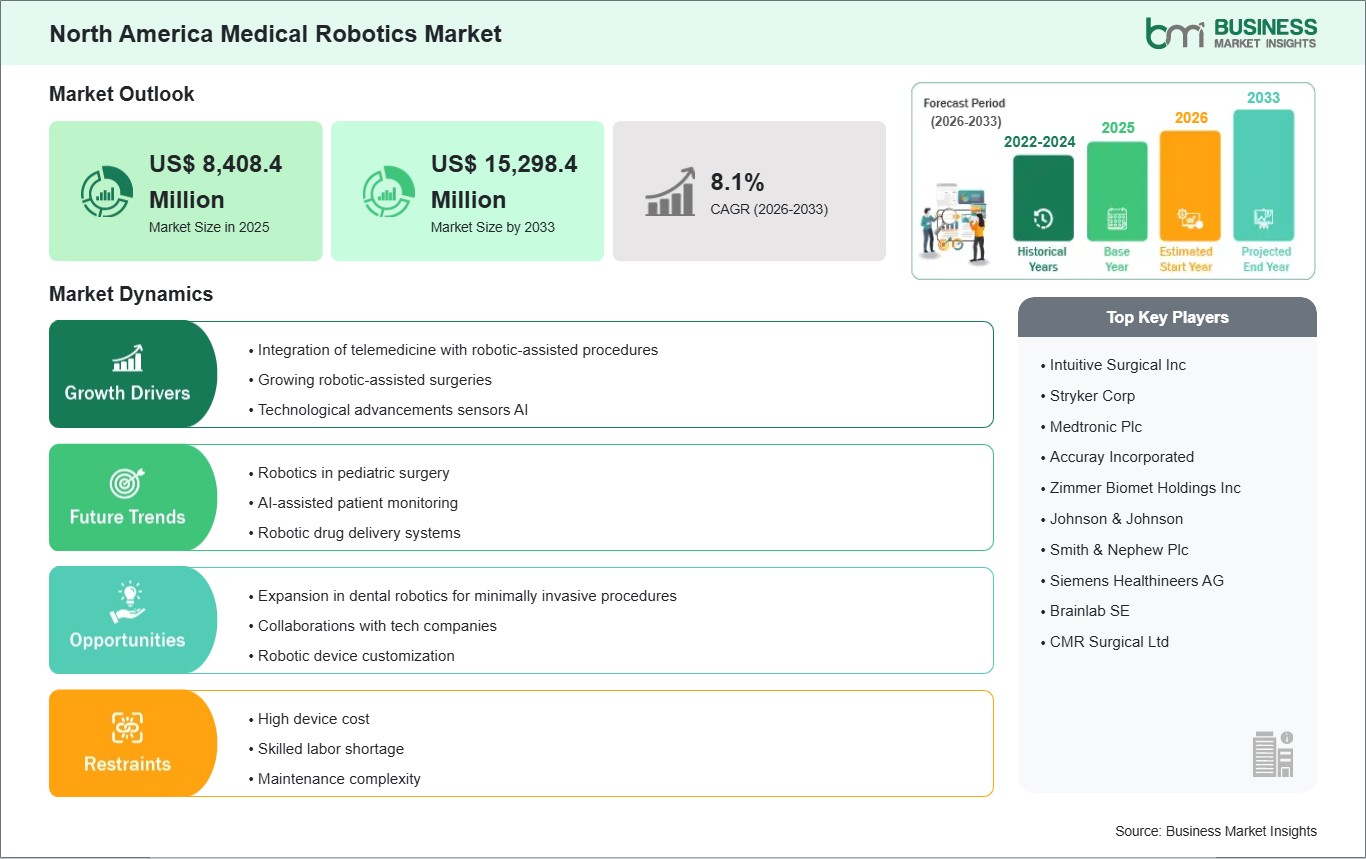
The North America medical robotics market is characterized by advanced adoption, driven by highly developed healthcare infrastructure, robust private and public healthcare funding, and a growing emphasis on precision and minimally invasive procedures. The market is dominated by hospitals and specialty centers in the United States and Canada that leverage robotics across surgical, rehabilitative, and diagnostic applications. Robotic-assisted surgery is the primary driver, particularly in urology, orthopedics, general surgery, and oncology, where precision, repeatability, and reduced recovery times directly improve patient outcomes. Robotics is also gaining traction in rehabilitation, hospital logistics, and telehealth-enabled surgical platforms, reflecting a broadening of applications beyond operating rooms. Market dynamics are influenced by extensive research and development activities, particularly in the United States, where collaborations among medical device manufacturers, academic research centers, and healthcare institutions accelerate technological innovation. Integration of AI, machine learning, and real-time imaging with robotic platforms is enhancing intraoperative decision-making, predictive analytics, and patient-specific procedure planning. High adoption rates are also supported by favorable regulatory pathways, reimbursement mechanisms, and a strong culture of innovation in medical technology. Despite the robust growth trajectory, adoption challenges include high capital expenditure, extensive training requirements, and integration with legacy hospital systems. Healthcare institutions are increasingly exploring innovative acquisition models such as leasing, robotics-as-a-service, and shared platform models to optimize utilization and ROI. Moreover, data interoperability and cybersecurity are becoming central considerations, as hospitals seek to connect robotics systems with electronic health records and advanced imaging platforms. North America represents a mature and technologically advanced market where medical robotics adoption is driven by clinical efficacy, operational efficiency, and institutional competitiveness, positioning the region as a global leader in robotics-enabled healthcare innovation.
Segment Analysis
North America Medical Robotics Market Segmentation
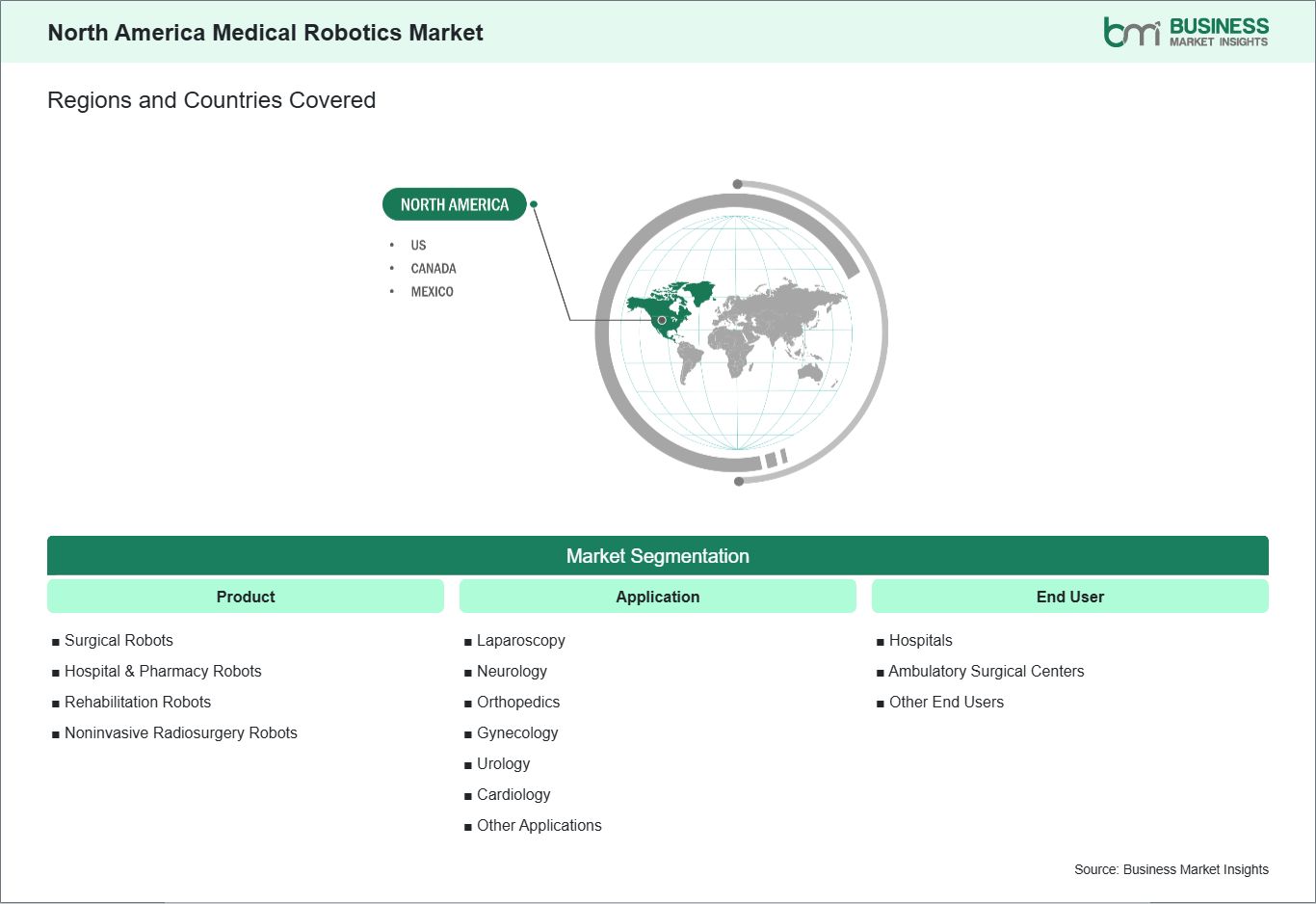
Key segments that contributed to the derivation of the North America Medical Robotics Market analysis are product, application, and end user.
- By product, the medical robotics market is segmented into surgical robots, hospital & pharmacy robots, rehabilitation robots, and non-invasive radiosurgery robots. The surgical robots segment dominated the market in 2025.
- In terms of application, the medical robotics market is categorized into laparoscopy, neurology, orthopedics, gynecology, urology, cardiology, and other applications. The laparoscopy segment dominated the market in 2025.
- Based on end user, the medical robotics market is classified into hospitals, ambulatory surgical centers, and other end users. The hospitals segment dominated the market in 2025.
Market Forces
North America Medical Robotics Market Drivers and Opportunities
Integration of telemedicine with robotic-assisted procedures
The integration of telemedicine with robotic-assisted procedures is transforming healthcare delivery in North America. Robotic systems, when combined with telemedicine platforms, enable surgeons to provide remote guidance, consultation, and even real-time procedural support across distances. This integration enhances access to specialized care for patients in rural and underserved areas, ensuring that advanced surgical expertise is available beyond major metropolitan centers. Robotic-assisted telemedicine also improves collaboration among clinical teams. Surgeons and specialists can remotely monitor procedures, offer guidance, and review imaging data in real-time, which helps maintain high standards of accuracy and efficiency. By combining robotic precision with telecommunication technology, healthcare providers can extend expert surgical care while maintaining safety, consistency, and quality throughout the patient journey. Furthermore, this convergence supports broader adoption of minimally invasive procedures. Patients benefit from reduced recovery times, smaller incisions, and improved post-operative outcomes, while providers can optimize resource utilization and surgical scheduling. As telemedicine becomes more integrated with robotic-assisted procedures, North American healthcare systems are expected to strengthen their capacity for remote care delivery, enhance patient access to specialized surgeries, and improve overall clinical efficiency.
Expansion in dental robotics for minimally invasive procedures
Dental robotics is emerging as a growing area within the North American medical robotics market, particularly for minimally invasive procedures. Robotic systems in dentistry allow practitioners to perform precise operations such as implant placement, endodontic procedures, and oral surgery with enhanced accuracy. This technology reduces human error, improves procedural consistency, and supports better patient outcomes through less invasive techniques. The adoption of dental robotics is transforming clinical workflows in dental practices. Robotic platforms can assist with imaging, instrument guidance, and real-time navigation during procedures, allowing dentists to focus on critical decision-making while relying on robotic precision for execution. This results in more predictable outcomes, reduced procedural time, and greater patient comfort, which is especially important for complex restorative or surgical interventions. Additionally, robotic solutions in dentistry are enabling more personalized and technology-driven care. Systems can be integrated with digital scanning, planning software, and patient records to tailor treatments to individual needs. As awareness of these benefits grows among dental professionals and patients, the demand for robotic-assisted dental procedures is expected to expand. This expansion reinforces the role of robotics in advancing minimally invasive dentistry and enhancing overall treatment quality across North America.
Size and Share Analysis
North America Medical Robotics Market Size and Share Analysis
The North America medical robotics market demonstrates steady growth, with size and share analysis highlighting evolving trends and competitive dynamics among key players. The report examines subsegments categorized within product, application, and end user, offering insights into their contribution to overall market performance.
By product, the surgical robots segment dominated the market in 2025, driven by the widespread adoption of advanced robotic systems for precision and complex surgeries.
In terms of application, the laparoscopy segment dominated the market in 2025, driven by the rising demand for minimally invasive procedures with shorter recovery times.
Based on end user, the hospitals segment dominated the market in 2025, driven by well-established healthcare infrastructure and high investment in cutting-edge surgical technologies.
Report Coverage
North America Medical Robotics Market Report Coverage and Deliverables
The "North America Medical Robotics Market Size and Forecast (2022–2033)" report provides a detailed analysis of the market covering below areas:
- North America Medical Robotics Market size and forecast at regional and country levels for all market segments covered under the scope
- North America Medical Robotics Market trends, as well as drivers, restraints, and opportunities
- North America Medical Robotics Market analysis covering key trends, regional framework, major players, regulations, and recent developments
- Industry landscape and competition analysis covering market concentration, heat map analysis, prominent players, and recent developments for the North America Medical Robotics Market
- Detailed company profiles, including SWOT analysis
Geographic Insights
North America Medical Robotics Market Geographic Insights
The geographical scope of the North America Medical Robotics Market report is divided into US, Canada, and Mexico. The US held the largest share in 2025.
Country-level insights into the North America Medical Robotics Market highlight differing adoption dynamics across the United States and Canada, shaped by healthcare infrastructure, policy frameworks, and clinical priorities. The United States is the dominant market, with hospitals across metropolitan hubs such as New York, Los Angeles, Houston, and Boston leading deployment of robotic-assisted surgical systems. Adoption spans urology, orthopedics, cardiothoracic surgery, and oncology, supported by advanced research collaborations, government and private funding, and strong insurance reimbursement frameworks. The U.S. market also emphasizes continuous innovation in AI-assisted surgery, tele-robotics, and hospital workflow automation. Canada demonstrates a growing adoption trajectory, with hospitals in Toronto, Vancouver, and Montreal integrating robotics for complex surgical procedures and rehabilitation. Adoption is supported by provincial healthcare funding, clinical trials, and partnerships with academic and technology institutions. Canadian hospitals focus on improving patient outcomes, operational efficiency, and access to advanced surgical technologies across both urban and regional centers. Overall, North America presents a mature and technologically sophisticated market. While the United States leads in scale, innovation, and infrastructure, Canada is progressively expanding robotics adoption with a focus on clinical outcomes, efficiency, and equitable access. Both countries are investing in workforce training, digital integration, and AI-enabled robotics to ensure long-term sustainability and leadership in medical technology, reinforcing North America’s position as a global hub for medical robotics deployment.
Industry Activity
Recent Developments
The North America Medical Robotics Market is evaluated by gathering qualitative and quantitative data post primary and secondary research, which includes important corporate publications, association data, and databases. A few of the key developments in the North America Medical Robotics Market are:
- In November 2025, Microbot Medical Inc. commenced the limited market release in the U.S. of its LIBERTY Endovascular Robotic System, the first FDA‑cleared single‑use, remotely operated robotic platform for peripheral endovascular procedures. The rollout followed completion of required infrastructure and initial commercial team hires to support physician adoption. Early physician feedback at clinical meetings was strongly positive, validating market interest. This launch marks a major step toward broad clinical integration in interventional radiology and endovascular care.
- In February 2026, the FDA cleared the Hugo™ robotic‑assisted surgery (RAS) system for urologic procedures, enabling its commercial introduction in the United States. The clearance allows Hugo to be used in minimally invasive prostatectomy, nephrectomy, and cystectomy procedures, expanding robotic surgical options available to U.S. hospitals. Designed with a modular architecture, the system offers hospitals and surgical teams an alternative to existing platforms. The launch marks a strategic push by Medtronic into the highly competitive North American robotic surgery market.
Trust & Transparency
Research Methodology
The market analysis combines proprietary research with secondary data from government agencies, company disclosures, regulatory filings, industry databases and expert interviews. Market estimates are validated through data triangulation, cross-market benchmarking and analyst
review.
View Full Research Methodology
Key Sources Referred:
World Health Organization (WHO)Organisation for Economic Cooperation and Development (OECD)The World Bank GroupWorldometerThe LancetInternational Bar AssociationInternational Trade Administration