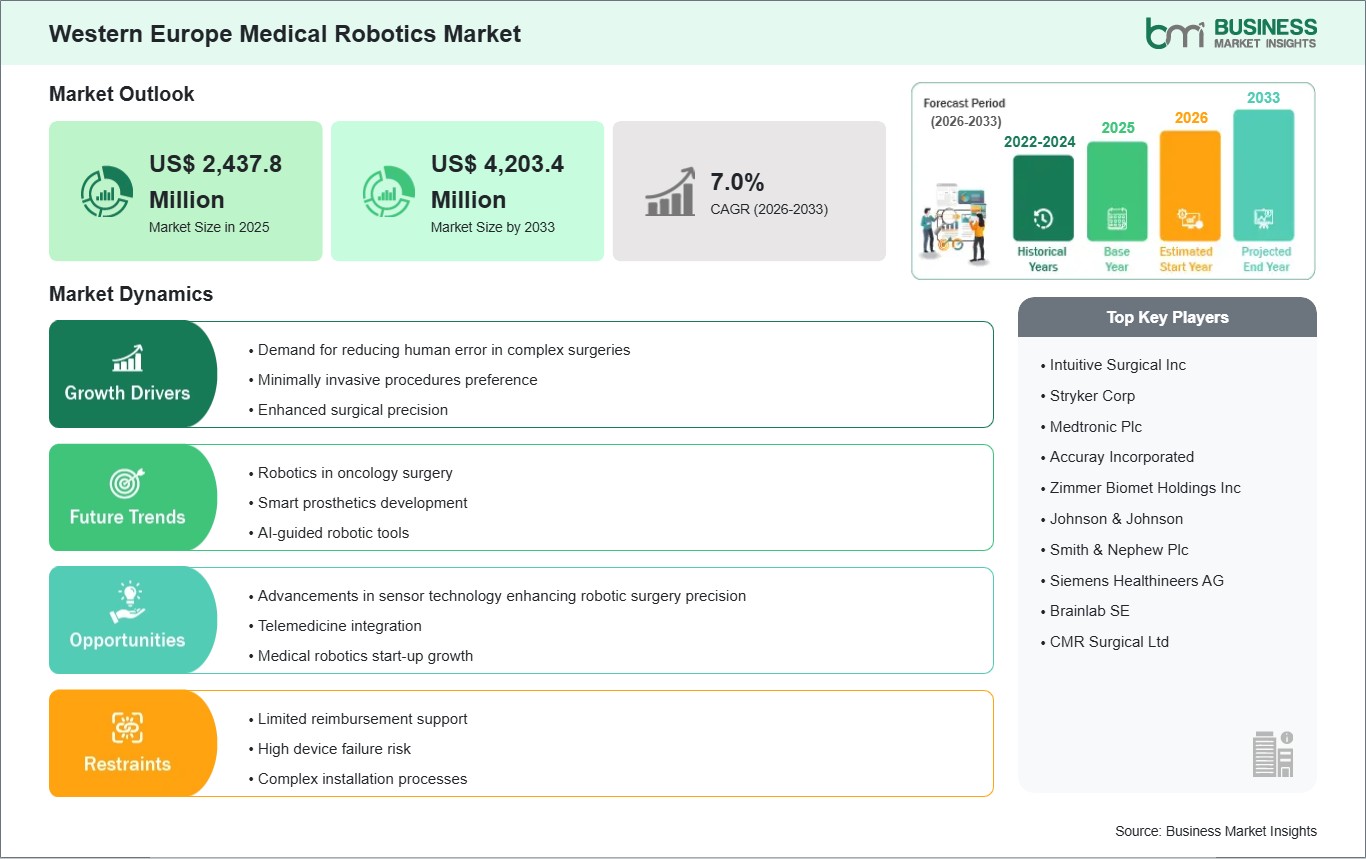
The Western Europe medical robotics market size is expected to reach US$ 4,203.4 million by 2033 from US$ 2,437.8 million in 2025. The market is estimated to record a CAGR of 7.0% from 2026 to 2033.
The Western Europe medical robotics market is experiencing dynamic growth, driven by high healthcare expenditure, advanced clinical infrastructure, and a strong emphasis on precision medicine and minimally invasive procedures. Countries including Germany, France, Italy, Spain, and the Netherlands are at the forefront of robotics adoption, primarily in surgical applications such as urology, gynecology, orthopedics, and cardiothoracic surgery. Hospitals in these markets require robotics not just as a clinical tool but also as a strategic differentiator, enhancing institutional reputation, improving patient outcomes, and reducing postoperative recovery times. The market is characterized by strong collaboration among hospitals, academic research centers, and robotics manufacturers to advance clinical innovation. Integration with complementary technologies such as AI-assisted navigation, 3D imaging, and predictive analytics enhances surgical precision and supports personalized patient care. Private hospitals and tertiary care centers often lead to adoption, investing in robotics to attract medical tourism and high-value cases, while public institutions implement robotics selectively, often through pilot programs or regional centers of excellence. Despite robust adoption, challenges persist. High acquisition and operational costs, coupled with workforce training requirements, create barriers for widespread deployment. Hospitals are exploring flexible acquisition strategies, including leasing, robotics-as-a-service, and multi-hospital sharing models, to optimize utilization and reduce financial burden. Regulatory complexity across Western Europe also demands stringent clinical validation, but this ensures high safety and performance standards. The market reflects a mature ecosystem where technology adoption is driven by clinical efficacy, operational efficiency, and strategic positioning, setting the stage for continued growth and innovation in the region.

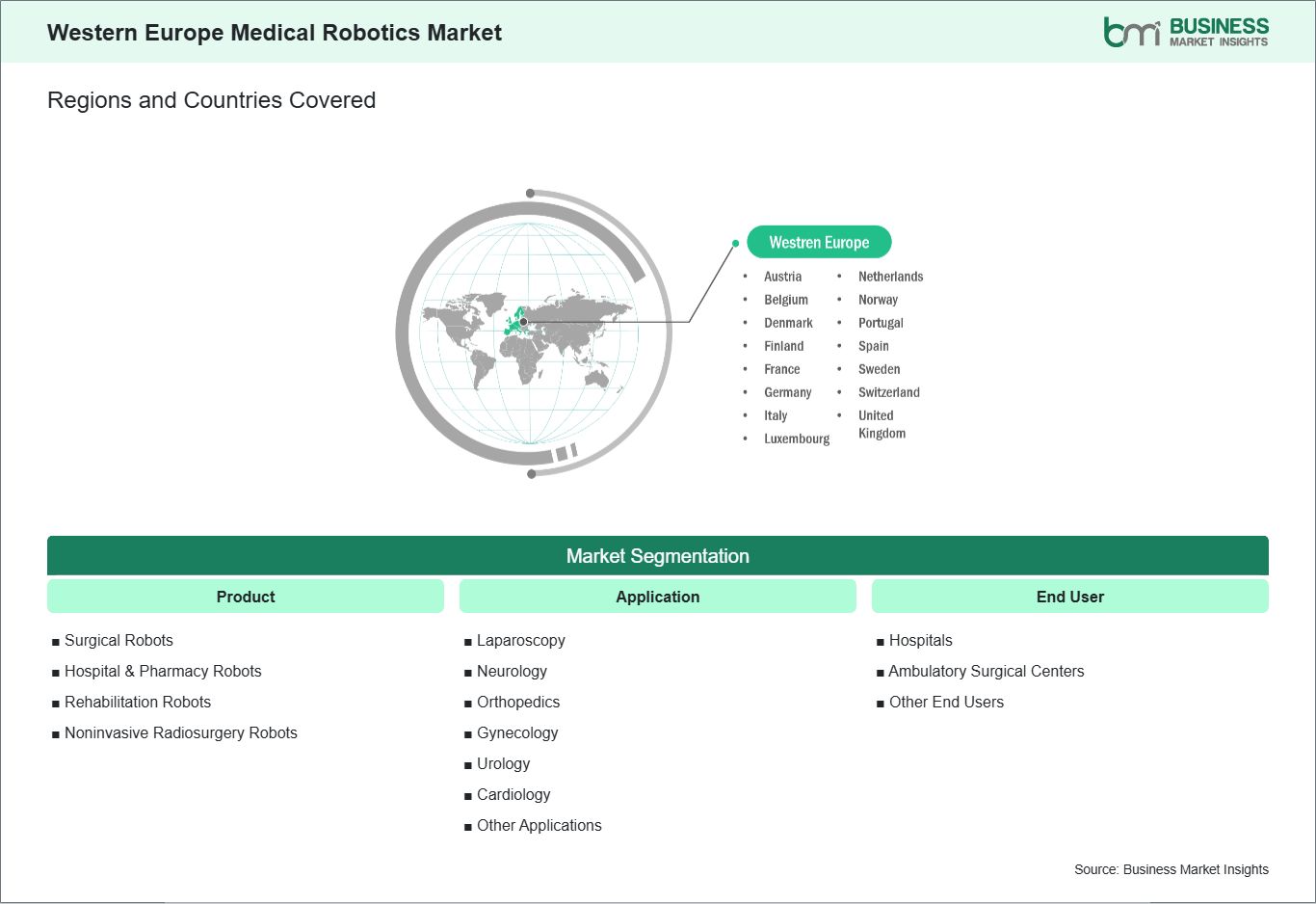
Key segments that contributed to the derivation of the Western Europe Medical Robotics Market analysis are product, application, and end user.
Reducing human error in complex surgeries accelerates the adoption of medical robotics in Western Europe. Surgical procedures in specialties such as cardiovascular, neurosurgery, and oncology often require high levels of precision, where even minor deviations can impact patient outcomes. Robotic-assisted systems enhance surgical accuracy, providing surgeons with better control, real-time feedback, and consistent instrument guidance, which mitigates the risk of errors during intricate operations. Healthcare providers in Western Europe are relying on robotic platforms to support both routine and complex procedures. Robotics allows surgeons to perform delicate maneuvers with stability and reproducibility, which reduces variability associated with human performance. By minimizing the chance of mistakes and improving procedural consistency, hospitals can enhance patient safety, optimize surgical workflows, and improve overall treatment reliability. Furthermore, the demand for error reduction is driving ongoing innovation in robotic systems and their integration into surgical practices. Hospitals are designing operating rooms and workflows around robotic capabilities, while training programs ensure surgeons and clinical teams can maximize the technology’s potential. As robotic adoption expands, Western European healthcare systems are positioning themselves to offer more reliable, high-quality surgical care while reinforcing patient confidence in advanced procedures.
Robotic-assisted surgery enables precise visualization, instrument control, and motion scaling, which are critical in high-risk procedures such as minimally invasive thoracic or abdominal surgeries. By leveraging these capabilities, surgeons can execute complex interventions more safely, reducing the likelihood of complications and the need for corrective procedures. The emphasis on precision also extends to standardizing surgical processes across different hospitals and care centers. Robotics allows teams to follow defined protocols with high reproducibility, which helps maintain consistent quality across multiple surgical environments. This approach supports better outcomes for patients and contributes to improved operational efficiency and streamlined postoperative care. In addition, the drive to reduce human error encourages continuous collaboration between surgeons, engineers, and healthcare administrators. Western European hospitals are integrating robotics with preoperative planning tools, real-time imaging, and decision-support systems, creating a cohesive environment that minimizes variability in surgical performance. As the region continues to prioritize patient safety and procedural accuracy, robotic-assisted surgery is becoming a cornerstone of advanced surgical care, addressing the critical need to reduce human error while enhancing treatment reliability.
The Western Europe medical robotics market demonstrates steady growth, with size and share analysis highlighting evolving trends and competitive dynamics among key players. The report examines subsegments categorized within product, application, and end user, offering insights into their contribution to overall market performance.
By product, the surgical robots segment dominated the market in 2025, driven by the high adoption of advanced robotic systems for complex and precision surgeries.
In terms of application, the laparoscopy segment dominated the market in 2025, driven by the growing preference for minimally invasive procedures with faster recovery and reduced complications.
Based on end user, the hospitals segment dominated the market in 2025, driven by strong healthcare infrastructure and substantial investments in cutting-edge surgical technologies.
| Report Attribute | Details |
|---|---|
| Market size in 2025 | US$ 2,437.8 Million |
| Market Size by 2033 | US$ 4,203.4 Million |
| CAGR (2026 - 2033) | 7.0% |
| Historical Data | 2022-2024 |
| Forecast period | 2026-2033 |
| Segments Covered | By Product
|
|
Regions and Countries Covered
| |
| Western Europe | Belgium, the Netherlands, Luxembourg, Germany, France, Italy, Spain, Switzerland, Sweden, Austria, the United Kingdom, Denmark, Portugal, Norway, Finland |
| Market leaders and key company profiles |
|
The "Western Europe Medical Robotics Market Size and Forecast (2022–2033)" report provides a detailed analysis of the market covering below areas:
The geographical scope of the Western Europe Medical Robotics Market report is divided into Belgium, the Netherlands, Luxembourg, Germany, France, Italy, Spain, Switzerland, Sweden, Austria, the UK, Denmark, Portugal, Norway, and Finland. Germany held the largest share in 2025.
Country-level insights into the Western Europe Medical Robotics Market demonstrate differentiated adoption patterns across Germany, France, Italy, Spain, and the Netherlands. Germany is the dominant market, with major hospitals in Berlin, Munich, and Hamburg leading the adoption of robotic-assisted systems for urology, orthopedics, cardiothoracic, and oncological procedures. Germany’s strong research and development ecosystem, public-private hospital collaborations, and advanced clinical training programs enable scalable deployment and continuous innovation in robotic platforms. France shows progressive adoption, focusing on private tertiary hospitals and teaching centers in Paris, Lyon, and Marseille. Robotics integration emphasizes minimally invasive surgery, clinical precision, and workflow efficiency. Collaborative programs with universities and research centers support training, pilot projects, and evidence-based deployment. Italy is advancing robotics in metropolitan hospitals and specialty centers, prioritizing high-precision interventions, postoperative recovery optimization, and surgical efficiency. Spain demonstrates increasing adoption, particularly in Barcelona and Madrid, with hospitals investing in robotics for oncology, gynecology, and orthopedic surgeries while integrating digital health systems to support procedural accuracy. The Netherlands is implementing robotics in academic hospitals and centers of excellence, combining AI-assisted surgical platforms with tele-robotics capabilities to improve patient outcomes and access to specialized expertise. Inter-hospital collaboration and clinical research initiatives drive adoption, particularly in high-complexity surgical specialties. Collectively, while Germany leads in scale, innovation, and ecosystem maturity, other Western European markets are adopting robotics strategically, with an emphasis on clinical outcomes, operational efficiency, and workforce training. Regional collaboration, academic partnerships, and integration with digital health initiatives are critical to expanding robotics adoption, positioning Western Europe as a global hub for advanced, technology-enabled healthcare.

The Western Europe Medical Robotics Market is evaluated by gathering qualitative and quantitative data post primary and secondary research, which includes important corporate publications, association data, and databases. A few of the key developments in the Western Europe Medical Robotics Market are:
The Western Europe Medical Robotics Market is valued at US$ 2,437.8 Million in 2025, it is projected to reach US$ 4,203.4 Million by 2033.
As per our report Western Europe Medical Robotics Market, the market size is valued at US$ 2,437.8 Million in 2025, projecting it to reach US$ 4,203.4 Million by 2033. This translates to a CAGR of approximately 7.0% during the forecast period.
The Western Europe Medical Robotics Market report typically cover these key segments-
The historic period, base year, and forecast period can vary slightly depending on the specific market research report. However, for the Western Europe Medical Robotics Market report:
The Western Europe Medical Robotics Market is populated by several key players, each contributing to its growth and innovation. Some of the major players include:
The Western Europe Medical Robotics Market report is valuable for diverse stakeholders, including:
Essentially, anyone involved in or considering involvement in the Western Europe Medical Robotics Market value chain can benefit from the information contained in a comprehensive market report.
Please tell us your area of interest
(Market Segments/ Regions and Countries/ Companies)