Market Summary
Executive Summary and Market Analysis
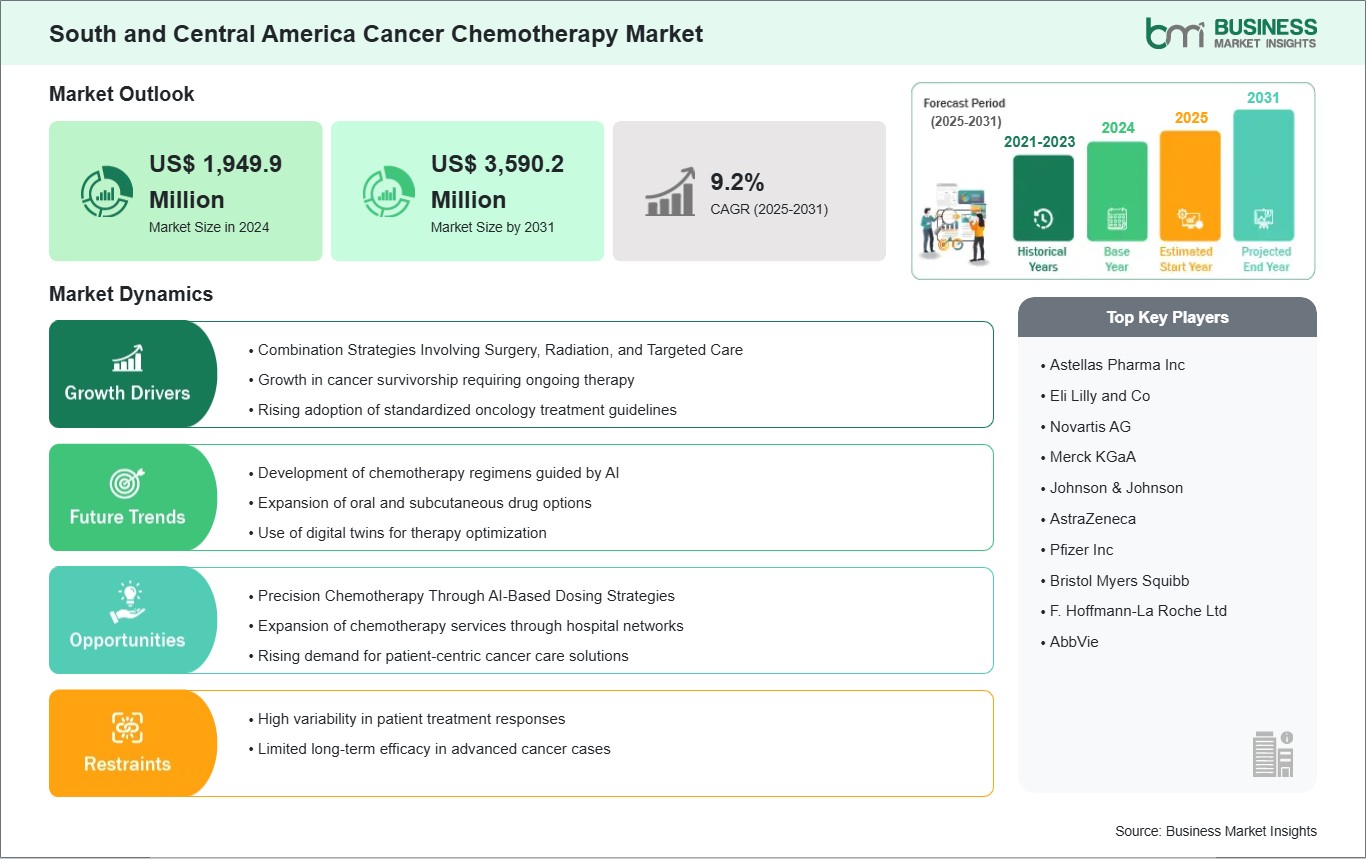
The South and Central America cancer chemotherapy market is expanding on the back of demographic shifts, higher cancer prevalence, and increasing investment in healthcare infrastructure. Brazil accounts for the largest share, supported by a robust public healthcare system (SUS), local generic drug manufacturing, and broad chemotherapy adoption across multiple indications. Mexico follows with significant demand backed by public health initiatives and expanding oncology services in the public and private sectors.
Chemotherapy continues to be deployed extensively for breast, lung, colorectal, and blood cancers, either as monotherapy or in combination with surgery, radiation, and targeted therapies. Institutional hospital settings remain the major administration point due to the need for clinical monitoring, particularly for intravenous regimens. Outpatient oncology centers and infusion services are increasingly important, especially in urban areas, offering greater convenience and enabling a shift toward decentralized care. Retail pharmacies and online platforms are expanding their role, particularly in oral chemotherapy agents and supportive care medications, improving patient access beyond hospital walls.
Regulatory reforms aimed at accelerating drug approvals and promoting biosimilar adoption are enhancing chemotherapy availability and reducing cost barriers. Collaboration between local health authorities, international pharmaceutical companies, and non-governmental organizations supports broader access to essential cytotoxic agents. Nevertheless, variability in healthcare financing and oncology infrastructure across South and Central America continues to influence chemotherapy utilization patterns.
Segment Analysis
South and Central America Cancer Chemotherapy Market Segmentation
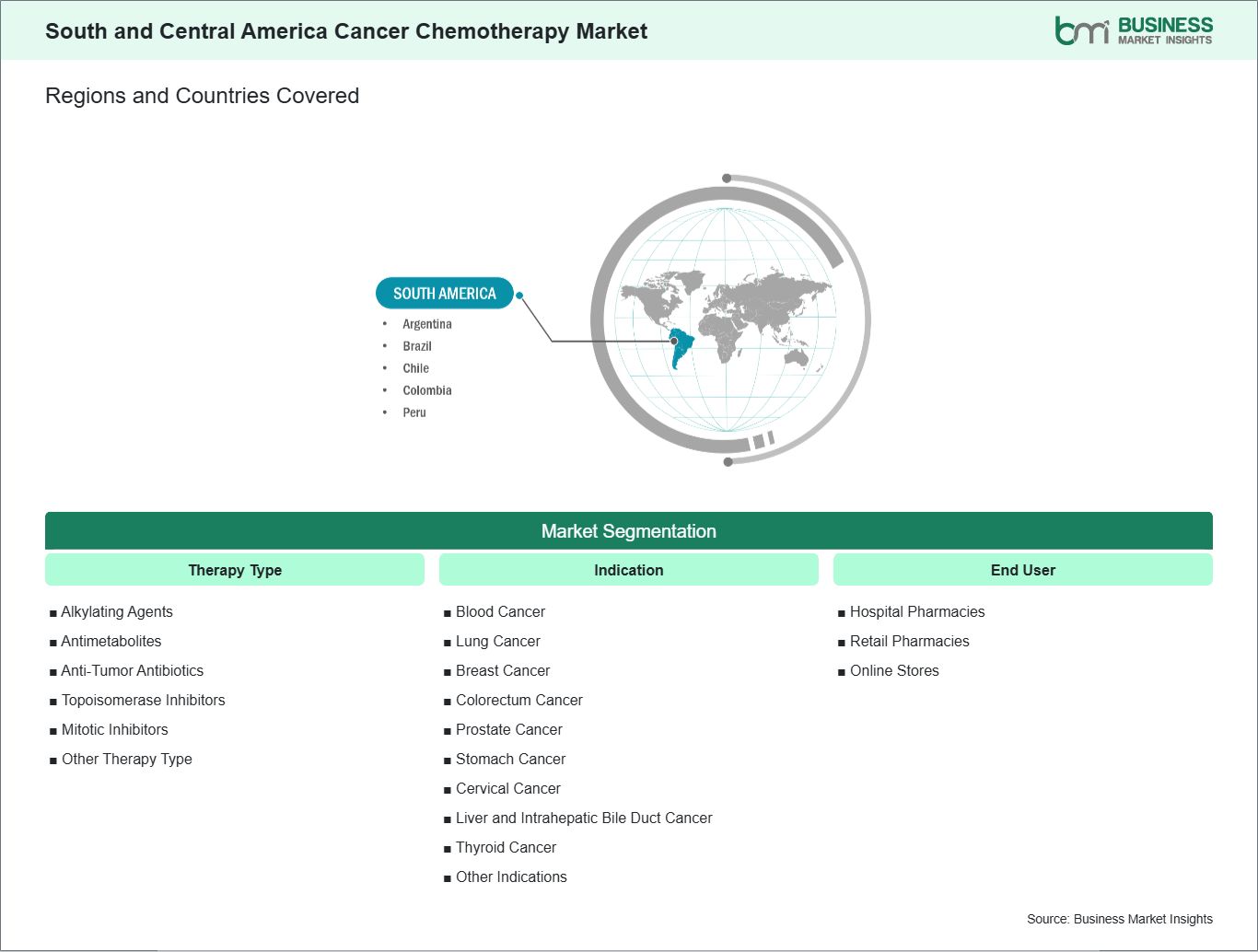
Key segments that contributed to the derivation of the South and Central America Cancer Chemotherapy market analysis are therapy type, indication, and distribution channel.
- By therapy type, the cancer chemotherapy market is segmented into alkylating agents, antimetabolites, anti-tumor antibiotics, topoisomerase inhibitors, mitotic inhibitors, and others. The alkylating agents segment dominated the market in 2024.
- Based on indication, the cancer chemotherapy market is segmented into blood cancer, lung cancer, breast cancer, colorectum cancer, prostate cancer, stomach cancer, cervical cancer, liver and intrahepatic bile duct cancer, thyroid cancer, and other indications. The lung cancer segment dominated the market in 2024.
- In terms of distribution channel, the market is segmented into hospital pharmacies, retail pharmacies, and online stores. The hospital pharmacies segment dominated the market in 2024.
Market Forces
South and Central America Cancer Chemotherapy Market Drivers and Opportunities
Combination Strategies Involving Surgery, Radiation, and Targeted Care
A significant driver of chemotherapy demand in South and Central America is the increased adoption of multimodal cancer treatment protocols that integrate chemotherapy with surgery, radiation therapy, and targeted agents. These strategies are supported by clinical evidence demonstrating improved outcomes when chemotherapy is used in the neoadjuvant setting to shrink tumors before surgery and in the adjuvant setting to reduce recurrence risk. Chemotherapy also functions as an effective radiosensitizer, enhancing the impact of radiation in locally advanced cancers such as head and neck, cervical, and lung cancers.
Additionally, chemotherapy remains central to combination regimens that include targeted therapies and immunotherapy agents. These integrated approaches are gaining traction in national clinical guidelines and real-world practice, particularly in urban cancer centers where infrastructure and specialist expertise are available. As access to targeted agents improves through regulatory reforms and public payer programs, combination regimens featuring chemotherapy backbone remain a key therapeutic strategy, driving sustained utilization and reinforcing chemotherapy's role within comprehensive oncology care pathways.
Precision Chemotherapy Through AI-Based Dosing Strategies
Artificial Intelligence (AI) enhances chemotherapy personalization and dosing optimization. AI tools can integrate large datasets including genomics, biomarkers, imaging data, treatment histories, and real-world outcomes to support individualized treatment planning. Predictive analytics can help clinicians identify optimal chemotherapy combinations, anticipate toxicity risks, and adjust dosing schedules in near real-time based on early response patterns.
Investments in digital health infrastructure and electronic medical records in major oncology hubs such as São Paulo, Mexico City, Buenos Aires, and Santiago are enabling early adoption of AI-assisted decision support systems. These systems aid in refining chemotherapy regimens, enhancing patient stratification, and informing adaptive therapy strategies. AI also supports clinical research by enabling smarter patient cohort selection and streamlining clinical trial design, thus accelerating evidence generation for chemotherapy combinations. As digital ecosystem maturity advances, AI has the potential to improve clinical outcomes, reduce adverse events, and enhance operational efficiency in oncology care.
Size and Share Analysis
South and Central America Cancer Chemotherapy Market Size and Share Analysis
The South and Central America Cancer Chemotherapy market demonstrates steady growth, with size and share analysis highlighting evolving trends and competitive dynamics among key players. The report examines subsegments categorized within therapy type, indication, and distribution channel, offering insights into their contribution to overall market performance.
By therapy type, the alkylating agents subsegment dominated the market in 2024, driven by their established roles in treating a range of solid and hematologic malignancies.
Based on indication, the lung cancer subsegment dominated the market in 2024, driven by infection prevention initiatives and demand for biocompatible devices in South and Central American healthcare systems.
By distribution channel, the hospital pharmacies subsegment dominated the market in 2024, driven by centralized chemotherapy administration and inpatient care needs, particularly for intravenous regimens.
Report Coverage
South and Central America Cancer Chemotherapy Market Report Coverage and Deliverables
The "South and Central America Cancer Chemotherapy Market Size and Forecast (2021–2031)" report provides a detailed analysis of the market covering below areas:
- South and Central America Cancer Chemotherapy market size and forecast at regional and country levels for key segments covered under the scope
- South and Central America Cancer Chemotherapy market trends, as well as market dynamics such as drivers, restraints, and key opportunities
- South and Central America Cancer Chemotherapy market analysis covering key trends, regional framework, major players, regulations, and recent market developments
- Industry landscape and competition analysis covering market concentration, heat map analysis, prominent players, and recent developments for the South and Central America Cancer Chemotherapy market
- Detailed company profiles, including SWOT analysis
Geographic Insights
South and Central America Cancer Chemotherapy Market Geographic Insights
The geographical scope of the South and Central America Cancer Chemotherapy market report is divided into Brazil, Argentina, Peru, Chile, and Colombia. Brazil held the largest share in 2024.
Brazil stands out as the largest market, supported by its Unified Health System (SUS), which guarantees broad access to essential chemotherapy drugs for the population. The country's strong local pharmaceutical manufacturing base ensures a stable supply of generics. At the same time, oncology centers in major cities routinely integrate chemotherapy with surgery, radiation, and targeted therapies, following evidence‑based protocols. Argentina demonstrates robust demand due to high cancer incidence, with both public and private systems emphasizing access to standard regimens and supportive care. However, economic volatility continues to challenge supply chains and pricing stability.
In Colombia and Chile, governments are strengthening oncology infrastructure and payer coverage, ensuring chemotherapy is widely available in hospitals and outpatient settings. Both countries are increasingly adopting combination protocols in line with evolving international guidelines. Meanwhile, Peru is an emerging market where chemotherapy utilization is growing. Public initiatives to expand cancer care and infrastructure improvements in urban centers are boosting uptake, though rural access remains limited. Collectively, these dynamics highlight South America's progress in expanding chemotherapy access, while underscoring persistent disparities between established and emerging markets.
Industry Activity
Recent Developments
The South and Central America Cancer Chemotherapy market is evaluated by gathering qualitative and quantitative data post primary and secondary research, which includes important corporate publications, association data, and databases. A few of the key developments in the South and Central America cancer chemotherapy market are:
- In July 2025, Fresenius Kabi announced the opening of a new compounding facility in Brazil, intended to enhance local production capacity for oncology drugs including chemotherapy agents to serve the supply needs.
- In May 2025, PharmaMar and Adium Pharma's Argentine subsidiary Raffo received local regulatory authorization in Argentina for Zepzelca (lurbinectedin) for adults with metastatic small cell lung cancer after prior platinum-based chemotherapy, marking expanded options in oncology treatment following chemotherapy.
Trust & Transparency
Research Methodology
The market analysis combines proprietary research with secondary data from government agencies, company disclosures, regulatory filings, industry databases and expert interviews. Market estimates are validated through data triangulation, cross-market benchmarking and analyst
review.
View Full Research Methodology
Key Sources Referred:
World Health Organization (WHO) World Heart Federation (WHF) Organisation for Economic Cooperation and Development (OECD) The World Bank Group Worldometer The Lancet International Bar Association International Trade Administration