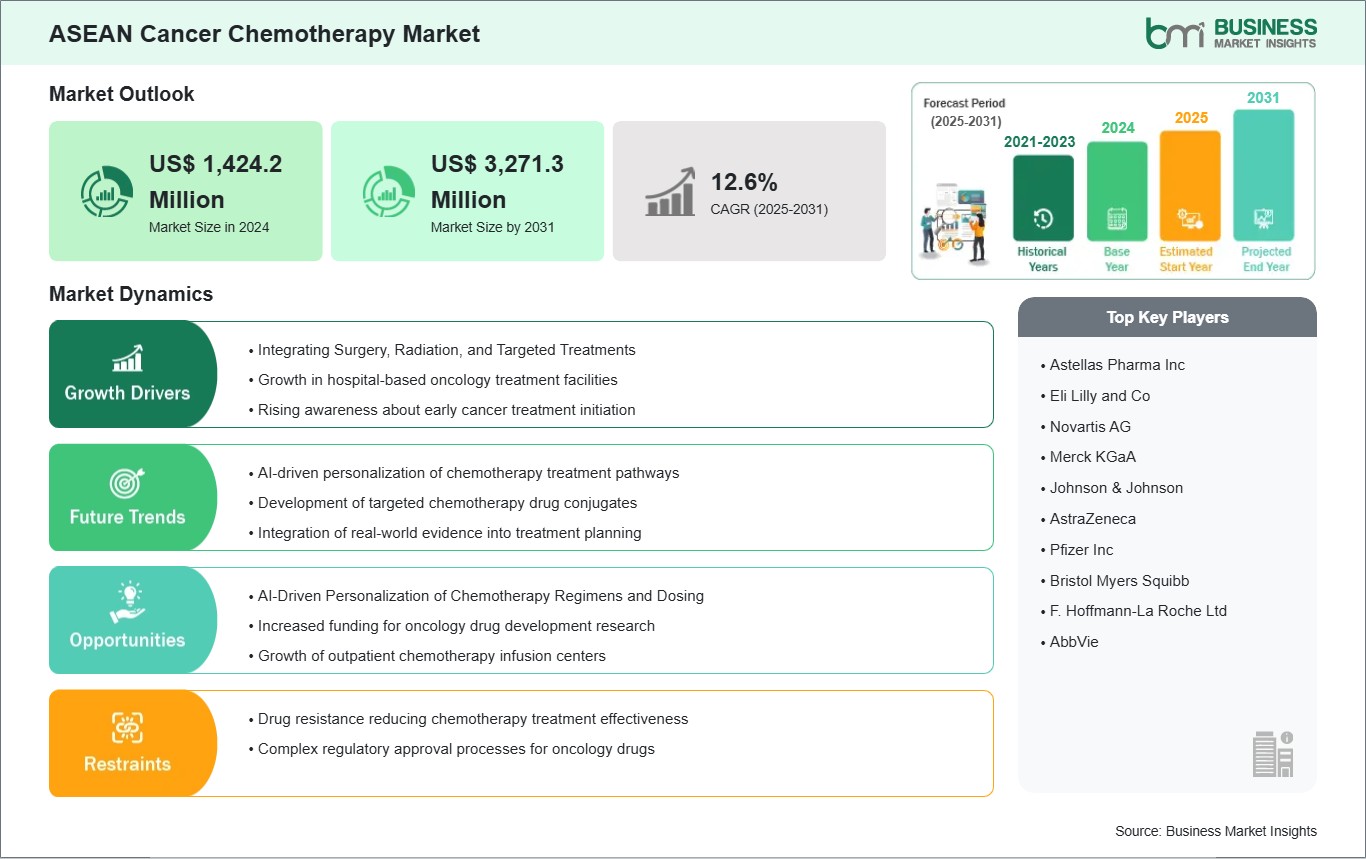
The ASEAN Cancer Chemotherapy Market size is expected to reach US$ 3,271.3 million by 2031 from US$ 1,424.2 million in 2024. The market is estimated to record a CAGR of 12.6% from 2025 to 2031.
The cancer chemotherapy market in ASEAN is evolving steadily, supported by demographic shifts, urbanization, lifestyle changes, and growing cancer awareness across the region. Countries such as Singapore, Thailand, Malaysia, and Indonesia account for a significant share of demand, while Vietnam and the Philippines are emerging markets with expanding oncology capabilities. Chemotherapy remains widely used as first-line and adjuvant therapy, particularly in public healthcare systems where access to advanced biologics may be limited.
Hospitals represent the primary treatment setting for chemotherapy administration across ASEAN due to infrastructure concentration and the availability of trained oncology professionals. Tertiary care hospitals and cancer centers dominate usage in urban regions, while regional and public hospitals rely heavily on essential chemotherapy drugs listed in national formularies. Retail pharmacies are gaining relevance for oral chemotherapy agents, particularly in private healthcare settings.
Government initiatives to strengthen cancer control programs, expand insurance coverage, and invest in oncology infrastructure are supporting market growth. At the same time, multinational pharmaceutical companies and regional generic manufacturers play a critical role in ensuring drug availability. Overall, the market reflects a transition phase, balancing affordability, access, and gradual adoption of combination therapies.

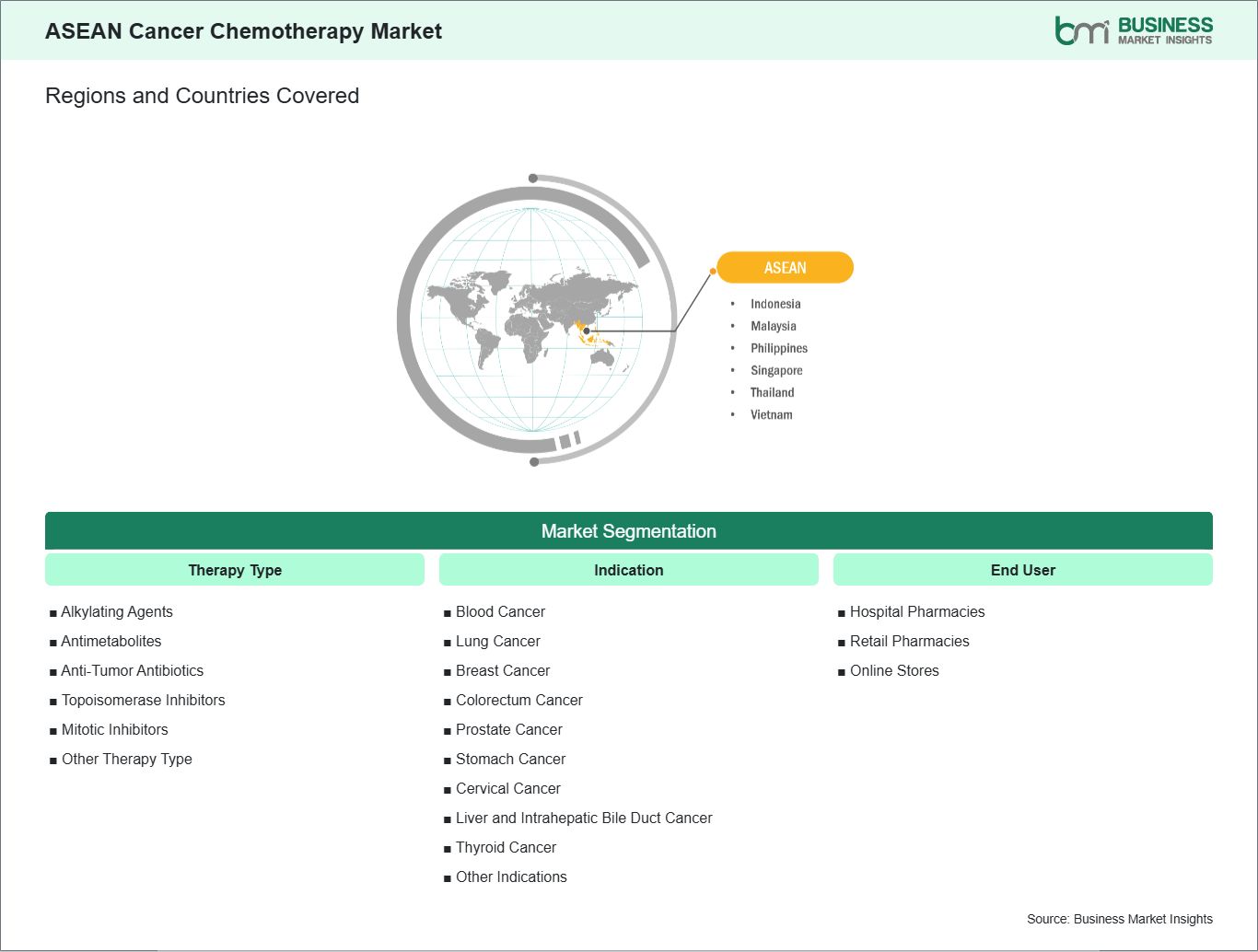
Key segments that contributed to the derivation of the ASEAN Cancer Chemotherapy market analysis are therapy type, indication, and distribution channel.
A key driver of the ASEAN cancer chemotherapy market is the increasing adoption of multimodal cancer treatment approaches that combine chemotherapy with surgery, radiation therapy, and targeted treatments. Chemotherapy is widely used in the neoadjuvant setting to shrink tumors before surgery, particularly in breast, cervical, and gastrointestinal cancers. In adjuvant settings, chemotherapy remains essential to reduce recurrence risk following surgical intervention. The integration of chemotherapy with radiation therapy is also expanding, especially in cervical, head and neck, lung, and colorectal cancers. Chemotherapy acts as a radiosensitizer, improving treatment efficacy and outcomes. This combined approach is increasingly incorporated into national cancer treatment guidelines across ASEAN countries, driving sustained chemotherapy utilization.
Although targeted therapies and immunotherapies are gaining attention, their high cost limits widespread adoption. As a result, chemotherapy continues to serve as the backbone of combination regimens, enhancing the effectiveness of newer agents when used together. These multimodal strategies improve survival outcomes and extend the clinical relevance of chemotherapy.
Digital health adoption is accelerating across the region. Traditional chemotherapy regimens often follow standardized protocols, which may not account for individual patient variability. AI-driven tools offer the potential to personalize treatment plans by analyzing clinical, genetic, and treatment-response data.
In advanced healthcare systems such as Singapore and Malaysia, AI platforms are increasingly being integrated into oncology workflows to support treatment planning, dose optimization, and toxicity prediction. These systems analyze electronic medical records, imaging data, and laboratory results to identify optimal chemotherapy regimens for individual patients, improving treatment efficacy and reducing adverse effects.
AI-enabled predictive modeling can also support adaptive dosing throughout treatment cycles, helping clinicians respond proactively to patient tolerance and disease progression. While adoption remains uneven across ASEAN, ongoing investments in health IT infrastructure and data interoperability are expected to accelerate AI integration. Over time, AI-driven personalization is likely to improve chemotherapy outcomes, enhance clinical decision-making, and create new opportunities across the market.

The ASEAN Cancer Chemotherapy market demonstrates steady growth, with size and share analysis highlighting evolving trends and competitive dynamics among key players. The report examines subsegments categorized by therapy type, indication, distribution channel, and geography, offering insights into their contribution to overall market performance.
By therapy type, the alkylating agents subsegment dominated the market in 2024, driven by their broad use across solid tumors and hematological malignancies, as well as their inclusion in national essential medicines lists.
Based on indication, the lung cancer subsegment dominated the market in 2024, driven by infection prevention initiatives and demand for biocompatible devices in ASEAN healthcare systems.
By distribution channel, the hospital pharmacies subsegment dominated the market in 2024, driven by centralized procurement and administration of chemotherapy drugs within public and private hospitals.
| Report Attribute | Details |
|---|---|
| Market size in 2024 | US$ 1,424.2 Million |
| Market Size by 2031 | US$ 3,271.3 Million |
| CAGR (2025 - 2031) | 12.6% |
| Historical Data | 2021-2023 |
| Forecast period | 2025-2031 |
| Segments Covered | By Therapy Type
|
|
Regions and Countries Covered
| |
| ASEAN | Indonesia, Malaysia, the Philippines, Singapore, Thailand, and Vietnam |
| Market leaders and key company profiles |
|
The "ASEAN Cancer Chemotherapy Market Size and Forecast (2025–2031)" report provides a detailed analysis of the market covering below areas:
The geographical scope of the ASEAN Cancer Chemotherapy market report is divided into: Indonesia, Malaysia, the Philippines, Singapore, Thailand, and Vietnam. Singapore held the largest share in 2024.
Singapore represents the most advanced market, supported by world-class oncology infrastructure, early adoption of combination therapies, and strong private healthcare participation. Chemotherapy is extensively used alongside targeted and immunotherapies in tertiary hospitals. Malaysia and Thailand demonstrate stable growth, driven by expanding public cancer programs, improved insurance coverage, and increasing access to chemotherapy drugs in government hospitals. These countries rely heavily on standardized chemotherapy regimens due to cost considerations. Indonesia represents the largest volume market in ASEAN, driven by population size and rising cancer incidence. Public hospitals dominate chemotherapy administration, with affordability and distribution efficiency as key success factors. Vietnam and the Philippines are emerging markets, characterized by improving diagnostic capabilities, increasing oncology awareness, and gradual expansion of chemotherapy access through public-private partnerships. Across ASEAN, urban centers show higher adoption of advanced regimens, while rural areas depend on basic chemotherapy drugs. These variations highlight the need for localized strategies focused on affordability, distribution, and physician training.

The ASEAN Cancer Chemotherapy market is evaluated by gathering qualitative and quantitative data post primary and secondary research, which includes important corporate publications, association data, and databases. A few of the key developments in the ASEAN cancer chemotherapy market are:
The ASEAN Cancer Chemotherapy Market is valued at US$ 1,424.2 Million in 2024, it is projected to reach US$ 3,271.3 Million by 2031.
As per our report ASEAN Cancer Chemotherapy Market, the market size is valued at US$ 1,424.2 Million in 2024, projecting it to reach US$ 3,271.3 Million by 2031. This translates to a CAGR of approximately 12.6% during the forecast period.
The ASEAN Cancer Chemotherapy Market report typically cover these key segments-
The historic period, base year, and forecast period can vary slightly depending on the specific market research report. However, for the ASEAN Cancer Chemotherapy Market report:
The ASEAN Cancer Chemotherapy Market is populated by several key players, each contributing to its growth and innovation. Some of the major players include:
The ASEAN Cancer Chemotherapy Market report is valuable for diverse stakeholders, including:
Essentially, anyone involved in or considering involvement in the ASEAN Cancer Chemotherapy Market value chain can benefit from the information contained in a comprehensive market report.
Please tell us your area of interest
(Market Segments/ Regions and Countries/ Companies)