Market Summary
Executive Summary and Market Analysis
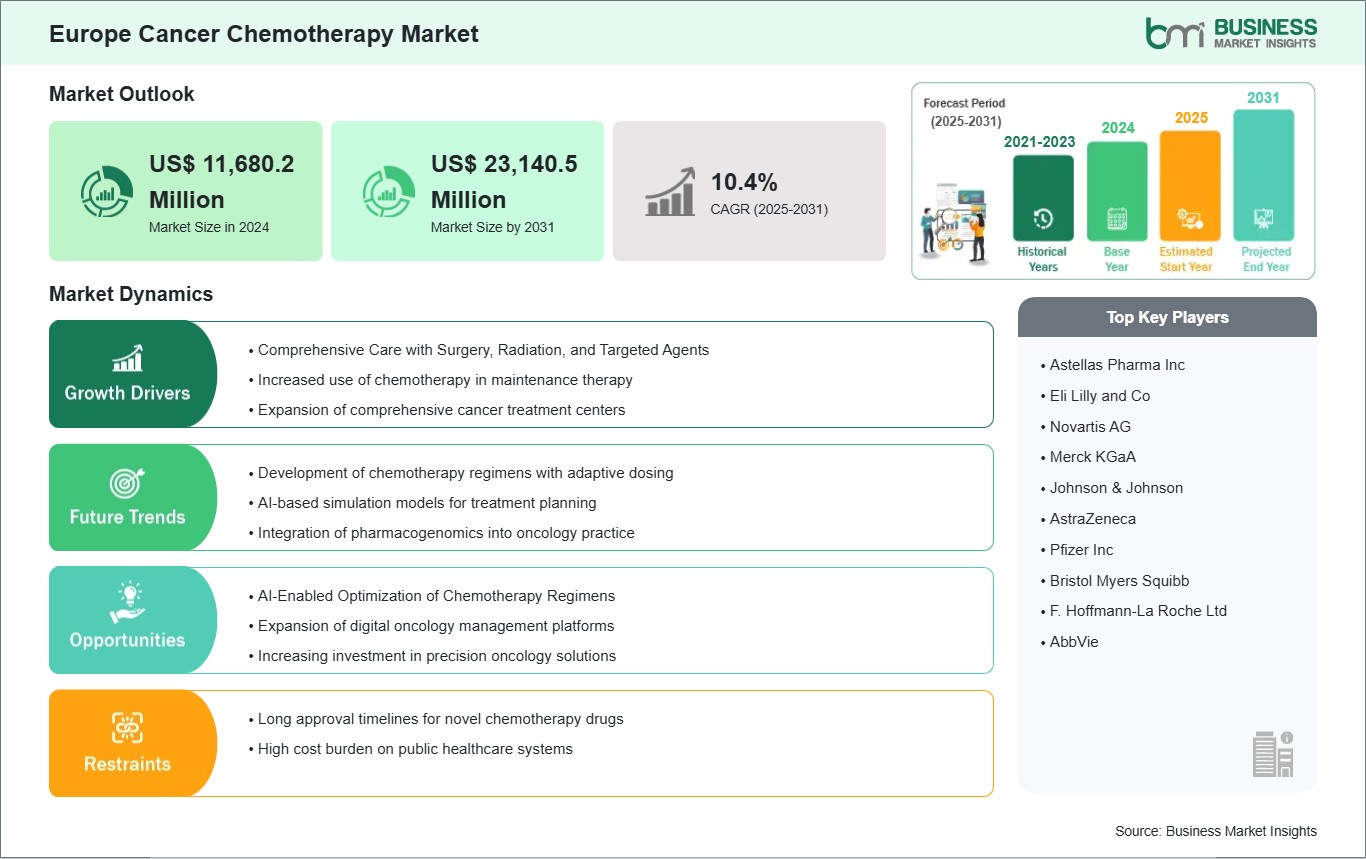
The Europe cancer chemotherapy market is experiencing sustained growth driven by demographic trends, including an aging population and rising cancer incidence rates; strong public healthcare systems with established chemotherapy reimbursement; and the presence of major oncology research networks that shape treatment paradigms. Chemotherapy remains a core component of treatment pathways across both early and late stages of disease. Europe's regulatory environment, coordinated through the European Medicines Agency (EMA), enables consistent approval standards and facilitates cross‑border market access, fostering broader availability of chemotherapy agents and combination regimens.
The market is segmented by therapy type, indication, and distribution channel. Intravenous chemotherapy formulations dominate due to established institutional administration practices, but oral cytotoxic agents are gaining adoption due to patient convenience and home‑based care options. Chemotherapy is often used in neoadjuvant and adjuvant settings, and in combination with surgery or radiation across various cancer types. Europe's oncology centers especially in Germany, France, the UK, Italy, and the Nordic region lead adoption of chemotherapy and combination protocols. Germany accounts for a significant share of the regional market due to its large population, high treatment volumes, and dense network of oncology centers. France is also poised for faster growth with strong national cancer control plans and robust centralized evaluation systems that expedite drug access.
Despite the rise of targeted and immune therapies, chemotherapy's widespread clinical acceptance and established role in standard-of-care regimens preserve its relevance. Market growth is further supported by biosimilar penetration and continued innovation in drug delivery technologies that improve safety and tolerability.
Segment Analysis
Europe Cancer Chemotherapy Market Segmentation
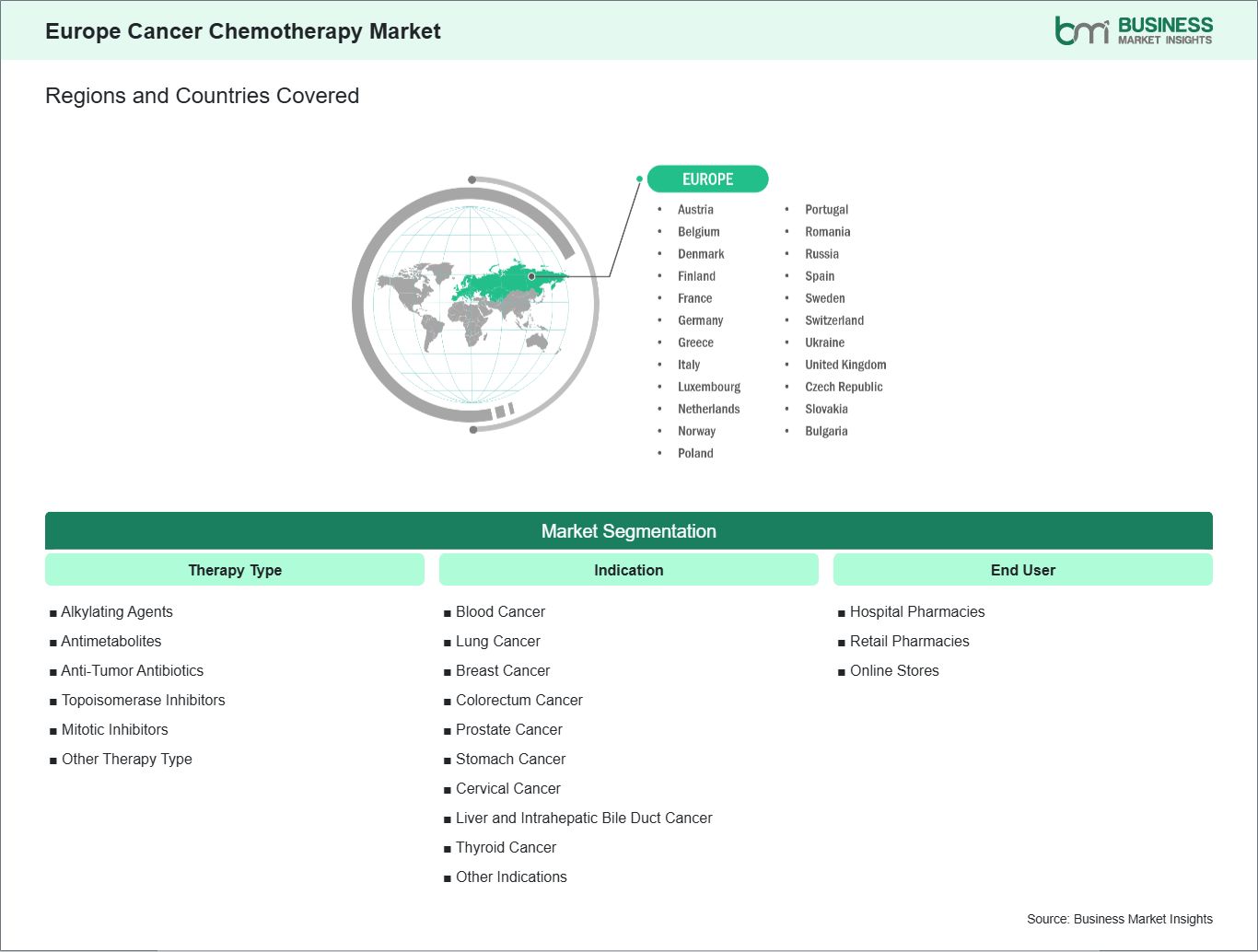
Key segments that contributed to the derivation of the Europe Cancer Chemotherapy market analysis are therapy type, indication, and distribution channel.
- By therapy type, the cancer chemotherapy market is segmented into alkylating agents, antimetabolites, anti-tumor antibiotics, topoisomerase inhibitors, mitotic inhibitors, and others. The alkylating agents segment dominated the market in 2024.
- Based on Indication, the cancer chemotherapy market is segmented into blood cancer, lung cancer, breast cancer, colorectum cancer, prostate cancer, stomach cancer, cervical cancer, liver and intrahepatic bile duct cancer, thyroid cancer, and other indications. The lung cancer segment dominated the market in 2024.
- In terms of distribution channel, the market is segmented into hospital pharmacies, retail pharmacies, and online stores. The hospital pharmacies segment dominated the market in 2024.
Market Forces
Europe Cancer Chemotherapy Market Drivers and Opportunities
Comprehensive Care with Surgery, Radiation, and Targeted Agents
A primary driver in Europe is the integration of chemotherapy within multimodal cancer treatment strategies. Clinical practice widely employs chemotherapy alongside surgery and radiation to improve outcomes; for example, neoadjuvant chemotherapy is applied to reduce tumor burden before surgical resection, while adjuvant chemotherapy is used post‑surgery to eliminate residual disease and lower recurrence risk. Chemotherapy also serves as a radiosensitizer, enhancing the effectiveness of radiation therapy in locally advanced tumors, including head and neck, cervical, and gastrointestinal cancers.
Furthermore, chemotherapy is frequently combined with targeted therapies and immunotherapy agents to improve survival in advanced and metastatic settings. Combination protocols involving checkpoint inhibitors or targeted small molecules are increasingly adopted in Europe's clinical guidelines for lung, breast, and colorectal cancers. These integrated approaches extend chemotherapy's clinical relevance, supporting patient outcomes while strengthening demand for traditional cytotoxic drugs within evolving oncology pathways.
AI-Enabled Optimization of Chemotherapy Regimens
Artificial Intelligence (AI) enables personalized treatment planning and optimization of dosing regimens. Traditional chemotherapy protocols often employ standardized dosing based on body surface area or fixed schedules, which may not capture individual patient variability in tumor biology, metabolism, or treatment response.
AI technologies can analyze large, multidimensional datasets including genomics, imaging, biomarkers, electronic health records, and real-world outcomes to support individualized chemotherapy decisions. Predictive algorithms assist clinicians in identifying optimal drug combinations, anticipating toxicity profiles, and adjusting doses dynamically throughout treatment. As healthcare systems in Europe increasingly invest in digital health infrastructure and interoperability, AI-driven tools are expected to enhance precision oncology, improve therapeutic efficacy, and reduce adverse events. Integration of AI into clinical decision support also accelerates learning across institutions, encouraging evidence-based optimization of chemotherapy regimens across diverse patient populations.
Size and Share Analysis
Europe Cancer Chemotherapy Market Size and Share Analysis
The Europe Cancer Chemotherapy market demonstrates steady growth, with size and share analysis highlighting evolving trends and competitive dynamics among key players. The report examines subsegments categorized within therapy type, indication, and distribution channel, offering insights into their contribution to overall market performance.
By therapy type, the alkylating agents subsegment dominated the market in 2024, driven by the widespread use in routine IV therapy and emergency care across hospitals and clinics.
Based on indication, the lung cancer subsegment dominated the market in 2024, driven by disease prevalence and standard treatment protocols that emphasize chemotherapy in both early and advanced settings.
By distribution channel, the hospital pharmacies subsegment dominated the market in 2024, driven by institutional administration of intravenous therapies.
Report Coverage
Europe Cancer Chemotherapy Market Report Coverage and Deliverables
The "Europe Cancer Chemotherapy Market Size and Forecast (2021–2031)" report provides a detailed analysis of the market covering below areas:
- Europe Cancer Chemotherapy market size and forecast at regional and country levels for key market segments covered under the scope
- Europe Cancer Chemotherapy market trends, as well as market dynamics such as drivers, restraints, and key opportunities
- Europe Cancer Chemotherapy market analysis covering key trends, regional framework, major players, regulations, and recent market developments
- Industry landscape and competition analysis covering market concentration, heat map analysis, prominent players, and recent developments for the Europe Cancer Chemotherapy market
- Detailed company profiles, including SWOT analysis
Geographic Insights
Europe Cancer Chemotherapy Market Geographic Insights
The geographical scope of the Europe Cancer Chemotherapy market report is divided into Belgium, Austria, Finland, Denmark, Greece, Poland, Romania, Russia, Ukraine, the Czech Republic, Slovakia, Bulgaria, Italy, Luxembourg, Germany, Switzerland, France, the Netherlands, Norway, Portugal, Spain, Sweden, and the UK. Germany held the largest share in 2024.
Germany represents the largest market share in Europe for chemotherapy, driven by high healthcare spending, dense networks of oncology centers, and strong clinical research infrastructure. Standardized multidisciplinary care and early diagnosis programs support widespread adoption across diverse cancer types. France demonstrates robust growth supported by proactive national cancer control strategies, centralized drug evaluation pathways, and high generic penetration. French oncology programs prioritize evidence-based chemotherapy regimens, particularly for breast and colorectal cancers, while expanding support for oral cytotoxic drugs to reduce hospital congestion. Despite regulatory realignment post-Brexit, the UK continues to exhibit strong demand for chemotherapy. Mutual recognition initiatives and streamlined approval processes maintain access to European Medicines Agency dossiers, ensuring ongoing chemotherapy availability. Italy and Spain exhibit steady expansion due to increasing healthcare allocation toward oncology, comprehensive cancer screening programs, and enhanced access to traditional chemotherapy and combination regimens. Southern European countries leverage biosimilar adoption to sustain chemotherapy access.
Industry Activity
Recent Developments
The Europe Cancer Chemotherapy market is evaluated by gathering qualitative and quantitative data post primary and secondary research, which includes important corporate publications, association data, and databases. A few of the key developments in the Europe cancer chemotherapy market are:
- In October 2025, at ESMO 2025, Pfizer, Merck & Co., and Astellas reported significant advances for muscle-invasive bladder cancer therapies, including combinations that reduce recurrence and progression when paired with or used alongside chemotherapy-related regimens, highlighting collaborative clinical progress in Europe.
- In May 2025, the European Commission granted marketing authorization for Itovebi (inavolisib) for adults with PIK3CA‑mutated, ER‑positive, HER2‑negative advanced breast cancer, enhancing targeted oncology options that may integrate with chemotherapy combinations.
Trust & Transparency
Research Methodology
The market analysis combines proprietary research with secondary data from government agencies, company disclosures, regulatory filings, industry databases and expert interviews. Market estimates are validated through data triangulation, cross-market benchmarking and analyst
review.
View Full Research Methodology
Key Sources Referred:
World Health Organization (WHO) World Heart Federation (WHF) Organisation for Economic Cooperation and Development (OECD) The World Bank Group Worldometer The Lancet International Bar Association International Trade Administration