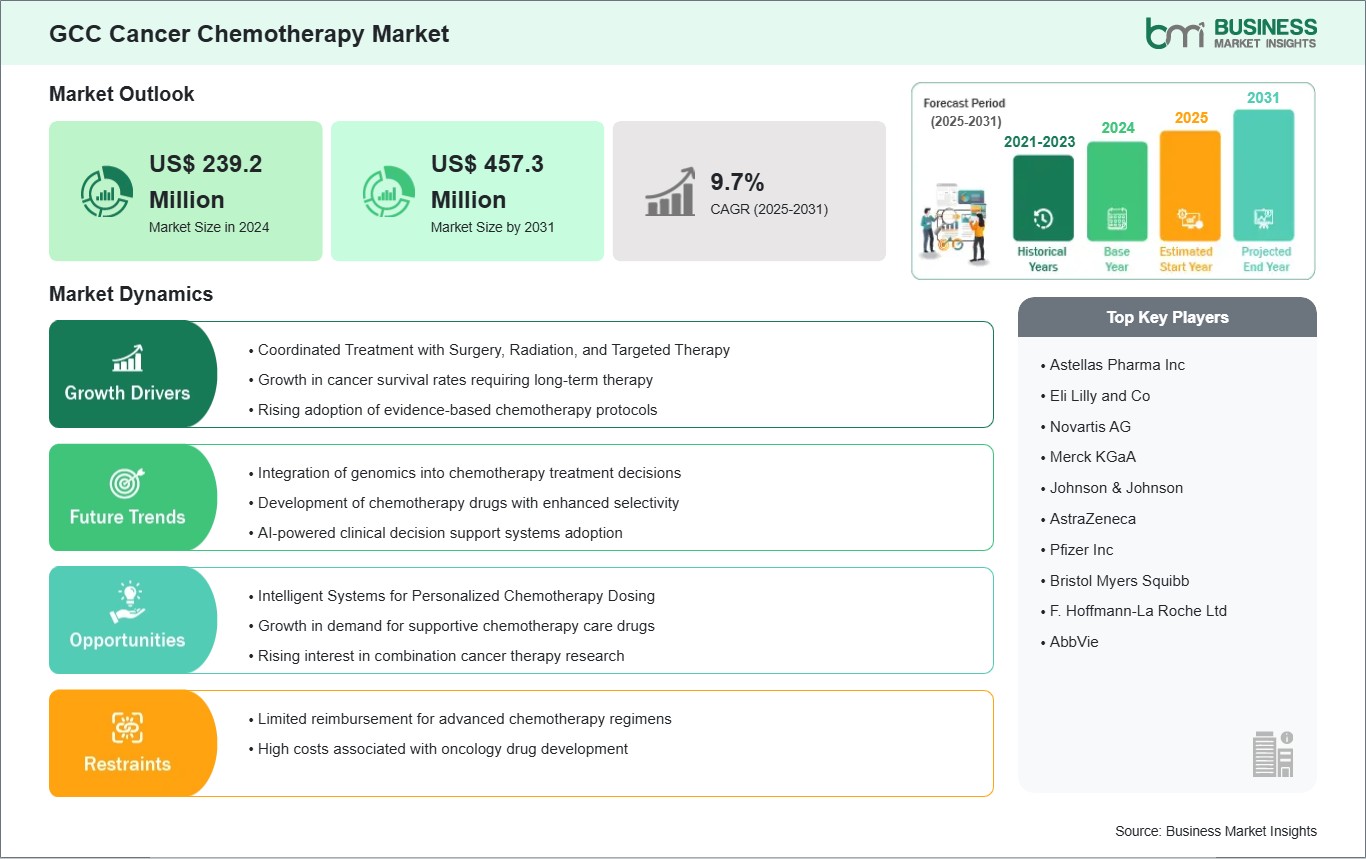
The GCC Cancer Chemotherapy Market size is expected to reach US$ 457.3 million by 2031 from US$ 239.2 million in 2024. The market is estimated to record a CAGR of 9.7% from 2025 to 2031.
The cancer chemotherapy market in the GCC is experiencing significant growth, driven by the rising incidence of cancer globally and substantial healthcare investments by member states. Saudi Arabia represents the largest share within the GCC due to its extensive healthcare restructuring under Vision 2030, which includes significant funding for specialized cancer centers, precision diagnostics, and advanced oncology care delivery. The UAE, particularly through major tertiary care hospitals and oncology networks in Dubai and Abu Dhabi, exhibits high chemotherapy utilization supported by advanced infrastructure and international partnerships. Qatar's National Cancer Program and Kuwait's healthcare reforms have strengthened oncology services, expanding patient access to chemotherapy regimens through public and private insurance models.
Chemotherapy services in the GCC include inpatient and outpatient administrations, with hospital pharmacies dominating as the primary distribution channel for injectable and intravenous drugs. Retail pharmacy networks and emerging online platforms are increasingly important for oral cytotoxic agents and supportive care formulations, reflecting patient preference for convenience and continuity of care. The GCC also shows rising adoption of personalized treatment approaches, where chemotherapy is integrated with targeted therapies and immunotherapies in multidisciplinary care protocols.
Regional initiatives emphasize building clinical research expertise, digital health integration, and training oncology professionals to enhance treatment outcomes. Strategic collaborations with international cancer centers and pharmaceutical companies are expanding the availability of innovative chemotherapy combinations and companion diagnostics, improving treatment precision and patient quality of life. Overall, the market reflects strengthening demand, evolving clinical practices, and expanding healthcare delivery systems that are expected to sustain growth through 2031.

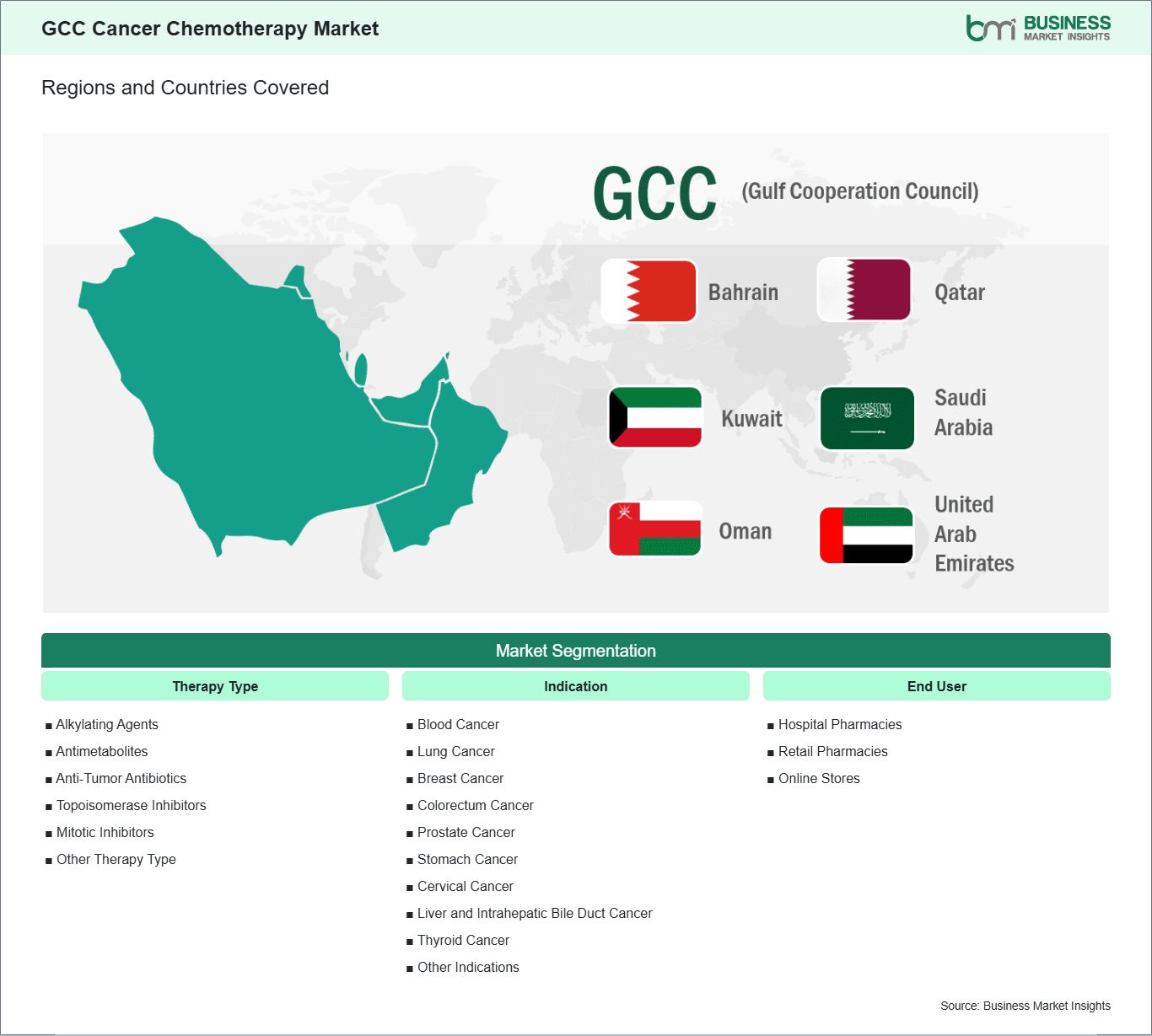
Key segments that contributed to the derivation of the GCC Cancer Chemotherapy market analysis are therapy type, indication, and distribution channel.
A key driver for the GCC cancer chemotherapy market is the increasing adoption of multimodal treatment strategies that combine chemotherapy with surgery, radiation therapy, and targeted agents. Chemotherapy is widely used in neoadjuvant settings to reduce tumor size before surgical resection and in adjuvant contexts to eliminate residual disease and reduce recurrence risk, especially in breast, colorectal, and prostate cancers. The region is also witnessing growing integration of chemotherapy with radiation therapy, where cytotoxic agents serve as radiosensitizers to enhance tumor response in locally advanced lung, head and neck, and gastrointestinal cancers.
In parallel, chemotherapy continues to be a foundational element within combination regimens involving targeted therapies and immunotherapies. These protocols are increasingly supported by clinical guidelines and evidence from global oncology practice, enhancing treatment outcomes and broadening therapeutic options for patients with advanced and metastatic disease. Particularly in high‑income GCC states such as Saudi Arabia and the UAE, multidisciplinary cancer care models emphasize integrated treatment pathways that leverage chemotherapy alongside novel biologics and precision agents to improve survival rates and quality of life.
The expansion of oncology centers, clinical trial networks, and partnerships with international research institutions further supports the adoption of combination approaches, creating opportunities for increased chemotherapy usage across multiple cancer indications. Continued focus on integrated care strengthens the clinical relevance of chemotherapy even as the region embraces precision oncology and targeted treatments.
Artificial Intelligence (AI) enables personalized regimens and optimized dosing strategies. AI tools can synthesize multi‑dimensional patient data including genomic profiles, clinical histories, imaging biomarkers, and real‑world treatment outcomes to support individualized treatment plans that improve effectiveness and minimize toxicity. In the GCC, investment in digital health infrastructure, electronic health records, and cloud-based clinical decision support systems is increasing, particularly in Saudi Arabia and the UAE, creating an environment conducive to AI integration.
AI‑enabled predictive models assist oncologists in selecting the most appropriate chemotherapy agents, scheduling optimal dosing, forecasting potential side effects, and adapting regimens based on early response signals. These capabilities enhance precision oncology and improve resource utilization within busy oncology services. Moreover, AI accelerates clinical research by enabling smarter patient stratification and real-time analytics in regional cancer care programs. Partnerships between AI firms and local health authorities along with rising adoption of AI-assisted diagnostics and treatment planning tools are expected to bolster personalized chemotherapy approaches across the GCC.

The GCC Cancer Chemotherapy market demonstrates steady growth, with size and share analysis highlighting evolving trends and competitive dynamics among key players. The report further examines subsegments categorized by therapy type, indication, and distribution channel, offering insights into their contribution to overall market performance.
By therapy type, the alkylating agents subsegment dominated the market in 2024, driven by their established clinical utility across multiple cancer types.
Based on indication, the lung cancer subsegment dominated the market in 2024, driven by infection prevention initiatives and demand for biocompatible devices in GCC healthcare systems.
By distribution channel, the hospital pharmacies subsegment dominated the market in 2024, driven by centralized administration of intravenous and infusion regimens.
| Report Attribute | Details |
|---|---|
| Market size in 2024 | US$ 239.2 Million |
| Market Size by 2031 | US$ 457.3 Million |
| CAGR (2025 - 2031) | 9.7% |
| Historical Data | 2021-2023 |
| Forecast period | 2025-2031 |
| Segments Covered | By Therapy Type
|
|
Regions and Countries Covered
| |
| GCC | United Arab Emirates, Bahrain, Saudi Arabia, Oman, Qatar, and Kuwait |
| Market leaders and key company profiles |
|
The "GCC Cancer Chemotherapy Market Size and Forecast (202–2031)" report provides a detailed analysis of the market covering below areas:
The geographical scope of the GCC Cancer Chemotherapy market report is divided into the UAE, Bahrain, Saudi Arabia, Oman, Qatar, and Kuwait. Saudi Arabia held the largest share in 2024.
Saudi Arabia is the largest market in the GCC, driven by extensive healthcare reforms under Vision 2030, which focus on modernizing oncology services, expanding cancer centers, and integrating precision medicine. Public and private sector collaborations, exemplified by initiatives such as the Oncology Center of Excellence under Johns Hopkins Aramco Healthcare, aim to elevate treatment quality, enhance early detection programs, and support clinical research networks. The UAE exhibits strong demand for chemotherapy across major metropolitan oncology centers, particularly in Dubai and Abu Dhabi, where advanced healthcare infrastructure, international medical partnerships, and investment in oncology technologies support high‑quality cancer care. Retail pharmacy expansions and outpatient infusion services further broaden chemotherapy access.
Qatar has launched comprehensive national cancer programs that prioritize access to systemic therapies, including chemotherapy, while enhancing screening and support services. Kuwait is bolstering oncology care via new cancer treatment protocols and infrastructure investments to improve patient outcomes. In Oman and Bahrain, government health systems continue to develop oncology treatment pathways with increasing chemotherapy adoption, although overall volumes remain smaller compared with Saudi Arabia and the UAE. Across the GCC, urban centers show higher uptake and access to advanced chemotherapy regimens, while strategies to expand care into peripheral regions are ongoing. Public payer systems and employer-based insurance schemes significantly influence chemotherapy uptake and affordability, shaping regional market dynamics.

The GCC Cancer Chemotherapy market is evaluated by gathering qualitative and quantitative data post primary and secondary research, which includes important corporate publications, association data, and databases. A few of the key developments in the GCC cancer chemotherapy market are:
The GCC Cancer Chemotherapy Market is valued at US$ 239.2 Million in 2024, it is projected to reach US$ 457.3 Million by 2031.
As per our report GCC Cancer Chemotherapy Market, the market size is valued at US$ 239.2 Million in 2024, projecting it to reach US$ 457.3 Million by 2031. This translates to a CAGR of approximately 9.7% during the forecast period.
The GCC Cancer Chemotherapy Market report typically cover these key segments-
The historic period, base year, and forecast period can vary slightly depending on the specific market research report. However, for the GCC Cancer Chemotherapy Market report:
The GCC Cancer Chemotherapy Market is populated by several key players, each contributing to its growth and innovation. Some of the major players include:
The GCC Cancer Chemotherapy Market report is valuable for diverse stakeholders, including:
Essentially, anyone involved in or considering involvement in the GCC Cancer Chemotherapy Market value chain can benefit from the information contained in a comprehensive market report.
Please tell us your area of interest
(Market Segments/ Regions and Countries/ Companies)