Market Summary
Executive Summary and Market Analysis
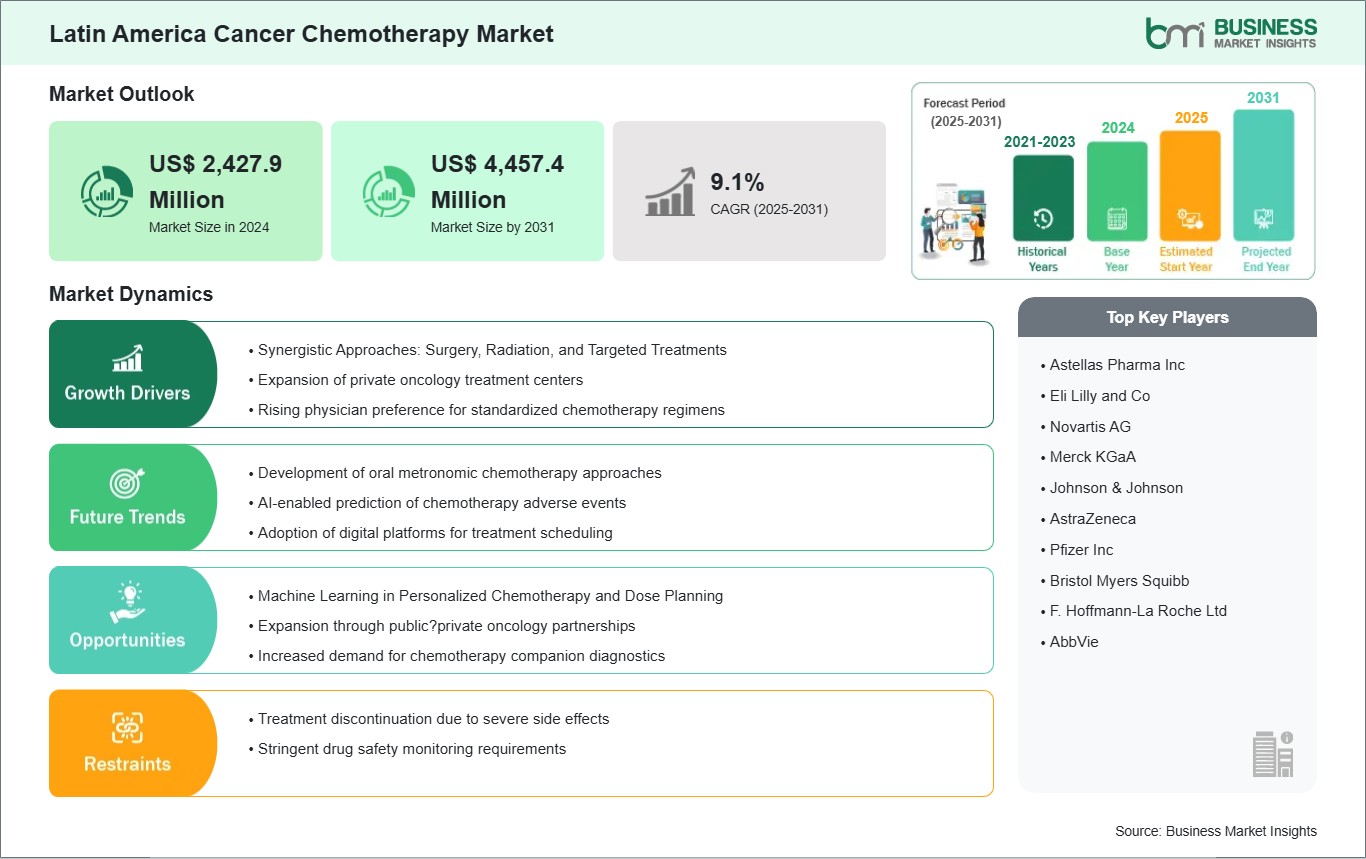
The Latin America cancer chemotherapy market is influenced by demographic trends, economic growth, and enhanced healthcare system capacity. Countries such as Brazil, Mexico, Argentina, Colombia, and Chile play leading roles in regional oncology adoption due to large populations, increasing public oncology funding, and stronger healthcare infrastructure. Brazil holds the largest share in the region, driven by extensive public payer programs, strong local pharmaceutical manufacturing, and broad chemotherapy utilization across multiple indications. Mexico follows with significant chemotherapy demand supported by public health initiatives and private healthcare expansions.
Chemotherapy is extensively used across solid tumors and hematologic cancers, either as monotherapy or in combination with surgery, radiation, or targeted agents. Hospitals and specialized cancer centers are the dominant delivery channels, while outpatient infusion services and retail pharmacy networks are gaining relevance, particularly for oral cytotoxic drugs and supportive care medications. Regulatory improvements and regional cooperation are helping shorten the time to drug approval and expand treatment options, though regulatory lags remain a challenge relative to North America and Europe. Overall, the cancer chemotherapy market in Latin America reflects substantial healthcare system evolution and persistent challenges in equitable drug access and clinical capacity.
Segment Analysis
Latin America Cancer Chemotherapy Market Segmentation
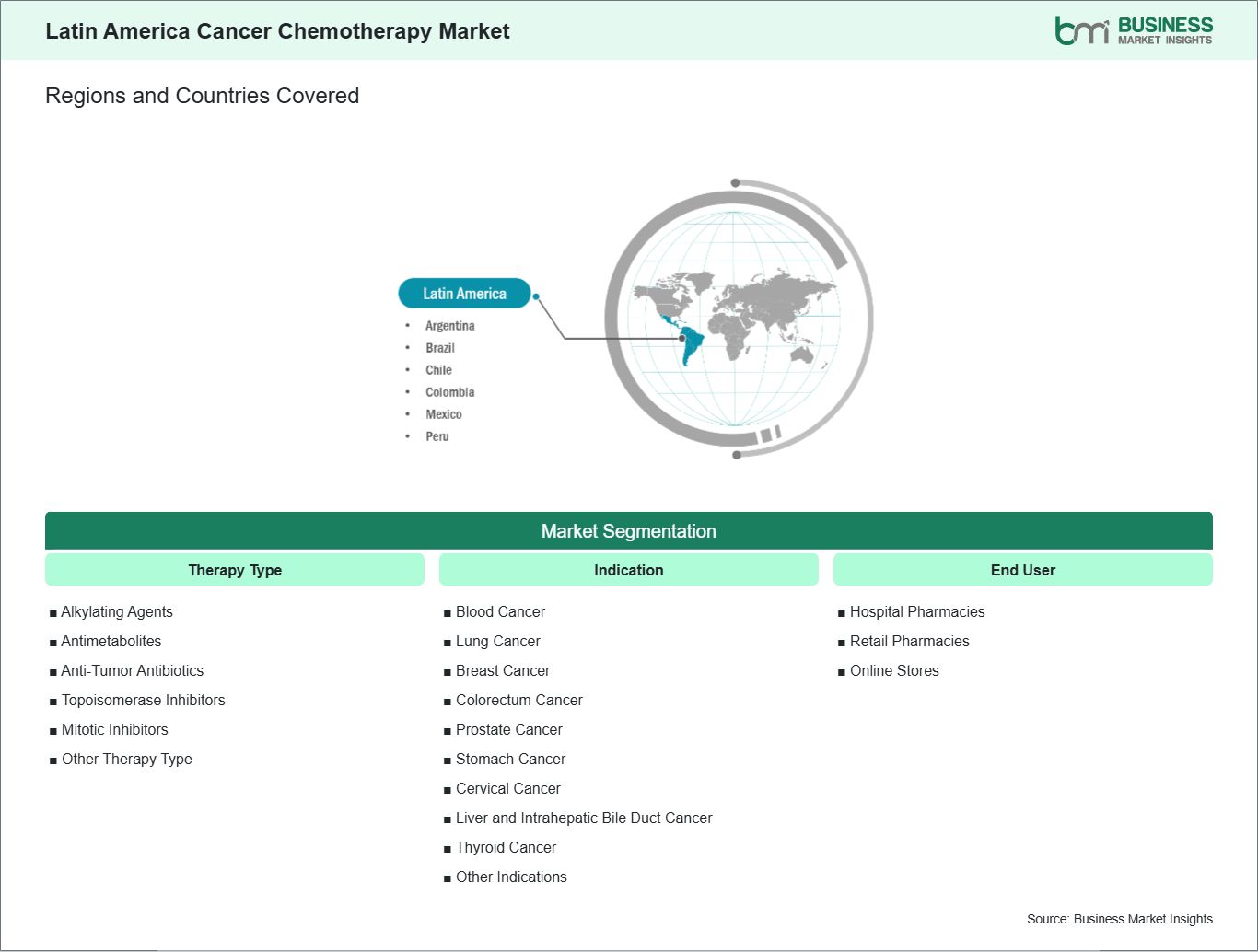
Key segments that contributed to the derivation of the Latin America Cancer Chemotherapy market analysis are therapy type, indication, and distribution channel.
- By therapy type, the cancer chemotherapy market is segmented into alkylating agents, antimetabolites, anti-tumor antibiotics, topoisomerase inhibitors, mitotic inhibitors, and others. The alkylating agents segment dominated the market in 2024.
- Based on indication, the cancer chemotherapy market is segmented into blood cancer, lung cancer, breast cancer, colorectum cancer, prostate cancer, stomach cancer, cervical cancer, liver and intrahepatic bile duct cancer, thyroid cancer, and other indications. The lung cancer segment dominated the market in 2024.
- By distribution channel, the market is segmented into hospital pharmacies, retail pharmacies, and online stores. The hospital pharmacies segment dominated the market in 2024.
Market Forces
Latin America Cancer Chemotherapy Market Drivers and Opportunities
Synergistic Approaches: Surgery, Radiation, and Targeted Treatments
A key driver of the Latin America cancer chemotherapy market is the increasing adoption of multimodal treatment strategies. Chemotherapy is widely used in the neoadjuvant setting to shrink tumors before surgery and as adjuvant therapy to eliminate residual disease across breast, colorectal, and lung cancers. It also serves as a radiosensitizer, improving outcomes in locally advanced tumors when combined with radiation therapy. These integrated approaches are increasingly reflected in clinical guidelines across major oncology centers in Brazil, Mexico, and Argentina.
Simultaneously, chemotherapy maintains its role in combination with targeted therapies and immunotherapies, which are being introduced more frequently as payers expand oncology coverage. While targeted agents often command higher prices, chemotherapy's relative affordability and broad applicability support its continued usage in first‑line and later‑line settings. These trends create opportunities for chemotherapy utilization, particularly as cancer care becomes multidisciplinary and evidence‑based across the region.
Machine Learning in Personalized Chemotherapy and Dose Planning
Artificial Intelligence (AI) enables personalized regimen design and optimized dosing strategies. AI tools can integrate clinical data, genetic profiles, imaging, and treatment response information to support individualized therapy plans that maximize efficacy and minimize toxicity. In major oncology hubs such as São Paulo, Mexico City, and Buenos Aires, digital health initiatives and electronic health record systems are facilitating early exploration of AI‑assisted decision support.
By enhancing predictive analytics for treatment response and toxicity risk, AI can help clinicians tailor chemotherapy choices and dosing schedules more precisely, especially in complex cases. AI also accelerates real‑world evidence generation and optimizes clinical trial design, making it easier to identify patient subgroups likely to benefit from specific chemotherapy combinations. As digital infrastructure matures and data sharing expands, AI has the potential to improve clinical outcomes and treatment efficiency.
Size and Share Analysis
Latin America Cancer Chemotherapy Market Size and Share Analysis
The Latin America Cancer Chemotherapy market demonstrates steady growth, with size and share analysis highlighting evolving trends and competitive dynamics among key players. The report further examines subsegments categorized by therapy type, indication, and distribution channel, offering insights into their contribution to overall market performance.
By therapy type, the alkylating agents subsegment dominated the market in 2024, driven by the widespread use in routine IV therapy and emergency care across hospitals and clinics.
Based on indication, the lung cancer subsegment dominated the market in 2024, driven by regional disease burden patterns and treatment protocols.
By distribution channel, the hospital pharmacies subsegment dominated the market in 2024, driven by centralized administration of intravenous regimens requiring clinical supervision.
Report Coverage
Latin America Cancer Chemotherapy Market Report Coverage and Deliverables
The "Latin America Cancer Chemotherapy Market Size and Forecast (2025–2031)" report provides a detailed analysis of the market covering below areas:
- Latin America Cancer Chemotherapy market size and forecast at regional and country levels for all the key market segments covered under the scope
- Latin America Cancer Chemotherapy market trends, as well as market dynamics such as drivers, restraints, and key opportunities
- Latin America Cancer Chemotherapy market analysis covering key market trends, regional framework, major players, regulations, and recent market developments
- Industry landscape and competition analysis covering market concentration, heat map analysis, prominent players, and recent developments for the Latin America Cancer Chemotherapy market
- Detailed company profiles, including SWOT analysis
Geographic Insights
Latin America Cancer Chemotherapy Market Geographic Insights
The geographical scope of the Latin America Cancer Chemotherapy market report is divided into Mexico, Brazil, Argentina, Peru, Chile, and Colombia. Brazil held the largest share in 2024.
Brazil is the largest chemotherapy market in the region, supported by the country's extensive public healthcare system (SUS) and strong local pharmaceutical manufacturing. Universal coverage facilitates broad access to essential chemotherapy drugs, while private oncology services expand advanced regimen utilization. The country also participates in regional clinical research and has a growing infrastructure for treatment delivery and early diagnosis.
Mexico follows closely, with public institutions and private providers delivering chemotherapy across urban and semi‑urban centers. Payer reforms and enhanced public financing have improved drug availability, although rural access remains uneven. Mexico's oncology programs emphasize early detection and combination treatment protocols, and partnerships with multinational pharmaceutical firms broaden access to both traditional and novel therapies.
Argentina exhibits robust demand for chemotherapy due to high cancer incidence and improving public oncology services. Regional collaborations and healthcare reforms support access, though economic volatility can affect supply chains and pricing. Colombia and Chile show steady growth, with growing investment in oncology infrastructure, reimbursement policies, and expanded use of outpatient infusion services, particularly in urban centers.
Industry Activity
Recent Developments
The Latin America Cancer Chemotherapy market is evaluated by gathering qualitative and quantitative data post primary and secondary research, which includes important corporate publications, association data, and databases. A few of the key developments in the Latin America cancer chemotherapy market are:
- In August 2025, Civica Rx expanded partnerships with hospitals in Argentina to ensure a steady supply of essential chemotherapy drugs, responding to ongoing challenges of oncology drug shortages in the region.
- In May 2025, PharmaMar and Adium Pharma's subsidiary, Raffo, obtained marketing authorization in Argentina for Zepzelca (lurbinectedin) for adult patients with metastatic small cell lung cancer who progressed after platinum-based chemotherapy, expanding post-chemotherapy treatment options.
Trust & Transparency
Research Methodology
The market analysis combines proprietary research with secondary data from government agencies, company disclosures, regulatory filings, industry databases and expert interviews. Market estimates are validated through data triangulation, cross-market benchmarking and analyst
review.
View Full Research Methodology
Key Sources Referred:
World Health Organization (WHO) World Heart Federation (WHF) Organisation for Economic Cooperation and Development (OECD) The World Bank Group Worldometer The Lancet International Bar Association International Trade Administration