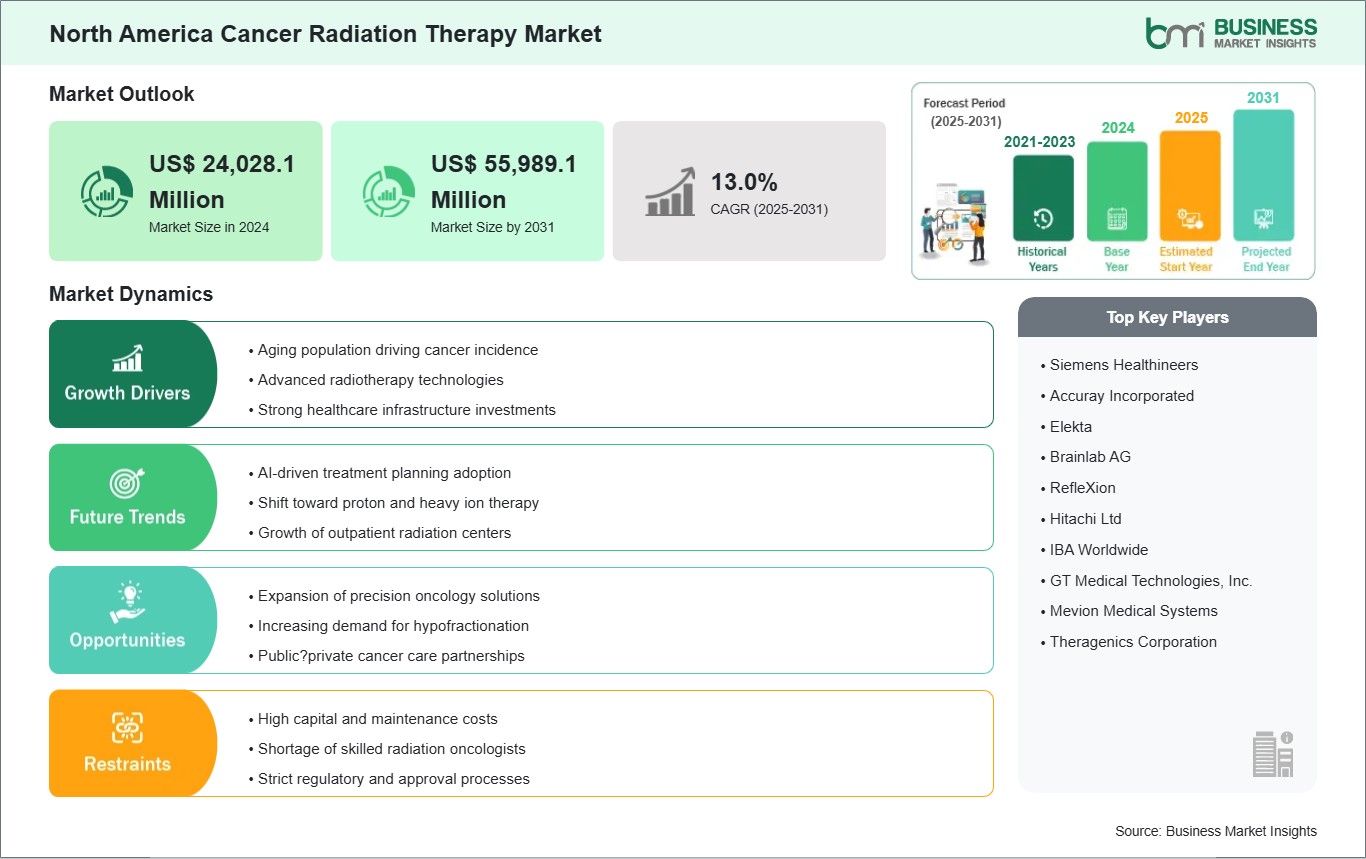
The North America cancer radiation therapy market size is expected to reach US$ 55,989.1 million by 2031 from US$ 24,028.1 million in 2024. The market is estimated to record a CAGR of 13.0% from 2025 to 2031.
The North America cancer radiation therapy market is highly advanced, supported by well-established healthcare infrastructure, widespread adoption of innovative technologies, and strong emphasis on precision oncology. Rising prevalence of breast, prostate, and lung cancers has fueled demand for sophisticated treatment modalities, including intensity-modulated radiotherapy (IMRT), stereotactic body radiotherapy (SBRT), proton therapy, and image-guided radiotherapy (IGRT). The region benefits from a dense network of specialized cancer centers and academic hospitals that integrate cutting-edge imaging, treatment planning software, and multidisciplinary oncology services. Collaboration between healthcare institutions, research organizations, and medical technology providers ensures rapid adoption of emerging radiotherapy innovations and continuous improvement of clinical protocols.
Opportunities for growth in North America stem from the integration of AI-assisted treatment planning, adaptive radiotherapy, and cloud-enabled workflow systems that improve precision, patient throughput, and accessibility in both urban and semi-urban centers. Ongoing government initiatives, insurance coverage expansion, and public-private partnerships are driving investment in new cancer centers and high-technology equipment. Additionally, regional focus on clinical trials, outcome tracking, and precision medicine supports the adoption of personalized radiation therapy strategies, positioning North America for sustained leadership in advanced oncology care and innovation in radiation therapy delivery.

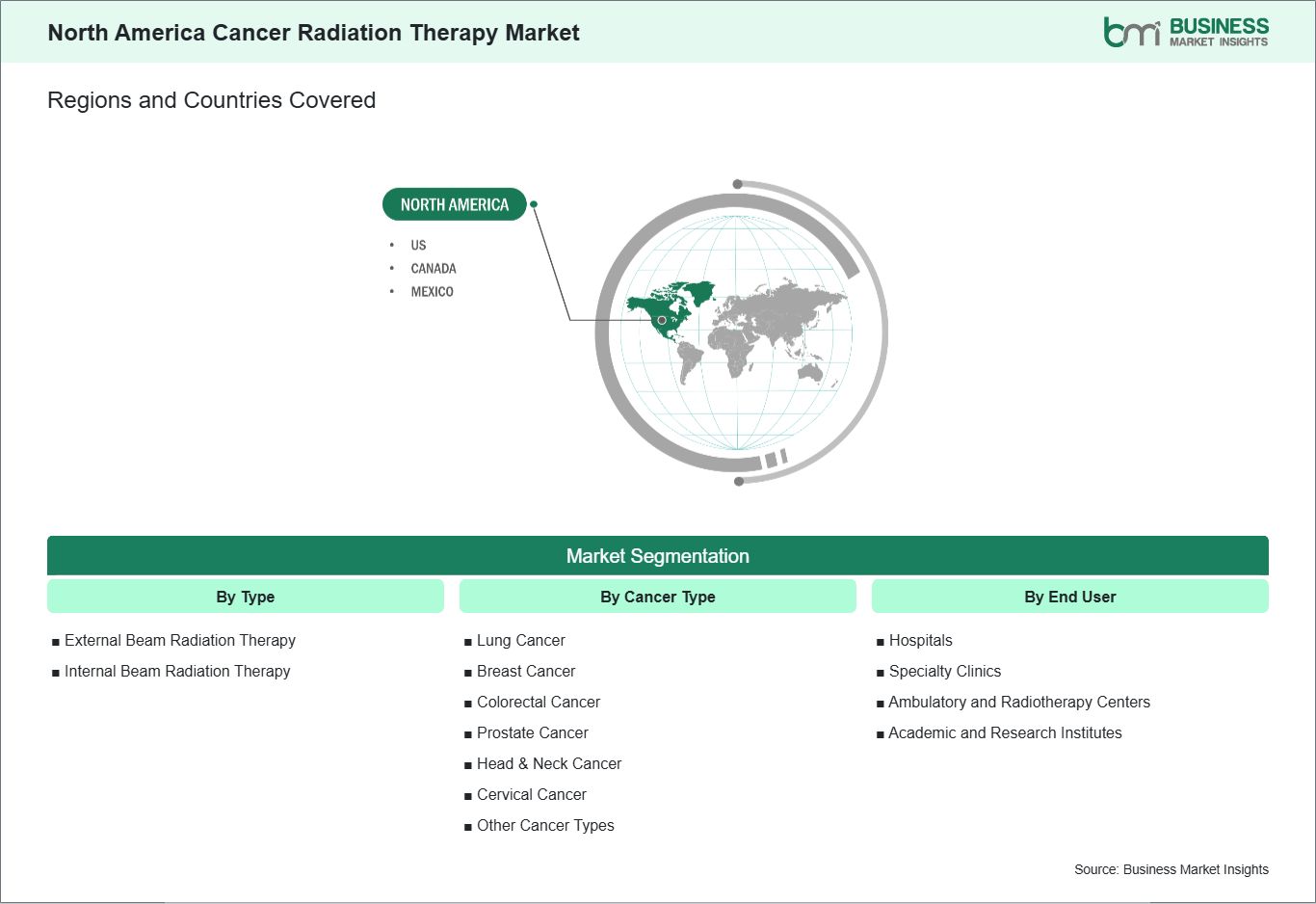
Key segments that contributed to the derivation of the North America cancer radiation therapy market analysis are type, cancer type, and end user.
Cancer prevalence continues to rise across North America, driven by aging populations, lifestyle factors, and environmental exposures. The US reports high burdens of breast, lung, and colorectal cancers, while Canada faces increasing prostate and skin cancer cases linked to demographic and behavioral trends. Obesity and smoking remain significant contributors, particularly in rural and underserved communities, while longer life expectancy ensures that age‑related cancers are more frequently diagnosed. This growing disease burden underscores the critical role of radiation therapy in comprehensive cancer care.
Screening programs and advanced diagnostics are channeling more patients into radiotherapy pathways. The US benefits from widespread mammography and colonoscopy programs, while Canada's organized cervical and colorectal screening initiatives are improving early detection. External beam radiation therapy is the dominant modality across major cancer centers in New York, Toronto, and Houston, while brachytherapy is widely used for prostate and gynecologic cancers. The increasing patient flow is placing pressure on hospitals to expand linear accelerator fleets and adopt more efficient treatment schedules.
Healthcare systems are investing heavily in oncology infrastructure to meet rising demand. Federal funding in the US supports cancer research and technology upgrades, while provincial programs in Canada prioritize equitable access to radiotherapy across urban and rural regions. As awareness campaigns and vaccination programs (HPV, hepatitis B) expand, more patients are diagnosed at treatable stages, reinforcing cancer prevalence as a sustained driver of the North American radiation therapy market.
Personalized medicine is reshaping cancer care across North America, with precision diagnostics, genomics, and advanced imaging driving individualized radiotherapy approaches. US cancer centers integrate molecular profiling into treatment planning, tailoring radiation doses to tumor biology and radio sensitivity. Canadian hospitals increasingly use MRI and PET/CT for adaptive contouring, enabling clinicians to refine dose delivery and minimize toxicity. This shift toward personalization is improving outcomes and patient satisfaction.
Technology adoption is broadening the personalization toolkit. Intensity‑modulated and image‑guided radiotherapy are standard in leading centers, while stereotactic body radiotherapy is widely used for oligometastatic disease and early‑stage lung cancer. Proton therapy facilities in the US and Canada provide organ‑sparing options for pediatric, head‑and‑neck, and thoracic tumors, while AI‑assisted planning platforms are emerging to optimize dose distributions and reduce inter‑clinician variability. These innovations enable customized treatment pathways.
Policy and reimbursement frameworks are reinforcing the move toward individualized care. Medicare and private insurers in the US increasingly cover advanced radiotherapy techniques, while Canadian provincial health systems fund precision platforms to ensure equitable access. Patients are seeking shorter, hypofractionated schedules with fewer side effects, and providers are responding with adaptive workflows and integrated care models. This rising demand for personalized medicine creates a strong opportunity for vendors, service providers, and healthcare systems to deliver advanced radiation therapy solutions tailored to North America's diverse patient population.

The North America cancer radiation therapy market demonstrates steady growth, with size and share analysis highlighting evolving trends and competitive dynamics among key players. The report further examines subsegments categorized within type, cancer type, and end user, offering insights into their contribution to overall market performance.
By type, the external beam radiation therapy subsegment dominated the market in 2024. Due to its widespread availability, precision targeting, noninvasive nature, and effectiveness in treating diverse cancers, it is the preferred choice across global oncology practices.
Based on cancer type, the lung cancer subsegment dominated the market in 2024. Due to its high incidence, strong link with smoking and pollution, late‑stage diagnoses, and reliance on advanced radiation techniques, it is the most treated cancer type globally.
In terms of end user, the hospitals subsegment dominated the market in 2024. Hospitals dominated the market since they provide comprehensive cancer care, advanced radiation infrastructure, skilled oncologists, and integrated treatment pathways, making them the primary setting for delivering radiation therapy services.
| Report Attribute | Details |
|---|---|
| Market size in 2024 | US$ 24,028.1 Million |
| Market Size by 2031 | US$ 55,989.1 Million |
| CAGR (2025 - 2031) | 13.0% |
| Historical Data | 2021-2023 |
| Forecast period | 2025-2031 |
| Segments Covered | By Type
|
|
Regions and Countries Covered
| |
| North America | US, Canada, Mexico |
| Market leaders and key company profiles |
|
The "North America Cancer Radiation Therapy Market Size and Forecast (2021 - 2031)" report provides a detailed analysis of the market covering below areas:
The geographical scope of the North America Cancer Radiation Therapy market report is divided into: The US, Canada, and Mexico. The US held the largest share in 2024.
The US dominates the North America cancer radiation therapy market due to its extensive oncology infrastructure, early adoption of advanced technologies, and strong clinical expertise. Leading cancer centers in cities such as New York, Boston, Houston, and Los Angeles provide comprehensive radiotherapy services, including IMRT, IGRT, SBRT, proton therapy, and brachytherapy. These centers integrate sophisticated imaging, treatment planning, and patient management systems, enabling high-precision care and multidisciplinary treatment coordination. US leadership is reinforced by continuous investment in research, technology development, and clinical training programs that keep the workforce at the forefront of emerging radiation therapy techniques. Academic and private institutions collaborate on clinical trials, protocol standardization, and innovation, ensuring rapid deployment of next-generation therapies. Combined with robust healthcare funding, a high density of advanced cancer centers, and widespread access to specialized clinicians, the US maintains its position as the dominant force driving radiation therapy adoption and innovation in North America.

The North America Cancer Radiation Therapy market is evaluated by gathering qualitative and quantitative data post primary and secondary research, which includes important corporate publications, association data, and databases. A few of the key developments in the North America cancer radiation therapy market are:
The North America Cancer Radiation Therapy Market is valued at US$ 24,028.1 Million in 2024, it is projected to reach US$ 55,989.1 Million by 2031.
As per our report North America Cancer Radiation Therapy Market, the market size is valued at US$ 24,028.1 Million in 2024, projecting it to reach US$ 55,989.1 Million by 2031. This translates to a CAGR of approximately 13.0% during the forecast period.
The North America Cancer Radiation Therapy Market report typically cover these key segments-
The historic period, base year, and forecast period can vary slightly depending on the specific market research report. However, for the North America Cancer Radiation Therapy Market report:
The North America Cancer Radiation Therapy Market is populated by several key players, each contributing to its growth and innovation. Some of the major players include:
The North America Cancer Radiation Therapy Market report is valuable for diverse stakeholders, including:
Essentially, anyone involved in or considering involvement in the North America Cancer Radiation Therapy Market value chain can benefit from the information contained in a comprehensive market report.
Please tell us your area of interest
(Market Segments/ Regions and Countries/ Companies)