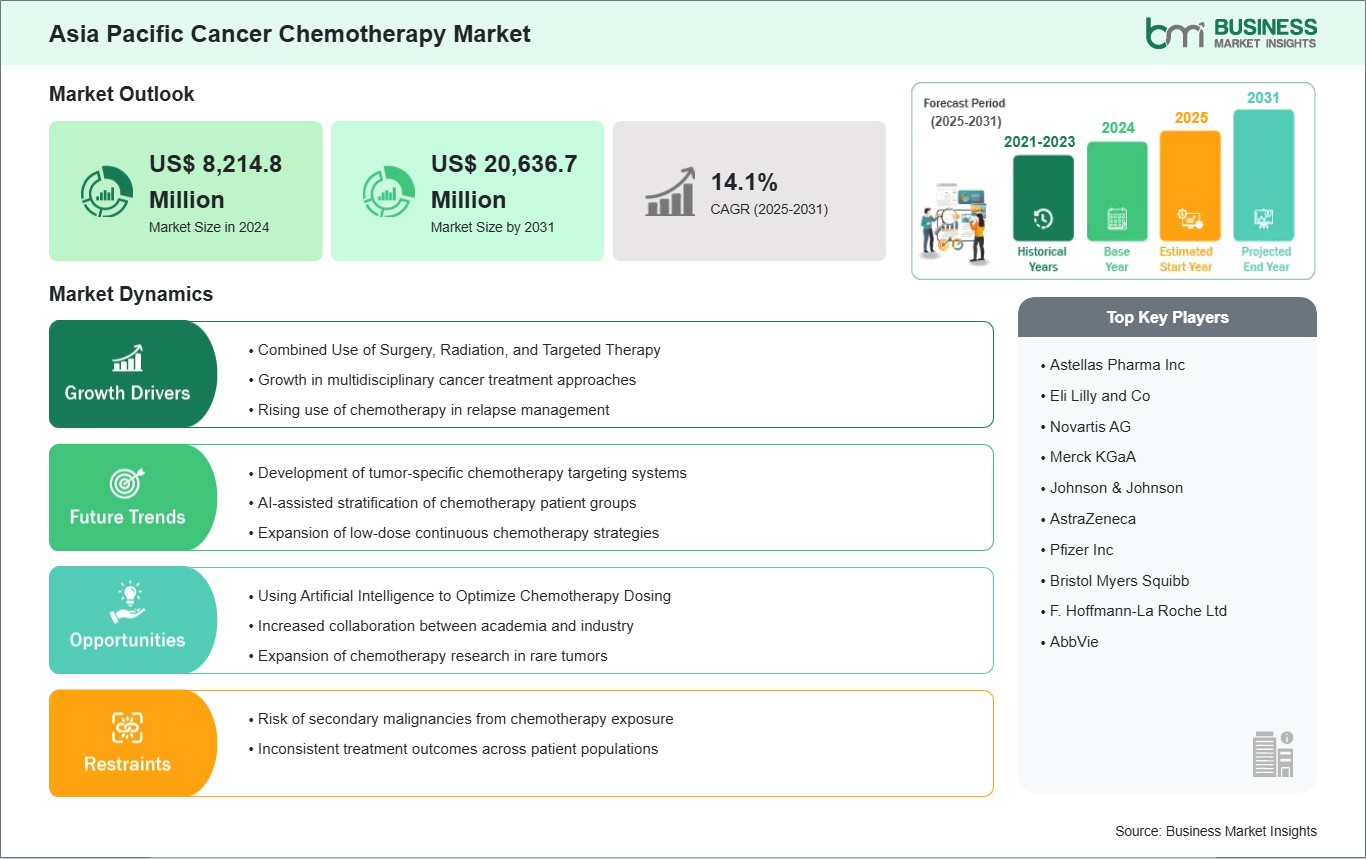
The Asia Pacific Cancer Chemotherapy Market size is expected to reach US$ 20,636.7 million by 2031 from US$ 8,214.8 million in 2024. The market is estimated to record a CAGR of 14.1% from 2025 to 2031.
The Asia Pacific cancer chemotherapy market is one of the fastest-growing markets globally, driven by demographic shifts, lifestyle changes, and increased cancer incidence. China, Japan, India, South Korea, and Australia dominate regional demand, supported by advanced healthcare infrastructure, high healthcare expenditure, and comprehensive cancer control programs. Emerging economies such as Vietnam, Thailand, and Indonesia show steady growth due to increasing access to oncology care, government initiatives, and rising awareness of early detection.
Chemotherapy continues to play a central role across treatment pathways as both a primary and adjuvant therapy. Hospitals particularly tertiary and specialized cancer centers dominate drug administration due to the need for skilled healthcare professionals and complex drug handling. Outpatient oncology clinics are increasingly popular for oral chemotherapy agents and maintenance therapy. Regional disparities exist in the region. Urban centers adopt advanced drug regimens and combination protocols, while rural areas primarily rely on standard cytotoxic therapies.
Regulatory frameworks in Asia Pacific are evolving, with faster approvals and increasing participation of global pharmaceutical companies. Generic drug production and distribution are also growing particularly in India and China enhancing affordability. Collectively, the market in Asia Pacific balances high-volume demand, infrastructure growth, and evolving clinical practices, positioning it for sustained expansion over the forecast period.

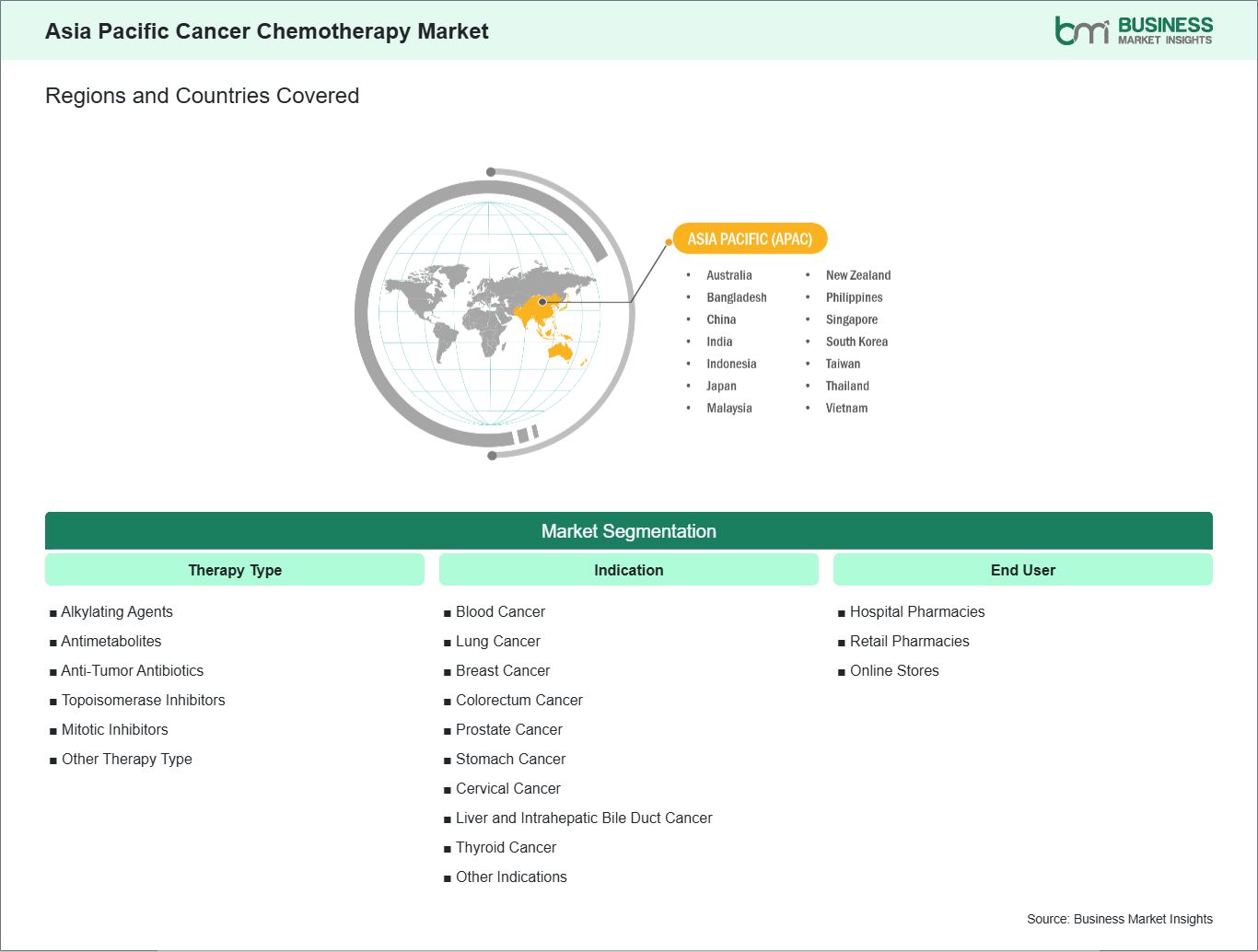
Key segments that contributed to the derivation of the Asia Pacific Cancer Chemotherapy market analysis are therapy type, indication, and distribution channel.
A significant driver for chemotherapy in Asia Pacific is the adoption of multimodal treatment strategies. Chemotherapy is frequently used neoadjuvant to reduce tumor burden before surgery in breast, colorectal, liver, and lung cancers. In adjuvant settings, chemotherapy eliminates residual disease, lowering recurrence rates.
Chemotherapy also acts as a radiosensitizer, enhancing the effectiveness of radiotherapy in cervical, head and neck, and gastrointestinal cancers. Moreover, it is often combined with targeted therapies and immunotherapy to overcome resistance mechanisms and improve survival outcomes. Countries such as Japan, South Korea, and Australia increasingly adopt these combination protocols, boosting chemotherapy consumption. In developing markets, chemotherapy remains central due to cost-effectiveness relative to high-priced biologics. These strategies not only improve treatment outcomes but also ensure chemotherapy retains clinical relevance, thereby making multimodal approaches a strong growth driver across Asia Pacific.
AI represents a growing opportunity to optimize chemotherapy outcomes in Asia Pacific. Standard dosing often fails to account for individual variability, leading to suboptimal efficacy or increased toxicity. AI algorithms can integrate genomic profiles, tumor biomarkers, imaging, lab results, and treatment histories to generate patient-specific chemotherapy plans.
Predictive modeling enables adaptive dosing, adjusting regimens in real-time based on patient response. Countries with advanced digital health infrastructure such as Japan, South Korea, and Australia are beginning to implement AI-driven decision support tools, improving precision, reducing adverse effects, and enabling more personalized care.
In emerging markets, AI adoption is slower but expected to rise as hospitals digitize medical records and adopt telemedicine. Over time, AI-enhanced chemotherapy planning could increase efficacy, reduce toxicity, and expand treatment accessibility across Asia Pacific.

The Asia Pacific Cancer Chemotherapy market demonstrates steady growth, with size and share analysis highlighting evolving trends and competitive dynamics among key players. The report examines subsegments categorized within therapy type, indication, distribution channel, and geography, offering insights into their contribution to overall market performance.
By therapy type, the alkylating agents subsegment dominated the market in 2024, driven by the widespread applicability in solid and hematologic tumors.
Based on indication, the lung cancer subsegment dominated the market in 2024, driven by high disease prevalence and reliance on chemotherapy.
In terms of distribution channel, the hospital pharmacies subsegment dominated the market in 2024, driven by support from government hospitals, oncology centers, and tertiary care institutions.
| Report Attribute | Details |
|---|---|
| Market size in 2024 | US$ 8,214.8 Million |
| Market Size by 2031 | US$ 20,636.7 Million |
| CAGR (2025 - 2031) | 14.1% |
| Historical Data | 2021-2023 |
| Forecast period | 2025-2031 |
| Segments Covered | By Therapy Type
|
|
Regions and Countries Covered
| |
| Asia-Pacific | Australia, China, India, Japan, South Korea, Indonesia, Malaysia, Philippines, Singapore, Thailand, Vietnam, Bangladesh, New Zealand, Taiwan |
| Market leaders and key company profiles |
|
The "Asia Pacific Cancer Chemotherapy Market Size and Forecast (2021–2031)" report provides a detailed analysis of the market covering below areas:
The geographical scope of the Asia Pacific Cancer Chemotherapy market report is divided into China, India, Japan, Australia, Bangladesh, Indonesia, Malaysia, New Zealand, Philippines, Singapore, South Korea, Taiwan, Thailand, and Vietnam. China held the largest share in 2024.
China represents the largest market due to its population size, rising cancer incidence, and robust government healthcare spending. Hospitals in tier-1 cities adopt combination therapies, advanced chemotherapy regimens, and AI-assisted treatment planning, while rural areas rely on essential drugs. Japan is highly mature, with well-established oncology infrastructure, rapid adoption of combination therapies, and advanced supportive care. Chemotherapy remains critical, particularly in hematologic and gastrointestinal cancers. India shows high growth potential driven by rising incidence, increasing access to public oncology services, and expanding generic chemotherapy production.
Cost remains a major factor influencing adoption. South Korea and Australia are advanced markets, with high adoption of multimodal therapy protocols and growing integration of AI in treatment planning. Southeast Asia which includes Indonesia, Thailand, Vietnam, and Malaysia represents emerging markets where urban hospitals lead in advanced chemotherapy adoption. In contrast, public hospitals in rural areas primarily rely on basic cytotoxic drugs. Affordability, distribution efficiency, and government initiatives drive growth. Across Asia Pacific, regional disparities exist between urban and rural areas, emphasizing the importance of infrastructure development, training, and drug access programs. Multinational companies play a key role in ensuring drug availability, while generic manufacturers contribute to affordability.

The Asia Pacific Cancer Chemotherapy market is evaluated by gathering qualitative and quantitative data post primary and secondary research, which includes important corporate publications, association data, and databases. A few of the key developments in the Asia Pacific cancer chemotherapy market are:
The Asia Pacific Cancer Chemotherapy Market is valued at US$ 8,214.8 Million in 2024, it is projected to reach US$ 20,636.7 Million by 2031.
As per our report Asia Pacific Cancer Chemotherapy Market, the market size is valued at US$ 8,214.8 Million in 2024, projecting it to reach US$ 20,636.7 Million by 2031. This translates to a CAGR of approximately 14.1% during the forecast period.
The Asia Pacific Cancer Chemotherapy Market report typically cover these key segments-
The historic period, base year, and forecast period can vary slightly depending on the specific market research report. However, for the Asia Pacific Cancer Chemotherapy Market report:
The Asia Pacific Cancer Chemotherapy Market is populated by several key players, each contributing to its growth and innovation. Some of the major players include:
The Asia Pacific Cancer Chemotherapy Market report is valuable for diverse stakeholders, including:
Essentially, anyone involved in or considering involvement in the Asia Pacific Cancer Chemotherapy Market value chain can benefit from the information contained in a comprehensive market report.
Please tell us your area of interest
(Market Segments/ Regions and Countries/ Companies)