Middle East Cancer Chemotherapy Market Outlook (2021–2031)

Historic Data: 2021-2023   |   Base Year: 2024   |   Forecast Period: 2025-2031
Report Content: Market Scope, Market Segmentation, Market Dynamics, and Competitive Analysis

Report Coverage:
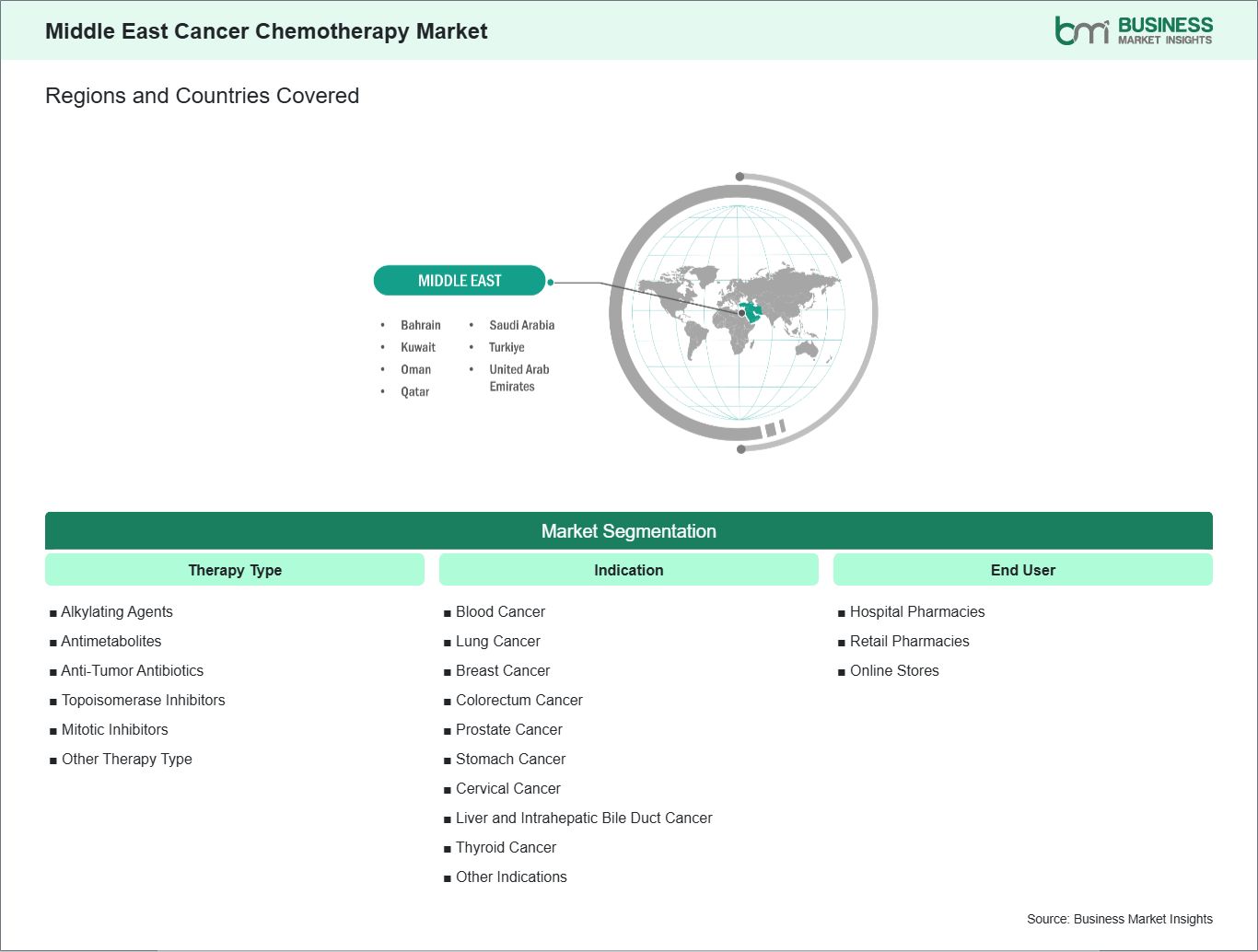
  • Therapy Type (Alkylating Agents, Antimetabolites, Anti-Tumor Antibiotics, Topoisomerase Inhibitors, Mitotic Inhibitors, Other Therapy Type)
  • Indication (Blood Cancer, Lung Cancer, Breast Cancer, Colorectum Cancer, Prostate Cancer, Stomach Cancer, Cervical Cancer, Liver and Intrahepatic Bile Duct Cancer, Thyroid Cancer, Other Indications)
  • End User (Hospital Pharmacies, Retail Pharmacies, Online Stores)

No. of Pages: 205
Report Code: BMIPUB00033451
Category: Life Sciences
Middle East Cancer Chemotherapy Market

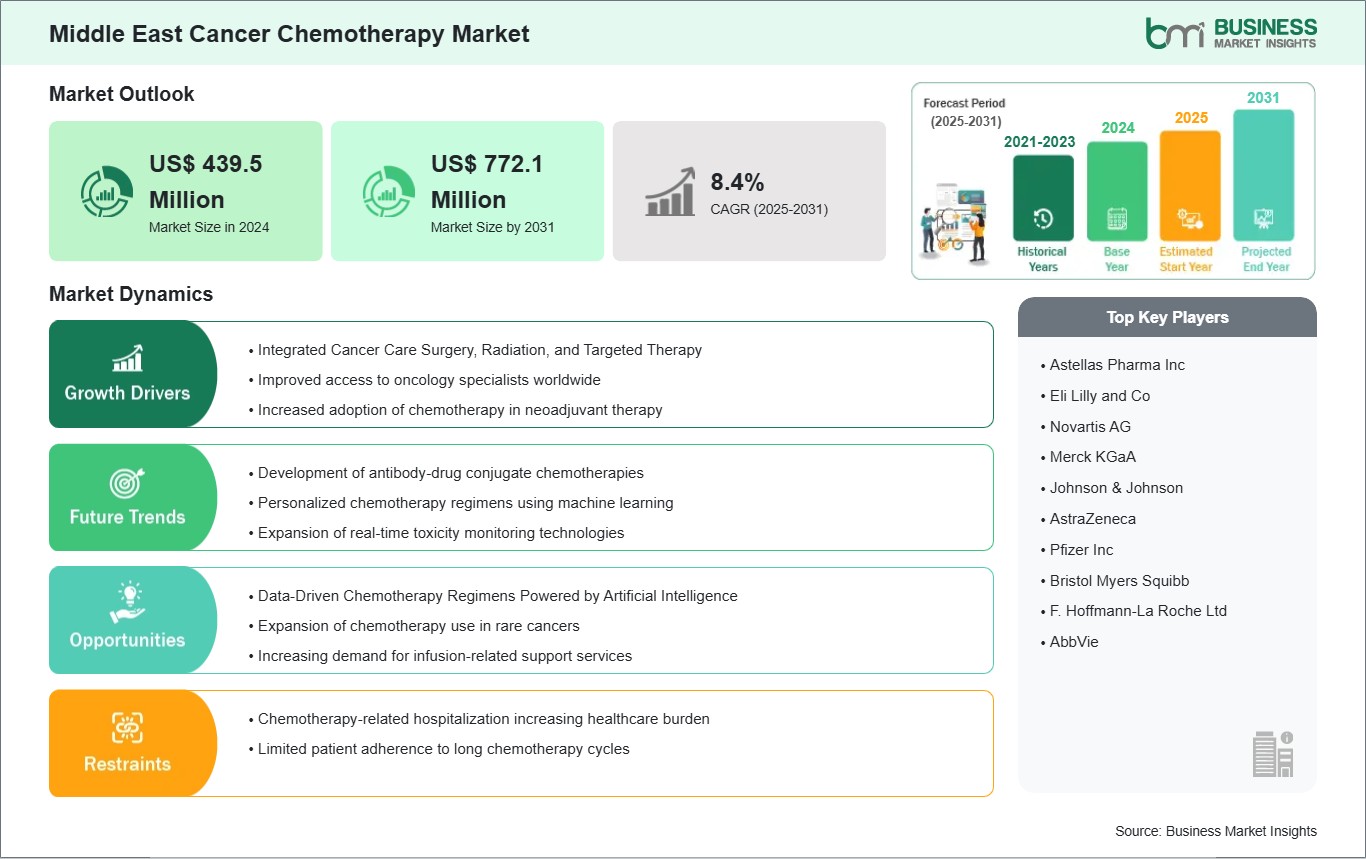
The Middle East Cancer Chemotherapy Market size is expected to reach US$ 772.1 million by 2031 from US$ 439.5 million in 2024. The market is estimated to record a CAGR of 8.4% from 2025 to 2031.

Executive Summary and Middle East Cancer Chemotherapy Market Analysis:

The Middle East cancer chemotherapy market is experiencing sustained expansion supported by demographic change, healthcare investment, and evolving oncology care delivery. Government health programs such as Saudi Arabia's Vision 2030 and the UAE's national health strategic plans emphasize early cancer detection, access to essential medicines, and the expansion of tertiary care capacity. Specialized oncology hospitals and cancer centers in major cities such as Riyadh, Jeddah, Dubai, and Abu Dhabi lead regional adoption of chemotherapy drugs and infusion services.

Chemotherapy continues to be widely deployed in the treatment of breast, lung, colorectal, prostate, and hematologic cancers. Standard practice often integrates chemotherapy with surgery, radiation therapy, targeted agents, and immunotherapies to improve outcomes. Hospital pharmacies dominate distribution due to the need for controlled administration of intravenous regimens, while retail and emerging online pharmacies become increasingly relevant for oral chemotherapy drugs and supportive care medications.

Regulatory reforms aimed at fast-tracking drug approvals and expanding biosimilar access are improving chemotherapy availability and affordability. Collaboration between local health authorities and global pharmaceutical companies is enhancing clinical trial participation and technology transfer. Despite disparities in rural areas and smaller markets, oncology service delivery is strengthening through workforce training, digital health initiatives, and infrastructure upgrades, thereby positioning the market for continued growth through 2031.

Middle East Cancer Chemotherapy Market - Strategic Insights:

global-market-strategic-framework
Get more information on this report

Middle East Cancer Chemotherapy Market Segmentation Analysis:

Key segments that contributed to the derivation of the Middle East Cancer Chemotherapy market analysis are therapy type, indication, and distribution channel.

  • By therapy type, the cancer chemotherapy market is segmented into alkylating agents, antimetabolites, anti-tumor antibiotics, topoisomerase inhibitors, mitotic inhibitors, and others. The alkylating agents segment dominated the market in 2024.
  • Based on indication, the cancer chemotherapy market is categorized into blood cancer, lung cancer, breast cancer, colorectum cancer, prostate cancer, stomach cancer, cervical cancer, liver and intrahepatic bile duct cancer, thyroid cancer, and other indications. The lung cancer segment dominated the market in 2024.
  • By distribution channel, the market is segmented into hospital pharmacies, retail pharmacies, and online stores. The hospital pharmacies segment dominated the market in 2024.

Middle East Cancer Chemotherapy Market Drivers and Opportunities:

Integrated Cancer Care Surgery, Radiation, and Targeted Therapy

One of the primary drivers of chemotherapy demand in the Middle East is the increasing use of multimodal oncology treatment strategies. Chemotherapy is extensively used as neoadjuvant therapy to shrink tumors before surgery and as adjuvant therapy to eliminate residual disease afterward, particularly in breast, colorectal, and lung cancers. Chemotherapy also enhances the efficacy of radiation therapy by acting as a radiosensitizer, improving tumor cell susceptibility to radiotherapy in locoregionally advanced cancers.

In parallel, chemotherapy remains central to combination regimens with targeted therapies and immunotherapy agents. These combinations are reflected in updated clinical guidelines. They are widely adopted in oncology centers across the region, particularly for advanced and metastatic disease, where integrated treatment approaches enhance survival and quality of life.

The expansion of oncology research networks, clinical trial participation, and international collaborations further supports integration of chemotherapy with targeted and immune-based therapies. This convergence of modalities expands therapeutic options, strengthens clinical relevance, and drives broader chemotherapy utilization across Middle Eastern oncology practice.

Data-Driven Chemotherapy Regimens Powered by Artificial Intelligence

Artificial Intelligence (AI) contributes to improved chemotherapy personalization and dosing optimization in the Middle East. AI platforms can analyze complex datasets including genomics, radiologic imaging, biomarkers, and electronic health records to identify optimal drug combinations, anticipate toxicity profiles, and tailor dosing schedules to individual patient characteristics.

Major healthcare hubs in the Middle East such as those in Saudi Arabia, the UAE, and emerging oncology centers in Egypt are investing in digital health infrastructure and AI-driven decision support tools. These systems enable clinicians to refine chemotherapy regimens, forecast treatment responses, and adapt protocols based on real-time data. Importantly, AI also supports clinical trial design by identifying appropriate patient subgroups and predictive biomarkers.

Ongoing partnerships between region-focused technology firms and healthcare institutions, as well as the introduction of locally developed AI solutions for early cancer detection, lay the foundation for broader adoption of precision chemotherapy strategies. As AI becomes more integrated within oncology workflows, it is expected to improve therapeutic outcomes, reduce adverse effects, and enhance healthcare resource allocation.

Middle East Cancer Chemotherapy Market Size and Share Analysis:

The Middle East Cancer Chemotherapy market demonstrates steady growth, with size and share analysis highlighting evolving trends and competitive dynamics among key players. The report further examines subsegments categorized by therapy type, indication, and distribution channel, offering insights into their contribution to overall market performance.

By therapy type, the alkylating agents subsegment dominated the market in 2024, driven by the established clinical efficacy and inclusion in treatment guidelines.

Based on indication, the lung cancer subsegment dominated the market in 2024, driven by regional disease prevalence and clinical protocols that emphasize systemic cytotoxic therapy in curative and palliative settings.

By distribution channel, the hospital pharmacies subsegment dominated the market in 2024, driven by the requirement for intravenous administration and monitoring.

Middle East Cancer Chemotherapy Market Report Highlights:

Report Attribute Details
Market size in 2024 US$ 439.5 Million
Market Size by 2031 US$ 772.1 Million
CAGR (2025 - 2031)8.4%
Historical Data 2021-2023
Forecast period 2025-2031
Segments Covered By Therapy Type
  • Alkylating Agents
  • Antimetabolites
  • Anti-Tumor Antibiotics
  • Topoisomerase Inhibitors
  • Mitotic Inhibitors
  • Other Therapy Type
By Indication
  • Blood Cancer
  • Lung Cancer
  • Breast Cancer
  • Colorectum Cancer
  • Prostate Cancer
  • Stomach Cancer
  • Cervical Cancer
  • Liver and Intrahepatic Bile Duct Cancer
  • Thyroid Cancer
  • Other Indications
By End User
  • Hospital Pharmacies
  • Retail Pharmacies
  • Online Stores
Regions and Countries Covered
Middle East Turkiye, the United Arab Emirates, Saudi Arabia, Bahrain, Oman, Egypt, South Africa and Africa, Algeria, Nigeria, Kuwait, and Qatar
Market leaders and key company profiles
  • Astellas Pharma Inc
  • Eli Lilly and Co
  • Novartis AG
  • Merck KGaA
  • Johnson & Johnson
  • AstraZeneca
  • Pfizer Inc
  • Bristol Myers Squibb
  • F. Hoffmann-La Roche Ltd
  • AbbVie
Get more information on this report

Middle East Cancer Chemotherapy Market Report Coverage and Deliverables:

The "Middle East Cancer Chemotherapy Market Size and Forecast (2025–2031)" report provides a detailed analysis of the market covering below areas:

  • Middle East Cancer Chemotherapy market size and forecast at regional and country levels for all the key market segments covered under the scope
  • Middle East Cancer Chemotherapy market trends, as well as market dynamics such as drivers, restraints, and key opportunities
  • Middle East Cancer Chemotherapy market analysis covering key market trends, regional framework, major players, regulations, and recent market developments
  • Industry landscape and competition analysis covering market concentration, heat map analysis, prominent players, and recent developments for the Middle East Cancer Chemotherapy market
  • Detailed company profiles, including SWOT analysis

Middle East Cancer Chemotherapy Market Geographic Insights:

The geographical scope of the Middle East Cancer Chemotherapy market report is divided into the UAE, Saudi Arabia, Bahrain, Oman, Kuwait, Qatar, and Turkiye. Turkiye held the largest share in 2024.

Turkiye and Saudi Arabia lead the chemotherapy market in the Middle East, driven by strong public healthcare funding, strategic national initiatives to modernize cancer care, and the presence of specialized oncology hospitals. The Saudi Food and Drug Authority (SFDA) supports accelerated drug approvals, enabling faster access to innovative chemotherapeutic agents and biosimilars. Urban centers such as Riyadh and Jeddah feature comprehensive chemotherapy services integrated with surgical and radiation oncology. The country's Vision 2030 healthcare reform emphasizes early cancer screening and integrated oncology services, contributing to increased treatment volumes and broad chemotherapy utilization. The UAE exhibits advanced chemotherapy adoption supported by world-class hospitals in Dubai and Abu Dhabi. Public and private oncology centers leverage multidisciplinary care approaches, including combination regimens of chemotherapy with targeted therapies and immunotherapies. The UAE's healthcare infrastructure, high physician density, and favorable insurance coverage support broad patient access to chemotherapy drugs and infusion services. Qatar continues to strengthen oncology programs through national cancer strategies that prioritize access to systemic therapies and enhanced diagnostic capabilities. Public health systems in Qatar emphasize integration of chemotherapy into standard care pathways across major cancer types. Kuwait, Bahrain, and Oman are expanding oncology services with increasing chemotherapy adoption, although overall market volumes are smaller relative to Saudi Arabia and the UAE. Ongoing investments in cancer care infrastructure and workforce training aim to improve regional access and treatment consistency.

global-market-geography
Get more information on this report

Middle East Cancer Chemotherapy Market Research Report Guidance:

  • The report includes qualitative and quantitative data in the Middle East Cancer Chemotherapy market across therapy type, indication, distribution channel, and geography.
  • The report starts with the key takeaways (chapter 2), highlighting the key trends and outlook of the Middle East Cancer Chemotherapy market.
  • Chapter 3 includes the research methodology of the study.
  • Chapter 4 further includes ecosystem analysis.
  • Chapter 5 highlights the major industry dynamics in the Middle East Cancer Chemotherapy market, including factors that are driving the market, prevailing deterrents, potential opportunities, as well as future trends. Impact analysis of these drivers and restraints is also covered in this section.
  • Chapter 6 discusses the Middle East Cancer Chemotherapy market scenario, in terms of historical market revenues, and forecast till the year 2031.
  • Chapters 7 to 11 cover Middle East Cancer Chemotherapy market segments by therapy type, indication, distribution channel, and geography across the UAE, Saudi Arabia, Bahrain, Oman, Kuwait, Qatar, and Turkiye. They cover the market revenue forecast and factors driving the market.
  • Chapter 12 describes the competitive analysis along with the heat map analysis for the key players operating in the market.
  • Chapter 13 describes the industry landscape analysis. It provides detailed descriptions of business activities such as market initiatives, new developments, mergers, and joint ventures globally, along with a competitive landscape.
  • Chapter 14 provides detailed profiles of the major companies operating in the Middle East Cancer Chemotherapy market. Companies have been profiled on the basis of their key facts, business descriptions, products, financial overview, SWOT analysis, and key developments.
  • Chapter 15, i.e., the appendix, is inclusive of a brief overview of the company, a list of abbreviations, and a disclaimer.

Middle East Cancer Chemotherapy Market News and Key Development:

The Middle East Cancer Chemotherapy market is evaluated by gathering qualitative and quantitative data through primary and secondary research, which includes important corporate publications, association data, and databases. A few of the key developments in the Middle East cancer chemotherapy market are:

  • In April 2025, Hikma Pharmaceuticals signed an exclusive licensing agreement to commercialize the PARP inhibitor rucaparib (Rubraca) across the Middle East and North Africa, broadening treatment options for ovarian and prostate cancer.
  • In November 2024, CStone Pharmaceuticals entered into a strategic licensing and commercialization agreement with a UAE-based partner to distribute its anti-PD-L1 antibody sugemalimab across the Middle East and North Africa region, expanding access to a novel cancer immunotherapy that can complement chemotherapy regimens in lung cancer and other indications.

Key Sources Referred:

  • World Health Organization (WHO)
  • World Heart Federation (WHF)
  • Organisation for Economic Cooperation and Development (OECD)
  • The World Bank Group
  • Worldometer
  • The Lancet
  • International Bar Association
  • International Trade Administration
The List of Companies - Middle East Cancer Chemotherapy Market
  • <p>Astellas Pharma Inc
  • Eli Lilly and Co
  • Novartis AG
  • Merck KGaA
  • Johnson &amp; Johnson
  • AstraZeneca
  • Pfizer Inc
  • Bristol Myers Squibb
  • F. Hoffmann-La Roche Ltd
  • AbbVie</p>
Frequently Asked Questions
How big is the Middle East Cancer Chemotherapy Market?

The Middle East Cancer Chemotherapy Market is valued at US$ 439.5 Million in 2024, it is projected to reach US$ 772.1 Million by 2031.

What is the CAGR for Middle East Cancer Chemotherapy Market by (2025 - 2031)?

As per our report Middle East Cancer Chemotherapy Market, the market size is valued at US$ 439.5 Million in 2024, projecting it to reach US$ 772.1 Million by 2031. This translates to a CAGR of approximately 8.4% during the forecast period.

What segments are covered in this report?

The Middle East Cancer Chemotherapy Market report typically cover these key segments-

  • Therapy Type (Alkylating Agents, Antimetabolites, Anti-Tumor Antibiotics, Topoisomerase Inhibitors, Mitotic Inhibitors, Other Therapy Type)
  • Indication (Blood Cancer, Lung Cancer, Breast Cancer, Colorectum Cancer, Prostate Cancer, Stomach Cancer, Cervical Cancer, Liver and Intrahepatic Bile Duct Cancer, Thyroid Cancer, Other Indications)
  • End User (Hospital Pharmacies, Retail Pharmacies, Online Stores)

What is the historic period, base year, and forecast period taken for Middle East Cancer Chemotherapy Market?

The historic period, base year, and forecast period can vary slightly depending on the specific market research report. However, for the Middle East Cancer Chemotherapy Market report:

  • Historic Period : 2021-2023
  • Base Year : 2024
  • Forecast Period : 2025-2031
  • Who are the major players in Middle East Cancer Chemotherapy Market?

    The Middle East Cancer Chemotherapy Market is populated by several key players, each contributing to its growth and innovation. Some of the major players include:

  • Astellas Pharma Inc
  • Eli Lilly and Co
  • Novartis AG
  • Merck KGaA
  • Johnson & Johnson
  • AstraZeneca
  • Pfizer Inc
  • Bristol Myers Squibb
  • F. Hoffmann-La Roche Ltd
  • AbbVie
  • Who should buy this report?

    The Middle East Cancer Chemotherapy Market report is valuable for diverse stakeholders, including:

    • Investors: Provides insights for investment decisions pertaining to market growth, companies, or industry insights. Helps assess market attractiveness and potential returns.
    • Industry Players: Offers competitive intelligence, market sizing, and trend analysis to inform strategic planning, product development, and sales strategies.
    • Suppliers and Manufacturers: Helps understand market demand for components, materials, and services related to concerned industry.
    • Researchers and Consultants: Provides data and analysis for academic research, consulting projects, and market studies.
    • Financial Institutions: Helps assess risks and opportunities associated with financing or investing in the concerned market.

    Essentially, anyone involved in or considering involvement in the Middle East Cancer Chemotherapy Market value chain can benefit from the information contained in a comprehensive market report.

    Available Report Formats

    pdf-format excel-format pptx-format
    Buy Now
    Sales Assistance
    +1 646 791 7070 (US & UK)
    Customization Form

    Please tell us your area of interest
    (Market Segments/ Regions and Countries/ Companies)