Market Summary
Executive Summary and Market Analysis
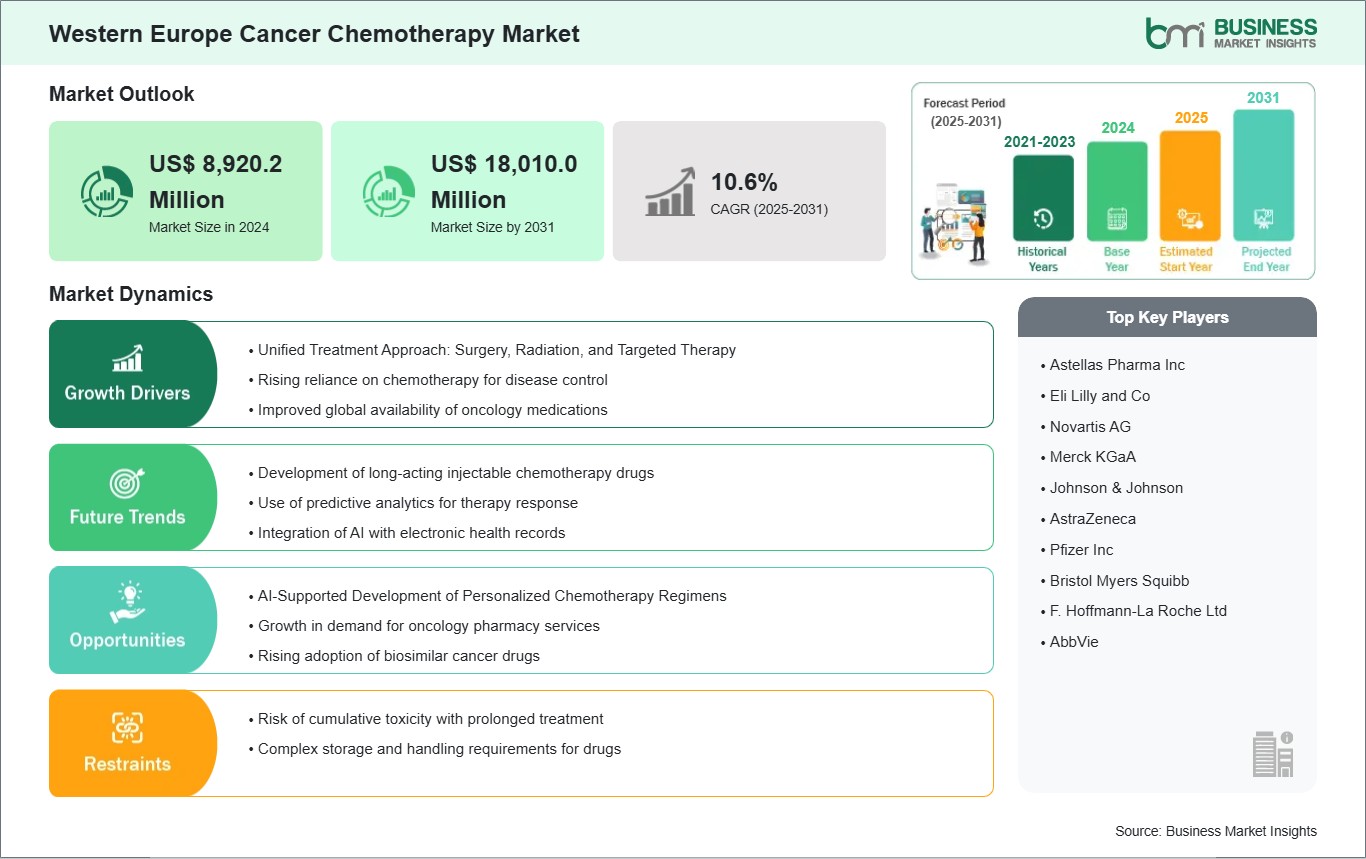
The Western Europe cancer chemotherapy market has shown consistent growth due to demographic trends driving higher cancer incidence, growing patient awareness, and significant investments in oncology services and infrastructure. Germany stands out as the largest market, supported by comprehensive national insurance coverage, a dense network of oncology centers, and early adoption of evidence-based chemo regimens. France follows with strong public financing, robust clinical governance, and proactive national cancer control plans that emphasize systemic therapy access. The UK maintains substantial chemotherapy utilization despite recent healthcare delivery reforms, with the National Health Service (NHS) supporting broad access to cytotoxic drugs and combination regimens. Southern European countries, including Italy and Spain, reflect high chemotherapy demand tied to cancer prevalence and expanding outpatient infusion services. Western Europe's regulatory ecosystem notably EMA approvals and CHMP recommendations ensures a high degree of uniformity and timely access to oncology medicines, including combination regimens that integrate chemotherapy backbones with novel agents.
Hospitals and comprehensive cancer centers dominate chemotherapy delivery due to the need for inpatient monitoring and intravenous administration. However, retail and online pharmacy channels are gaining ground for oral chemotherapy agents and supportive care medications, increasing patient convenience and adherence. Public payer frameworks and strong reimbursement policies ensure access across socioeconomic groups, although variations in wait times and regional access disparities persist in some countries. Overall, the market reflects a balance of innovation, broad access, and clinical depth, positioning it for continued relevance through 2031.
Segment Analysis
Western Europe Cancer Chemotherapy Market Segmentation
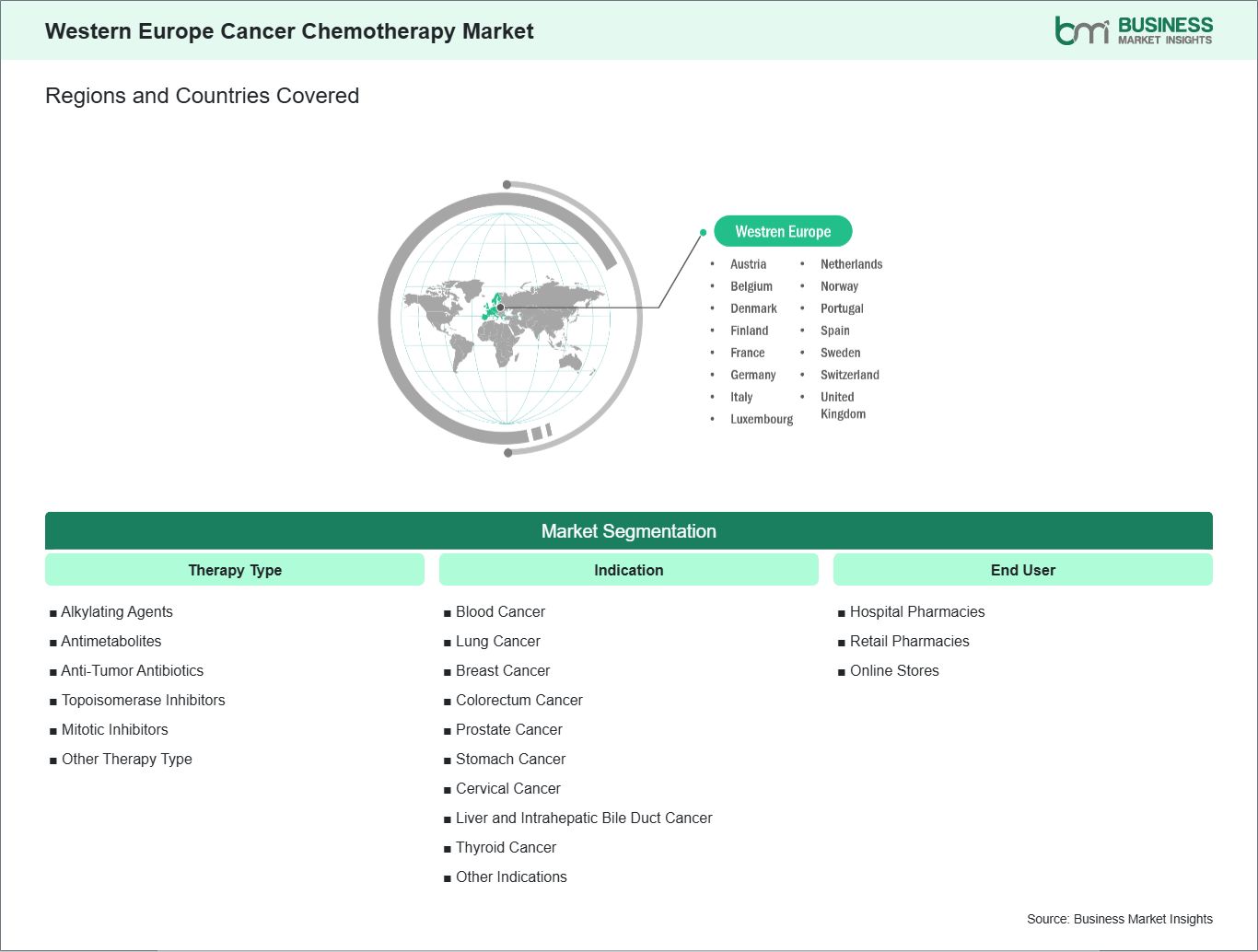
Key segments that contributed to the derivation of the Western Europe Cancer Chemotherapy market analysis are therapy type, indication, and distribution channel.
- By therapy type, the cancer chemotherapy market is segmented into alkylating agents, antimetabolites, anti-tumor antibiotics, topoisomerase inhibitors, mitotic inhibitors, and others. The alkylating agents segment dominated the market in 2024.
- Based on indication, the cancer chemotherapy market is segmented into blood cancer, lung cancer, breast cancer, colorectum cancer, prostate cancer, stomach cancer, cervical cancer, liver and intrahepatic bile duct cancer, thyroid cancer, and other indications. The lung cancer segment dominated the market in 2024.
- By distribution channel, the market is segmented into hospital pharmacies, retail pharmacies, and online stores. The hospital pharmacies segment dominated the market in 2024.
Market Forces
Western Europe Cancer Chemotherapy Market Drivers and Opportunities
Unified Treatment Approach: Surgery, Radiation, and Targeted Therapy
A central driver of chemotherapy demand in Western Europe is its integration into multimodal oncology treatment strategies. Chemotherapy is routinely used neoadjuvant to reduce tumor volume before surgical resection and adjuvant to eradicate residual disease, particularly in breast, colorectal, and lung cancers. Chemotherapy also functions as a radiosensitizer when combined with radiation therapy, enhancing tumor cell susceptibility and improving outcomes in locally advanced malignancies such as head and neck or cervical cancers.
Beyond traditional use, chemotherapy remains integral to combination regimens with targeted therapies and immunotherapies. European clinical guidelines increasingly recommend these integrated approaches for advanced and metastatic cancers, reflecting growing evidence of improved survival outcomes. For example, combining cytotoxic drugs with agents that inhibit specific molecular pathways or immune checkpoints is now standard in indications such as triple-negative breast cancer and urothelial carcinoma, driving sustained chemotherapy utilization alongside novel agents. These multimodal strategies widen the clinical applicability of chemo-inclusive regimens and reinforce their relevance in evolving oncology protocols.
AI-Supported Development of Personalized Chemotherapy Regimens
Artificial Intelligence (AI) enables personalization and dosing optimization. AI platforms can analyze vast multidimensional datasets including genomics, imaging biomarkers, electronic health records, and real-world treatment outcomes to tailor chemotherapy regimens to individual patient profiles. Predictive models can identify optimal drug combinations, forecast toxicity risks, and support adaptive dosing adjustments based on early response patterns.
Western European healthcare systems especially in countries such as Sweden, Denmark, Germany, and the Netherlands are increasingly adopting digital infrastructure capable of supporting AI-assisted clinical decision support. These systems help oncologists refine treatment plans, anticipate adverse events, and integrate personalized strategies into conventional chemotherapy protocols. AI also accelerates research by enabling smarter patient stratification in clinical trials and enhancing real-world evidence generation, which can inform guideline updates and improve overall treatment efficiency. As digital health capacity expands, AI integration is expected to elevate precision chemotherapy planning across the region.
Size and Share Analysis
Western Europe Cancer Chemotherapy Market Size and Share Analysis
The Western Europe Cancer Chemotherapy market demonstrates steady growth, with size and share analysis highlighting evolving trends and competitive dynamics among key players. The report further examines subsegments categorized by therapy type, indication, and distribution channel, offering insights into their contribution to overall market performance.
By therapy type, the alkylating agents subsegment dominated the market in 2024, driven by the cost considerations and well-established clinical roles.
Based on indication, the lung cancer subsegment dominated the market in 2024, driven by regional cancer epidemiology and clinical guideline recommendations.
By distribution channel, the hospital pharmacies subsegment dominated the market in 2024, driven by centralized care delivery and requirements for intravenous administration.
Report Coverage
Western Europe Cancer Chemotherapy Market Report Coverage and Deliverables
The "Western Europe Cancer Chemotherapy Market Size and Forecast (2025–2031)" report provides a detailed analysis of the market covering below areas:
- Western Europe Cancer Chemotherapy market size and forecast at regional and country levels for all key market segments covered under the scope
- Western Europe Cancer Chemotherapy market trends, as well as market dynamics such as drivers, restraints, and key opportunities
- Western Europe Cancer Chemotherapy market analysis covering key market trends, regional framework, major players, regulations, and recent market developments
- Industry landscape and competition analysis covering market concentration, heat map analysis, prominent players, and recent developments for the Western Europe Cancer Chemotherapy market
- Detailed company profiles, including SWOT analysis
Geographic Insights
Western Europe Cancer Chemotherapy Market Geographic Insights
The geographical scope of the Western Europe Cancer Chemotherapy market report is divided into Belgium, the Netherlands, Luxembourg, Germany, France, Italy, Spain, Switzerland, Sweden, Austria, the UK, Denmark, Portugal, Norway, and Finland. Germany held the largest share in 2024.
Germany is the largest and most mature market in Western Europe for chemotherapy, bolstered by highly developed hospital systems, a dense network of oncology specialists, and robust clinical trial activity. German cancer centers routinely adopt standardized chemotherapy protocols integrated with surgery and radiation, and increasingly embrace evidence-based combination regimens involving targeted therapies. France exhibits strong chemotherapy demand supported by proactive national cancer control policies, centralized evaluation processes, and widespread reimbursement through the French healthcare system. Breast, lung, and colorectal cancers account for substantial chemotherapy usage, and French oncologists actively participate in clinical research that informs evolving chemotherapy practices.
In the UK, the NHS ensures chemotherapy access across major cancer types, while national guideline updates reflect integration of combination regimens with novel agents. Oncology services in the UK balance high demand with cost-effective care pathways that emphasize outcome optimization. Italy and Spain demonstrate steady chemotherapy utilization backed by comprehensive public healthcare systems and growing investments in oncology infrastructure. Both markets are integrating outpatient infusion centers and expanding access to oral cytotoxic agents to improve patient convenience. The Netherlands and Belgium contribute through innovative oncology cultures and high clinical trial participation, often adopting cutting-edge combination strategies early. These countries emphasize precision oncology and evidence-based care, which includes tailored chemotherapy approaches.
Industry Activity
Recent Developments
The Western Europe Cancer Chemotherapy market is evaluated by gathering qualitative and quantitative data post primary and secondary research, which includes important corporate publications, association data, and databases. A few of the key developments in the Western Europe cancer chemotherapy market are:
- In October 2025, Roche announced that it would present more than 30 abstracts at ESMO 2025 in Berlin, showcasing advances across multiple tumor types and underlining continued oncology innovation impacting chemo-inclusive treatment strategies.
- In April 2025, the EMA's CHMP recommended a label update for Roche's Phesgo (pertuzumab/trastuzumab subcutaneous), allowing administration outside clinical settings for HER2-positive breast cancer, enabling easier integration with concurrent chemotherapy regimens.
Trust & Transparency
Research Methodology
The market analysis combines proprietary research with secondary data from government agencies, company disclosures, regulatory filings, industry databases and expert interviews. Market estimates are validated through data triangulation, cross-market benchmarking and analyst
review.
View Full Research Methodology
Key Sources Referred:
World Health Organization (WHO) World Heart Federation (WHF) Organisation for Economic Cooperation and Development (OECD) The World Bank Group Worldometer The Lancet International Bar Association International Trade Administration