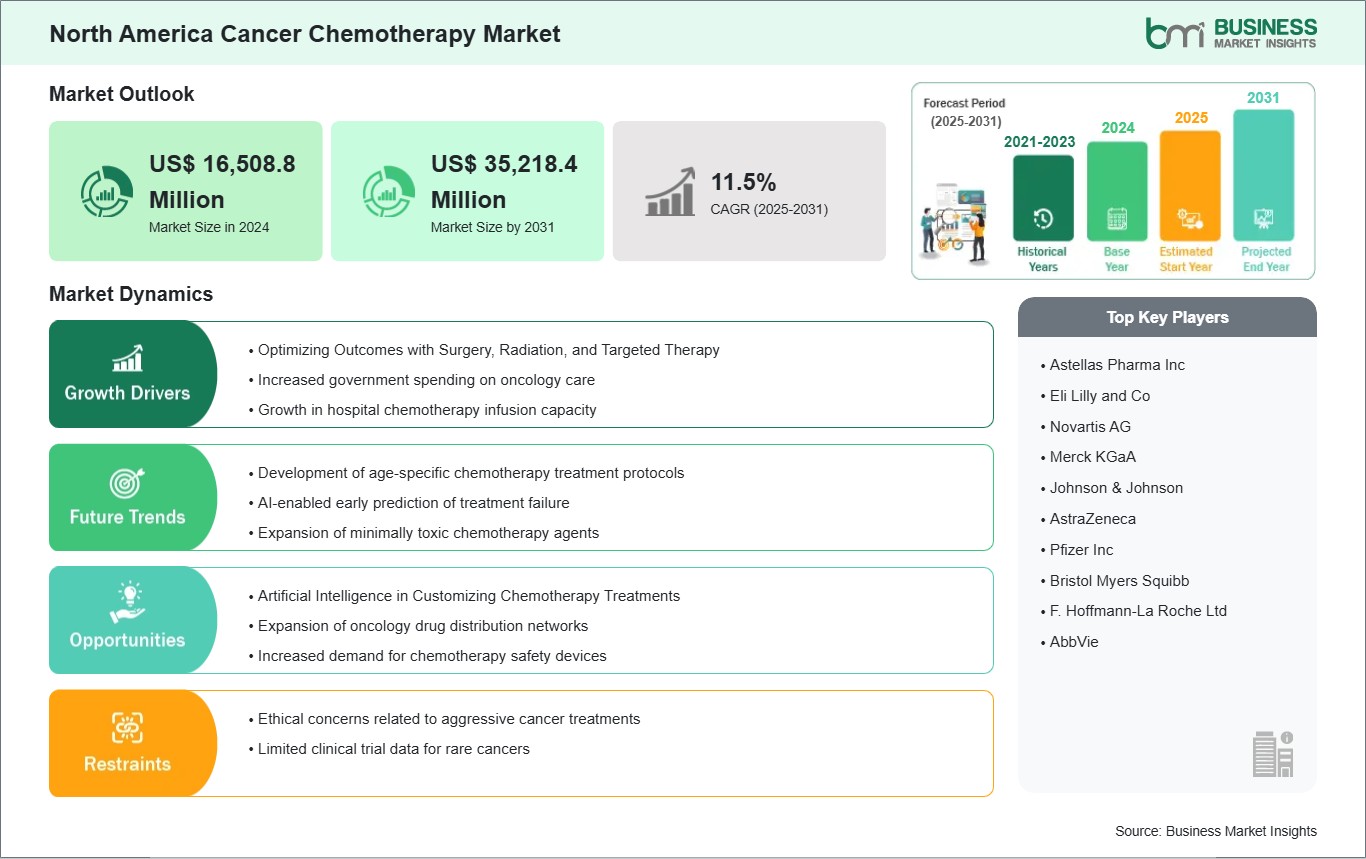
The North America Cancer Chemotherapy Market size is expected to reach US$ 35,218.4 million by 2031 from US$ 16,508.8 million in 2024. The market is estimated to record a CAGR of 11.5% from 2025 to 2031.
The cancer chemotherapy market in North America is witnessing consistent expansion due to the region's high cancer prevalence, aging population, and advanced healthcare infrastructure. The US accounts for the largest share of regional demand, followed by Canada, while Mexico is emerging as a developing oncology market supported by healthcare reforms and increasing access to cancer treatment services. Chemotherapy continues to be extensively used across solid tumors and hematological malignancies, either as a primary treatment or in combination with other therapeutic modalities.
North America benefits from a well-established ecosystem comprising academic medical centers, comprehensive cancer hospitals, outpatient infusion clinics, and specialty oncology pharmacies. Hospitals remain the dominant end-use setting for chemotherapy administration due to the complexity of treatment protocols, need for clinical monitoring, and integration with surgery and radiation therapy. However, outpatient infusion centers are gaining prominence, particularly for maintenance therapy and less intensive regimens.
Regulatory support, strong payer coverage, and ongoing clinical trials accelerate the adoption of new chemotherapy drugs and combination regimens. The availability of both branded and generic chemotherapeutic agents ensures treatment affordability and accessibility. Overall, North America reflects a highly developed, innovation-driven chemotherapy market with sustained demand.

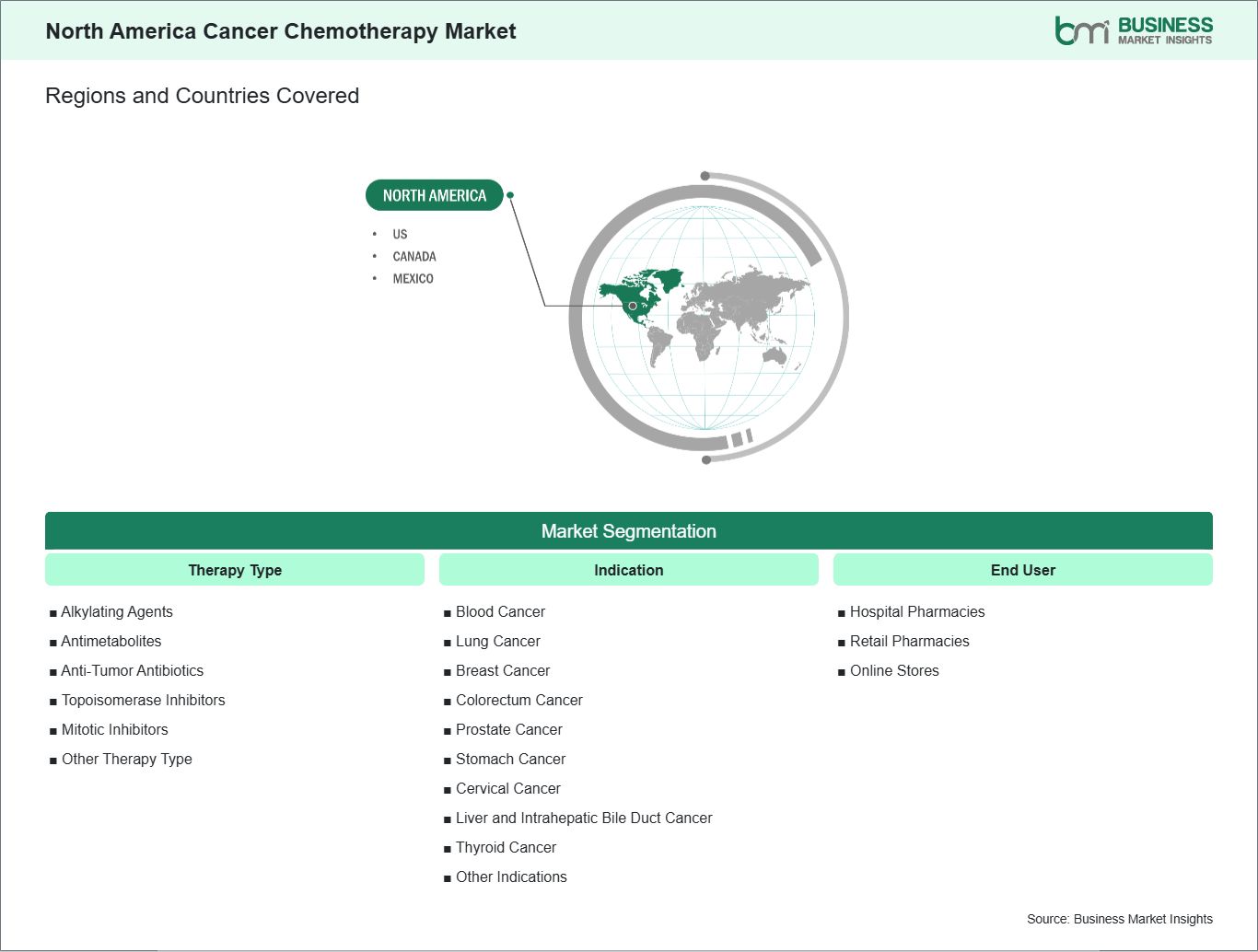
Key segments that contributed to the derivation of the North America Cancer Chemotherapy market analysis are therapy type, indication, and distribution channel.
In North America, chemotherapy is extensively used as part of multimodal treatment strategies. In current clinical practice, chemotherapy is rarely used in isolation; instead, it is integrated with surgery, radiation therapy, targeted therapy, and immunotherapy to improve treatment outcomes and survival rates. This approach is widely reflected in national treatment guidelines and real-world oncology protocols.
Chemotherapy is frequently administered in the neoadjuvant setting, where it reduces tumor size before surgical intervention, improves resectability, and helps preserve organ function. In the adjuvant setting, chemotherapy plays a vital role in eliminating microscopic residual disease following surgery, thereby reducing recurrence risk across breast, colorectal, lung, and blood cancers.
In combination with radiation therapy, chemotherapy acts as a radiosensitizer, increasing tumor cell susceptibility to radiation damage. Chemoradiation has become a standard of care for multiple cancer types, including lung, head and neck, esophageal, cervical, and gastrointestinal cancers. Furthermore, chemotherapy continues to serve as the therapeutic backbone in combination with targeted agents and immune checkpoint inhibitors, particularly in advanced and metastatic disease. These combination strategies significantly expand chemotherapy utilization and reinforce its long-term clinical relevance in North America.
Artificial Intelligence (AI) enables personalized treatment regimens and optimized dosing strategies. Traditional chemotherapy dosing is often based on body surface area and standardized protocols, which may not account for individual variability in genetics, metabolism, and tumor biology. AI technologies address these limitations by enabling data-driven treatment personalization.
AI algorithms analyze complex datasets, including genomic profiles, tumor biomarkers, imaging data, electronic health records, and treatment outcomes. By identifying predictive patterns, AI supports the selection of optimal chemotherapy agents, combinations, and dosing schedules tailored to individual patients. This approach improves therapeutic efficacy while minimizing adverse effects and dose-limiting toxicities.
AI-driven predictive models also enable dynamic dose adjustments throughout the treatment cycle based on patient response and tolerance. Clinical decision support systems powered by AI assist oncologists in navigating increasingly complex treatment pathways and rapidly expanding clinical evidence. As digital health adoption, data interoperability, and real-world evidence generation continue to advance in North America, AI-enabled chemotherapy optimization is expected to enhance patient outcomes and market growth significantly.

The North America Cancer Chemotherapy market demonstrates steady growth, with size and share analysis highlighting evolving trends and competitive dynamics among key players. The report examines subsegments categorized within therapy type, indication, and distribution channel, offering insights into their contribution to overall market performance.
By therapy type, the alkylating agents subsegment dominated the market in 2024, driven by their broad applicability, long clinical history, and continued use in solid tumors and hematologic cancers.
Based on indication, the lung cancer subsegment dominated the market in 2024, driven by infection prevention initiatives and demand for biocompatible devices in North American healthcare systems.
By distribution channel, the hospital pharmacies subsegment dominated the market in 2024, driven by inpatient chemotherapy administration and centralized oncology care.
| Report Attribute | Details |
|---|---|
| Market size in 2024 | US$ 16,508.8 Million |
| Market Size by 2031 | US$ 35,218.4 Million |
| CAGR (2025 - 2031) | 11.5% |
| Historical Data | 2021-2023 |
| Forecast period | 2025-2031 |
| Segments Covered | By Therapy Type
|
|
Regions and Countries Covered
| |
| North America | US, Canada, Mexico |
| Market leaders and key company profiles |
|
The "North America Cancer Chemotherapy Market Size and Forecast (2021–2031)" report provides a detailed analysis of the market covering below areas:
The geographical scope of the North America Cancer Chemotherapy market report is divided into the US, Canada, and Mexico. The US held the largest share in 2024.
The US dominates the regional market due to its high cancer burden, extensive oncology infrastructure, strong reimbursement mechanisms, and continuous regulatory approvals for chemotherapy drugs and combination regimens. The presence of leading pharmaceutical companies and research institutions further strengthens market leadership. Canada represents a mature and stable market supported by universal healthcare coverage and coordinated provincial cancer programs. Public funding ensures consistent access to chemotherapy across the population, while investments in oncology infrastructure support steady demand. Mexico is an emerging chemotherapy market, driven by expanding healthcare access, rising cancer awareness, and gradual improvements in oncology diagnostics and treatment capacity. While affordability remains a challenge, public-private partnerships and healthcare reforms are supporting incremental market growth.

The North America Cancer Chemotherapy market is evaluated by gathering qualitative and quantitative data post primary and secondary research, which includes important corporate publications, association data, and databases. A few of the key developments in the North America cancer chemotherapy market are:
The North America Cancer Chemotherapy Market is valued at US$ 16,508.8 Million in 2024, it is projected to reach US$ 35,218.4 Million by 2031.
As per our report North America Cancer Chemotherapy Market, the market size is valued at US$ 16,508.8 Million in 2024, projecting it to reach US$ 35,218.4 Million by 2031. This translates to a CAGR of approximately 11.5% during the forecast period.
The North America Cancer Chemotherapy Market report typically cover these key segments-
The historic period, base year, and forecast period can vary slightly depending on the specific market research report. However, for the North America Cancer Chemotherapy Market report:
The North America Cancer Chemotherapy Market is populated by several key players, each contributing to its growth and innovation. Some of the major players include:
The North America Cancer Chemotherapy Market report is valuable for diverse stakeholders, including:
Essentially, anyone involved in or considering involvement in the North America Cancer Chemotherapy Market value chain can benefit from the information contained in a comprehensive market report.
Please tell us your area of interest
(Market Segments/ Regions and Countries/ Companies)