Middle East and Africa Cancer Chemotherapy Market Outlook (2021–2031)

Historic Data: 2021-2023   |   Base Year: 2024   |   Forecast Period: 2025-2031
Report Content: Market Scope, Market Segmentation, Market Dynamics, and Competitive Analysis

Report Coverage:
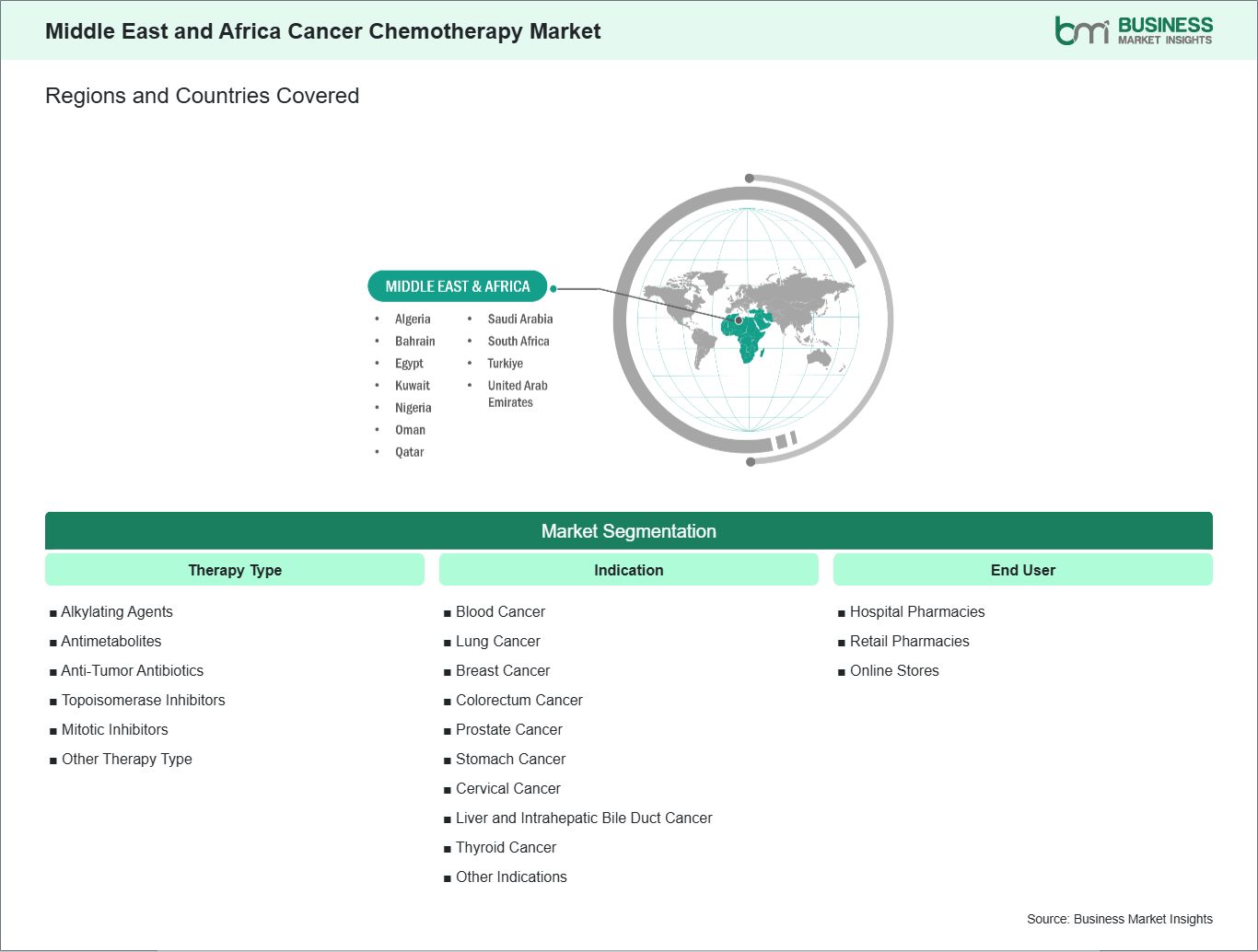
  • Therapy Type (Alkylating Agents, Antimetabolites, Anti-Tumor Antibiotics, Topoisomerase Inhibitors, Mitotic Inhibitors, Other Therapy Type)
  • Indication (Blood Cancer, Lung Cancer, Breast Cancer, Colorectum Cancer, Prostate Cancer, Stomach Cancer, Cervical Cancer, Liver and Intrahepatic Bile Duct Cancer, Thyroid Cancer, Other Indications)
  • End User (Hospital Pharmacies, Retail Pharmacies, Online Stores)

No. of Pages: 229
Report Code: BMIPUB00033457
Category: Life Sciences
Middle East and Africa Cancer Chemotherapy Market

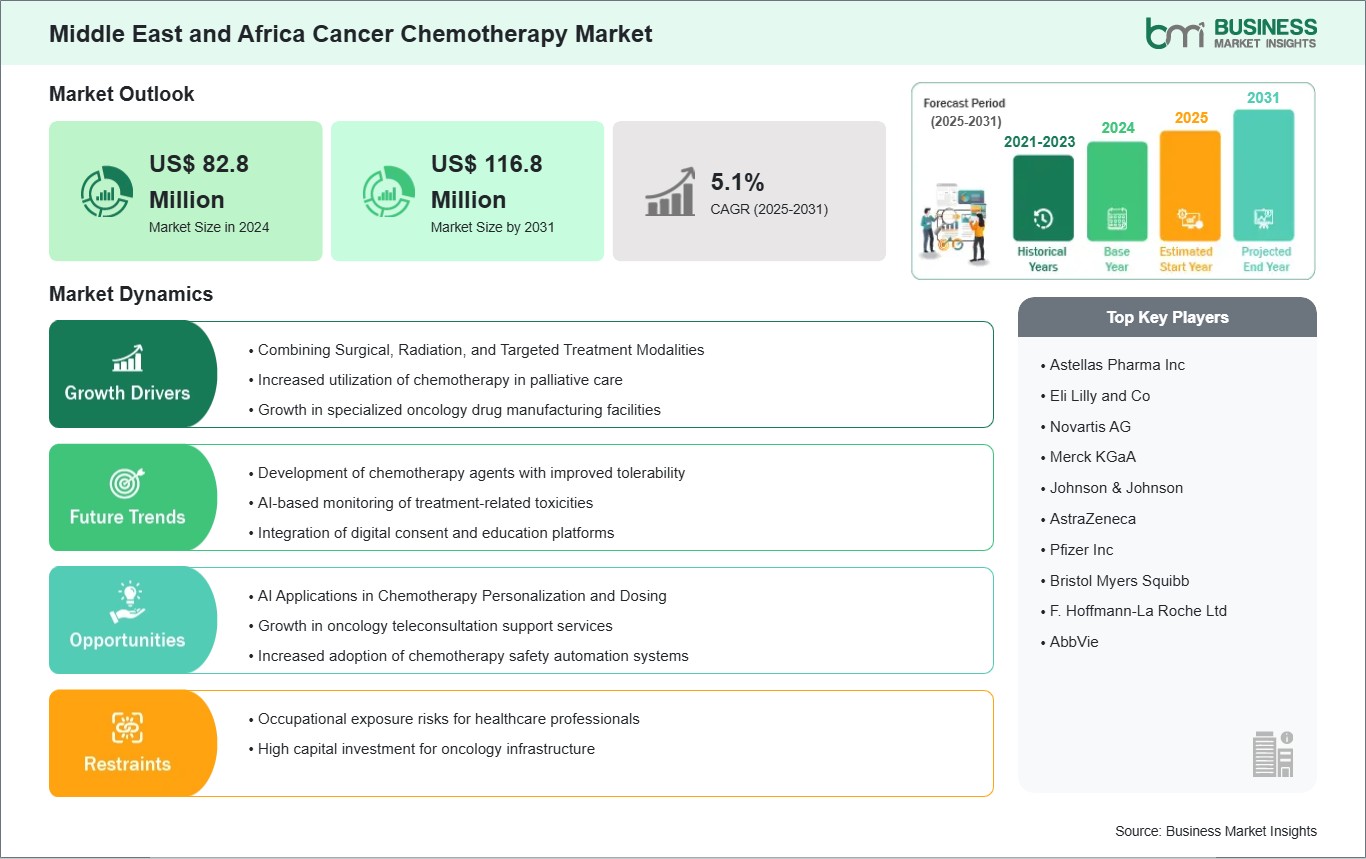
The Middle East and Africa Cancer Chemotherapy Market size is expected to reach US$ 116.8 million by 2031 from US$ 82.8 million in 2024. The market is estimated to record a CAGR of 5.1% from 2025 to 2031.

Executive Summary and Middle East and Africa Cancer Chemotherapy Market Analysis:

The Middle East and Africa cancer chemotherapy market is shaped by demographic trends, rising cancer incidence, increasing healthcare spending, and evolving clinical practices. Gulf Cooperation Council (GCC) countries including Saudi Arabia, the UAE, Qatar, Kuwait, Bahrain, and Oman lead regional demand with well‑funded healthcare systems, comprehensive oncology services, and strong reimbursement frameworks. These markets demonstrate high chemotherapy usage across breast, lung, colorectal, and hematologic cancers, leveraging multidisciplinary care models that integrate chemotherapy with surgery, radiation, targeted therapies, and immunotherapies. In North Africa, nations such as Egypt are expanding cancer care capacity through government programs and public‑private collaborations, improving access to chemotherapy drugs and infusion services. South Africa stands out in sub‑Saharan Africa with a relatively advanced cancer care ecosystem supported by a mix of public hospitals and private oncology networks.

Other African countries exhibit varied treatment access, with oncology services concentrated in urban centers and affordability challenges in low‑resource settings. Hospitals and specialized cancer centers are the primary treatment settings for chemotherapy due to the need for clinical monitoring, intravenous infusion capabilities, and oncology expertise. Outpatient infusion centers are gaining traction in urban centers, offering chemotherapy administration with improved convenience. Retail pharmacies and online channels increasingly serve as distribution points for oral chemotherapeutic drugs and supportive care medications. Across Middle East and Africa, initiatives to improve cancer screening, guideline standardization, and oncology workforce training are facilitating broader chemotherapy adoption. Continued investments in oncology infrastructure, digital health systems, and public reimbursement programs are expected to support the market growth through 2031.

Middle East and Africa Cancer Chemotherapy Market - Strategic Insights:

global-market-strategic-framework
Get more information on this report

Middle East and Africa Cancer Chemotherapy Market Segmentation Analysis:

Key segments that contributed to the derivation of the Middle East and Africa Cancer Chemotherapy market analysis are therapy type, indication, and distribution channel.

  • By therapy type, the cancer chemotherapy market is divided into alkylating agents, antimetabolites, anti-tumor antibiotics, topoisomerase inhibitors, mitotic inhibitors, and others. The alkylating agents segment dominated the market in 2024.
  • Based on indication, the cancer chemotherapy market is categorized into blood cancer, lung cancer, breast cancer, colorectum cancer, prostate cancer, stomach cancer, cervical cancer, liver and intrahepatic bile duct cancer, thyroid cancer, and other indications. The lung cancer segment dominated the market in 2024.
  • In terms of distribution channel, the market is segmented into hospital pharmacies, retail pharmacies, and online stores. The hospital pharmacies segment dominated the market in 2024.

Middle East and Africa Cancer Chemotherapy Market Drivers and Opportunities:

Combining Surgical, Radiation, and Targeted Treatment Modalities

A key driver of the Middle East and Africa cancer chemotherapy market is the widespread adoption of multimodal oncology treatment strategies that integrate chemotherapy with surgery, radiation therapy, targeted therapies, and immunotherapy. Chemotherapy is often administered in the neoadjuvant setting to reduce tumor burden before surgical intervention and as adjuvant therapy to eradicate residual disease and reduce recurrence risk. This multimodal approach is standard in breast, colorectal, and other solid tumor protocols.

Chemotherapy also functions as a radiosensitizer, enhancing tumor response when combined with radiation therapy, particularly in locally advanced lung, head and neck, and gynecologic cancers. Clinics and cancer centers across GCC and North African oncology networks increasingly incorporate chemoradiation in standard practice.

Moreover, chemotherapy remains integral to combination regimens with targeted agents and immuno‑oncology drugs, especially for advanced and metastatic disease, where dual or triple modality protocols improve survival outcomes. In the Middle East, public and private oncology centers actively adopt such combinations as part of national guideline frameworks, while in Africa, these approaches are gaining traction in major urban hospitals.

This integration of therapies not only improves clinical outcomes but also reinforces chemotherapy's central role within evolving treatment paradigms, driving consistent demand.

AI Applications in Chemotherapy Personalization and Dosing

Artificial Intelligence (AI) enables personalized regimen design and optimized dosing strategies. Traditional chemotherapy dosing is largely protocol‑based and may not fully account for patient‑specific factors such as genetic variability, tumor heterogeneity, metabolism, and treatment response patterns. AI tools can integrate clinical records, genomic and biomarker data, imaging results, and longitudinal treatment outcomes to support individualized treatment decisions.

In the Middle East particularly in Saudi Arabia, the UAE, and select urban centers across Egypt and North Africa investments in digital health infrastructure and electronic medical records are enabling initial implementations of AI‑driven clinical decision support tools. These systems assist oncologists in identifying optimal chemotherapy combinations, adjusting dosing schedules based on early response, forecasting potential toxicities, and selecting complementary targeted agents where appropriate.

AI also has the potential to support real‑world evidence generation and clinical trial optimization by enabling patient stratification, predictive outcome modeling, and biomarker discovery. While adoption varies across the Middle East and Africa due to differences in digital readiness and healthcare investment, the growing focus on precision oncology and data interoperability sets the stage for expanded use of AI in chemotherapy optimization.

Middle East and Africa Cancer Chemotherapy Market Size and Share Analysis:

The Middle East and Africa Cancer Chemotherapy market demonstrates steady growth, with size and share analysis highlighting evolving trends and competitive dynamics among key players. The report examines subsegments categorized within therapy type, indication, and distribution channel, offering insights into their contribution to overall market performance.

By therapy type, the alkylating agents subsegment dominated the market in 2024, driven by cost considerations and widespread clinical usage.

Based on indication, the lung cancer subsegment dominated the market in 2024, driven by high incidence and established chemotherapy protocols.

By distribution channel, the hospital pharmacies subsegment dominated the market in 2024, driven by centralized oncology care and infusion services.

Middle East and Africa Cancer Chemotherapy Market Report Highlights:

Report Attribute Details
Market size in 2024 US$ 82.8 Million
Market Size by 2031 US$ 116.8 Million
CAGR (2025 - 2031)5.1%
Historical Data 2021-2023
Forecast period 2025-2031
Segments Covered By Therapy Type
  • Alkylating Agents
  • Antimetabolites
  • Anti-Tumor Antibiotics
  • Topoisomerase Inhibitors
  • Mitotic Inhibitors
  • Other Therapy Type
By Indication
  • Blood Cancer
  • Lung Cancer
  • Breast Cancer
  • Colorectum Cancer
  • Prostate Cancer
  • Stomach Cancer
  • Cervical Cancer
  • Liver and Intrahepatic Bile Duct Cancer
  • Thyroid Cancer
  • Other Indications
By End User
  • Hospital Pharmacies
  • Retail Pharmacies
  • Online Stores
Regions and Countries Covered
Middle East and Africa Bahrain, Kuwait, Oman, Qatar, Saudi Arabia, United Arab Emirates, Turkiye, South Africa, Egypt, Algeria, Nigeria
Market leaders and key company profiles
  • Astellas Pharma Inc
  • Eli Lilly and Co
  • Novartis AG
  • Merck KGaA
  • Johnson & Johnson
  • AstraZeneca
  • Pfizer Inc
  • Bristol Myers Squibb
  • F. Hoffmann-La Roche Ltd
  • AbbVie
Get more information on this report

Middle East and Africa Cancer Chemotherapy Market Report Coverage and Deliverables:

The "Middle East and Africa Cancer Chemotherapy Market Size and Forecast (2021–2031)" report provides a detailed analysis of the market covering below areas:

  • Middle East and Africa Cancer Chemotherapy market size and forecast at regional and country levels for key market segments covered under the scope
  • Middle East and Africa Cancer Chemotherapy market trends, as well as market dynamics such as drivers, restraints, and key opportunities
  • Middle East and Africa Cancer Chemotherapy market analysis covering key trends, regional framework, major players, regulations, and recent market developments
  • Industry landscape and competition analysis covering market concentration, heat map analysis, prominent players, and recent developments for the Middle East and Africa Cancer Chemotherapy market
  • Detailed company profiles, including SWOT analysis

Middle East and Africa Cancer Chemotherapy Market Geographic Insights:

The geographical scope of the Middle East and Africa Cancer Chemotherapy market report is divided into Turkiye, the UAE, Saudi Arabia, Bahrain, Oman, Egypt, South Africa and Africa, Algeria, Nigeria, Kuwait, and Qatar. South Africa held the largest share in 2024.

The most advanced chemotherapy markets in the Middle East and Africa include South Africa, Saudi Arabia, the UAE, Qatar, Kuwait, Bahrain, and Oman. South Africa and Saudi Arabia lead due to strong public funding, national healthcare strategy enhancements, and substantial investments in oncology centers and precision diagnostics. Chemotherapy utilization is high across major indications, with multidisciplinary care models increasingly integrating targeted therapies and immunotherapies where appropriate. UAE oncology centers in Dubai and Abu Dhabi provide advanced chemotherapy services complemented by international clinical collaborations. Qatar and Kuwait continue to expand cancer care infrastructure and improve chemotherapy access through public insurance coverage and integrated cancer programs.

In Egypt, the government's focus on scaling up oncology services, including chemotherapy delivery, has led to stronger public hospital systems and private sector involvement. Nigeria and Algeria are strengthening cancer care networks, expanding chemotherapy availability, and improving early diagnosis efforts. These programs aim to reduce treatment disparities and enhance clinical outcomes. Other sub‑Saharan African nations exhibit diverse access; cancer care capacity is concentrated in urban centers, and chemotherapy access remains constrained in rural and low‑income regions. Public health initiatives, international partnerships, and advocacy programs are working to enhance equitable access to chemotherapy drugs and supportive care. Across Middle East and Africa, urban populations show higher chemotherapy uptake and access to advanced regimens, while resource‑limited areas face challenges in infrastructure, trained personnel, and consistent drug supply. Policymaker efforts focus on workforce training, oncology referral networks, and drug procurement reforms to expand equitable chemotherapy access across the region.

global-market-geography
Get more information on this report

Middle East and Africa Cancer Chemotherapy Market Research Report Guidance:

  • The report includes qualitative and quantitative data in the Middle East and Africa Cancer Chemotherapy market across therapy type, indication, distribution channel, and geography.
  • The report starts with the key takeaways (chapter 2), highlighting key trends and outlook of the Middle East and Africa Cancer Chemotherapy market.
  • Chapter 3 includes the research methodology of the study.
  • Chapter 4 includes ecosystem analysis.
  • Chapter 5 highlights the major industry dynamics in the Middle East and Africa Cancer Chemotherapy market, including factors that are driving the market, prevailing deterrents, potential opportunities, as well as future trends. Impact analysis of these drivers and restraints is also covered in this section.
  • Chapter 6 discusses the Middle East and Africa Cancer Chemotherapy market scenario, in terms of historical market revenues, and forecast till the year 2031.
  • Chapters 7 to 11 cover Middle East and Africa Cancer Chemotherapy market segments by therapy type, indication, distribution channel, and geography across Turkiye, the UAE, Saudi Arabia, Bahrain, Oman, Egypt, South Africa and Africa, Algeria, Nigeria, Kuwait, and Qatar. They cover the market revenue, forecast, and factors driving the market.
  • Chapter 12 describes the competitive analysis along with the heat map analysis for the key players operating in the market.
  • Chapter 13 describes the industry landscape analysis. It provides detailed descriptions of business activities such as market initiatives, new developments, mergers, and joint ventures globally, along with a competitive landscape.
  • Chapter 14 provides detailed profiles of the major companies operating in the Middle East and Africa Cancer Chemotherapy market. Companies have been profiled on the basis of their key facts, business descriptions, products, financial overview, SWOT analysis, and key developments.
  • Chapter 15, i.e., the appendix, is inclusive of a brief overview of the company, a list of abbreviations, and a disclaimer.

Middle East and Africa Cancer Chemotherapy Market News and Key Development:

The Middle East and Africa Cancer Chemotherapy market is evaluated by gathering qualitative and quantitative data post primary and secondary research, which includes important corporate publications, association data, and databases. A few of the key developments in the Middle East and Africa cancer chemotherapy market are:

  • In July 2025, NeOnc Technologies signed a non‑binding US$ 50 million strategic term sheet with Quazar Investment to launch a dedicated clinical trials platform and expansion into the UAE, positioning the company to initiate and manage late‑stage oncology trials locally and strengthen clinical development infrastructure in MEA markets.
  • In February 2025, Burjeel Holdings a leading healthcare provider in the GCC announced plans to establish a regional radiation oncology network after acquiring an 80% stake in Advanced Care Oncology Center in Dubai, expanding capacity for integrated oncology services, including chemotherapy, radiation therapy, and advanced diagnostics across the GCC.

Key Sources Referred:

  • World Health Organization (WHO)
  • World Heart Federation (WHF)
  • Organisation for Economic Cooperation and Development (OECD)
  • The World Bank Group
  • Worldometer
  • The Lancet
  • International Bar Association
  • International Trade Administration
The List of Companies - Middle East and Africa Cancer Chemotherapy Market
  • <p>Astellas Pharma Inc
  • Eli Lilly and Co
  • Novartis AG
  • Merck KGaA
  • Johnson &amp; Johnson
  • AstraZeneca
  • Pfizer Inc
  • Bristol Myers Squibb
  • F. Hoffmann-La Roche Ltd
  • AbbVie</p>
Frequently Asked Questions
How big is the Middle East and Africa Cancer Chemotherapy Market?

The Middle East and Africa Cancer Chemotherapy Market is valued at US$ 82.8 Million in 2024, it is projected to reach US$ 116.8 Million by 2031.

What is the CAGR for Middle East and Africa Cancer Chemotherapy Market by (2025 - 2031)?

As per our report Middle East and Africa Cancer Chemotherapy Market, the market size is valued at US$ 82.8 Million in 2024, projecting it to reach US$ 116.8 Million by 2031. This translates to a CAGR of approximately 5.1% during the forecast period.

What segments are covered in this report?

The Middle East and Africa Cancer Chemotherapy Market report typically cover these key segments-

  • Therapy Type (Alkylating Agents, Antimetabolites, Anti-Tumor Antibiotics, Topoisomerase Inhibitors, Mitotic Inhibitors, Other Therapy Type)
  • Indication (Blood Cancer, Lung Cancer, Breast Cancer, Colorectum Cancer, Prostate Cancer, Stomach Cancer, Cervical Cancer, Liver and Intrahepatic Bile Duct Cancer, Thyroid Cancer, Other Indications)
  • End User (Hospital Pharmacies, Retail Pharmacies, Online Stores)

What is the historic period, base year, and forecast period taken for Middle East and Africa Cancer Chemotherapy Market?

The historic period, base year, and forecast period can vary slightly depending on the specific market research report. However, for the Middle East and Africa Cancer Chemotherapy Market report:

  • Historic Period : 2021-2023
  • Base Year : 2024
  • Forecast Period : 2025-2031
  • Who are the major players in Middle East and Africa Cancer Chemotherapy Market?

    The Middle East and Africa Cancer Chemotherapy Market is populated by several key players, each contributing to its growth and innovation. Some of the major players include:

  • Astellas Pharma Inc
  • Eli Lilly and Co
  • Novartis AG
  • Merck KGaA
  • Johnson & Johnson
  • AstraZeneca
  • Pfizer Inc
  • Bristol Myers Squibb
  • F. Hoffmann-La Roche Ltd
  • AbbVie
  • Who should buy this report?

    The Middle East and Africa Cancer Chemotherapy Market report is valuable for diverse stakeholders, including:

    • Investors: Provides insights for investment decisions pertaining to market growth, companies, or industry insights. Helps assess market attractiveness and potential returns.
    • Industry Players: Offers competitive intelligence, market sizing, and trend analysis to inform strategic planning, product development, and sales strategies.
    • Suppliers and Manufacturers: Helps understand market demand for components, materials, and services related to concerned industry.
    • Researchers and Consultants: Provides data and analysis for academic research, consulting projects, and market studies.
    • Financial Institutions: Helps assess risks and opportunities associated with financing or investing in the concerned market.

    Essentially, anyone involved in or considering involvement in the Middle East and Africa Cancer Chemotherapy Market value chain can benefit from the information contained in a comprehensive market report.

    Available Report Formats

    pdf-format excel-format pptx-format
    Buy Now
    Sales Assistance
    +1 646 791 7070 (US & UK)
    Customization Form

    Please tell us your area of interest
    (Market Segments/ Regions and Countries/ Companies)