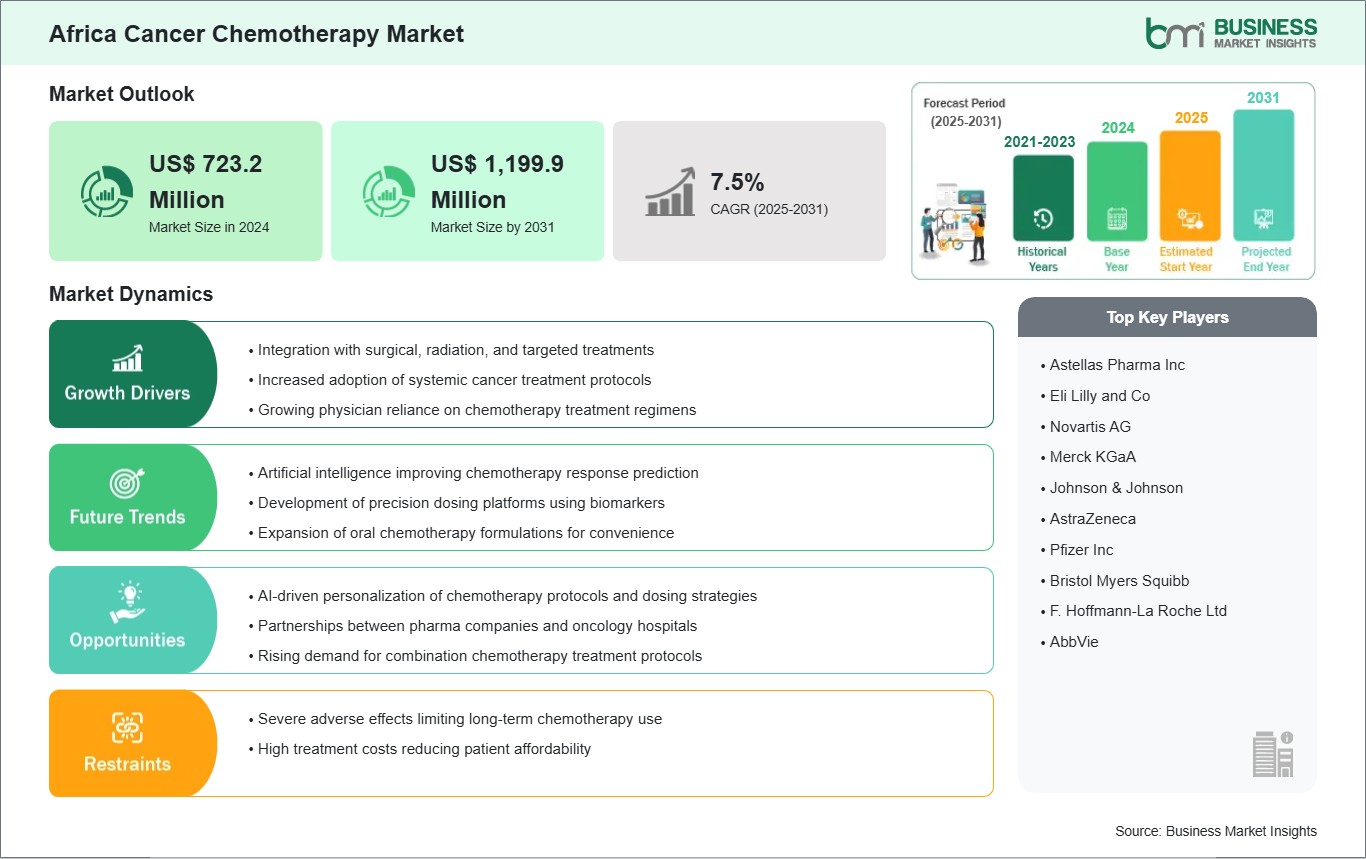
The Africa Cancer Chemotherapy Market size is expected to reach US$ 1,199.9 million by 2031 from US$ 723.2 million in 2024. The market is estimated to record a CAGR of 7.5% from 2025 to 2031.
The Africa cancer chemotherapy market is undergoing structural evolution driven by expanding oncology awareness, gradual health system modernization, and increasing engagement from multinational pharmaceutical companies. Chemotherapy remains a cornerstone of cancer treatment across the continent due to its broad clinical applicability and relatively established protocols compared to advanced therapies. Market activity is shaped by a fragmented healthcare delivery landscape, where public hospitals dominate treatment volumes while private oncology centers increasingly influence purchasing decisions and therapy selection. Supply chains are characterized by heavy reliance on imported active pharmaceutical ingredients and finished formulations, making vendor reliability, cold-chain logistics, and regulatory compliance critical competitive factors. From a market structure perspective, branded generics play a central role, supported by cost-sensitive procurement frameworks and national essential medicines lists. Competitive intensity is moderate, with global manufacturers, regional distributors, and local formulators competing on portfolio breadth, regulatory approvals, and pricing flexibility.
Policy-driven tendering systems strongly influence demand patterns, particularly in government-funded cancer programs. In parallel, international donor initiatives and public–private partnerships are reshaping access pathways by supporting drug availability and treatment continuity. Regulatory harmonization efforts across regional economic blocs are beginning to streamline approvals, although inconsistencies still affect time-to-market. Overall, the market reflects a transition phase where operational efficiency, localized partnerships, and portfolio optimization are more decisive than scale, positioning chemotherapy as a strategically important but operationally complex segment within Africa’s broader oncology ecosystem.

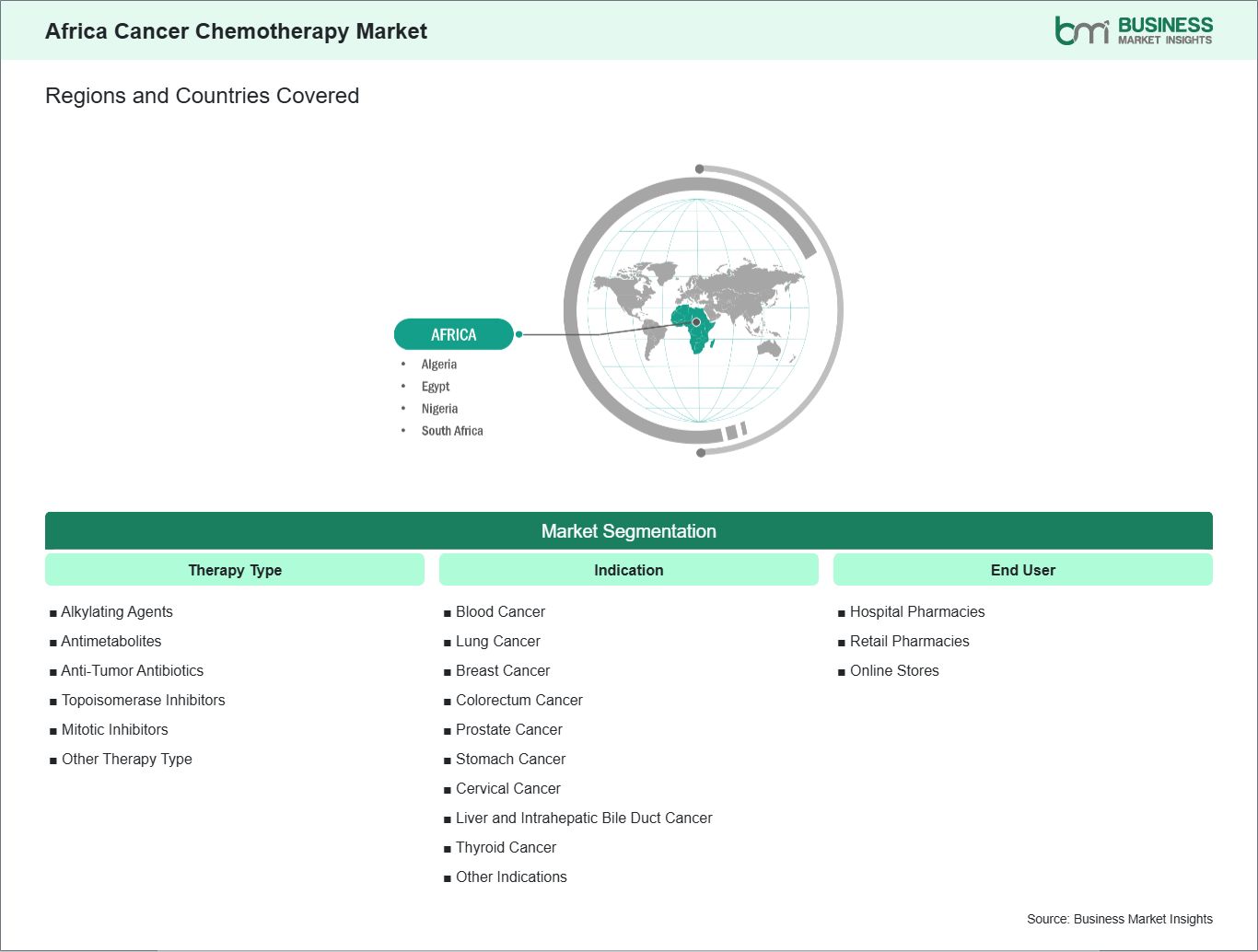
Key segments that contributed to the derivation of the Africa Cancer Chemotherapy market analysis are therapy type, indication, and distribution channel.
Chemotherapeutic agents are increasingly used in combination with surgery, radiation, and targeted therapies. Historically, chemotherapy was often deployed as a standalone systemic treatment. Today, multimodal treatment strategies have become the clinical standard for several solid and hematologic cancers, significantly enhancing patient outcomes and driving demand for chemotherapeutic drugs. The combination of chemotherapeutic drugs with surgery plays a crucial role in cancer treatment. Chemotherapy is frequently administered in the neoadjuvant setting (before surgery) to reduce tumor size, improve resectability, and address microscopic disease. It is also used as adjuvant therapy (after surgery) to eliminate residual cancer cells and reduce the risk of recurrence. As surgical interventions become more precise and increasingly adopted across a wide range of cancer types, the continued reliance on perioperative chemotherapy supports sustained market uptake.
Integration of chemotherapeutic drugs with radiation therapy strengthens therapeutic efficacy. Chemotherapy can act as a radiosensitizer, making tumor cells more susceptible to radiation-induced damage. This synergistic approach is especially common in head & neck, cervical, and lung cancers. The growing global adoption of combined chemoradiation protocols in standard treatment guidelines boosts chemotherapy utilization. The trend toward combining chemotherapy with targeted therapies and immunotherapies expands treatment options for resistant or advanced cancers. Chemotherapy can enhance the effectiveness of targeted agents by killing rapidly proliferating cells, disrupting tumor microenvironments, and overcoming resistance mechanisms. The rise of precision oncology has encouraged clinical trials and approvals for combination regimens, which in turn drives broader chemotherapy use across diverse patient populations. These combination strategies optimize treatment outcomes and extend the clinical relevance of chemotherapeutic drugs.
Artificial intelligence (AI) is leveraged to develop personalized chemotherapy regimens and optimize dosing strategies. Traditional chemotherapy has often followed standardized protocols based on cancer type and stage, but patient responses vary widely due to genetic, molecular, and physiological differences. AI offers the potential to transform this landscape by enabling precision‐tailored treatment plans, reducing toxicity, and improving therapeutic outcomes. AI algorithms can analyze large, complex datasets including genomic profiles, tumor biomarkers, imaging results, electronic health records, and real-time patient responses to identify patterns that human clinicians might miss. By integrating these multidimensional data points, AI can help determine the most effective drug combinations, optimal dosing schedules, and treatment durations for individual patients. This personalization aims to maximize efficacy while minimizing adverse effects, which is particularly valuable in chemotherapy, where toxicity can limit dose intensity and patient quality of life.
Furthermore, AI-driven predictive modeling can anticipate how patients will metabolize and respond to specific chemotherapy agents, enabling dynamic dose adjustments throughout the treatment course. Machine learning systems can continuously refine predictions as new data becomes available, supporting adaptive therapy that evolves with the patient's condition. AI-powered clinical decision support tools help oncologists navigate expanding therapeutic options and evidence, enhancing treatment precision and confidence. As healthcare systems increasingly adopt digital infrastructure and real-world data accumulates, AI's role in chemotherapy personalization promises more effective, efficient, and patient-centric cancer care.

The Africa Cancer Chemotherapy market demonstrates steady growth, with size and share analysis highlighting evolving trends and competitive dynamics among key players. The report further examines subsegments categorized by therapy type, indication, and distribution channel, offering insights into their contribution to overall market performance.
By therapy type, the alkylating agents subsegment dominated the market in 2024, driven by the widespread use in routine IV therapy and emergency care across hospitals and clinics.
Based on indication, the lung cancer subsegment dominated the market in 2024, driven by infection prevention initiatives and demand for biocompatible devices in African healthcare systems.
By distribution channel, the hospital pharmacies subsegment dominated the market in 2024, driven by government investment in healthcare infrastructure and the expansion of private medical facilities across Africa.
| Report Attribute | Details |
|---|---|
| Market size in 2024 | US$ 723.2 Million |
| Market Size by 2031 | US$ 1,199.9 Million |
| CAGR (2025 - 2031) | 7.5% |
| Historical Data | 2021-2023 |
| Forecast period | 2025-2031 |
| Segments Covered | By Therapy Type
|
|
Regions and Countries Covered
| |
| Africa | Egypt, South Africa, Nigeria, and Algeria |
| Market leaders and key company profiles |
|
The "Africa Cancer Chemotherapy Market Size and Forecast (2025–2031)" report provides a detailed analysis of the market covering below areas:
The geographical scope of the Africa Cancer Chemotherapy market report is divided into Egypt, South Africa, Nigeria, and Algeria. South Africa held the largest share in 2024.
Country-level dynamics within the Africa cancer chemotherapy market vary significantly, reflecting differences in healthcare infrastructure, policy maturity, and economic capacity. South Africa stands out as a relatively advanced market, characterized by established oncology networks, stronger private-sector participation, and higher adoption of protocol-driven chemotherapy regimens. In contrast, Egypt functions as a regional manufacturing and export hub, benefiting from domestic pharmaceutical production capabilities and structured public procurement systems. Nigeria represents a high-potential but operationally challenging market, where chemotherapy access is expanding through private hospitals and medical tourism inflows, despite reimbursement limitations and infrastructure gaps. Morocco and Tunisia exhibit improving regulatory frameworks and oncology specialization, supporting steady chemotherapy utilization within public healthcare settings. East African countries such as Kenya and Tanzania are increasingly investing in national cancer institutes, which is enhancing centralized chemotherapy delivery but still constrained by funding variability. Francophone West African markets rely heavily on donor-supported programs and pooled procurement mechanisms, influencing product mix and supplier selection. Across smaller economies, chemotherapy availability is often limited to tertiary centers, creating geographic access disparities. These country-specific conditions necessitate tailored market entry and expansion strategies, emphasizing regulatory navigation, stakeholder engagement, and adaptive pricing models. Collectively, Africa’s chemotherapy landscape is not homogeneous; instead, it is a mosaic of national markets at different stages of oncology system development, each requiring localized commercial and operational approaches.

The Africa Cancer Chemotherapy market is evaluated by gathering qualitative and quantitative data post primary and secondary research, which includes important corporate publications, association data, and databases. A few of the key developments in the Africa cancer chemotherapy market are:
The Africa Cancer Chemotherapy Market is valued at US$ 723.2 Million in 2024, it is projected to reach US$ 1,199.9 Million by 2031.
As per our report Africa Cancer Chemotherapy Market, the market size is valued at US$ 723.2 Million in 2024, projecting it to reach US$ 1,199.9 Million by 2031. This translates to a CAGR of approximately 7.5% during the forecast period.
The Africa Cancer Chemotherapy Market report typically cover these key segments-
The historic period, base year, and forecast period can vary slightly depending on the specific market research report. However, for the Africa Cancer Chemotherapy Market report:
The Africa Cancer Chemotherapy Market is populated by several key players, each contributing to its growth and innovation. Some of the major players include:
The Africa Cancer Chemotherapy Market report is valuable for diverse stakeholders, including:
Essentially, anyone involved in or considering involvement in the Africa Cancer Chemotherapy Market value chain can benefit from the information contained in a comprehensive market report.
Please tell us your area of interest
(Market Segments/ Regions and Countries/ Companies)