Market Summary
Executive Summary and Market Analysis
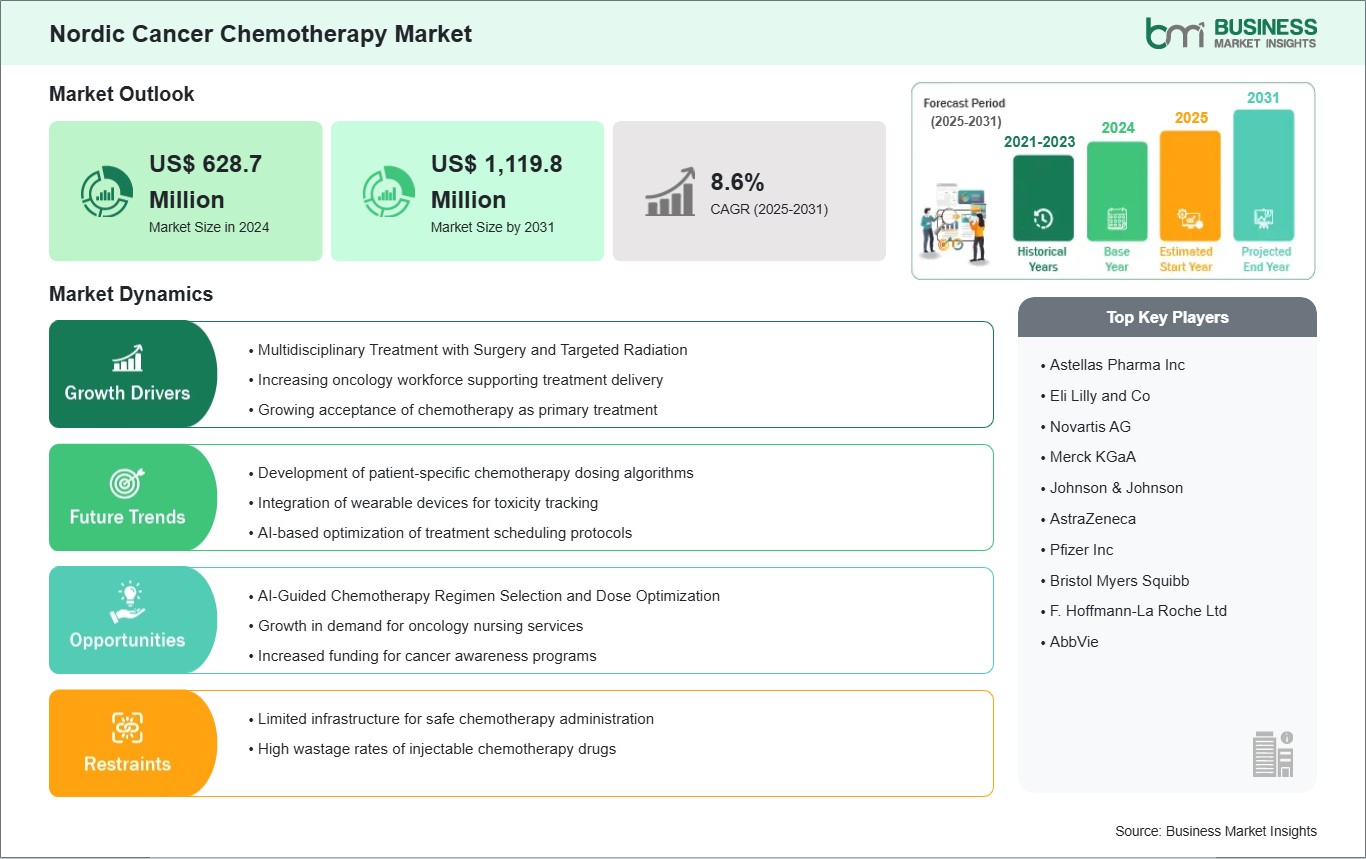
The Nordic cancer chemotherapy market is experiencing stable growth supported by progressive healthcare infrastructure, high levels of healthcare spending, and comprehensive oncology care programs. Universal health coverage in Sweden, Denmark, Norway, Finland, and Iceland ensures that essential chemotherapeutic drugs are accessible to a large proportion of the population. National cancer control plans emphasize early detection, multidisciplinary care, and evidence‑based treatment protocols, which contribute to consistent chemotherapy utilization across major cancer types, including breast, lung, colorectal, and hematologic malignancies.
Hospitals and dedicated oncology centers are central to chemotherapy administration due to the complexity of intravenous regimens and the requirement for clinical monitoring. Retail pharmacies play an important role in distributing oral chemotherapy agents and supportive care medications, while online pharmacy services have grown in prominence for maintenance therapies and patient convenience.
The Nordic region's advanced oncology ecosystem supported by widespread adoption of clinical guidelines, high physician density, and robust pharmacovigilance systems ensures rapid implementation of new clinical evidence, including chemotherapy combinations with radiation, targeted therapies, and immunotherapies where appropriate. Research collaborations across academic institutions and strong ties with global pharmaceutical manufacturers further enhance drug availability and clinical trial participation. Overall, the market reflects a blend of high accessibility, innovation uptake, and strong public health investment that positions it for continued expansion through 2031.
Segment Analysis
Nordic Cancer Chemotherapy Market Segmentation
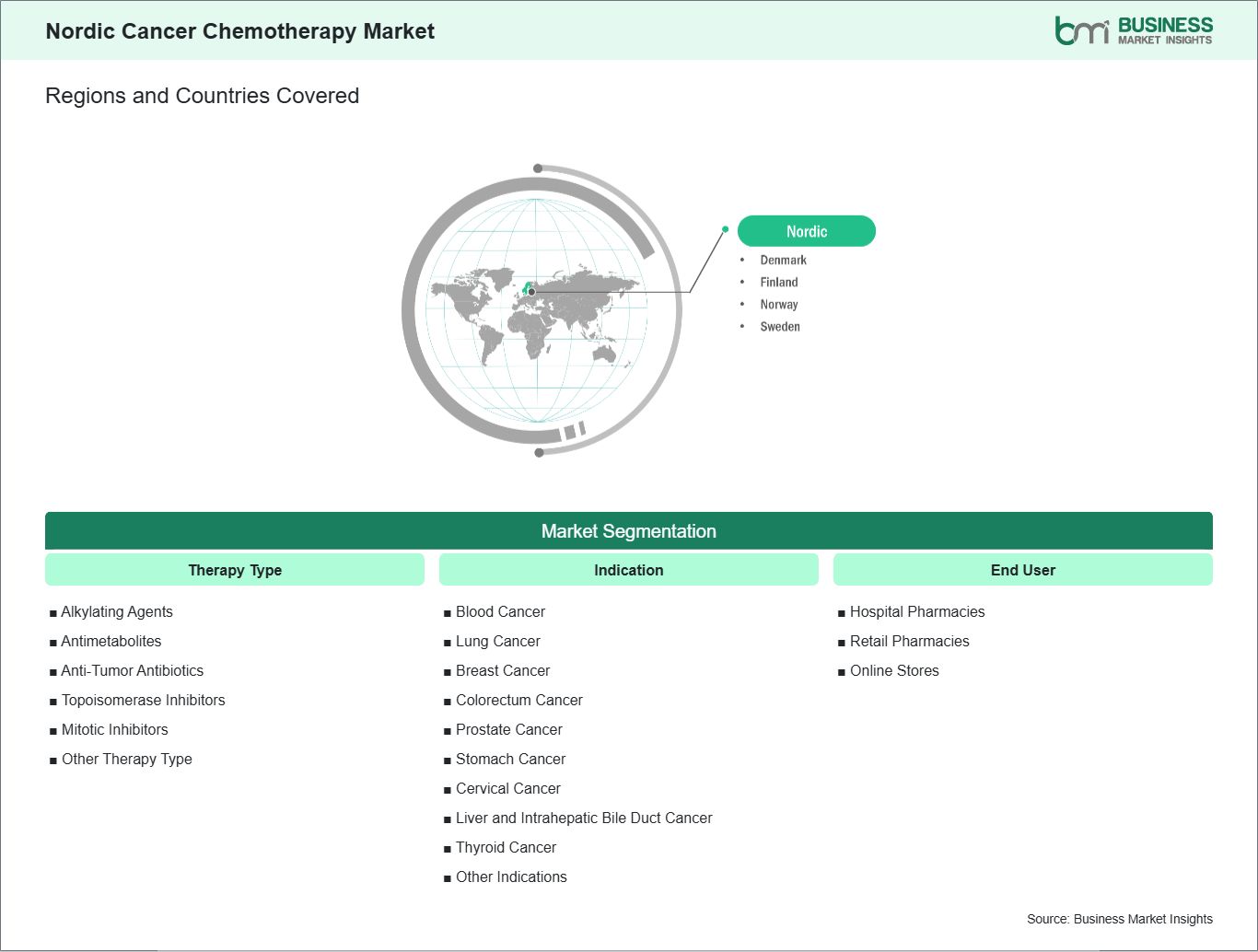
Key segments that contributed to the derivation of the Nordic Cancer Chemotherapy market analysis are therapy type, indication, and distribution channel.
- By therapy type, the cancer chemotherapy market is segmented into alkylating agents, antimetabolites, anti-tumor antibiotics, topoisomerase inhibitors, mitotic inhibitors, and others. The alkylating agents segment dominated the market in 2024.
- Based on indication, the cancer chemotherapy market is segmented into blood cancer, lung cancer, breast cancer, colorectum cancer, prostate cancer, stomach cancer, cervical cancer, liver and intrahepatic bile duct cancer, thyroid cancer, and other indications. The lung cancer segment dominated the market in 2024.
- By distribution channel, the market is segmented into hospital pharmacies, retail pharmacies, and online stores. The hospital pharmacies segment dominated the market in 2024.
Market Forces
Nordic Cancer Chemotherapy Market Drivers and Opportunities
Multidisciplinary Treatment with Surgery and Targeted Radiation
A major driver of chemotherapy utilization in the Nordic region is the widespread adoption of multimodal cancer treatment strategies that integrate chemotherapy with surgery, radiation therapy, and targeted treatments. Chemotherapy is commonly administered in the neoadjuvant setting to shrink tumors before surgery and as adjuvant therapy to eliminate residual disease, particularly in breast, colorectal, and lung cancers. In addition, the use of chemoradiation protocols combining chemotherapy as a radiosensitizer with radiation therapy has become standard for specific indications such as head and neck and cervical cancers.
The Nordic oncology community also actively adopts combination regimens involving chemotherapy with immune checkpoint inhibitors and targeted agents. These integrated approaches are reflected in national and institutional clinical guidelines, which encourage multidisciplinary collaboration and evidence‑based care to improve survival outcomes across both localized and advanced disease states. As targeted therapies and immunotherapies continue to evolve, chemotherapy remains an essential backbone component of several combination protocols, reinforcing its strategic role in regional cancer care.
AI-Guided Chemotherapy Regimen Selection and Dose Optimization
AI offers opportunities to enhance chemotherapy personalization and dose optimization in Nordic cancer care. AI‑enabled platforms can analyze large clinical datasets including electronic health records, genomics, radiomics, laboratory results, and real‑world treatment outcomes to support individualized chemotherapy decision‑making. Predictive models can help identify optimal drug combinations and dosing schedules, anticipate toxicity risks, and dynamically adjust regimens based on patient response.
The Nordic countries with their strong digital healthcare infrastructure and national registries are well-positioned to adopt AI tools in oncology practice. Several hospitals and clinical research groups in Sweden, Denmark, and Norway are experimenting with AI‑driven decision support systems to enhance chemotherapy planning, toxicity forecasting, and treatment effectiveness tracking. AI also supports clinical trial optimization by enabling smarter patient stratification and predictive analytics, accelerating the development of novel chemotherapy combinations, and improving evidence generation. As AI integration expands, it is expected to enhance personalized oncology care further and improve patient outcomes.
Size and Share Analysis
Nordic Cancer Chemotherapy Market Size and Share Analysis
The Nordic Cancer Chemotherapy market demonstrates steady growth, with size and share analysis highlighting evolving trends and competitive dynamics among key players. The report further examines subsegments categorized by therapy type, indication, distribution channel, and end user, offering insights into their contribution to overall market performance.
By therapy type, the alkylating agents subsegment dominated the market in 2024, driven by the widespread use in routine IV therapy and emergency care across hospitals and clinics.
Based on indication, the lung cancer subsegment dominated the market in 2024, driven by regional cancer burden and standardized clinical guidelines that emphasize systemic therapy.
By distribution channel, the hospital pharmacies subsegment dominated the market in 2024, driven by the need for monitored infusion and inpatient care.
Report Coverage
Nordic Cancer Chemotherapy Market Report Coverage and Deliverables
The "Nordic Cancer Chemotherapy Market Size and Forecast (2021–2031)" report provides a detailed analysis of the market covering below areas:
- Nordic Cancer Chemotherapy market size and forecast at regional and country levels for all the key market segments covered under the scope
- Nordic Cancer Chemotherapy market trends, as well as market dynamics such as drivers, restraints, and key opportunities
- Nordic Cancer Chemotherapy market analysis covering key market trends, regional framework, major players, regulations, and recent market developments
- Industry landscape and competition analysis covering market concentration, heat map analysis, prominent players, and recent developments for the Nordic Cancer Chemotherapy market
- Detailed company profiles, including SWOT analysis
Geographic Insights
Nordic Cancer Chemotherapy Market Geographic Insights
The geographical scope of the Nordic Cancer Chemotherapy market report is divided into Sweden, Denmark, Norway, and Finland. Sweden held the largest share in 2024.
Sweden represents one of the most developed chemotherapy markets in the region due to its sophisticated healthcare infrastructure and proactive cancer control strategies. Swedish oncology centers are well integrated with national registries that support outcome tracking and evidence‑based chemotherapy use across major cancer types. Public reimbursement ensures nearly universal access to essential chemotherapy agents and combination regimens across the country. At the same time, academic research institutions contribute to clinical trial participation and the adoption of new treatment protocols. Denmark has a long‑standing history of collaboration in oncology care, supported by centralized oncology networks, high clinical trial participation, and rapid adoption of evidence‑based chemotherapy regimens. Danish treatment protocols commonly integrate chemotherapy with surgery and radiation, particularly in breast, colorectal, and lung cancers.
Strong digital health systems and national databases enhance patient care coordination and real‑world evidence generation. Norway exhibits robust cancer care delivery supported by comprehensive national health coverage. Chemotherapy use is high across standard indications, and Norwegian oncology centers are increasingly incorporating combination therapies with targeted agents and immunotherapies based on clinical guidelines. The country's investment in research and health technology assessment ensures that chemotherapy regimens with strong evidence of clinical benefit are prioritized for adoption. Finland maintains accessible chemotherapy services through its universal healthcare system, with an emphasis on precision medicine and clinical guideline integration. Oncology centers in Helsinki, along with large tertiary hospitals across Finland, implement standardized protocols that include neoadjuvant and adjuvant chemotherapy for breast and gastrointestinal cancers, while also expanding supportive care services to improve patient outcomes.
Industry Activity
Recent Developments
The Nordic Cancer Chemotherapy market is evaluated by gathering qualitative and quantitative data post primary and secondary research, which includes important corporate publications, association data, and databases. A few of the key developments in the Nordic cancer chemotherapy market are:
- In May 2025, Novartis revealed that it was presenting data from more than 60 abstracts at key oncology conferences, highlighting its oncology portfolio across solid tumors and hematologic malignancies. These presentations included results that were relevant to chemotherapy combinations for cancers such as breast and genitourinary tumors.
- In May 2025, Roche reported that adding its PI3K inhibitor Itovebi to standard regimens significantly reduced the risk of death in certain breast cancer patients, demonstrating how novel targeted agents can be used in conjunction with chemotherapy-based standards of care.
Trust & Transparency
Research Methodology
The market analysis combines proprietary research with secondary data from government agencies, company disclosures, regulatory filings, industry databases and expert interviews. Market estimates are validated through data triangulation, cross-market benchmarking and analyst
review.
View Full Research Methodology
Key Sources Referred:
World Health Organization (WHO) World Heart Federation (WHF) Organisation for Economic Cooperation and Development (OECD) The World Bank Group Worldometer The Lancet International Bar Association International Trade Administration