Market Summary
Executive Summary and Market Analysis
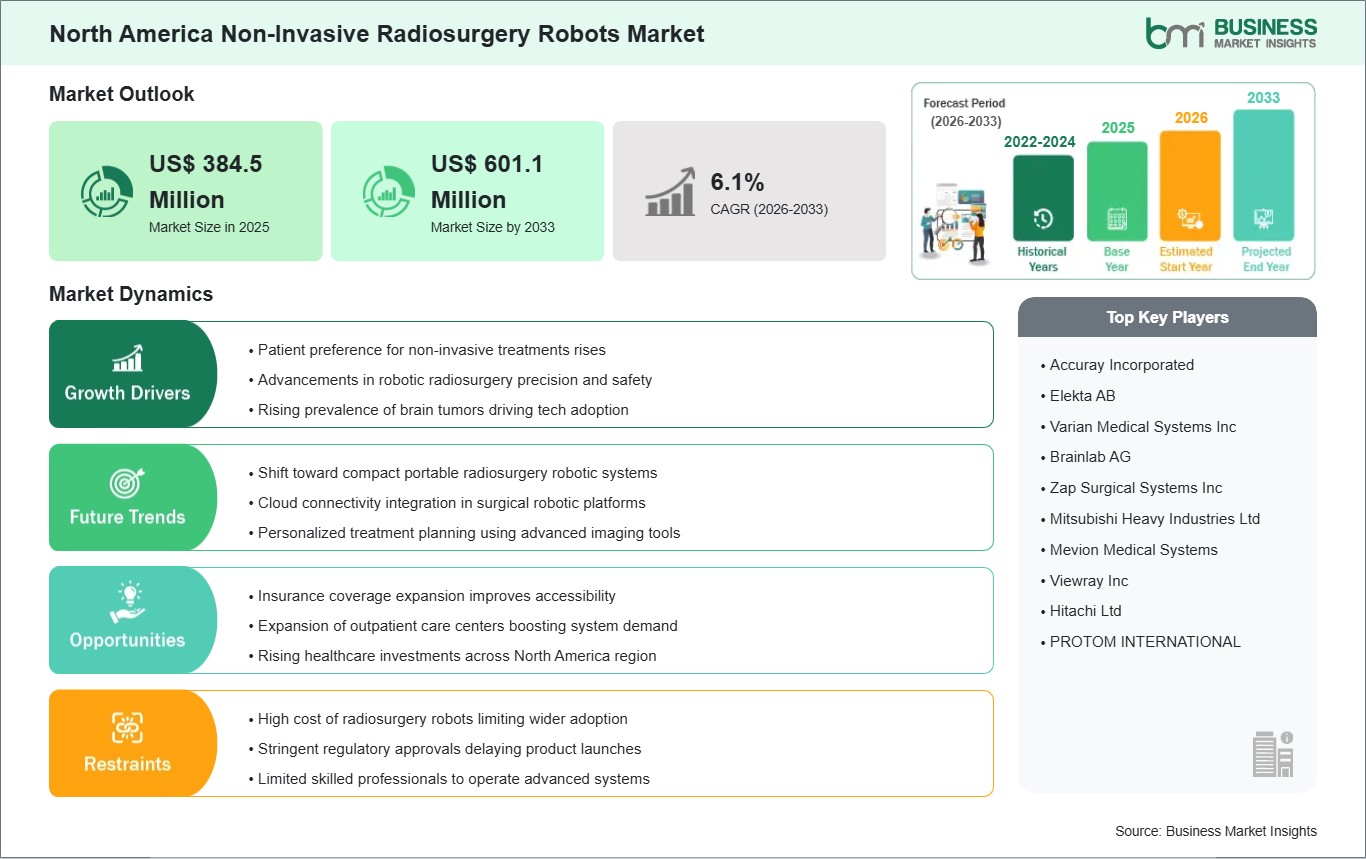
The North America Non-Invasive Radiosurgery Robots market is characterized by rapid technological adoption, driven by the region’s strong healthcare infrastructure, high awareness of precision medicine, and increasing prevalence of complex oncological and neurological disorders. Hospitals and specialized treatment centers are integrating robotic radiosurgery systems to enhance procedural accuracy, reduce patient risk, and improve recovery times, particularly in the treatment of brain tumors, spinal lesions, and other complex neurosurgical conditions. The market is shaped by a combination of global robotics manufacturers and regional healthcare technology providers, with competition focused on system precision, integration with advanced imaging modalities, AI-assisted treatment planning, and automated patient motion management. Adoption is concentrated in urban tertiary hospitals and high-volume oncology centers with established imaging capabilities and highly trained clinical personnel. Private hospitals often lead deployment initiatives to differentiate services, attract medical tourists, and establish centers of excellence, while public hospitals adopt robotic systems through structured procurement programs and government-supported modernization initiatives. The market faces challenges, including high capital expenditure, a limited pool of skilled operators, and regulatory considerations that require compliance with both federal and state standards. However, the advantages of robotic radiosurgery—such as improved clinical outcomes, reduced procedural complications, and operational efficiency—position it as a strategic investment for hospitals. Overall, North America represents a highly mature and competitive market where early adopters set clinical and operational benchmarks, and technological innovation continues to drive market differentiation.
Segment Analysis
North America Non-Invasive Radiosurgery Robots Market Segmentation
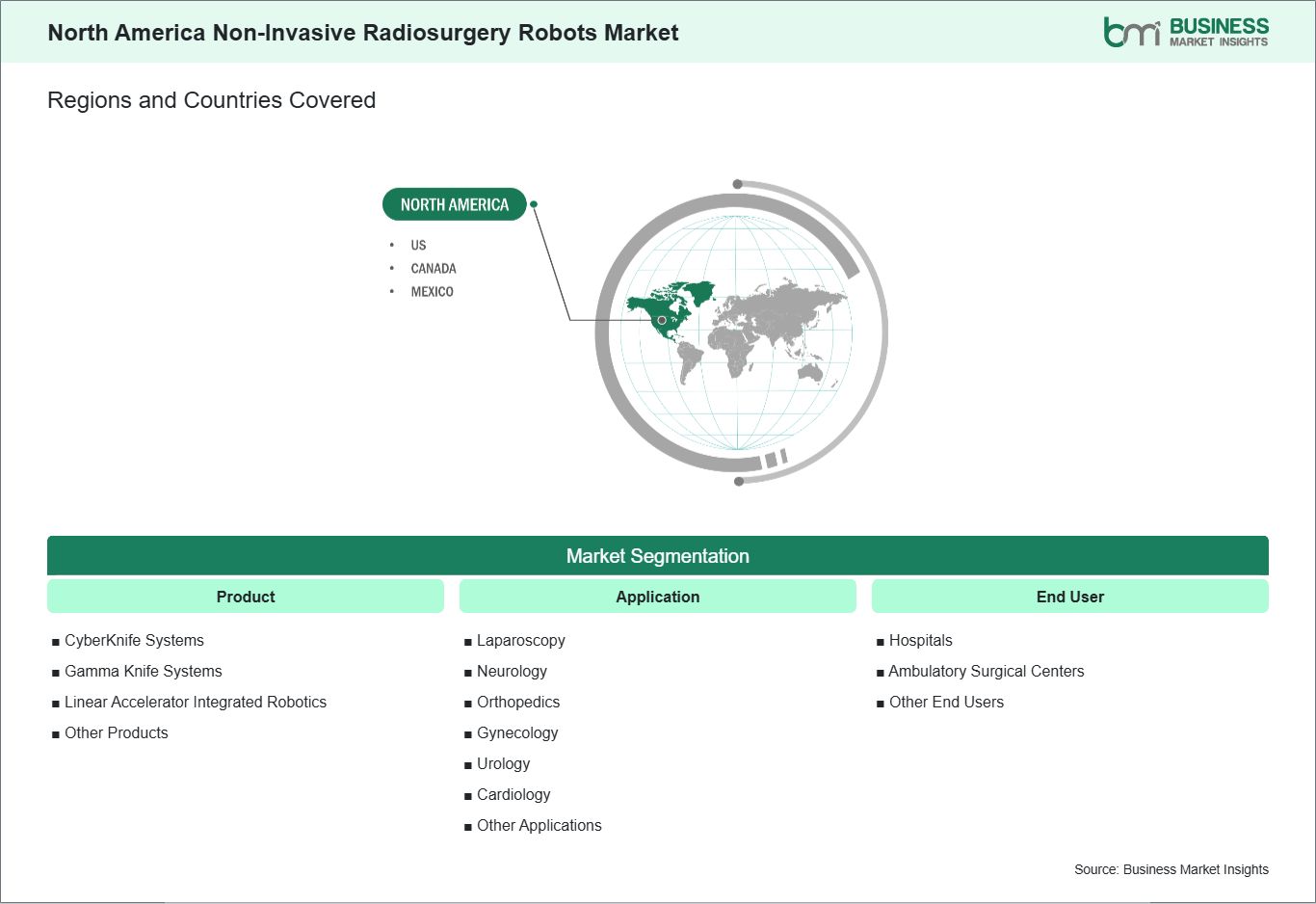
Key segments that contributed to the derivation of the North America non-invasive radiosurgery robots market analysis are product, application, and end user.
- By product, the non-invasive radiosurgery robots market is segmented into cyberknife systems, gamma knife systems, linear accelerator (linac) integrated robotics and other products. The medication cyberknife systems segment dominated the market in 2025.
- In terms of application, the non-invasive radiosurgery robots market is categorized into laparoscopy, neurology, orthopedics, gynecology, urology, cardiology and other applications. The laparoscopy segment dominated the market in 2025.
- Based on end user, the market is classified into hospitals, ambulatory surgical centers and other end users. The hospitals segment dominated the market in 2025.
Market Forces
North America Non-Invasive Radiosurgery Robots Market Drivers and Opportunities
Patient preference for non-invasive treatments rises
The North America non-invasive radiosurgery robots market is witnessing robust growth driven by increasing patient preference for non-invasive cancer treatments. Patients across the United States and Canada are becoming more aware of minimally invasive options that reduce recovery times, minimize surgical trauma, and limit post-operative complications. Non-invasive radiosurgery robots enable precise radiation delivery to tumors without requiring traditional surgical incisions, which appeals to patients seeking treatment options that are less physically taxing. This trend is particularly prominent among older adults, individuals with comorbidities, and those concerned with quality-of-life considerations during cancer therapy. Healthcare providers are responding to this preference by incorporating robotic radiosurgery systems into multidisciplinary oncology programs. Hospitals and cancer centers are highlighting the advantages of non-invasive procedures, including shorter hospital stays and outpatient treatment capabilities, to attract patients who prioritize comfort and convenience. Patient-centric marketing and educational campaigns are also reinforcing awareness about the benefits of robotic radiosurgery, encouraging more individuals to choose this treatment modality over conventional surgery or extended radiation therapy regimens. As a result, patient demand is increasingly influencing investment decisions in robotic systems across North American healthcare facilities. In addition to influencing hospital adoption, patient preference is shaping clinical workflows and care pathways. Physicians are integrating non-invasive radiosurgery into standard treatment protocols, offering alternatives for tumors in sensitive or hard-to-reach locations. The focus on patient comfort and reduced recovery time also aligns with broader healthcare goals of improving patient satisfaction and outcomes. By responding to the growing demand for minimally invasive treatment options, North American healthcare providers are expanding access to robotic radiosurgery while reinforcing its role as a preferred treatment choice for modern oncology care.
Insurance coverage expansion improves accessibility
The expansion of insurance coverage for non-invasive radiosurgery procedures is a key factor driving market growth in North America. Public and private insurers are increasingly recognizing robotic radiosurgery as an effective and safe treatment for a variety of cancers, which has improved reimbursement policies and reduced out-of-pocket costs for patients. This coverage expansion makes advanced robotic treatments more accessible to a wider population, including those who may have previously opted for conventional therapies due to financial constraints. Hospitals and clinics are leveraging these insurance improvements to promote broader adoption and ensure that more patients can benefit from precision radiation therapy. Insurance coverage also supports hospitals in justifying investments in robotic radiosurgery systems. With reimbursement policies in place, healthcare facilities can anticipate a return on investment while providing cutting-edge treatment services. The availability of insurance-backed treatment reduces the financial barrier for patients and encourages them to seek earlier intervention, improving overall clinical outcomes. In addition, insurance coverage often extends to outpatient procedures, which aligns with the minimally invasive nature of robotic radiosurgery and supports efficient hospital operations. Furthermore, expanded insurance coverage promotes regional adoption by enabling healthcare providers to offer radiosurgery services in both metropolitan and smaller urban centers. Hospitals in diverse geographic locations can implement robotic systems knowing that patients will have access to reimbursement, enhancing equitable access to advanced oncology care across North America. Coverage expansion also incentivizes collaboration between hospitals, insurers, and technology providers to optimize treatment protocols and cost-effectiveness. Overall, the combination of insurance support and patient demand is strengthening the North American non-invasive radiosurgery robots market, improving accessibility, affordability, and adoption of these advanced cancer treatments.
Size and Share Analysis
North America Non-Invasive Radiosurgery Robots Market Size and Share Analysis
The North America non-invasive radiosurgery robots market demonstrates steady growth, with size and share analysis highlighting evolving trends and competitive dynamics among key players. The report examines subsegments categorized within product, application, and end user, offering insights into their contribution to overall market performance.
By product, the medication cyberknife systems segment dominated the market in 2025, driven by widespread clinical adoption due to high precision and real‑time image‑guided capabilities that enhance treatment outcomes and reduce damage to healthy tissue.
In terms of application, the laparoscopy subsegment dominated the market in 2025, driven by strong demand for minimally invasive procedures that offer faster recovery, fewer complications, and improved patient satisfaction.
Based on end user, the hospitals subsegment dominated the market in 2025, driven by extensive healthcare infrastructure and high investments in advanced oncology technologies to meet growing patient volume and complex treatment needs.
Report Coverage
North America Non-Invasive Radiosurgery Robots Market Report Coverage and Deliverables
The "North America Non-Invasive Radiosurgery Robots Market Size and Forecast (2022–2033)" report provides a detailed analysis of the market covering below areas:
- North America Non-Invasive Radiosurgery Robots Market size and forecast at regional and country levels for all segments covered under the scope
- North America Non-Invasive Radiosurgery Robots Market trends, as well as drivers, restraints, and opportunities
- North America Non-Invasive Radiosurgery Robots Market analysis covering key trends, regional framework, major players, regulations, and recent developments
- Industry landscape and competition analysis covering market concentration, heat map analysis, prominent players, and recent developments for the North America Non-Invasive Radiosurgery Robots Market
- Detailed company profiles, including SWOT analysis
Geographic Insights
North America Non-Invasive Radiosurgery Robots Market Geographic Insights
The geographical scope of the North America Non-Invasive Radiosurgery Robots Market report is divided into US, Canada, and Mexico. The US held the largest share in 2025.
The North America Non-Invasive Radiosurgery Robots market exhibits varied adoption across the U.S., Canada, and Mexico, reflecting differences in healthcare infrastructure, investment capacity, and clinical specialization. The U.S. emerges as the dominant market, with leading hospitals in metropolitan areas such as New York, Los Angeles, Boston, and Chicago actively deploying robotic radiosurgery systems to enhance treatment precision, optimize workflow efficiency, and expand access to minimally invasive procedures. Adoption in the U.S. is driven by a combination of private and public investments, advanced tertiary hospitals, well-established oncology and neurosurgery centers, and comprehensive training programs for radiation oncologists and neurosurgeons. Hospitals leverage robotic systems to improve clinical outcomes, reduce procedural risks, and strengthen institutional reputation, particularly in centers of excellence and high-volume tertiary care facilities. Canada represents a secondary growth market, with adoption concentrated in urban tertiary hospitals and specialized cancer centers in Toronto, Montreal, and Vancouver. Canadian hospitals prioritize clinical accuracy, patient safety, and operational efficiency, often deploying systems through public-private partnerships, pilot programs, and structured government-supported funding initiatives. Mexico is an emerging market, with deployment focused on major urban hospitals in Mexico City, Monterrey, and Guadalajara, where infrastructure and specialized personnel are sufficient to manage advanced radiosurgery technology. Adoption in Mexico often relies on referral networks or shared-service models, allowing hospitals to provide patient access to high-precision treatments while managing resource limitations. Across all three countries, successful adoption is supported by vendor strategies offering flexible financing, structured clinical training, and ongoing technical support. High-volume hospitals and specialized centers act as primary adoption hubs, while smaller institutions often rely on networked access to robotic systems. The U.S.’s dominance reflects its larger healthcare infrastructure, higher investment capacity, and concentration of advanced tertiary hospitals, positioning it as the key driver of growth in North America. Canada and Mexico provide incremental opportunities for market expansion as awareness, healthcare modernization, and minimally invasive treatment adoption continue to grow across the region.
Industry Activity
Recent Developments
The North America Non-Invasive Radiosurgery Robots Market is evaluated by gathering qualitative and quantitative data post primary and secondary research, which includes important corporate publications, association data, and databases. A few of the key developments in the North America non-invasive radiosurgery robots market are:
- In November 2025, ZAP Surgical’s ZAP‑Axon Radiosurgery Planning System achieved U.S. FDA 510(k) clearance (and parallel EU CE certification), authorizing its clinical use across the United States and EU as a dedicated cranial radiosurgery planning platform. This regulatory approval is critical for enabling efficient treatment planning for ZAP‑X systems at North American centres. It delivers a streamlined interface built specifically for stereotactic radiosurgery case workflows, enhancing precision and usability. The dual approvals mark an important expansion in regulatory recognition of next‑generation radiosurgery tooling.
- In January 2024, Westchester Medical Center in New York announced it would become the first hospital in New York State to install the ZAP‑X Gyroscopic Radiosurgery system, bringing this non‑invasive robotic radiosurgery technology to the Hudson Valley region. The installation, slated for mid‑2024, represents a regional product launch of the ZAP‑X platform to serve patients needing high‑precision radiosurgery without open surgery. This initiative positions the medical centre as an advanced radiosurgery provider in the northeastern U.S., complementing existing treatment modalities.
Trust & Transparency
Research Methodology
The market analysis combines proprietary research with secondary data from government agencies, company disclosures, regulatory filings, industry databases and expert interviews. Market estimates are validated through data triangulation, cross-market benchmarking and analyst
review.
View Full Research Methodology
Key Sources Referred:
World Health Organization (WHO)Organisation for Economic Cooperation and Development (OECD)The World Bank GroupWorldometerThe LancetInternational Bar AssociationInternational Trade Administration