Market Summary
Executive Summary and Market Analysis
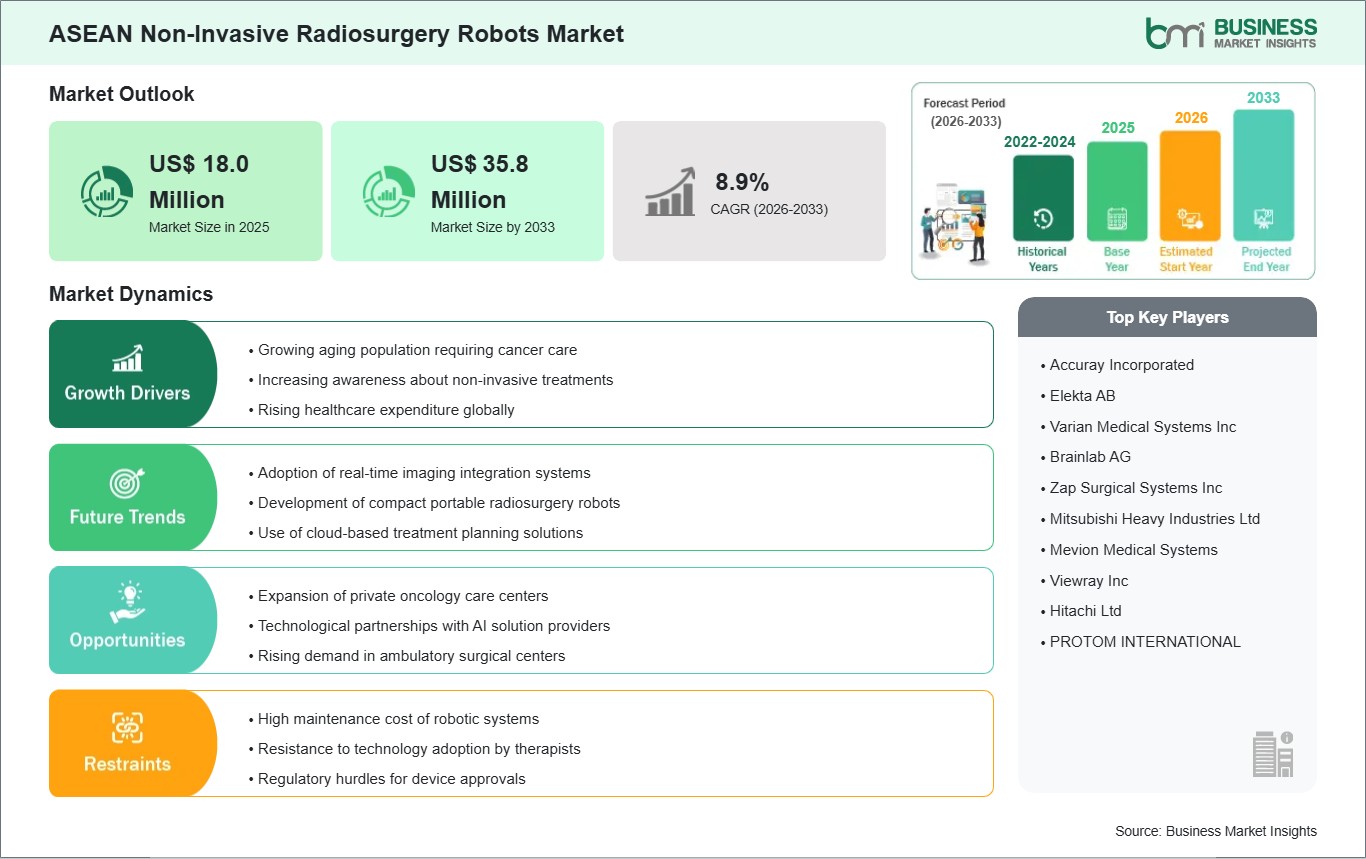
The ASEAN Non‑Invasive Radiosurgery Robots market is emerging as a high-potential segment within the region’s healthcare technology landscape, driven by the growing need for precision oncology and minimally invasive treatment options. Hospitals across ASEAN are increasingly under pressure to improve patient outcomes while optimizing operational efficiency, and robotic radiosurgery systems provide a solution by enabling highly targeted radiation therapy with minimal collateral tissue damage. These systems are particularly relevant for neurological and oncological applications, where conventional surgical approaches can be invasive, time-consuming, and costly. The market is characterized by a combination of early adopters in more developed healthcare economies—such as Singapore and Malaysia—and emerging demand from nations like Indonesia, Thailand, and Vietnam, where the expansion of private hospital networks is accelerating. Adoption patterns are influenced by several factors: the availability of trained radiation oncologists, hospital infrastructure capabilities, and the integration of advanced imaging modalities into treatment planning. Key differentiators among vendors include precision of radiation delivery, workflow efficiency, system interoperability, and after-sales service networks. However, challenges persist. High upfront capital requirements and limited clinical training programs in many ASEAN countries constrain widespread adoption. Additionally, disparate regulatory frameworks across the region create hurdles for manufacturers seeking to expand into multiple markets simultaneously. Despite these challenges, the sector is gaining strategic importance as hospitals and governments increasingly recognize the clinical and economic value of robotic radiosurgery, particularly in enhancing treatment accuracy, reducing patient recovery times, and increasing hospital throughput. For investors and healthcare administrators, this market presents a long-term opportunity to deploy high-value technology solutions that strengthen regional healthcare capabilities while positioning early adopters as leaders in precision oncology.
Segment Analysis
ASEAN Non-Invasive Radiosurgery Robots Market Segmentation
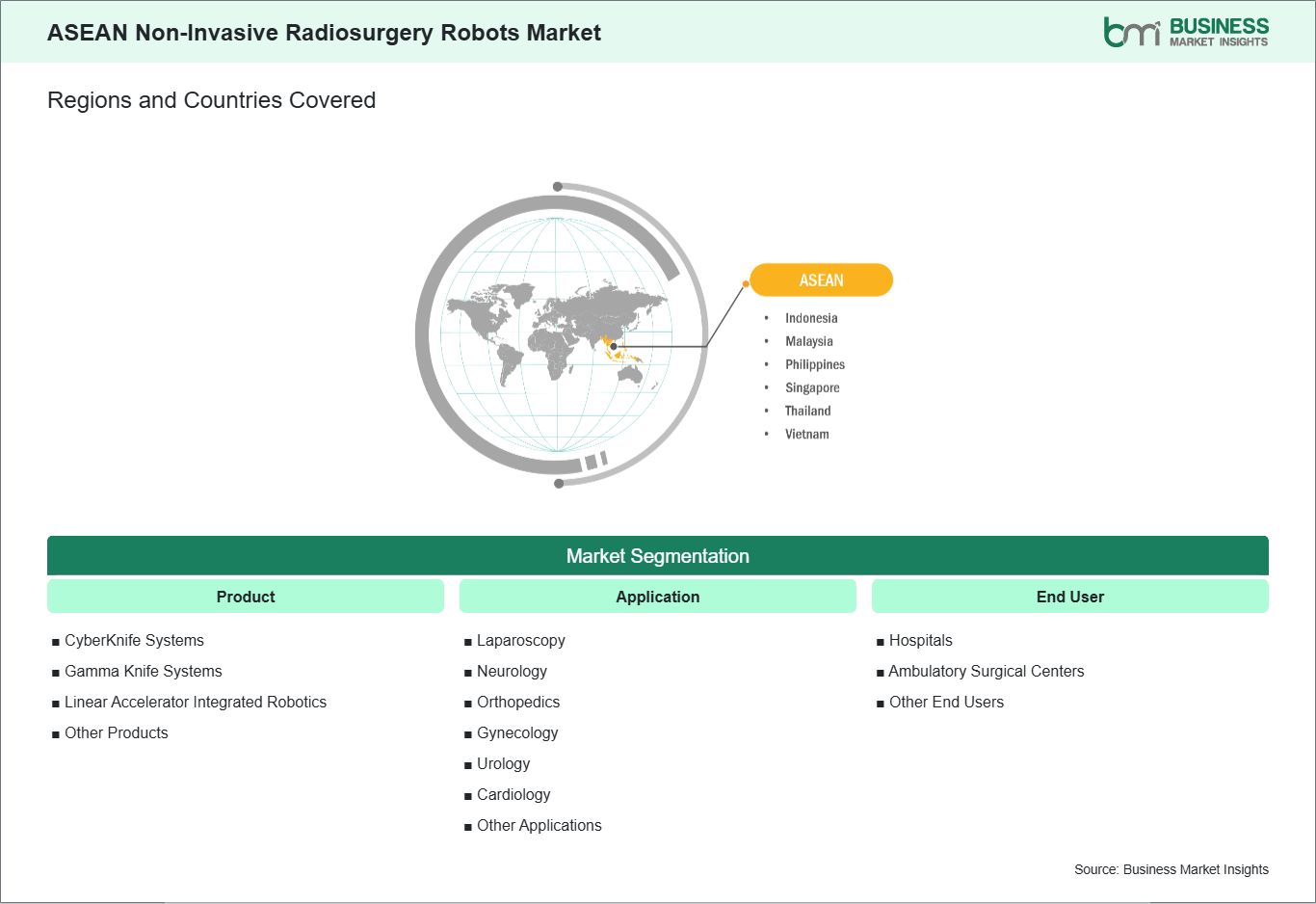
Key segments that contributed to the derivation of the ASEAN non-invasive radiosurgery robots market analysis are product, application, and end user.
- By product, the non-invasive radiosurgery robots market is segmented into cyberknife systems, gamma knife systems, linear accelerator (linac) integrated robotics and other products. The medication cyberknife systems segment dominated the market in 2025.
- In terms of application, the non-invasive radiosurgery robots market is categorized into laparoscopy, neurology, orthopedics, gynecology, urology, cardiology and other applications. The laparoscopy segment dominated the market in 2025.
- Based on end user, the market is classified into hospitals, ambulatory surgical centers and other end users. The hospitals segment dominated the market in 2025.
Market Forces
ASEAN Non-Invasive Radiosurgery Robots Market Drivers and Opportunities
Increasing demand for precise tumor treatment
Healthcare providers in ASEAN countries are witnessing a growing demand for highly precise tumor treatment, driven by rising awareness of cancer care options and an expanding base of patients seeking advanced therapeutic alternatives. Traditional surgical approaches have limitations in treating tumors located in difficult‑to‑access areas or in patients with comorbidities that increase surgical risk. In response, hospitals and oncology centers across the region are exploring non‑invasive radiosurgery robots capable of delivering focused radiation with sub‑millimeter accuracy. These technologies address treatment challenges by targeting tumor tissues while preserving surrounding healthy structures, making them particularly appealing for complex oncology cases where precision is paramount. In key ASEAN healthcare markets, clinicians and hospital administrators are highlighting the importance of precision in improving patient outcomes and reducing the long‑term burden of treatment side effects. Non‑invasive radiosurgery robots are increasingly seen as complementary tools to existing radiotherapy services, enabling more coordinated care pathways that integrate diagnostics, planning, and treatment delivery. Healthcare facilities with established oncology departments are actively engaging with technology partners to evaluate these systems for both primary and recurrent tumor cases. The focus on precision is also influencing procurement decisions, with healthcare leaders prioritizing solutions that demonstrate consistent accuracy and reproducibility in clinical performance. Patient preference is another influential factor shaping demand for precise tumor treatments in the ASEAN region. Many patients and referring physicians express a strong interest in treatment options that minimize hospitalization time and reduce procedural discomfort. Non‑invasive radiosurgery robots offer appealing characteristics in this regard, as they typically require no incisions and support outpatient treatment frameworks. As public and private healthcare providers seek to improve competitive positioning, investment in precision‑focused technologies is emerging as a strategic differentiator. These investments are not only intended to elevate the quality of care but also to support broader institutional goals of enhancing treatment efficiency and patient satisfaction.
Development of portable radiosurgery systems
The development of portable radiosurgery systems is gaining traction as healthcare facilities in ASEAN look to expand access to advanced oncology treatments beyond traditional hospital settings. Historically, radiosurgery equipment has been centralized in major medical centers due to its size, complexity, and infrastructure requirements. However, developers are responding to regional needs by designing more compact and mobile systems that can be deployed in secondary care centers and specialist clinics. This shift supports a broader vision of decentralizing cancer care, enabling healthcare providers to bring sophisticated treatment technologies closer to underserved populations without the need for extensive capital infrastructure. In response to evolving clinical demands, medical technology companies are collaborating with ASEAN healthcare institutions to tailor portable radiosurgery solutions that align with local operational environments. These collaborations often involve adapting system features to accommodate space constraints, varying power and connectivity conditions, and existing clinical workflows. By emphasizing modular design and ease of integration, developers are helping healthcare providers incorporate radiosurgery capabilities without the extended timelines and costs typically associated with large fixed installations. This approach resonates with hospitals and regional clinics that prioritize flexibility and scalable technology investments. The emphasis on portability also reflects broader healthcare trends in the ASEAN market, where facility administrators are seeking technologies that support versatile care delivery models. Portable radiosurgery systems can serve as interim solutions while permanent infrastructure upgrades are planned, or as part of mobile outreach programs targeting rural and peri‑urban communities. By facilitating broader geographic access to radiosurgery services, portable systems help reduce treatment disparities and support more inclusive oncology care frameworks. As the regional healthcare landscape continues to evolve, innovation in portable radiosurgery technology is likely to play an important role in shaping how advanced cancer treatments are delivered across diverse clinical settings.
Size and Share Analysis
ASEAN Non-Invasive Radiosurgery Robots Market Size and Share Analysis
The ASEAN non-invasive radiosurgery robots market demonstrates steady growth, with size and share analysis highlighting evolving trends and competitive dynamics among key players. The report examines subsegments categorized within product, application, and end user, offering insights into their contribution to overall market performance.
By product, the medication cyberknife systems segment dominated the market in 2025, driven by their ability to offer precise, real‑time image‑guided radiosurgery suitable for a wide range of tumor types with minimal damage to surrounding healthy tissues.
In terms of application, the laparoscopy subsegment dominated the market in 2025, driven by increasing preference for minimally invasive procedures across ASEAN healthcare facilities due to faster patient recovery and reduced procedural risks.
Based on end user, the hospitals subsegment dominated the market in 2025, driven by high patient throughput, growing investment in advanced oncology treatment infrastructure, and greater adoption of robotic radiosurgery technologies in tertiary care centers.
Report Coverage
ASEAN Non-Invasive Radiosurgery Robots Market Report Coverage and Deliverables
The "ASEAN Non-Invasive Radiosurgery Robots Market Size and Forecast (2022–2033)" report provides a detailed analysis of the market covering below areas:
- ASEAN Non-Invasive Radiosurgery Robots Market size and forecast at regional and country levels for all segments covered under the scope
- ASEAN Non-Invasive Radiosurgery Robots Market trends, as well as drivers, restraints, and opportunities
- ASEAN Non-Invasive Radiosurgery Robots Market analysis covering key trends, regional framework, major players, regulations, and recent developments
- Industry landscape and competition analysis covering market concentration, heat map analysis, prominent players, and recent developments for the ASEAN Non-Invasive Radiosurgery Robots Market
- Detailed company profiles, including SWOT analysis
Geographic Insights
ASEAN Non-Invasive Radiosurgery Robots Market Geographic Insights
The geographical scope of the ASEAN Non-Invasive Radiosurgery Robots Market report is divided into Indonesia, Malaysia, the Philippines, Singapore, Thailand, and Vietnam. Indonesia held the largest share in 2025.
Within the ASEAN region, market dynamics for non-invasive radiosurgery robots vary widely, reflecting differences in healthcare infrastructure, investment capacity, and clinical expertise. Indonesia emerges as the dominant market, driven by its large population, rapidly expanding urban hospital networks, and increasing demand for precision oncology solutions. Major hospitals in Jakarta, Surabaya, and Bandung are prioritizing advanced robotic radiosurgery systems to improve patient outcomes, reduce treatment times, and strengthen domestic oncology capabilities, positioning Indonesia as the regional hub for investment and adoption. Malaysia follows as a significant growth market, with hospitals in Kuala Lumpur, Penang, and Johor leveraging robotic systems to attract both local and international patients and enhance service quality in private tertiary care centers. Singapore remains a highly developed but smaller-scale market, with leading cancer centers and specialty hospitals adopting cutting-edge systems primarily to maintain regional leadership in medical technology and cater to medical tourism. Thailand shows selective adoption, particularly in Bangkok and Chiang Mai, where flagship hospitals integrate radiosurgery robots as part of broader oncology programs, although expansion beyond major urban centers is limited by public healthcare budget constraints. The Philippines is gradually emerging, with private hospitals in Metro Manila investing in pilot programs to offer advanced treatment options, though adoption remains constrained by workforce capacity and infrastructure gaps. Vietnam represents an early-stage market, where robotic radiosurgery systems are primarily deployed in private specialty clinics and urban referral centers, with broader penetration limited by financing and technical support challenges. Across these countries, commercial success hinges on tailored strategies: vendors that provide flexible acquisition models, extensive operator training, and robust local service networks are most likely to achieve scale. Indonesia’s dominance reflects not only market size but also the strategic prioritization of advanced treatment technologies in major urban centers, setting the benchmark for regional growth and serving as a launchpad for broader ASEAN expansion.
Industry Activity
Recent Developments
The ASEAN Non-Invasive Radiosurgery Robots Market is evaluated by gathering qualitative and quantitative data post primary and secondary research, which includes important corporate publications, association data, and databases. A few of the key developments in the ASEAN non-invasive radiosurgery robots market are:
- In May 2025, Vietnam, FV Hospital in Ho Chi Minh City announced its acquisition and installation of the CyberKnife S7 robotic radiosurgery system, marking the first deployment of this AI‑integrated non‑invasive robotic radiosurgery platform in Southeast Asia. The advanced system offers highly accurate, AI‑enhanced tumor tracking capable of treating tumors anywhere in the body without surgery. Treatment sessions can be completed in significantly fewer visits with reduced side effects, expanding advanced cancer care options locally. The investment positions FV Hospital’s Hy Vong Cancer Centre as a regional leader in precision oncology technology.
- In April 2025, ZAP Surgical Systems announced that the ZAP‑X Gyroscopic Radiosurgery platform will be installed at Kaohsiung Show Chwan Memorial Hospital in Taiwan, representing a major introduction of vault‑free non‑invasive radiosurgery technology in the broader ASEAN/APAC region. This next‑generation SRS platform delivers gyroscopically steered beams to precisely target tumors with minimal radiation to healthy tissue. Installation is slated for the fourth quarter of 2025 with patient treatments expected in early 2026. The facility aims to enhance its neuro‑oncology services with this cutting‑edge radiosurgery robot solution.
Trust & Transparency
Research Methodology
The market analysis combines proprietary research with secondary data from government agencies, company disclosures, regulatory filings, industry databases and expert interviews. Market estimates are validated through data triangulation, cross-market benchmarking and analyst
review.
View Full Research Methodology
Key Sources Referred:
World Health Organization (WHO)Organisation for Economic Cooperation and Development (OECD)The World Bank GroupWorldometerThe LancetInternational Bar AssociationInternational Trade Administration