Market Summary
Executive Summary and Global Market Analysis
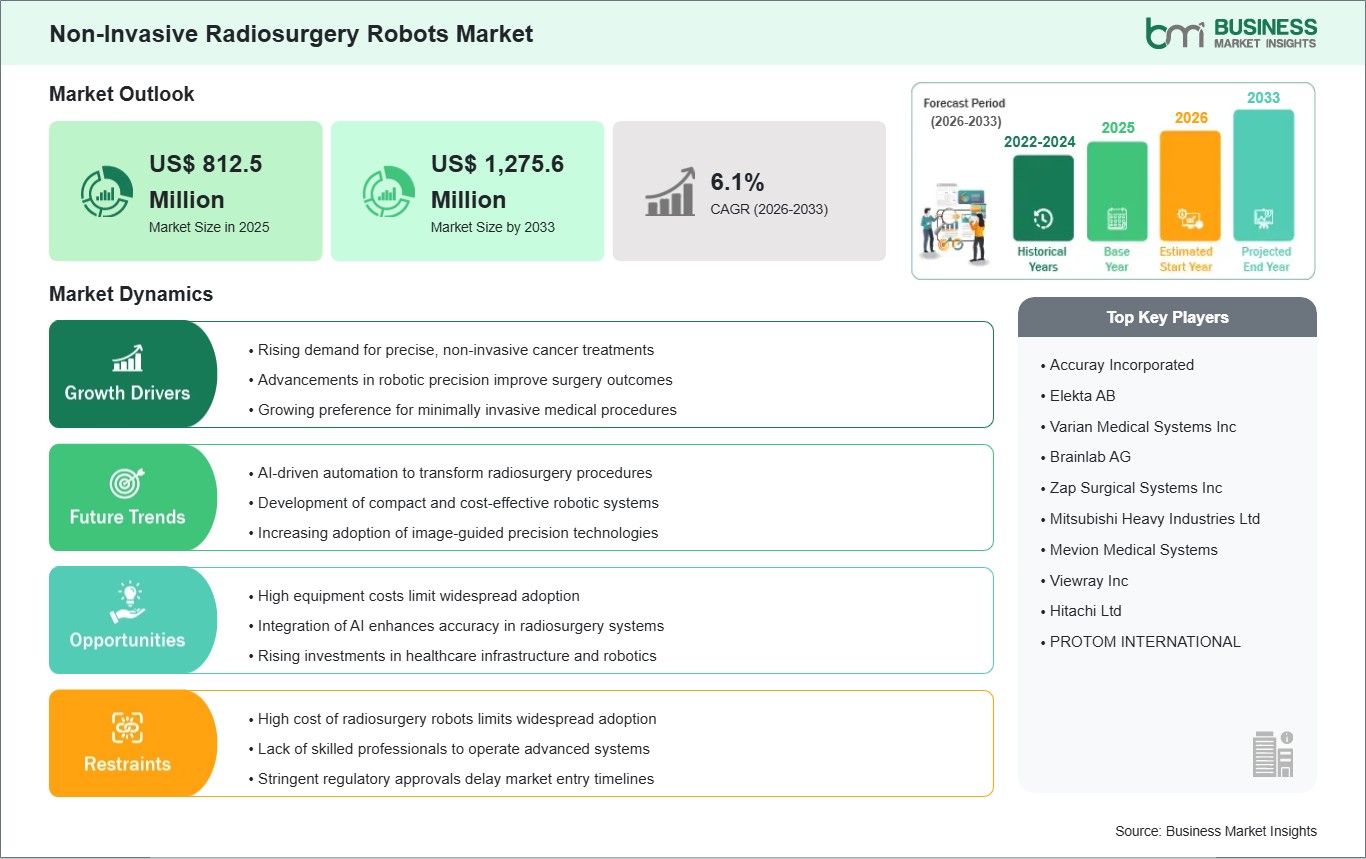
The global non-invasive radiosurgery robots market is experiencing steady strategic evolution driven by advancements in precision oncology, robotics integration, and image-guided treatment technologies. These systems enable highly targeted radiation therapy for tumors and neurological disorders without surgical incisions, significantly improving patient recovery timelines and reducing procedural risks. Market participants are increasingly focusing on robotic accuracy, adaptive imaging, and automated treatment planning to enhance clinical outcomes and operational efficiency within healthcare institutions. Hospitals and specialized cancer treatment centers are prioritizing technologies that support minimally invasive treatment protocols, which is contributing to growing institutional interest in radiosurgery robotics. From a market dynamics perspective, technology differentiation remains a key competitive factor. Manufacturers are investing in artificial intelligence-assisted targeting, motion tracking capabilities, and real-time imaging integration to improve treatment accuracy during radiosurgical procedures. Additionally, the integration of cloud-based treatment planning software and advanced analytics is enabling clinicians to design highly customized therapy regimens, supporting better patient-specific treatment strategies. These technological advancements are reshaping the value proposition of radiosurgery robots, positioning them as critical tools in modern radiation oncology departments. Strategic partnerships between medical device manufacturers, research institutions, and oncology centers are further strengthening innovation pipelines. Such collaborations are facilitating clinical validation studies, improving regulatory approvals, and accelerating the commercialization of next-generation radiosurgery systems. Furthermore, healthcare providers are emphasizing workflow optimization and multi-indication treatment capability, encouraging vendors to design versatile robotic systems capable of addressing multiple tumor types, including brain, spine, lung, and prostate lesions. Another important factor influencing market development is the shift toward outpatient treatment models. As healthcare systems worldwide prioritize value-based care and improved patient outcomes, the demand for technologically advanced, non-invasive treatment platforms continues to expand. Overall, the market landscape is characterized by continuous innovation, growing clinical adoption, and a strategic focus on precision-driven cancer treatment technologies.
Segment Analysis
Non-Invasive Radiosurgery Robots Market Segmentation
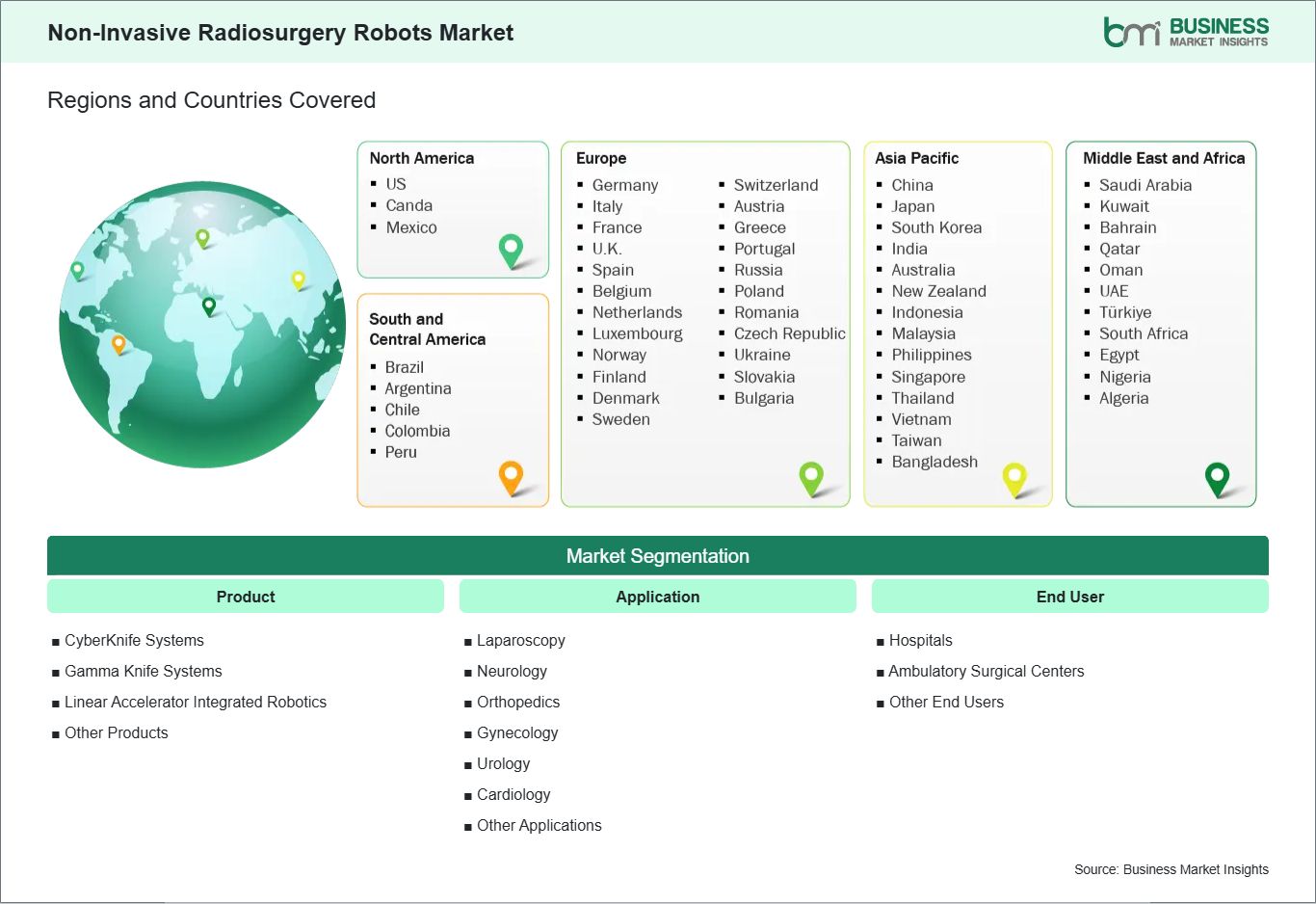
Key segments that contributed to the derivation of the non-invasive radiosurgery robots market analysis are product, application, and end user.
By product, the non-invasive radiosurgery robots market is segmented into cyberknife systems, gamma knife systems, linear accelerator (LINAC) integrated robotics, and other products. The medication cyberknife systems segment dominated the market in 2025.
In terms of application, the non-invasive radiosurgery robots market is categorized into laparoscopy, neurology, orthopedics, gynecology, urology, cardiology, and other applications. The laparoscopy segment dominated the market in 2025.
Based on end user, the market is classified into hospitals, ambulatory surgical centers, and other end users. The hospitals segment dominated the market in 2025.
Market Forces
Non-Invasive Radiosurgery Robots Market Drivers and Opportunities
Demand for Precise, Non-Invasive Cancer Treatments
There is an increase in the global demand for non-invasive radiosurgery robots, as healthcare systems make the effort to use non-invasive treatments with better clinical outcomes. Using robotic radiosurgery systems, the clinician can accurately deliver a high-energy beam of radiation sub-millimeter to the tumor, thus eliminating the need for several procedures involving open surgery. The delivery of high-radiation beams via the use of robotic radiosurgery systems is particularly beneficial in treating tumors located in or near the brain, spine, and lungs, where many conventional surgeries would involve considerable risk to the patient. As patients and their care providers become aware of available minimally invasive therapy options, hospitals are relying on robotic radiosurgery as part of their cancer treatment programs in order to better facilitate patient recovery time, minimize patient length of stay in the hospital, and improve the accuracy of tumor treatment.
Non-invasive radiosurgery robots are becoming increasingly accepted in North America and Europe, due to strongly developed healthcare infrastructures and advanced oncology research. Cancer centers in Canada and the US have utilized this technology widely to treat patients with disorders resulting from neurological conditions, metastatic malignancies, and prostate cancer. Additionally, nations such as Germany, France, and Great Britain are advancing their stereotactic radiosurgery capabilities in their universities and research institutions. The growing demand is largely attributed to an increase in the elderly population in these regions.
High Equipment Costs Limit Widespread Adoption
Noninvasive radiosurgery robots are expensive, which limits their adoption. The advanced hardware needed for a radiosurgery robot includes 3 main components: the robotic platform, the technology to deliver the radiation, and specialized imaging systems. Hospitals also must invest in the treatment room with radiation shielding, dedicated planning software used to plan procedures before delivering treatments, and ongoing maintenance services. Once the robot is purchased and installed, hospitals must have highly skilled specialists to operate it, including radiation oncologists, physicists, and technical engineers. For many healthcare facilities, the cost of owning a robot makes it difficult to justify the investment when compared to the costs of conventional radiotherapy machinery. In developed nations, healthcare providers have multiple funding options available to support the acquisition of advanced technology. In mature markets—such as North America and Western Europe—hospitals may depend on government subsidies, health insurance reimbursement processes, or large healthcare systems to help finance the purchase of advanced radiosurgery equipment; however, several hospitals experience budgetary limitations and extensive medical equipment approval procedures that slow the adoption of advanced technology.
Size and Share Analysis
Non-Invasive Radiosurgery Robots Market Size and Share Analysis
The Non-Invasive Radiosurgery Robots Market demonstrates steady growth, with size and share analysis highlighting evolving trends and competitive dynamics among key players. The report examines subsegments categorized within product, application, and end user, offering insights into their contribution to overall market performance.
By product, the medication cyberknife systems segment dominated the market in 2025, driven by the growing adoption of robotic radiosurgery for highly precise, non-invasive cancer treatment with minimal damage to surrounding tissues.
In terms of application, the laparoscopy segment dominated the market in 2025, driven by the increasing preference for minimally invasive surgeries that reduce hospital stays, surgical risks, and recovery time.
Based on end user, the hospitals segment dominated the market in 2025, driven by the high volume of complex surgical procedures and strong financial and infrastructure capacity to adopt advanced robotic systems.
Report Coverage
Non-Invasive Radiosurgery Robots Market Report Coverage and Deliverables
The "Non-Invasive Radiosurgery Robots Market Size and Forecast (2022–2033)" report provides a detailed analysis of the market covering below areas:
- Non-Invasive Radiosurgery Robots Market size and forecast at global, regional, and country levels for all the key market segments covered under the scope
- Non-Invasive Radiosurgery Robots Market trends, as well as drivers, restraints, and opportunities
- Non-Invasive Radiosurgery Robots Market analysis covering key trends, global and regional framework, major players, regulations, and recent developments
- Industry landscape and competition analysis covering market concentration, heat map analysis, prominent players, and recent developments for the Non-Invasive Radiosurgery Robots Market
- Detailed company profiles, including SWOT analysis
Geographic Insights
Non-Invasive Radiosurgery Robots Market Geographic Insights
The geographical scope of the non-invasive radiosurgery robots market report is divided into North America, Asia Pacific, Europe, Middle East & Africa, and South & Central America. North America held the largest share in 2025.
The global non-invasive radiosurgery robots market is characterized by various patterns of adoption among different regions. Factors such as healthcare infrastructure, technological readiness, and availability of advanced or specialty oncology treatment facilities impact the rate at which various markets have adopted these devices. North America is currently the largest single regional market because of a well-developed healthcare delivery system and high levels of clinical acceptance of robotic-assisted radiation therapies. Leading medical device companies, along with ongoing technological advancements driven by new product introductions and collaborative research between hospitals and academic institutions, support North America's market position.
Furthermore, the vast majority of US and Canadian healthcare providers are focused on implementing state-of-the-art treatment options that allow for more accurate localization of tumors and improved patient care through the use of non-invasive radiosurgery robotic systems. In Europe, several countries are currently making substantial investments in radiotherapy technologies, as these investments will support their national healthcare systems and ultimately improve the overall quality of services associated with cancer treatment in their respective regions. Numerous hospitals and specialty oncology centers in Western Europe are now beginning to adopt robotic radiosurgery systems to provide physicians with the tools necessary for managing complex neurological and oncological diseases. Moreover, ongoing research initiatives and cross-border clinical trials in Europe are helping to evaluate and improve next-generation radiosurgical technologies.
Industry Activity
Recent Developments
The Non-Invasive Radiosurgery Robots Market is evaluated by gathering qualitative and quantitative data post primary and secondary research, which includes important corporate publications, association data, and databases. A few of the key developments in the non-invasive radiosurgery robots market are:
- In November 2025, ZAP Surgical Systems received U.S. FDA 510(k) clearance and EU CE certification for the ZAP‑Axon Radiosurgery Planning System. The software integrates with the ZAP-X platform to support advanced treatment planning for cranial stereotactic radiosurgery. Regulatory approval allows clinical use of the software across the US and the European Union. The platform improves treatment workflow, visualization, and planning efficiency for clinicians.
- In July 2025, Elekta AB received U.S. FDA 510(k) clearance for its Leksell Gamma Knife radiosurgery system to treat adults with drug-resistant mesial temporal lobe epilepsy. The approval expands the system's clinical indications beyond tumors and vascular disorders. The Gamma Knife delivers 192 highly focused radiation beams to target specific brain regions without open surgery. This regulatory clearance enables US hospitals to use the system for non-invasive epilepsy treatment.
Trust & Transparency
Research Methodology
The market analysis combines proprietary research with secondary data from government agencies, company disclosures, regulatory filings, industry databases and expert interviews. Market estimates are validated through data triangulation, cross-market benchmarking and analyst
review.
View Full Research Methodology
Key Sources Referred:
World Health Organization (WHO) Organisation for Economic Cooperation and Development (OECD) The World Bank Group Worldometer The Lancet International Bar Association International Trade Administration