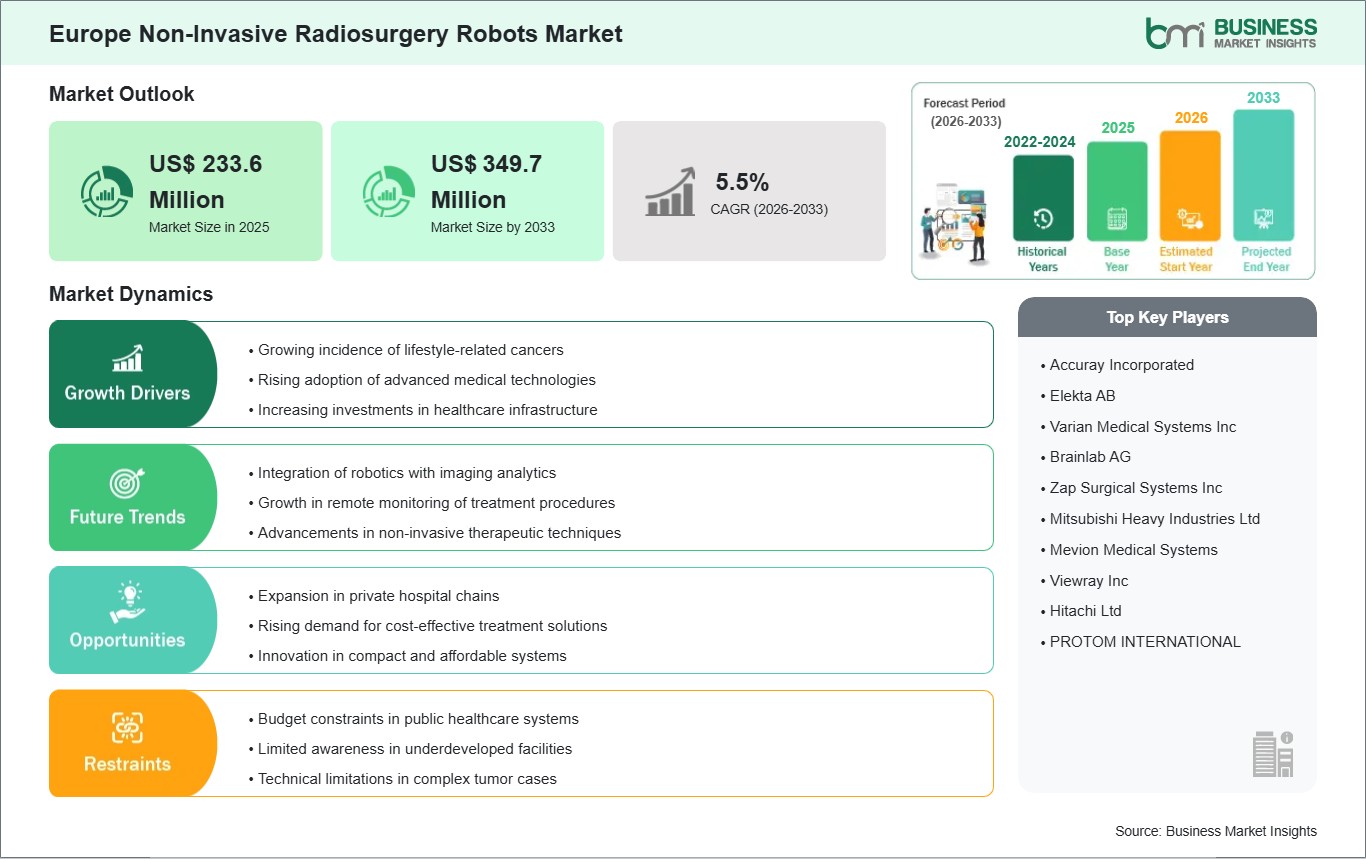
The Europe non-invasive radiosurgery robots market size is expected to reach US$349.7 million by 2033 from US$233.6 million in 2025. The market is estimated to record a CAGR of 5.5% from 2026 to 2033.
The Europe Non-Invasive Radiosurgery Robots market is experiencing steady expansion, driven by rising demand for precision oncology and minimally invasive neurosurgical treatments. Hospitals and specialty care centers across the continent are increasingly adopting robotic radiosurgery platforms to enhance treatment accuracy, reduce procedural risks, and improve patient throughput. These systems are particularly relevant in managing complex tumors and neurological conditions where traditional surgery may pose high risks or prolonged recovery periods. The market landscape is shaped by both international robotics manufacturers and domestic technology integrators, with differentiation based on treatment precision, operational efficiency, imaging integration, and after-sales support. Adoption is concentrated in tertiary hospitals and urban medical centers that possess advanced imaging infrastructure and trained clinical personnel. The competitive environment emphasizes technological innovation, such as AI-assisted treatment planning, real-time motion compensation, and automated radiation delivery, which enable physicians to execute complex procedures with higher accuracy. Market growth is influenced by hospital strategies to enhance service quality, maintain competitive positioning in oncology and neurosurgery, and attract both domestic and international patients. However, challenges persist, including high capital expenditure, limited workforce expertise, and regulatory variability across European countries. Furthermore, integration of robotic systems requires coordination between radiology, oncology, and neurosurgical departments, adding operational complexity. Despite these hurdles, hospitals recognize the long-term clinical and financial benefits of robotic radiosurgery, including reduced hospitalization duration, lower complication rates, and improved patient satisfaction. The market is also benefiting from increasing public and private investments in healthcare modernization, as well as research initiatives exploring broader clinical applications for robotic radiosurgery. Europe presents a technologically sophisticated and strategically attractive environment for the adoption of non-invasive radiosurgery robots, where early deployment in leading hospitals sets benchmarks for clinical precision, operational efficiency, and patient-centric care.

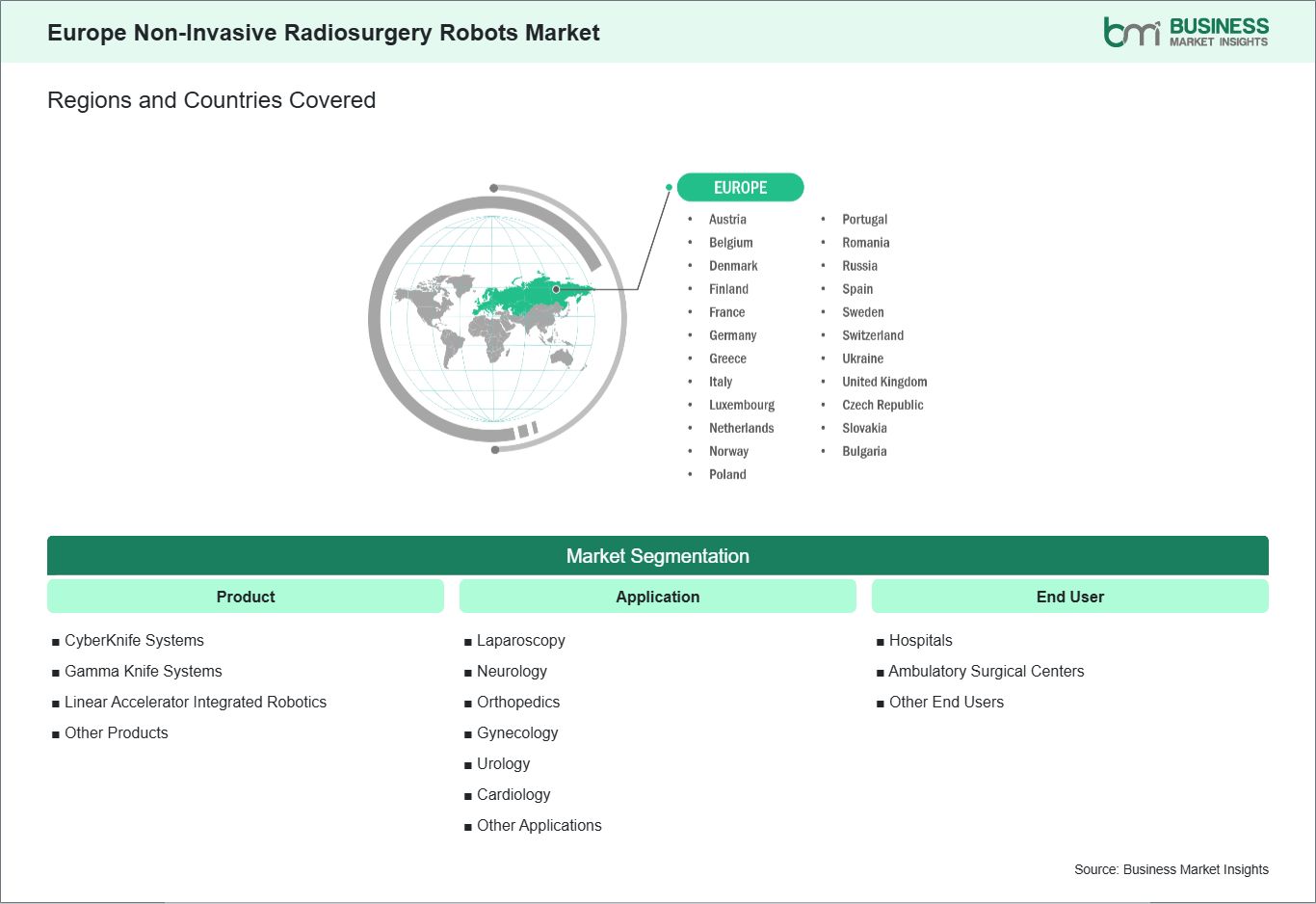
Key segments that contributed to the derivation of the Europe non-invasive radiosurgery robots market analysis are product, application, and end user.
The Europe non-invasive radiosurgery robots market is being significantly influenced by the region’s aging population, which is experiencing a higher prevalence of chronic conditions and cancer. As life expectancy increases, healthcare systems face growing demand for advanced, minimally invasive treatment options that can address complex medical needs without subjecting patients to the risks of traditional surgery. Non-invasive radiosurgery robots offer precise radiation therapy that targets tumors while reducing physical stress on elderly patients, making them an attractive solution for geriatric care. Hospitals and cancer centers are increasingly investing in these technologies to provide safer, more effective treatment options for a patient population that is more vulnerable to complications from conventional surgical interventions. Healthcare providers in Europe are observing a marked increase in age-related cancers such as prostate, colorectal, and lung cancers. Older patients often present with comorbidities, including cardiovascular disease, diabetes, or respiratory conditions, which complicate traditional surgical procedures. Non-invasive radiosurgery robots address these challenges by allowing treatment to be delivered in outpatient settings with minimal recovery time and lower risk of complications. The ability to administer highly targeted therapy while preserving surrounding healthy tissue is particularly important for elderly patients whose recovery capacity may be limited. Hospitals are leveraging these technologies to improve treatment accessibility, safety, and overall quality of care for aging populations. The rise in geriatric patients is also influencing healthcare infrastructure planning and investment across Europe. Governments and private healthcare institutions are expanding oncology units and equipping hospitals with robotic radiosurgery platforms to meet the growing demand for specialized treatments. Additionally, training programs for clinicians are evolving to focus on geriatric care protocols in conjunction with robotic systems, ensuring that elderly patients receive treatments tailored to their specific health profiles. By aligning technology adoption with demographic trends, European healthcare providers are strengthening their capacity to manage chronic conditions and cancer in an aging population while promoting better clinical outcomes and patient-centered care.
Strategic partnerships with leading healthcare providers are a key factor driving growth in the Europe non-invasive radiosurgery robots market. Technology developers are collaborating with hospitals, academic medical centers, and specialized oncology clinics to integrate robotic radiosurgery platforms into established clinical workflows. These partnerships facilitate access to advanced equipment, operational expertise, and clinical research support, enabling hospitals to implement highly precise and reliable treatment protocols. By working closely with leading healthcare institutions, technology providers can demonstrate system capabilities, refine treatment planning software, and develop solutions that align with the unique requirements of European healthcare systems. Partnerships also extend to collaborative programs focused on clinical research, training, and professional development. Hospitals and technology developers are jointly conducting studies to evaluate the efficacy, safety, and long-term outcomes of robotic radiosurgery across different tumor types and patient demographics. These initiatives help build clinical evidence supporting the use of non-invasive robotic systems, which is critical for adoption in conservative healthcare environments. Training programs developed through partnerships ensure that medical personnel are proficient in operating advanced robotics and integrating them into multidisciplinary oncology care teams, enhancing both patient safety and treatment efficiency. Furthermore, collaborative partnerships support innovation and regional expansion of radiosurgery technology. By establishing pilot programs and demonstration centers in major European hospitals, technology developers can provide hands-on experience and technical guidance while addressing infrastructure and workflow challenges. Hospitals benefit from shared expertise and ongoing system optimization, while vendors gain insights into real-world clinical applications that drive product refinement. Collectively, these partnerships foster a collaborative ecosystem where healthcare providers, technology developers, and research institutions work together to accelerate the adoption of non-invasive radiosurgery robots, ultimately improving access to advanced cancer treatments across Europe.
The Europe non-invasive radiosurgery robots market demonstrates steady growth, with size and share analysis highlighting evolving trends and competitive dynamics among key players. The report examines subsegments categorized within product, application, and end user, offering insights into their contribution to overall market performance.
By product, the medication cyberknife systems segment dominated the market in 2025, driven by strong clinical preference for highly precise, image‑guided radiosurgery that improves tumor targeting while sparing healthy tissue.
In terms of application, the laparoscopy subsegment dominated the market in 2025, driven by increasing adoption of minimally invasive procedures that reduce patient recovery time and procedural complications.
Based on end user, the hospitals subsegment dominated the market in 2025, driven by established healthcare infrastructure, high patient throughput, and capacity to invest in advanced oncology technologies including robotic radiosurgery systems.
| Report Attribute | Details |
|---|---|
| Market size in 2025 | US$ 233.6 Million |
| Market Size by 2033 | US$ 349.7 Million |
| CAGR (2026 - 2033) | 5.5% |
| Historical Data | 2022-2024 |
| Forecast period | 2026-2033 |
| Segments Covered | By Product
|
|
Regions and Countries Covered
| |
| Europe | Belgium, Austria, Finland, Denmark, Greece, Poland, Romania, Russia, Ukraine, Czech Republic, Slovakia, Bulgaria, Italy, Luxembourg, Germany, Switzerland, France, Netherlands, Norway, Portugal, Spain, Sweden, United Kingdom |
| Market leaders and key company profiles |
|
The "Europe Non-Invasive Radiosurgery Robots Market Size and Forecast (2022–2033)" report provides a detailed analysis of the market covering below areas:
The geographical scope of the Europe Non-Invasive Radiosurgery Robots Market report is divided into Belgium, Austria, Finland, Denmark, Greece, Poland, Romania, Russia, Ukraine, the Czech Republic, Slovakia, Bulgaria, Italy, Luxembourg, Germany, Switzerland, France, the Netherlands, Norway, Portugal, Spain, Sweden, and the UK. Germany held the largest share in 2025.
The Europe Non-Invasive Radiosurgery Robots market exhibits substantial variation in adoption across Belgium, Austria, Finland, Denmark, Greece, Poland, Romania, Russia, Ukraine, the Czech Republic, Slovakia, Bulgaria, Italy, Luxembourg, Germany, Switzerland, France, the Netherlands, Norway, Portugal, Spain, Sweden, and the UK, shaped by differences in healthcare infrastructure, regulatory frameworks, and investment capacity. Germany emerges as the dominant market, supported by a robust network of tertiary hospitals, specialized oncology and neurosurgery centers, and a high degree of technology adoption. Hospitals in Berlin, Munich, Frankfurt, and Hamburg are actively integrating robotic radiosurgery systems to enhance precision treatment, optimize workflow efficiency, and reduce patient recovery times. Germany’s strong clinical research ecosystem, well-established reimbursement frameworks, and skilled workforce facilitate rapid adoption of advanced systems, making it a regional hub for both clinical implementation and innovation. Secondary markets in Western Europe, including France, the UK, Switzerland, and the Netherlands, demonstrate strong but slightly smaller adoption, driven by private hospitals and research institutions seeking advanced treatment capabilities and enhanced operational efficiency. Southern European countries such as Italy, Spain, Greece, and Portugal show selective deployment, typically in high-volume tertiary hospitals and specialized oncology centers, while adoption in Nordic markets like Sweden, Norway, Finland, and Denmark emphasizes technology integration within urban medical centers and regional cancer networks. Eastern European countries—including Poland, Romania, the Czech Republic, Slovakia, Bulgaria, Ukraine, and Russia—represent emerging markets where uptake is concentrated in major urban hospitals and centers of excellence. Challenges in these regions include capital constraints, workforce training gaps, and infrastructure limitations, although cross-border collaborations and pilot programs are driving gradual expansion. Across all these countries, successful market penetration depends on tailored strategies that combine flexible procurement options, robust technical support, and professional training programs for clinicians and technical staff. Germany’s dominance is reflected not only in the volume of installed systems but also in its influence on regional clinical standards, adoption best practices, and innovation, establishing it as the primary driver of growth in Europe’s non-invasive radiosurgery robotics market.

The Europe Non-Invasive Radiosurgery Robots Market is evaluated by gathering qualitative and quantitative data post primary and secondary research, which includes important corporate publications, association data, and databases. A few of the key developments in the Europe non-invasive radiosurgery robots market are:
The Europe Non-Invasive Radiosurgery Robots Market is valued at US$ 233.6 Million in 2025, it is projected to reach US$ 349.7 Million by 2033.
As per our report Europe Non-Invasive Radiosurgery Robots Market, the market size is valued at US$ 233.6 Million in 2025, projecting it to reach US$ 349.7 Million by 2033. This translates to a CAGR of approximately 5.5% during the forecast period.
The Europe Non-Invasive Radiosurgery Robots Market report typically cover these key segments-
The historic period, base year, and forecast period can vary slightly depending on the specific market research report. However, for the Europe Non-Invasive Radiosurgery Robots Market report:
The Europe Non-Invasive Radiosurgery Robots Market is populated by several key players, each contributing to its growth and innovation. Some of the major players include:
The Europe Non-Invasive Radiosurgery Robots Market report is valuable for diverse stakeholders, including:
Essentially, anyone involved in or considering involvement in the Europe Non-Invasive Radiosurgery Robots Market value chain can benefit from the information contained in a comprehensive market report.
Please tell us your area of interest
(Market Segments/ Regions and Countries/ Companies)