Market Summary
Executive Summary and Market Analysis
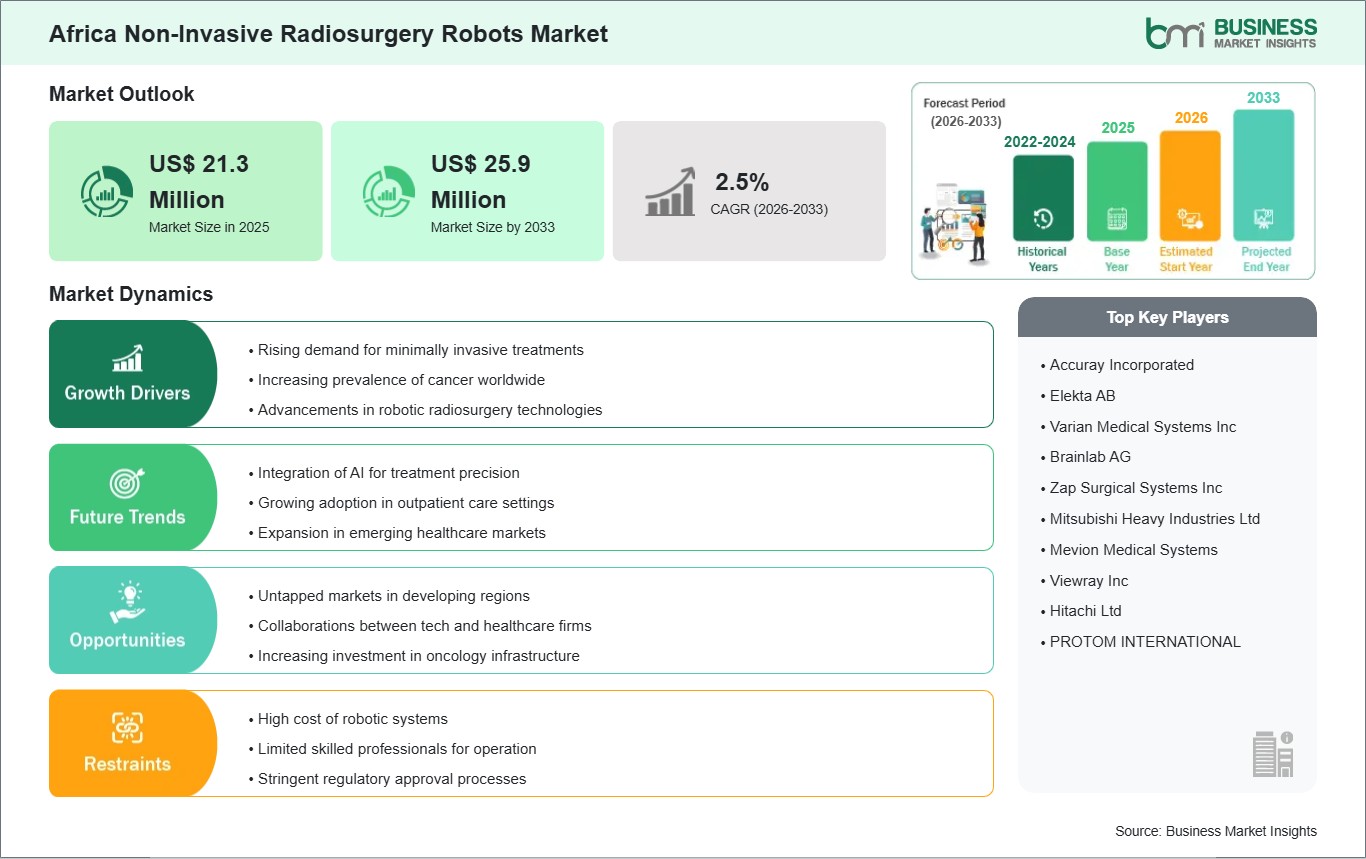
The Africa non‑invasive radiosurgery robots sector is driven by the imperative to modernize oncology care and expand access to high‑precision treatment modalities. Market dynamics in Africa are shaped by an increasing incidence of cancer and neurological disorders, alongside a growing recognition among healthcare providers of the clinical and economic value associated with robotic radiosurgery platforms. Unlike traditional radiotherapy, non‑invasive radiosurgery systems offer precise, targeted radiation delivery with minimal collateral damage, facilitating shorter treatment regimens and enhanced patient throughput. Key stakeholders in this market include global medical technology firms that specialize in advanced radiation oncology solutions, as well as regional healthcare investment groups partnering to deploy pilot programs and centers of excellence.
The competitive landscape is characterized by rapid technological advancements in imaging integration, artificial intelligence‑assisted planning, and motion management tools—enabling greater procedural accuracy and expanding therapeutic indications beyond conventional oncology to include select neurological and complex lesion treatments. Market adoption is constrained by a combination of high capital expenditure requirements, fragmented healthcare infrastructure, and a limited pool of trained clinical specialists capable of operating and maintaining complex robotically‑assisted radiosurgery systems. These challenges are further compounded by regulatory variability across African nations, where approval timelines and compliance standards differ substantially. Despite these constraints, incremental deployments in key markets such as South Africa, Egypt, and select North African countries signal emerging commercial opportunities, as healthcare systems invest in advanced medical technologies that improve treatment outcomes and institutional prestige.
Segment Analysis
Africa Non-Invasive Radiosurgery Robots Market Segmentation
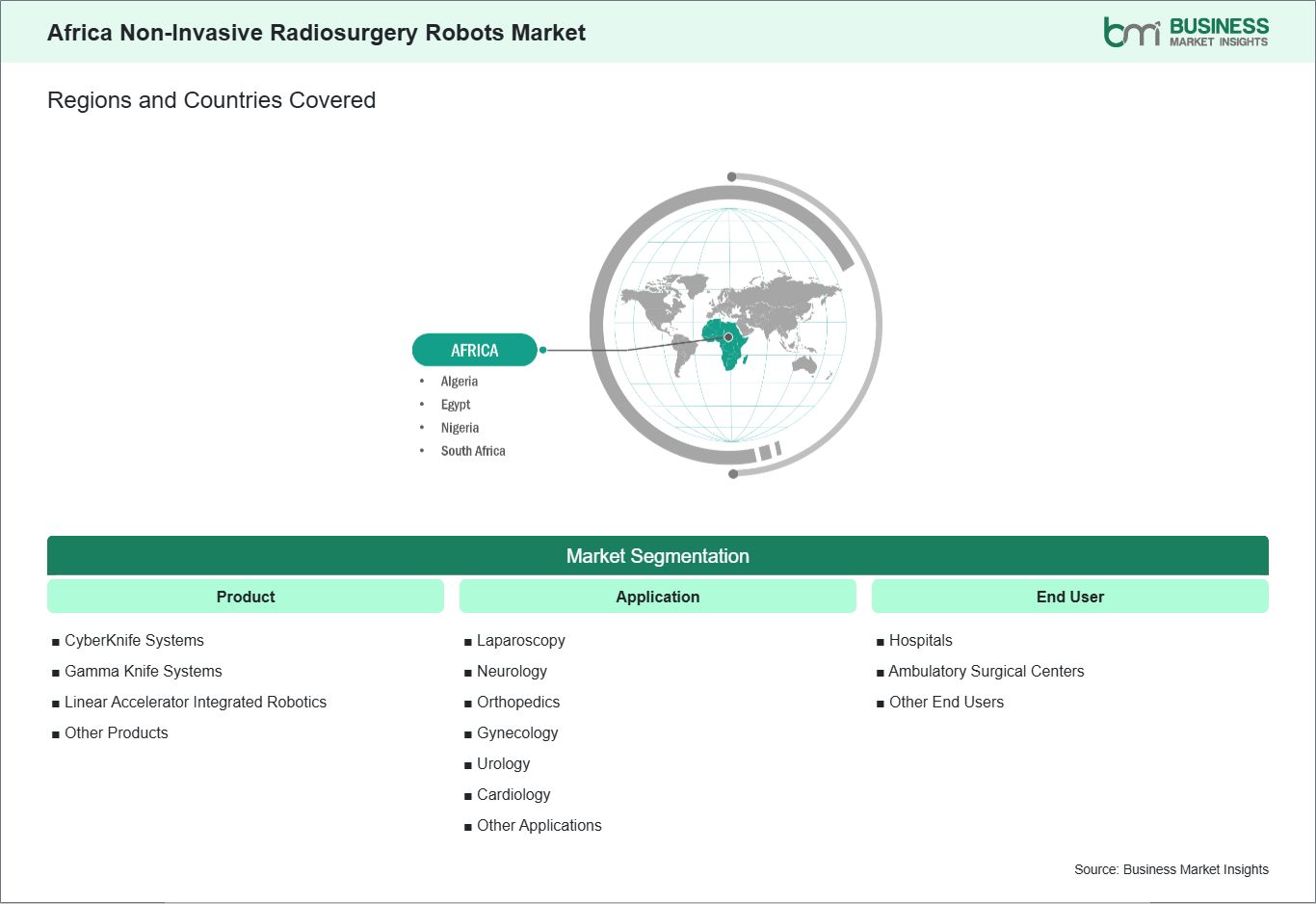
Key segments that contributed to the derivation of the Africa non-invasive radiosurgery robots market analysis are product, application, and end user.
- By product, the non-invasive radiosurgery robots market is segmented into cyberknife systems, gamma knife systems, linear accelerator (LINAC) integrated robotics, and other products. The medication cyberknife systems segment dominated the market in 2025.
- In terms of application, the non-invasive radiosurgery robots market is categorized into laparoscopy, neurology, orthopedics, gynecology, urology, cardiology, and other applications. The laparoscopy segment dominated the market in 2025.
- Based on end user, the market is classified into hospitals, ambulatory surgical centers, and other end users. The hospitals segment dominated the market in 2025.
Market Forces
Africa Non-Invasive Radiosurgery Robots Market Drivers and Opportunities
Increased Prevalence of Cancer Cases
Over the past decade, there has been an increase in the number of cancer patients throughout Africa. Demographic shifts, lifestyle changes, and increased longevity across many African countries have placed growing pressure on healthcare systems to address the rising burden of cancer. Industry stakeholders are beginning to investigate new types of treatment modalities that may improve the outcomes of cancer treatments.
Non-invasive robotic radiosurgery has a wide range of applications in the treatment of various malignancies. Using this non-invasive approach, less invasive treatment options can be provided to patients who may not be physically able to tolerate traditional methods of surgical intervention. The increase in cancer cases in large metropolitan areas across Africa has driven the development of new oncology infrastructure, including diagnostic imaging and radiotherapy facilities. Consequently, non-invasive radiosurgical robotics has become an integral component in improving cancer outcomes through the establishment of advanced oncology centers. Furthermore, many urban clinics are evolving into regional centers for advanced oncology services while investing in the infrastructure needed to deliver these treatments.
Integration with AI and Machine Learning
Artificial intelligence (AI) and machine learning (ML) are rapidly being integrated into non-invasive radiosurgery robots. These developments will facilitate treatment planning, improve radiotherapy dosages, and assist in providing a timely and accurate response to the radiosurgery robot's treatment plan. By using AI-based image acquisition and predictive data analysis tools, radiosurgery robots will assist physicians in proven methods of tumor targeting and sequencing treatments, even when the presented tumor is complex. Furthermore, current research in Africa on these technologies shows strong potential to improve treatment precision and reduce regional variability caused by the uneven distribution of clinical specialists across the continent. Furthermore, there is a growing number of early adopters within the African continent utilizing improvements in data analysis technology to facilitate highly accurate diagnostics prior to initiating customized radiosurgery protocols.
The use of machine learning models to extract insights from large imaging datasets and historical treatment regimens can assist radiation oncologists in determining optimal treatment parameters. This is particularly valuable in settings with high clinician workloads and limited access to experienced specialists. AI/ML can also automate selected analytical processes and provide decision support, improving local clinical capacity while reducing the time required for labor-intensive treatment planning.
Size and Share Analysis
Africa Non-Invasive Radiosurgery Robots Market Size and Share Analysis
The Africa non-invasive radiosurgery robots market demonstrates steady growth, with size and share analysis highlighting evolving trends and competitive dynamics among key players. The report examines subsegments categorized within product, application, and end user, offering insights into their contribution to overall market performance.
By product, the medication cyberknife systems segment dominated the market in 2025, driven by their high precision, real‑time tumor tracking, and versatility in treating a wide range of tumors with non‑invasive, sub‑millimeter accuracy compared with other radiosurgery technologies.
In terms of application, the laparoscopy subsegment dominated the market in 2025, driven by the rising demand for minimally invasive surgical procedures that reduce recovery time and complications, making robotic radiosurgery increasingly preferred for internal abdominal and pelvic tumor interventions.
Based on end user, the hospitals subsegment dominated the market in 2025, driven by their extensive infrastructure, multidisciplinary oncology teams, and financial capacity to adopt advanced radiosurgery robots to manage complex cancer care and high patient volumes.
Report Coverage
Africa Non-Invasive Radiosurgery Robots Market Report Coverage and Deliverables
The "Africa Non-Invasive Radiosurgery Robots Market Size and Forecast (2022–2033)" report provides a detailed analysis of the market covering below areas:
- Africa Non-Invasive Radiosurgery Robots Market size and forecast at regional and country levels for all segments covered under the scope
- Africa Non-Invasive Radiosurgery Robots Market trends, as well as drivers, restraints, and opportunities
- Africa Non-Invasive Radiosurgery Robots Market analysis covering key trends, regional framework, major players, regulations, and recent developments
- Industry landscape and competition analysis covering market concentration, heat map analysis, prominent players, and recent developments for the Africa Non-Invasive Radiosurgery Robots Market
- Detailed company profiles, including SWOT analysis
Geographic Insights
Africa Non-Invasive Radiosurgery Robots Market Geographic Insights
The geographical scope of the Africa Non-Invasive Radiosurgery Robots Market report is divided into Egypt, South Africa, Nigeria, and Algeria. Nigeria held the largest share in 2025.
The Africa non-invasive radiosurgery robots market is composed of 50 different nations with diverse dynamics that are defined by varying characteristics surrounding the country's healthcare system, capacity to invest in healthcare technology, as well as the focus of policymakers on healthcare technologies.
Nigeria has been identified as the top market for potential adoption and for the future growth of robotic radiosurgery due to its large population, increasing rate of cancer and neurological disease, and the growth of a tertiary care hospital system to support the development of innovative robotic radiosurgery systems. Many leading public and private institutions across Nigeria's capital cities of Lagos and Abuja will continue to prioritize the adoption of precision oncology technologies, thus reducing outbound medical travel and improving healthcare facility usage to treat Nigerian citizens through the development of robotics.
South Africa is a developed but smaller-scale market for robotic radiosurgery; it consists of a network of private specialty hospitals and outpatient cancer treatment facilities located in Johannesburg, Cape Town, and Pretoria that focus on the treatment of neurological disorders and prostate cancer. The market growth in South Africa is constrained by its limited volume of patients receiving treatment and relatively higher operational costs compared to Nigeria.
In Egypt, growth prospects remain strong, supported by government funding to improve national cancer care and reduce the need for patients to seek treatment abroad. Cairo and Alexandria are emerging as key healthcare centers, expanding radiology-based services to meet growing demand for advanced surgical interventions and specialized cancer care.
Industry Activity
Recent Developments
The Africa Non-Invasive Radiosurgery Robots Market is evaluated by gathering qualitative and quantitative data post primary and secondary research, which includes important corporate publications, association data, and databases. A few of the key developments in the Africa non-invasive radiosurgery robots market are:
- In July 2025, ZAP Surgical Systems announced that Ibn Sina Medical Center in Casablanca will install the ZAP‑X Gyroscopic Radiosurgery platform, a cutting‑edge non‑invasive brain surgery robot designed for precise stereotactic radiosurgery. The self‑shielded system eliminates the need for traditional radiation vaults and uses gyroscopic targeting to deliver beams from thousands of angles. Installation is scheduled for summer 2025 with patient treatments set to begin in early fall, enhancing neuro‑oncology care. This marks the first adoption of the ZAP‑X radiosurgery technology in Africa.
- In July 2025, Elekta's Leksell Gamma Knife radiosurgery system received U.S. FDA 510(k) clearance for expanded use in treating refractory, drug-resistant mesial temporal lobe epilepsy (MTLE) in adults. The clearance enabled clinicians to deliver focused, non-invasive gamma radiation therapy for epilepsy without open-skull surgery, expanding the system's established indications for brain lesions and functional disorders. This development marked an expansion of the clinical applications of an established radiosurgery platform.
Trust & Transparency
Research Methodology
The market analysis combines proprietary research with secondary data from government agencies, company disclosures, regulatory filings, industry databases and expert interviews. Market estimates are validated through data triangulation, cross-market benchmarking and analyst
review.
View Full Research Methodology
Key Sources Referred:
World Health Organization (WHO)Organisation for Economic Cooperation and Development (OECD)The World Bank GroupWorldometerThe LancetInternational Bar AssociationInternational Trade Administration