Market Summary
Executive Summary and Market Analysis
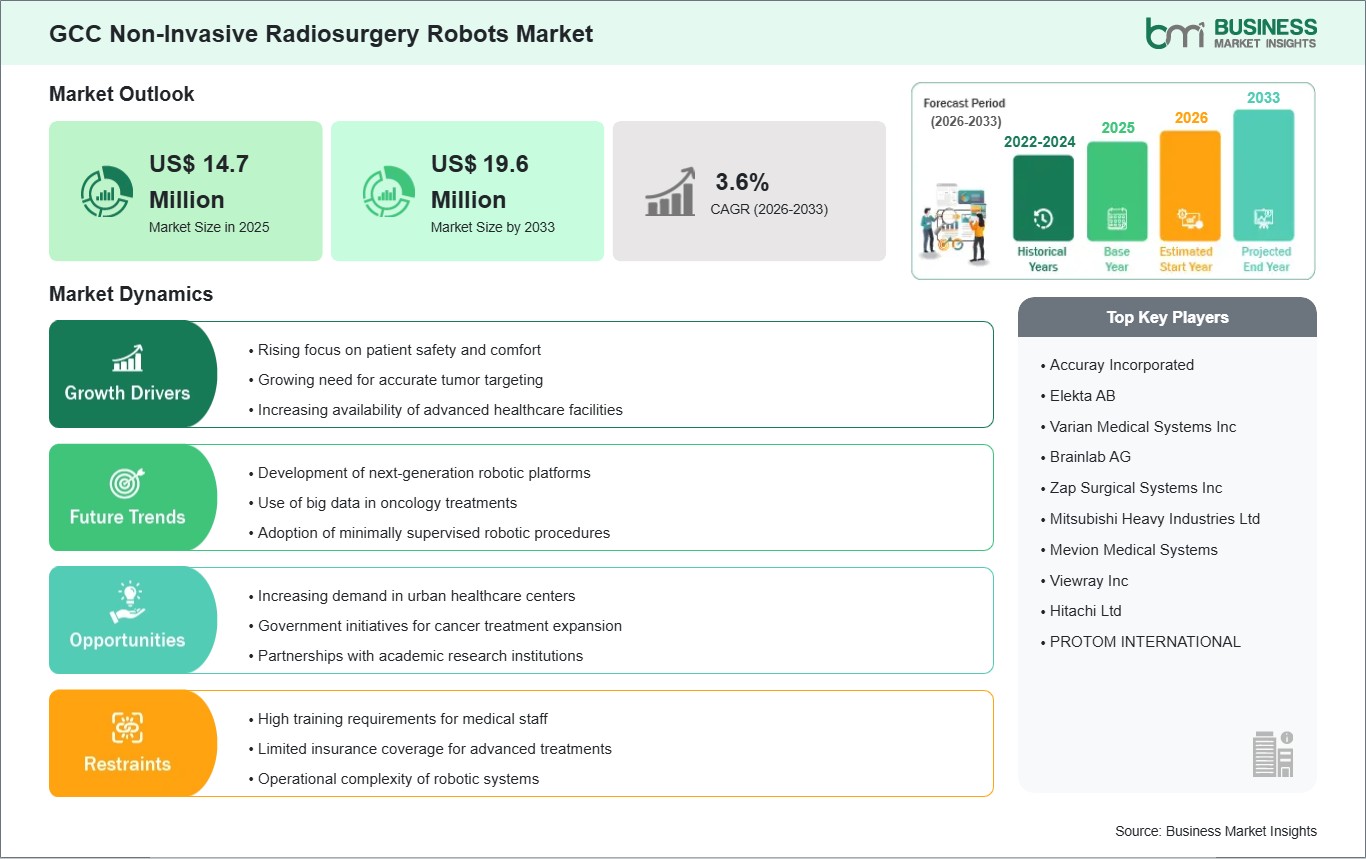
The GCC Non-Invasive Radiosurgery Robots market is rapidly emerging as a strategic segment within the region’s healthcare modernization initiatives, reflecting growing demand for advanced precision oncology and neurosurgical treatments. Hospitals and specialty centers across the Gulf Cooperation Council countries are increasingly integrating robotic radiosurgery platforms to enhance treatment accuracy, minimize procedural risks, and improve patient experience. These systems are particularly relevant in managing complex tumors and neurological conditions where conventional surgical approaches may be associated with higher complication rates and prolonged recovery periods. Market dynamics are influenced by both global medical robotics manufacturers and regional healthcare technology integrators, with competition centered on system precision, imaging integration, workflow efficiency, and comprehensive service offerings. Early adoption is concentrated in urban tertiary hospitals and private healthcare networks that cater to both domestic patients and international medical tourists. The adoption trend is further supported by government-driven initiatives to enhance cancer care infrastructure and attract advanced medical technologies to the region. Technological differentiators such as AI-assisted treatment planning, real-time patient motion compensation, and automated radiation delivery are positioning these systems as high-value solutions for hospitals seeking to optimize clinical outcomes. Despite the promising growth trajectory, the market faces challenges, including high capital expenditure, limited availability of trained radiation oncologists, and the need to align regulatory compliance with diverse healthcare standards across GCC countries. Nevertheless, growing awareness of the clinical and operational benefits of robotic radiosurgery, combined with strategic investments by both public and private healthcare institutions, is enhancing the market’s maturity. Providers recognize that integrating these technologies can improve patient throughput, reduce procedural complications, and establish hospitals as leaders in advanced oncology and neurosurgery care. Overall, the GCC presents a technologically sophisticated and strategically attractive environment for non-invasive radiosurgery robots, with early adopters demonstrating the value proposition for broader regional deployment.
Segment Analysis
GCC Non-Invasive Radiosurgery Robots Market Segmentation
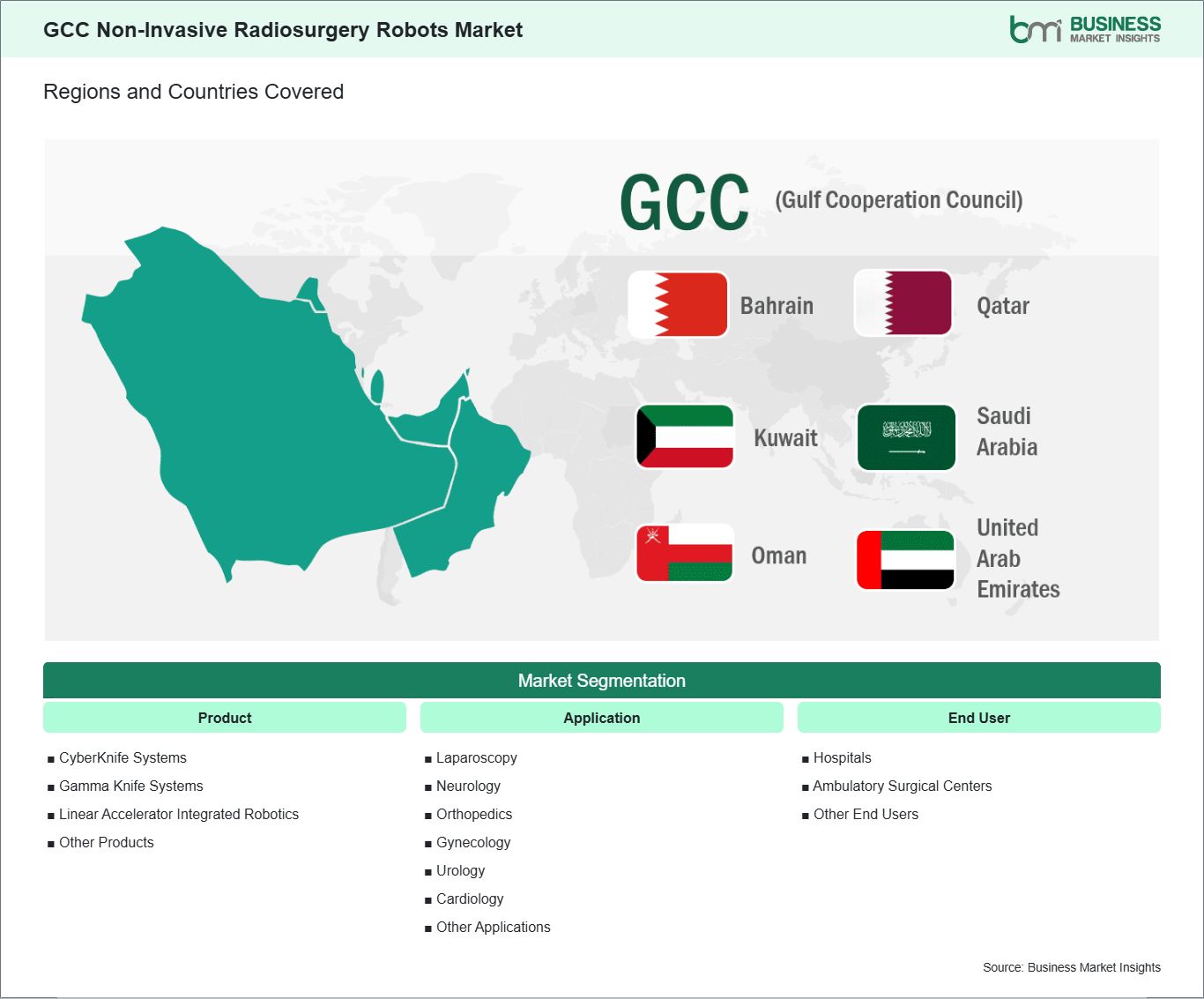
Key segments that contributed to the derivation of the GCC non-invasive radiosurgery robots market analysis are product, application, and end user.
- By product, the non-invasive radiosurgery robots market is segmented into cyberknife systems, gamma knife systems, linear accelerator (linac) integrated robotics and other products. The medication cyberknife systems segment dominated the market in 2025.
- In terms of application, the non-invasive radiosurgery robots market is categorized into laparoscopy, neurology, orthopedics, gynecology, urology, cardiology and other applications. The laparoscopy segment dominated the market in 2025.
- Based on end user, the market is classified into hospitals, ambulatory surgical centers and other end users. The hospitals segment dominated the market in 2025.
Market Forces
GCC Non-Invasive Radiosurgery Robots Market Drivers and Opportunities
Shorter hospital stays increase treatment efficiency
The GCC non-invasive radiosurgery robots market is benefiting from the growing emphasis on treatments that minimize patient hospital stays while maintaining high clinical precision. Healthcare providers in the Gulf region are increasingly focused on optimizing patient flow and operational efficiency, particularly in oncology care where treatment schedules are often intensive. Non-invasive radiosurgery robots allow for highly targeted radiation therapy that reduces procedural invasiveness, enabling patients to receive treatment in shorter sessions and with minimal recovery time. Hospitals can therefore accommodate more patients within existing infrastructure, improving throughput without compromising quality of care. Shorter hospital stays are particularly valuable in a region experiencing rising cancer prevalence alongside increasing demand for modern healthcare services. By reducing the length of inpatient treatment, robotic radiosurgery systems help alleviate bed shortages and improve resource utilization in busy oncology centers. This efficiency also benefits patients and families, as outpatient or same-day treatment options reduce disruption to daily life and lower overall costs associated with extended hospitalization. Hospitals in the GCC are leveraging these operational benefits to position themselves as providers of advanced, patient-centered oncology care, while simultaneously enhancing institutional efficiency and sustainability. The focus on treatment efficiency also supports broader healthcare system objectives, including cost containment and the delivery of high-quality services in line with regional health initiatives. Shorter hospital stays enable providers to streamline staff workflows, allocate resources more effectively, and reduce the risk of hospital-acquired infections. By integrating robotic radiosurgery platforms into treatment protocols, hospitals are able to achieve precision therapy outcomes while maintaining operational flexibility. This trend underlines the importance of minimally invasive treatment technologies in addressing both patient and institutional needs within the GCC healthcare landscape.
Expansion into veterinary oncology applications
The GCC non-invasive radiosurgery robots market is witnessing emerging opportunities in veterinary oncology, as advanced treatment solutions are extended to companion animals and specialized veterinary centers. Pet ownership and animal welfare awareness are growing across Gulf countries, driving demand for innovative medical procedures for pets, particularly in cases of cancer. Veterinary hospitals and animal care clinics are exploring non-invasive robotic radiosurgery systems to provide precise, targeted treatments for animals with tumors, mirroring the benefits these technologies provide in human oncology. This expansion is creating a new segment for robotic technology providers within the region. Veterinary applications of radiosurgery robots offer several advantages, including reduced stress and trauma for animal patients, as well as faster recovery times. Minimally invasive procedures allow animals to return to normal activity more quickly, reducing hospitalization needs and improving overall treatment outcomes. Clinics adopting robotic systems are able to treat tumors with high accuracy in sensitive areas, such as near vital organs, where conventional surgical intervention may be risky. This precision not only enhances survival rates but also strengthens the reputation of veterinary centers as providers of state-of-the-art care, supporting the growth of veterinary oncology as a specialized service within the GCC. Furthermore, partnerships between veterinary institutions and technology providers are facilitating the adaptation of human radiosurgery platforms for animal use. Custom software configurations and specialized treatment planning protocols are developed to accommodate anatomical and physiological differences across species. These initiatives are helping clinics maximize the utility of robotic systems while broadening the technology’s market reach. As GCC countries continue to invest in advanced medical technologies for both human and animal care, veterinary oncology represents a promising area for market growth, complementing existing adoption trends in human non-invasive radiosurgery applications.
Size and Share Analysis
GCC Non-Invasive Radiosurgery Robots Market Size and Share Analysis
The GCC non-invasive radiosurgery robots market demonstrates steady growth, with size and share analysis highlighting evolving trends and competitive dynamics among key players. The report examines subsegments categorized within product, application, and end user, offering insights into their contribution to overall market performance.
By product, the medication cyberknife systems segment dominated the market in 2025, driven by strong demand for precise, real‑time image‑guided radiosurgery that enhances treatment accuracy and reduces damage to surrounding healthy tissue.
In terms of application, the laparoscopy subsegment dominated the market in 2025, driven by growing preference for minimally invasive therapeutic procedures that offer faster recovery and reduced complications.
Based on end user, the hospitals subsegment dominated the market in 2025, driven by well‑developed healthcare infrastructure and investment capacity that enable adoption of advanced robotic radiosurgery systems for cancer care.
Report Coverage
GCC Non-Invasive Radiosurgery Robots Market Report Coverage and Deliverables
The "GCC Non-Invasive Radiosurgery Robots Market Size and Forecast (2022–2033)" report provides a detailed analysis of the market covering below areas:
- GCC Non-Invasive Radiosurgery Robots Market size and forecast at regional and country levels for all segments covered under the scope
- GCC Non-Invasive Radiosurgery Robots Market trends, as well as drivers, restraints, and opportunities
- GCC Non-Invasive Radiosurgery Robots Market analysis covering key trends, regional framework, major players, regulations, and recent developments
- Industry landscape and competition analysis covering market concentration, heat map analysis, prominent players, and recent developments for the GCC Non-Invasive Radiosurgery Robots Market
- Detailed company profiles, including SWOT analysis
Geographic Insights
GCC Non-Invasive Radiosurgery Robots Market Geographic Insights
The geographical scope of the GCC Non-Invasive Radiosurgery Robots Market report is divided into UAE, Bahrain, Saudi Arabia, Oman, Qatar, and Kuwait. UAE held the largest share in 2025.
The GCC Non-Invasive Radiosurgery Robots market demonstrates varied adoption patterns across UAE, Bahrain, Saudi Arabia, Oman, Qatar, and Kuwait, driven by differences in healthcare infrastructure, investment capacity, and hospital specialization. Saudi Arabia emerges as the dominant market, supported by extensive government investment in tertiary hospitals, specialized oncology centers, and private healthcare networks, particularly in cities such as Riyadh, Jeddah, and Dammam. Hospitals in Saudi Arabia are increasingly integrating robotic radiosurgery systems to enhance precision in oncology and neurosurgery treatments, improve operational efficiency, and expand patient throughput. The country benefits from a strong clinical research ecosystem, well-established reimbursement policies, and ongoing professional training programs, which together accelerate adoption and establish Saudi Arabia as a regional hub for advanced medical technologies. The UAE represents another key market, with hospitals in Dubai and Abu Dhabi focusing on high-precision radiosurgery to attract international patients, enhance medical tourism, and strengthen the reputation of flagship medical centers. Qatar and Kuwait are emerging markets, where adoption is concentrated in major urban tertiary hospitals that prioritize advanced imaging integration and treatment accuracy for complex neurological and oncological cases. Oman and Bahrain demonstrate selective deployment, often within centralized tertiary care centers, with adoption gradually expanding as hospitals upgrade infrastructure and develop trained personnel. Across the GCC, successful adoption relies heavily on vendor strategies that combine flexible financing options, comprehensive clinical training, and robust post-sale technical support. High-volume hospitals and specialized centers are the primary drivers of market growth, while smaller institutions often rely on referral or shared-service models to access robotic radiosurgery technologies. Saudi Arabia’s dominance reflects its larger healthcare infrastructure, greater investment capacity, and concentrated urban adoption, positioning it as the primary driver of growth in the GCC region. Meanwhile, other GCC countries represent strategic opportunities for incremental market expansion as hospitals increasingly prioritize precision, minimally invasive treatment solutions.
Industry Activity
Recent Developments
The GCC Non-Invasive Radiosurgery Robots Market is evaluated by gathering qualitative and quantitative data post primary and secondary research, which includes important corporate publications, association data, and databases. A few of the key developments in the GCC non-invasive radiosurgery robots market are:
- In April 2025, Cleveland Clinic Abu Dhabi announced the launch of its CyberKnife treatment programme, making it the first private tertiary centre in the UAE to offer robotic radiosurgery for complex brain and spinal tumours. This milestone expanded treatment choices beyond conventional radiotherapy, enabling highly accurate, non‑invasive sessions with reduced side effects. The programme integrates multidisciplinary care, enhancing patient outcomes through coordinated oncology services. It also positions Abu Dhabi as a regional hub for precision radiosurgery.
- In June 2025, a CyberKnife S7 robotic radiosurgery system was installed at King Fahd Medical City in Riyadh, Saudi Arabia, supporting the Kingdom’s Vision 2030 goal of enhancing advanced oncology infrastructure. The system provides sub‑millimeter precision for treating tumours throughout the body without surgical incisions. Its integration into a major public healthcare facility broadens access to non‑invasive radiosurgery for Saudi patients. This installation underscores Saudi Arabia’s commitment to adopting cutting‑edge medical robotics.
Trust & Transparency
Research Methodology
The market analysis combines proprietary research with secondary data from government agencies, company disclosures, regulatory filings, industry databases and expert interviews. Market estimates are validated through data triangulation, cross-market benchmarking and analyst
review.
View Full Research Methodology
Key Sources Referred:
World Health Organization (WHO)Organisation for Economic Cooperation and Development (OECD)The World Bank GroupWorldometerThe LancetInternational Bar AssociationInternational Trade Administration