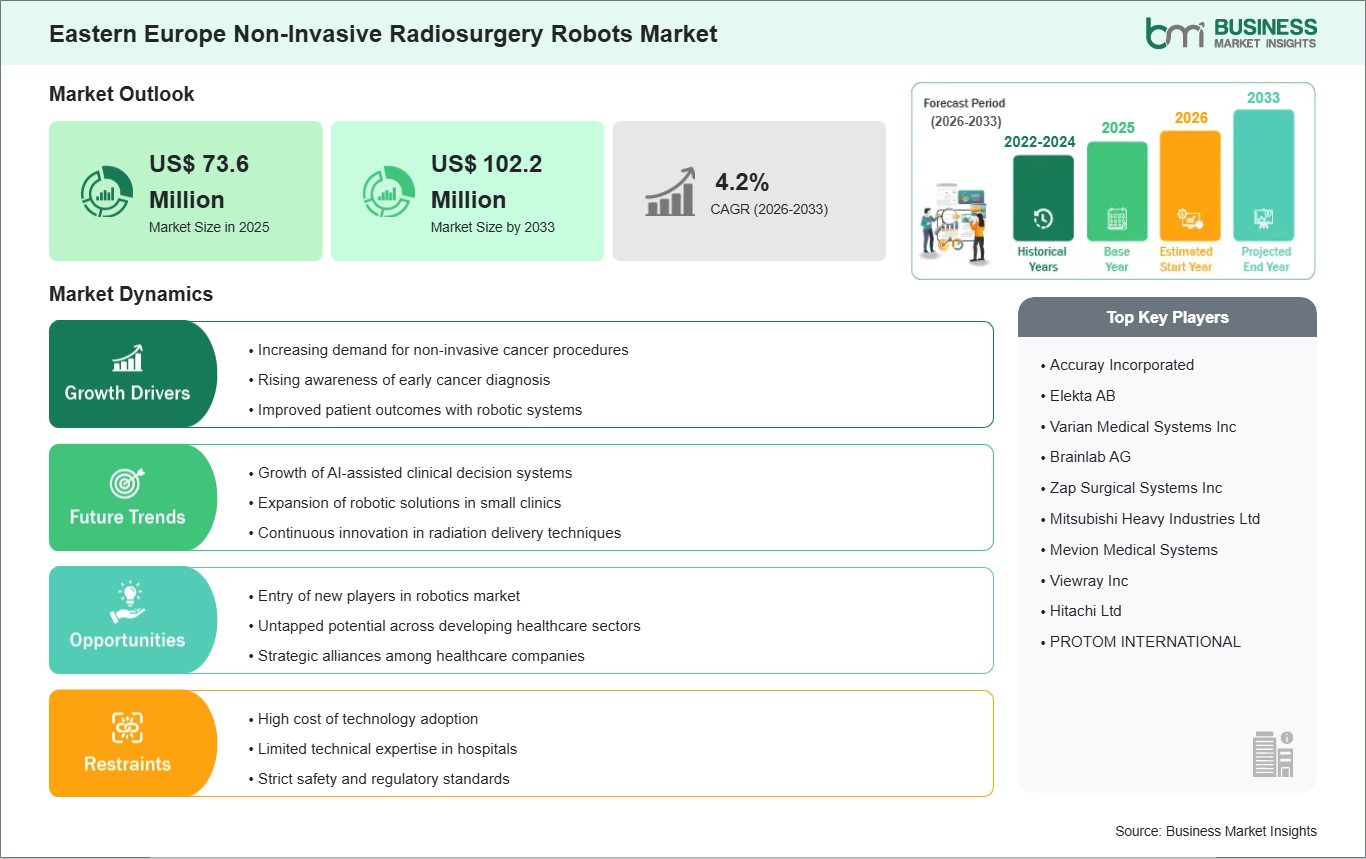
The Eastern Europe non-invasive radiosurgery robots market size is expected to reach US$102.2 million by 2033 from US$73.6 million in 2025. The market is estimated to record a CAGR of 4.2% from 2026 to 2033.
The Eastern Europe Non-Invasive Radiosurgery Robots market is increasingly gaining traction as healthcare systems across the region focus on precision oncology and minimally invasive neurosurgical procedures. Hospitals and specialty treatment centers are actively exploring robotic radiosurgery systems to improve clinical outcomes, enhance patient safety, and optimize operational efficiency. These systems offer targeted radiation therapy for complex tumors and neurological conditions without requiring invasive surgery, reducing recovery times and procedural risk. Market dynamics are shaped by the intersection of technology innovation, rising patient demand for advanced treatments, and the growth of private hospital networks seeking to differentiate their services. Key technological differentiators include AI-assisted treatment planning, real-time imaging integration, and automated motion management, which collectively improve accuracy and treatment efficiency. Adoption is concentrated in urban centers and high-volume hospitals where infrastructure and technical expertise are available, while rural areas face limitations in access and specialist availability. The competitive landscape is driven by international medical robotics manufacturers collaborating with regional healthcare providers to deploy cutting-edge solutions, often in conjunction with research and training programs. Challenges include high capital expenditure, a limited pool of trained operators, and varying regulatory requirements across the region. Nevertheless, ongoing government and private initiatives to modernize oncology infrastructure, combined with rising awareness of the clinical benefits of non-invasive radiosurgery, are enhancing market receptivity. Healthcare administrators recognize the value of robotic systems in increasing throughput, reducing long-term treatment costs, and positioning hospitals as leaders in advanced patient care. Overall, the market is characterized by steady growth potential, with early adopters setting benchmarks for operational efficiency, clinical precision, and patient-centric service delivery.

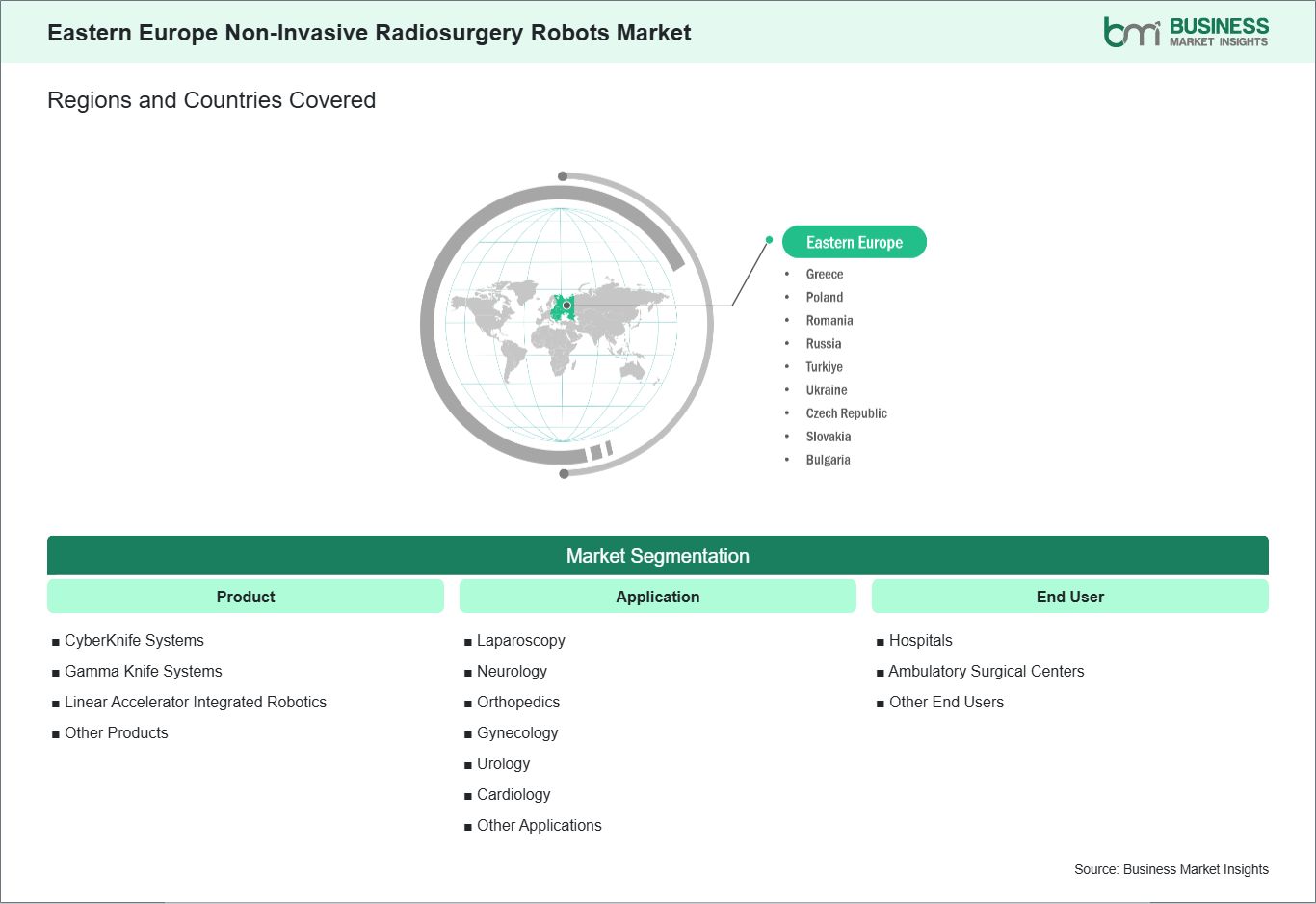
Key segments that contributed to the derivation of the Eastern Europe non-invasive radiosurgery robots market analysis are product, application, and end user.
Eastern Europe’s non-invasive radiosurgery robots market is experiencing growth as governments and private healthcare providers increasingly invest in modernizing hospital infrastructure and oncology care facilities. Across the region, healthcare systems are expanding their capacity to treat cancer patients through the introduction of advanced medical technologies, including robotic radiosurgery platforms. These investments aim to improve treatment precision, enhance patient safety, and streamline operational workflows in hospitals. By integrating robotic radiosurgery into newly developed or upgraded oncology centers, healthcare providers can offer minimally invasive treatments that reduce hospital stays and improve clinical outcomes for patients. In several Eastern European countries, rising cancer incidence and increasing demand for advanced treatment options are driving infrastructure expansion. Hospitals are equipping themselves with state-of-the-art imaging systems and integrating them with robotic treatment platforms to support high-precision tumor targeting. These developments reflect a broader regional trend of adopting digital and automated technologies to enhance healthcare delivery. Additionally, the focus on modernizing facilities includes specialized training for medical personnel to operate sophisticated robotic systems efficiently. By aligning infrastructure upgrades with advanced technology adoption, Eastern European hospitals are positioning themselves to deliver higher-quality care while managing growing patient volumes. Private investment is also playing a crucial role in the region, particularly in urban centers where demand for specialized oncology care is concentrated. Healthcare providers are forming partnerships with technology developers to acquire robotic radiosurgery systems as part of comprehensive modernization programs. These investments not only enhance the technological capabilities of hospitals but also increase patient access to advanced cancer treatment. By expanding infrastructure and adopting precision technologies, Eastern European healthcare systems are addressing both immediate clinical needs and long-term strategic goals, supporting the growth of the non-invasive radiosurgery robots market in the region.
Awareness campaigns are a significant factor driving adoption of non-invasive radiosurgery robots in Eastern Europe. Hospitals and cancer care centers are actively promoting the benefits of robotic radiosurgery, emphasizing precision treatment, minimal invasiveness, and reduced recovery times. These campaigns target both patients and referring physicians to increase understanding of how robotic radiosurgery differs from conventional treatments, including its ability to treat tumors in hard-to-reach areas with fewer complications. By educating the public about these advantages, healthcare providers aim to generate patient demand and support informed decision-making in oncology care. Medical societies and patient advocacy groups are also contributing to awareness efforts across the region. They organize workshops, seminars, and informational campaigns to highlight the effectiveness and safety of robotic radiosurgery technologies. By presenting real-world examples and clinical success stories, these initiatives help build trust in robotic treatment options. Awareness campaigns further address misconceptions about radiation therapy and promote the value of minimally invasive procedures in improving patient quality of life. This combination of education and outreach is encouraging broader acceptance of advanced radiosurgery solutions among both patients and healthcare professionals. Hospitals are complementing public education efforts with professional training programs that familiarize clinicians with robotic systems and treatment protocols. By equipping oncologists, radiologists, and support staff with the knowledge to operate radiosurgery robots confidently, healthcare providers ensure that the benefits promoted in awareness campaigns are realized in practice. Increased familiarity among medical professionals also helps optimize treatment planning and delivery, enhancing patient outcomes and safety. Overall, awareness campaigns in Eastern Europe are not only raising the profile of non-invasive radiosurgery robots but also driving practical adoption, supporting market growth, and fostering a more technology-enabled oncology ecosystem.
The Eastern Europe non-invasive radiosurgery robots market demonstrates steady growth, with size and share analysis highlighting evolving trends and competitive dynamics among key players. The report examines subsegments categorized within product, application, and end user, offering insights into their contribution to overall market performance.
By product, the medication cyberknife systems segment dominated the market in 2025, driven by broader clinical adoption due to their capability to perform precise, real‑time image‑guided non‑invasive treatment across diverse tumor types with minimal harm to healthy tissue.
In terms of application, the laparoscopy subsegment dominated the market in 2025, driven by an increasing preference for minimally invasive treatment options that offer reduced recovery times and lower procedural risk.
Based on end user, the hospitals subsegment dominated the market in 2025, driven by higher patient volumes, established oncology infrastructure, and investment capacity that support deployment and utilization of advanced radiosurgery robotic systems.
| Report Attribute | Details |
|---|---|
| Market size in 2025 | US$ 73.6 Million |
| Market Size by 2033 | US$ 102.2 Million |
| CAGR (2026 - 2033) | 4.2% |
| Historical Data | 2022-2024 |
| Forecast period | 2026-2033 |
| Segments Covered | By Product
|
|
Regions and Countries Covered
| |
| Eastern Europe | Russia, Poland, Ukraine, Romania, the Czech Republic, Slovakia, Bulgaria, Greece |
| Market leaders and key company profiles |
|
The "Eastern Europe Non-Invasive Radiosurgery Robots Market Size and Forecast (2022–2033)" report provides a detailed analysis of the market covering below areas:
The geographical scope of the Eastern Europe Non-Invasive Radiosurgery Robots Market report is divided Russia, Poland, Ukraine, Romania, the Czech Republic, Slovakia, Bulgaria, and Greece. Russia held the largest share in 2025.
The Eastern Europe Non-Invasive Radiosurgery Robots market shows significant diversity in adoption patterns across Russia, Poland, Ukraine, Romania, the Czech Republic, Slovakia, Bulgaria, and Greece, driven by differences in healthcare infrastructure, investment priorities, and clinical expertise. Russia emerges as the dominant market within the region, with major metropolitan hospitals and specialized oncology and neurosurgery centers actively integrating robotic radiosurgery systems to enhance treatment precision and operational efficiency. Cities such as Moscow and St. Petersburg serve as hubs for advanced oncology programs, supported by substantial government investment in healthcare modernization and the growing presence of private hospital networks. The country’s adoption is further accelerated by partnerships with international technology providers, research institutions, and structured clinical training programs that ensure effective utilization of sophisticated robotic systems. Poland and the Czech Republic represent secondary growth markets, with hospitals in Warsaw, Krakow, Prague, and Brno gradually incorporating robotic radiosurgery platforms to improve patient outcomes in oncology and neurology. These countries focus on leveraging advanced imaging capabilities and clinical expertise to expand the scope of precision treatments. Romania, Ukraine, Slovakia, Bulgaria, and Greece are emerging markets where adoption remains concentrated in major urban hospitals and tertiary care centers. In these countries, high capital costs, workforce training limitations, and variable regulatory frameworks slow broader deployment, although pilot programs and cross-border collaborations are beginning to introduce robotic radiosurgery into key medical facilities. Across all eight countries, successful market penetration is closely tied to vendor strategies that offer flexible acquisition models, robust clinical training, and responsive technical support. High-volume hospitals and leading oncology centers drive adoption, while smaller institutions often rely on referral-based models to access advanced treatment technologies. Overall, Russia’s dominance reflects its larger healthcare infrastructure, higher investment capacity, and concentrated urban adoption, positioning it as the primary driver of regional growth, while the other Eastern European markets present incremental opportunities for expansion as healthcare modernization progresses.

The Eastern Europe Non-Invasive Radiosurgery Robots Market is evaluated by gathering qualitative and quantitative data post primary and secondary research, which includes important corporate publications, association data, and databases. A few of the key developments in the Eastern Europe non-invasive radiosurgery robots market are:
The Eastern Europe Non-Invasive Radiosurgery Robots Market is valued at US$ 73.6 Million in 2025, it is projected to reach US$ 102.2 Million by 2033.
As per our report Eastern Europe Non-Invasive Radiosurgery Robots Market, the market size is valued at US$ 73.6 Million in 2025, projecting it to reach US$ 102.2 Million by 2033. This translates to a CAGR of approximately 4.2% during the forecast period.
The Eastern Europe Non-Invasive Radiosurgery Robots Market report typically cover these key segments-
The historic period, base year, and forecast period can vary slightly depending on the specific market research report. However, for the Eastern Europe Non-Invasive Radiosurgery Robots Market report:
The Eastern Europe Non-Invasive Radiosurgery Robots Market is populated by several key players, each contributing to its growth and innovation. Some of the major players include:
The Eastern Europe Non-Invasive Radiosurgery Robots Market report is valuable for diverse stakeholders, including:
Essentially, anyone involved in or considering involvement in the Eastern Europe Non-Invasive Radiosurgery Robots Market value chain can benefit from the information contained in a comprehensive market report.
Please tell us your area of interest
(Market Segments/ Regions and Countries/ Companies)