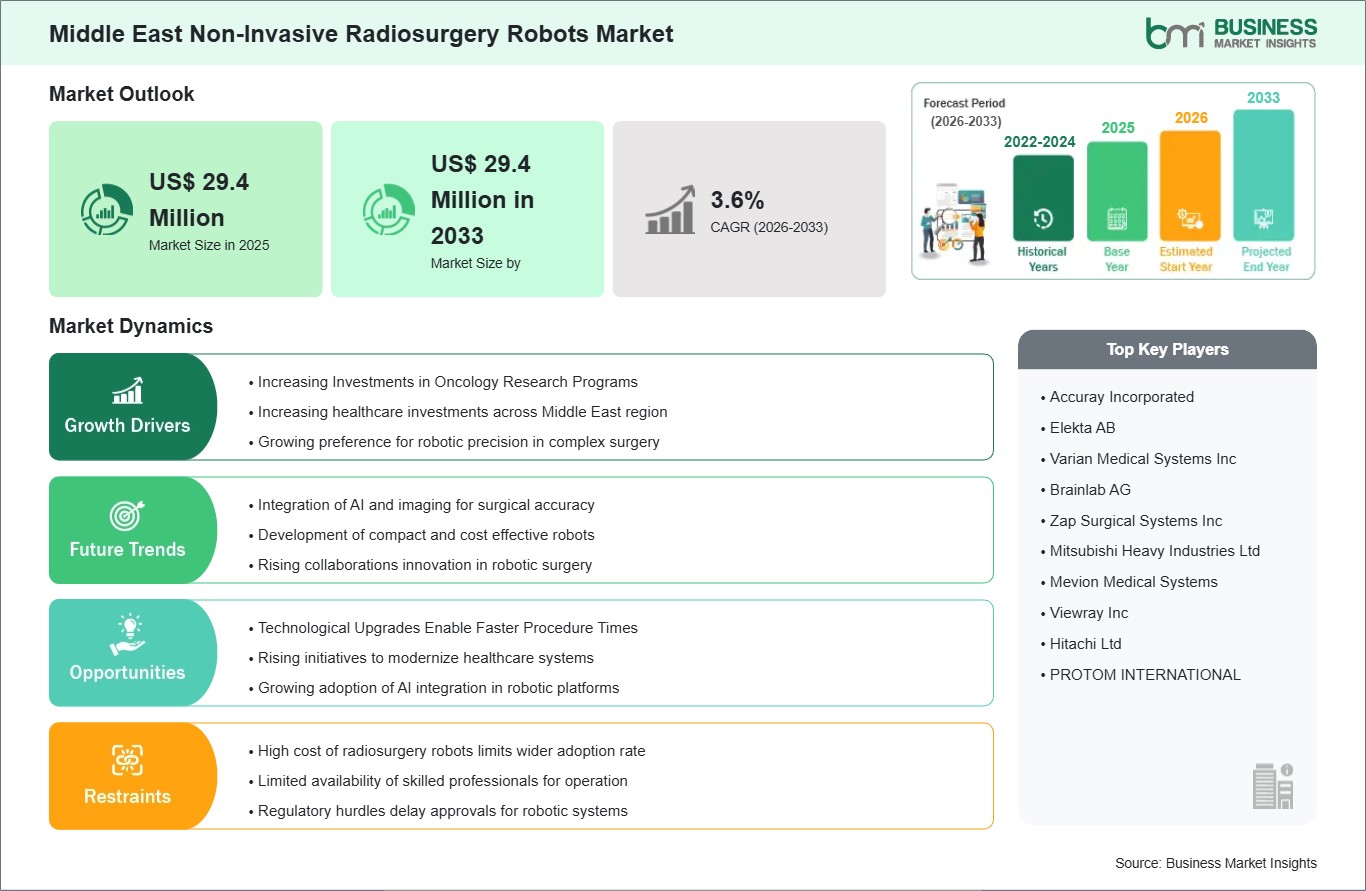
The Middle East non-invasive radiosurgery robots market size is expected to reach US$39.1 million by 2033 from US$29.4 million in 2025. The market is estimated to record a CAGR of 3.6% from 2026 to 2033.
The Middle East Non-Invasive Radiosurgery Robots market is witnessing significant momentum as hospitals and specialty centers increasingly prioritize precision oncology and neurosurgical treatments. Non-invasive radiosurgery robots provide high-precision radiation delivery for complex tumors and neurological disorders, enabling minimally invasive procedures that reduce patient risk and accelerate recovery. Market dynamics in the region are shaped by a combination of government healthcare modernization initiatives, private sector investments, and international technology partnerships. Adoption is concentrated in tertiary hospitals and advanced private healthcare facilities that possess robust imaging infrastructure and skilled clinical personnel. Competition in the market is largely technology-driven, with manufacturers differentiating products based on imaging integration, AI-assisted treatment planning, motion management, and system automation. Private hospitals often lead adoption to differentiate services and attract regional and international patients, while public hospitals adopt these systems through pilot programs, government-supported funding, and partnerships with international vendors. Despite opportunities, market challenges include high capital investment, limited trained clinical staff, and regulatory variability across Middle Eastern countries, which can impact procurement and deployment timelines. The region’s strategic focus on enhancing oncology infrastructure and modernizing neurosurgery capabilities, however, creates a favorable environment for growth. Hospitals that integrate robotic radiosurgery systems not only achieve improved clinical outcomes and operational efficiency but also enhance institutional reputation and patient trust. Overall, the Middle East market represents a high-growth, technology-driven segment within the broader medical robotics ecosystem, where early adopters are setting clinical and operational benchmarks for regional expansion.

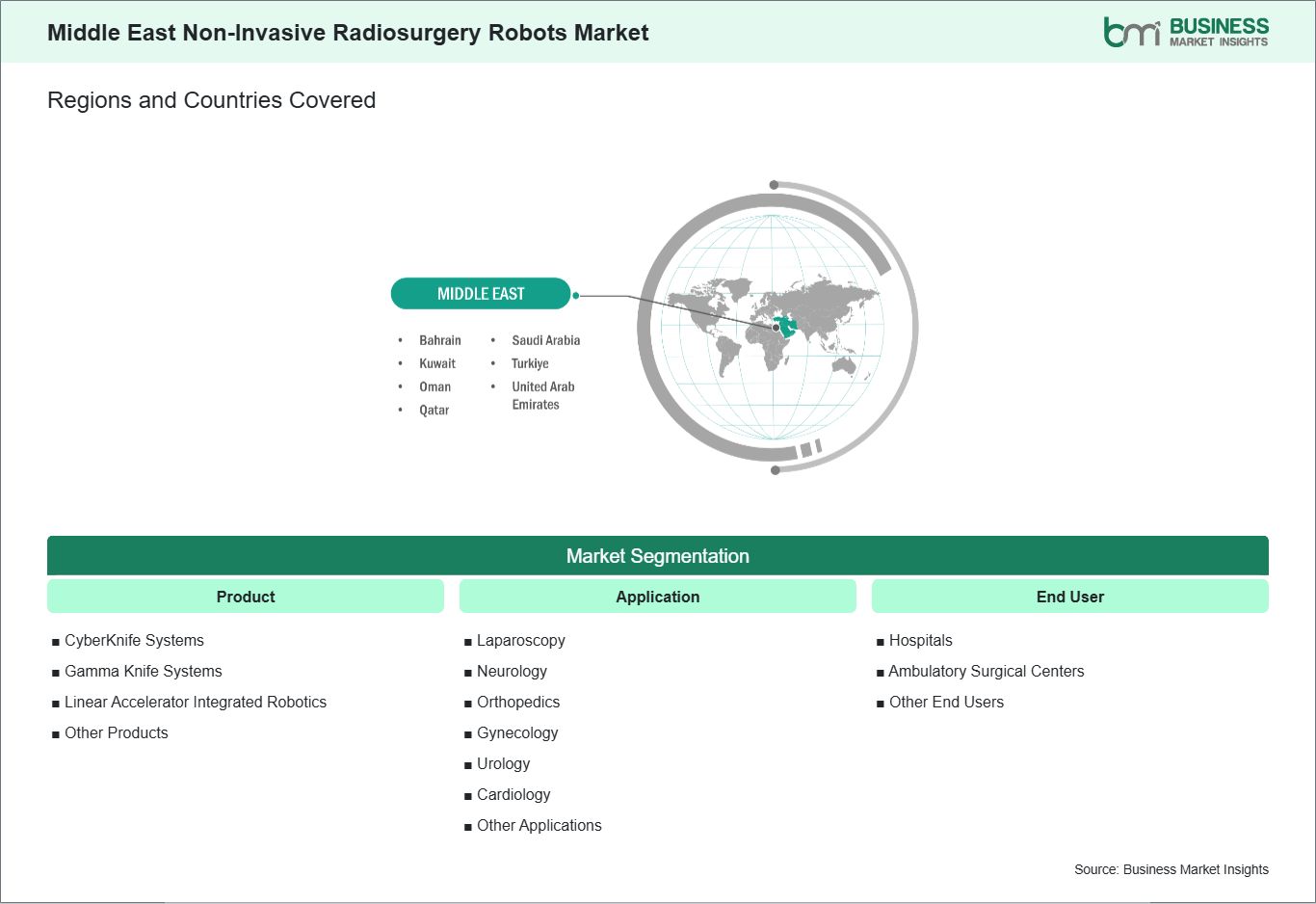
Key segments that contributed to the derivation of the Middle East non-invasive radiosurgery robots market analysis are product, application, and end user.
The Middle East non-invasive radiosurgery robots market is experiencing significant growth driven by increasing investments in oncology research programs. Governments and private healthcare institutions in the region are actively funding initiatives that aim to improve cancer diagnosis, treatment outcomes, and access to advanced technologies. These research programs support the integration of robotic radiosurgery platforms into clinical practice by providing the necessary infrastructure, clinical trials, and validation studies. By investing in oncology research, stakeholders are fostering innovation and encouraging the adoption of minimally invasive treatment methods that offer higher precision and lower complication rates compared to conventional procedures. Healthcare providers across the Middle East are leveraging research programs to better understand regional cancer trends and tailor radiosurgery applications to local patient needs. Specialized cancer centers are partnering with universities and research institutions to study the effectiveness of robotic radiosurgery for various tumor types, treatment protocols, and patient demographics. These initiatives provide clinicians with critical data to optimize treatment planning, improve targeting accuracy, and enhance clinical outcomes. Research-driven adoption also ensures that new technologies are validated within regional healthcare systems before widespread implementation, building confidence among medical professionals and policymakers. Furthermore, oncology research programs in the Middle East are contributing to workforce development and professional training. Clinicians, radiologists, and technical staff receive education on robotic radiosurgery operation, imaging integration, and precision therapy techniques, ensuring the effective utilization of advanced systems. The combination of investment in research and workforce development strengthens the regional ecosystem for high-precision oncology care. Overall, increasing support for oncology research programs is a key factor enabling the growth of the non-invasive radiosurgery robots market in the Middle East, promoting evidence-based adoption and advancing regional cancer treatment capabilities.
Technological upgrades in non-invasive radiosurgery robots are significantly improving procedural efficiency in the Middle East, making advanced cancer treatments more accessible and convenient for patients. Modern robotic systems feature enhanced imaging integration, automated treatment planning, and precision beam delivery, which reduce the time required to complete therapy sessions. Faster procedures not only improve patient experience by minimizing time on the treatment table but also allow healthcare providers to treat a larger number of patients per day. Hospitals and oncology centers in the region are increasingly adopting these upgraded systems to enhance throughput and optimize the use of clinical resources. Incorporating advanced software and real-time imaging technology has enabled radiosurgery robots to streamline workflow from planning to delivery. By automating tasks such as target localization, motion tracking, and beam adjustment, treatment sessions are completed with greater efficiency without compromising accuracy. This is particularly valuable in high-demand oncology centers, where patient volumes are rising due to increased awareness and early cancer detection initiatives. Faster procedures also reduce the logistical burden on hospital infrastructure, allowing facilities to better allocate staff, equipment, and treatment rooms. The focus on procedural efficiency is complemented by continuous system enhancements through partnerships with technology developers. Hospitals in the Middle East are collaborating with vendors to implement upgrades that improve automation, minimize setup time, and enhance treatment accuracy. These improvements also support outpatient and same-day treatment models, making non-invasive radiosurgery more patient-friendly. Overall, technological advancements that reduce procedure times are helping regional healthcare providers deliver efficient, high-quality oncology care while supporting the expansion and adoption of radiosurgery robots across the Middle East.
The Middle East non-invasive radiosurgery robots market demonstrates steady growth, with size and share analysis highlighting evolving trends and competitive dynamics among key players. The report examines subsegments categorized within product, application, and end user, offering insights into their contribution to overall market performance.
By product, the medication cyberknife systems segment dominated the market in 2025, driven by growing demand for high-precision, image-guided radiosurgery that enables non-invasive treatment of complex tumors with minimal impact on healthy tissue.
In terms of application, the laparoscopy subsegment dominated the market in 2025, driven by increasing preference for minimally invasive procedures that reduce recovery time and procedural risks.
Based on end user, the hospitals subsegment dominated the market in 2025, driven by advanced healthcare infrastructure and investment capacity to adopt and operate robotic radiosurgery systems for cancer treatment.
| Report Attribute | Details |
|---|---|
| Market size in 2025 | US$ 29.4 Million |
| Market Size by | US$ 29.4 Million in 2033 |
| CAGR (2026 - 2033) | 3.6% |
| Historical Data | 2022-2024 |
| Forecast period | 2026-2033 |
| Segments Covered | By Product
|
|
Regions and Countries Covered
| |
| Middle East | UAE, Saudi Arabia, Bahrain, Oman, Kuwait, Qatar, and Turkiye |
| Market leaders and key company profiles |
|
The "Middle East Non-Invasive Radiosurgery Robots Market Size and Forecast (2022–2033)" report provides a detailed analysis of the market covering below areas:
The geographical scope of the Middle East Non-Invasive Radiosurgery Robots Market report is divided into UAE, Saudi Arabia, Bahrain, Oman, Kuwait, Qatar, and Turkiye. Turkiye held the largest share in 2025.
The Middle East Non-Invasive Radiosurgery Robots market demonstrates significant variation in adoption across Turkiye, UAE, Saudi Arabia, Bahrain, Oman, Kuwait, and Qatar, driven by differences in healthcare infrastructure, investment capacity, and hospital specialization. Turkiye emerges as the dominant market, supported by a robust network of tertiary hospitals, specialized oncology and neurosurgery centers, and a well-established private healthcare sector concentrated in Istanbul, Ankara, and Izmir. Hospitals in Turkiye are rapidly integrating robotic radiosurgery systems to improve treatment precision, optimize workflow efficiency, and expand access to minimally invasive procedures. Government-led healthcare modernization initiatives, investments in medical technology, and professional training programs for radiation oncologists and neurosurgeons further accelerate adoption, positioning Turkiye as a regional hub for advanced oncology and neurosurgical care. Saudi Arabia and the UAE are secondary growth markets, with urban hospitals in Riyadh, Jeddah, Dubai, and Abu Dhabi deploying robotic radiosurgery to enhance specialized oncology services, operational efficiency, and patient outcomes. Qatar, Kuwait, Oman, and Bahrain represent smaller yet expanding markets, with adoption concentrated in tertiary hospitals equipped with advanced imaging infrastructure and skilled clinical personnel. Hospitals in these countries emphasize clinical accuracy, patient safety, and operational efficiency, often implementing systems through pilot programs, partnerships with technology vendors, or shared-service models to provide broader access. Across all countries, successful market penetration is driven by vendor strategies offering flexible financing solutions, ongoing technical support, and structured clinical training. High-volume urban hospitals and specialized centers serve as primary adoption hubs, while smaller institutions rely on referral networks to access robotic radiosurgery technologies. Turkiye’s dominance reflects its larger healthcare infrastructure, higher investment capacity, and concentration of advanced tertiary hospitals, establishing it as the key driver of growth in the Middle East. Other countries in the region provide incremental opportunities for technology deployment and service expansion as hospitals increasingly prioritize precision, minimally invasive treatment solutions and patient-centric care.

The Middle East Non-Invasive Radiosurgery Robots Market is evaluated by gathering qualitative and quantitative data post primary and secondary research, which includes important corporate publications, association data, and databases. A few of the key developments in the Middle East non-invasive radiosurgery robots market are:
The Middle East Non-Invasive Radiosurgery Robots Market is valued at US$ 29.4 Million in 2025, it is projected to reach US$ 29.4 Million in 2033 by .
As per our report Middle East Non-Invasive Radiosurgery Robots Market, the market size is valued at US$ 29.4 Million in 2025, projecting it to reach US$ 29.4 Million in 2033 by . This translates to a CAGR of approximately 3.6% during the forecast period.
The Middle East Non-Invasive Radiosurgery Robots Market report typically cover these key segments-
The historic period, base year, and forecast period can vary slightly depending on the specific market research report. However, for the Middle East Non-Invasive Radiosurgery Robots Market report:
The Middle East Non-Invasive Radiosurgery Robots Market is populated by several key players, each contributing to its growth and innovation. Some of the major players include:
The Middle East Non-Invasive Radiosurgery Robots Market report is valuable for diverse stakeholders, including:
Essentially, anyone involved in or considering involvement in the Middle East Non-Invasive Radiosurgery Robots Market value chain can benefit from the information contained in a comprehensive market report.
Please tell us your area of interest
(Market Segments/ Regions and Countries/ Companies)