Market Summary
Executive Summary and Market Analysis
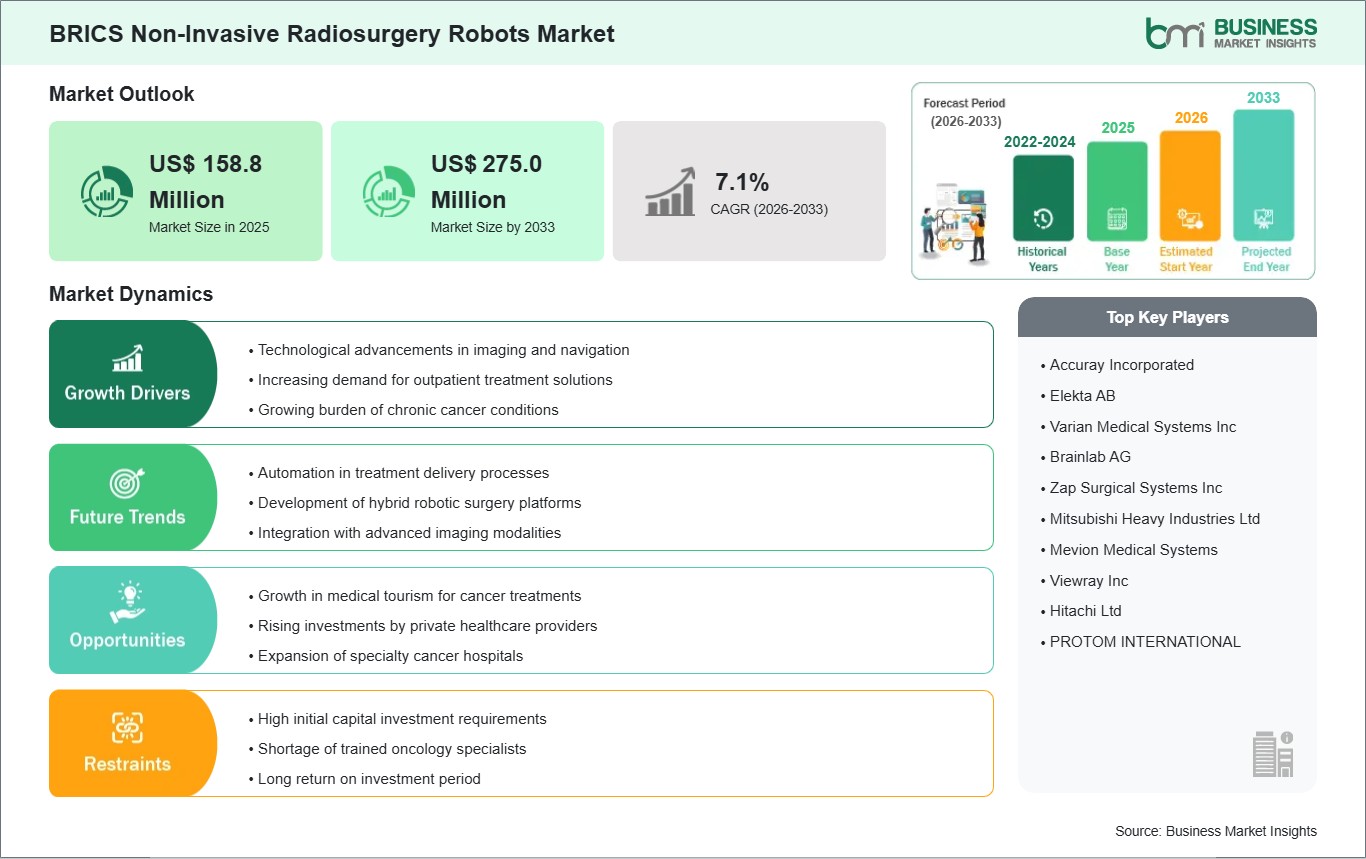
The BRICS Non-Invasive Radiosurgery Robots market represents a rapidly evolving segment within the broader medical robotics and radiation oncology ecosystem, driven by increasing healthcare modernization efforts and the growing need for high-precision treatment technologies. Countries within the BRICS bloc Brazil, Russia, India, China, and South Africa—are experiencing rising incidences of cancer and neurological disorders, which is accelerating demand for advanced therapeutic solutions that offer improved clinical accuracy and reduced patient recovery times. Non-invasive radiosurgery robots are gaining strategic attention because they enable highly targeted radiation therapy without traditional surgical intervention, thereby improving patient safety and treatment efficiency. The market landscape is shaped by the presence of international medical technology manufacturers collaborating with domestic healthcare providers to introduce advanced radiosurgery systems into major tertiary hospitals and specialized cancer institutes. Large urban hospitals are typically the first adopters, integrating robotic radiosurgery with advanced imaging modalities such as MRI and CT systems to support complex treatment planning and precision dose delivery. Another notable factor influencing the market is the expansion of private healthcare networks across several BRICS countries, where competitive pressures encourage hospitals to adopt high-end treatment technologies to enhance their clinical capabilities and attract premium patient segments. Despite these positive dynamics, the market also faces several structural challenges. High capital investment requirements, limited availability of trained specialists, and uneven healthcare infrastructure across urban and rural areas can restrict the pace of adoption. Furthermore, procurement processes in public healthcare systems often involve lengthy evaluation and approval stages. Nevertheless, ongoing government initiatives aimed at strengthening cancer care infrastructure and expanding access to specialized treatment centers are gradually improving the market environment. As healthcare systems within BRICS economies continue to emphasize technological innovation and patient-centric treatment models, non-invasive radiosurgery robots are increasingly viewed as a critical component of advanced oncology care delivery.
Segment Analysis
BRICS Non-Invasive Radiosurgery Robots Market Segmentation
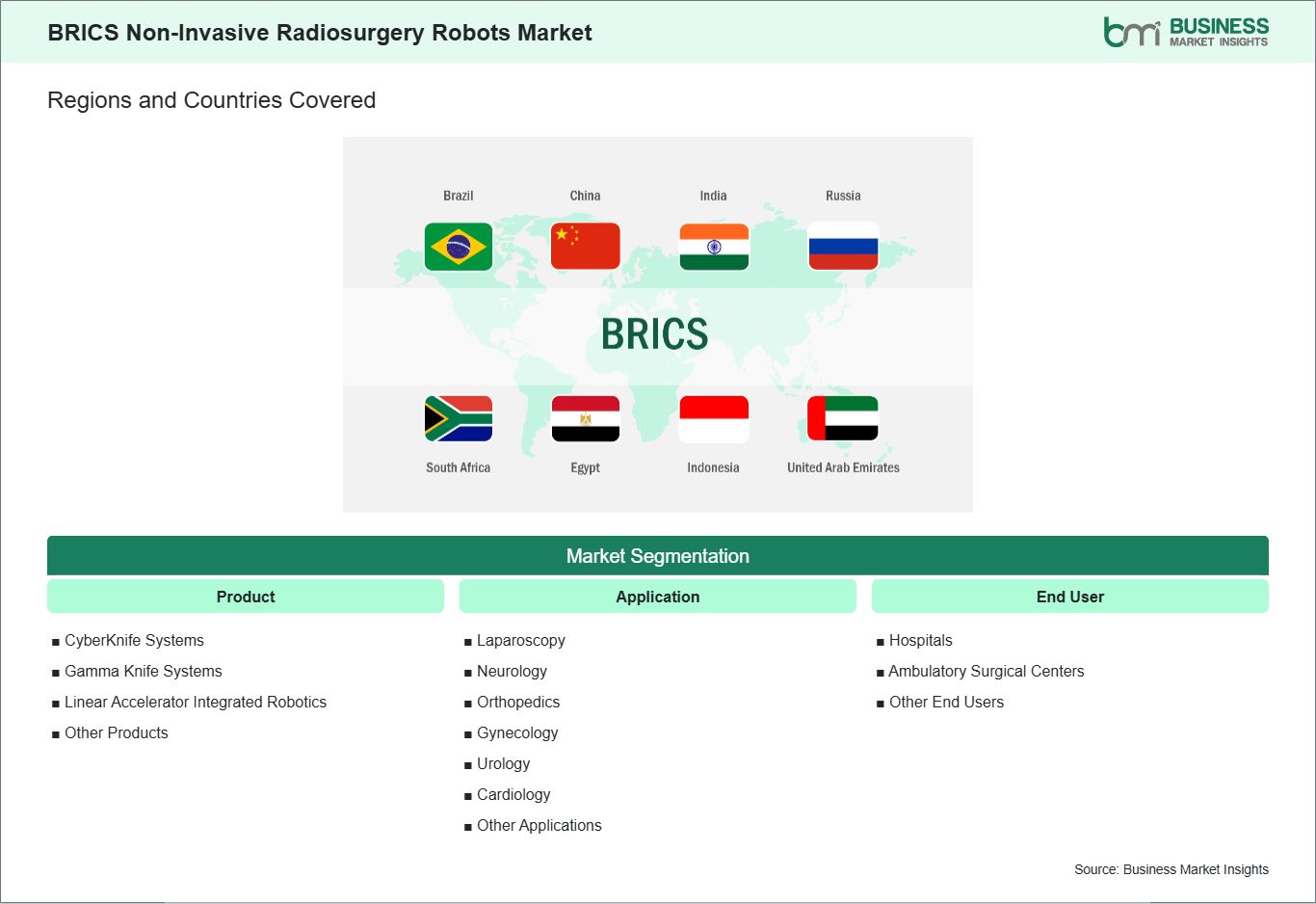
Key segments that contributed to the derivation of the BRICS non-invasive radiosurgery robots market analysis are product, application, and end user.
- By product, the non-invasive radiosurgery robots market is segmented into cyberknife systems, gamma knife systems, linear accelerator (linac) integrated robotics and other products. The medication cyberknife systems segment dominated the market in 2025.
- In terms of application, the non-invasive radiosurgery robots market is categorized into laparoscopy, neurology, orthopedics, gynecology, urology, cardiology and other applications. The laparoscopy segment dominated the market in 2025.
- Based on end user, the market is classified into hospitals, ambulatory surgical centers and other end users. The hospitals segment dominated the market in 2025.
Market Forces
BRICS Non-Invasive Radiosurgery Robots Market Drivers and Opportunities
Minimally invasive procedures reduce recovery time
The BRICS non-invasive radiosurgery robots market is expanding as healthcare systems increasingly prioritize minimally invasive cancer treatment options that reduce patient recovery time and hospital stays. Radiosurgery robots enable physicians to deliver highly focused radiation to tumors without the need for traditional surgical incisions. This approach is particularly beneficial in healthcare environments where hospitals aim to improve patient throughput while maintaining treatment effectiveness. By eliminating many of the risks associated with open surgery, robotic radiosurgery allows patients to undergo treatment with minimal disruption to surrounding tissues. As healthcare providers across BRICS economies continue to modernize oncology care, minimally invasive radiosurgery is gaining recognition as a practical and patient-friendly treatment option. Large and rapidly evolving healthcare systems within BRICS countries are facing increasing cancer burdens, which is encouraging hospitals to adopt efficient treatment technologies. In China, millions of new cancer cases are diagnosed each year, prompting significant investment in advanced oncology infrastructure and treatment capabilities. Hospitals in major urban centers are introducing robotic radiosurgery platforms that can treat complex tumors with targeted radiation while reducing the need for lengthy surgical procedures. Similarly, India’s healthcare sector has been expanding its use of advanced radiotherapy technologies through government cancer control programs and private hospital investments aimed at improving access to modern treatment methods. These developments highlight the growing interest in non-invasive robotic treatment solutions that support faster patient recovery and improved clinical efficiency. Other BRICS members are also integrating minimally invasive radiosurgery into their oncology care strategies. In Brazil, rising cases of lung cancer and other malignancies have increased the need for precision-based radiation therapies capable of treating tumors without extensive surgical intervention. Russia and South Africa are gradually strengthening their oncology treatment infrastructure through specialized cancer centers and partnerships with international technology providers. Across these markets, hospitals are exploring radiosurgery robots as part of broader efforts to enhance cancer treatment capacity and improve patient outcomes. The emphasis on reduced recovery time and improved patient comfort continues to support the adoption of non-invasive robotic radiosurgery systems throughout the BRICS healthcare landscape.
Customizable robots for specialized cancer treatments
Customization is becoming an important factor shaping the BRICS non-invasive radiosurgery robots market, as healthcare providers seek flexible robotic platforms that can address a wide variety of tumor types and treatment requirements. Radiosurgery robots are designed to deliver radiation with high precision through programmable treatment planning and adaptable robotic movement. These systems can be configured to treat tumors in different parts of the body, including the brain, spine, lungs, and prostate. By adjusting radiation angles, treatment doses, and imaging guidance protocols, clinicians can tailor therapies to the specific needs of individual patients. This flexibility is particularly valuable in large and diverse healthcare systems where hospitals manage a wide range of oncology cases. Advanced robotic radiosurgery systems also incorporate image-guided technologies that allow clinicians to track tumor movement and adjust treatment delivery in real time. Systems such as robotic linear accelerators and stereotactic radiosurgery platforms combine imaging tools with robotic arms capable of delivering radiation beams from multiple angles. This level of customization enables physicians to target tumors that shift during breathing or patient movement, ensuring that radiation is delivered accurately throughout the treatment session. For hospitals in BRICS countries, this capability enhances clinical confidence and expands the range of cancers that can be treated using non-invasive robotic techniques. Customization also supports the development of specialized treatment programs within BRICS oncology centers. Hospitals are increasingly organizing dedicated units for neurological tumors, spinal disorders, and other complex cancers that require highly precise radiation therapy. Globally, more than a thousand robotic radiosurgery systems are already deployed in hospitals and specialized cancer treatment facilities, reflecting growing confidence in these technologies. As BRICS countries continue investing in modern healthcare infrastructure, customizable robotic radiosurgery platforms are expected to play a central role in expanding access to advanced cancer therapies. Their ability to adapt to diverse clinical needs makes them particularly suitable for large healthcare markets where patient populations and disease profiles vary widely.
Size and Share Analysis
BRICS Non-Invasive Radiosurgery Robots Market Size and Share Analysis
The BRICS non-invasive radiosurgery robots market demonstrates steady growth, with size and share analysis highlighting evolving trends and competitive dynamics among key players. The report examines subsegments categorized within product, application, and end user, offering insights into their contribution to overall market performance.
By product, the medication cyberknife systems segment dominated the market in 2025, riven by their ability to deliver highly precise, real-time image-guided radiation therapy with sub-millimeter accuracy for treating tumors across different parts of the body non-invasively.
In terms of application, the laparoscopy subsegment dominated the market in 2025, driven by the increasing demand for minimally invasive treatment approaches that enable greater procedural precision, smaller incisions, and faster patient recovery.
Based on end user, the hospitals subsegment dominated the market in 2025, driven by the availability of advanced oncology infrastructure, specialized medical professionals, and the capacity to manage high volumes of complex cancer treatments using robotic radiosurgery systems.
Report Coverage
BRICS Non-Invasive Radiosurgery Robots Market Report Coverage and Deliverables
The "BRICS Non-Invasive Radiosurgery Robots Market Size and Forecast (2022–2033)" report provides a detailed analysis of the market covering below areas:
- BRICS Non-Invasive Radiosurgery Robots Market size and forecast at regional and country levels for all segments covered under the scope
- BRICS Non-Invasive Radiosurgery Robots Market trends, as well as drivers, restraints, and opportunities
- BRICS Non-Invasive Radiosurgery Robots Market analysis covering key trends, regional framework, major players, regulations, and recent developments
- Industry landscape and competition analysis covering market concentration, heat map analysis, prominent players, and recent developments for the BRICS Non-Invasive Radiosurgery Robots Market
- Detailed company profiles, including SWOT analysis
Geographic Insights
BRICS Non-Invasive Radiosurgery Robots Market Geographic Insights
The geographical scope of the BRICS Non-Invasive Radiosurgery Robots Market report is divided into Russia, Brazil, South Africa, India, the UAE, and China. China held the largest share in 2025.
The BRICS Non-Invasive Radiosurgery Robots market demonstrates varied adoption dynamics across Russia, Brazil, South Africa, India, the UAE, and China, reflecting differences in healthcare infrastructure maturity, technology investment capacity, and oncology care strategies. India emerges as the dominant market within this landscape, driven by its large patient population, rapidly expanding oncology treatment infrastructure, and increasing investments by private and multi-specialty hospital networks. Major healthcare hubs such as Mumbai, Delhi, Bengaluru, and Hyderabad are actively incorporating advanced radiosurgery platforms into neurology and oncology programs to improve treatment precision and expand access to minimally invasive therapies. The growth of specialized cancer institutes, coupled with strong demand for advanced treatment modalities from both domestic and international patients, positions India as a central hub for radiosurgery technology deployment in emerging markets. In addition, increasing collaboration between hospitals, medical technology providers, and clinical research institutions is accelerating the integration of robotic radiosurgery solutions across leading tertiary care facilities. China represents another influential market, supported by extensive government initiatives aimed at modernizing cancer treatment infrastructure and expanding high-end medical technology adoption in major metropolitan hospitals. Healthcare providers in Beijing, Shanghai, and Guangzhou are increasingly implementing advanced radiosurgery platforms to enhance complex tumor treatment capabilities and strengthen precision medicine initiatives. Brazil demonstrates steady adoption trends, with leading private hospitals in São Paulo and Rio de Janeiro investing in advanced radiosurgery technologies to improve specialized oncology care and maintain competitiveness within the region’s healthcare sector. Russia is gradually expanding its deployment of non-invasive radiosurgery robots through national medical research centers and specialized neurosurgical institutes, particularly in major cities such as Moscow and St. Petersburg. South Africa remains a key gateway for advanced medical technologies within the African region, where private hospital groups and academic medical centers are exploring robotic radiosurgery to enhance neurology and oncology services. Meanwhile, the UAE is emerging as a technologically progressive healthcare market, with hospitals in Dubai and Abu Dhabi adopting high-precision radiosurgery systems to support advanced cancer treatment programs and attract international medical tourism.
Industry Activity
Recent Developments
The BRICS Non-Invasive Radiosurgery Robots Market is evaluated by gathering qualitative and quantitative data post primary and secondary research, which includes important corporate publications, association data, and databases. A few of the key developments in the BRICS non-invasive radiosurgery robots market are:
- In January 2025, the Chinese National Medical Products Administration (NMPA) approved both the CyberKnife S7 System and the Radixact SynC System for clinical use in China. The CyberKnife S7 is the latest robotic, non‑invasive radiosurgery platform capable of sub‑millimeter precision treatments, while Radixact SynC incorporates advanced imaging and adaptive delivery technology. These approvals expand access to high‑precision radiation therapy across India’s largest oncology market. This regulatory milestone enhances treatment options for oncologists and patients nationwide.
- In July 2025, AIG Hospitals in Hyderabad unveiled South India’s first ZAP‑X® Gyroscopic Radiosurgery Platform, a non‑invasive system designed to treat brain tumors and intracranial conditions without surgery. The gyroscopic system eliminates the need for a conventional radiation bunker and cobalt sources, providing precise, outpatient stereotactic radiosurgery. This launch marks a significant expansion of cutting‑edge radiosurgery technology in the BRICS region. The system is expected to be fully operational within the broader hospital oncology program.
Trust & Transparency
Research Methodology
The market analysis combines proprietary research with secondary data from government agencies, company disclosures, regulatory filings, industry databases and expert interviews. Market estimates are validated through data triangulation, cross-market benchmarking and analyst
review.
View Full Research Methodology
Key Sources Referred:
World Health Organization (WHO)Organisation for Economic Cooperation and Development (OECD)The World Bank GroupWorldometerThe LancetInternational Bar AssociationInternational Trade Administration