Market Summary
Executive Summary and Market Analysis
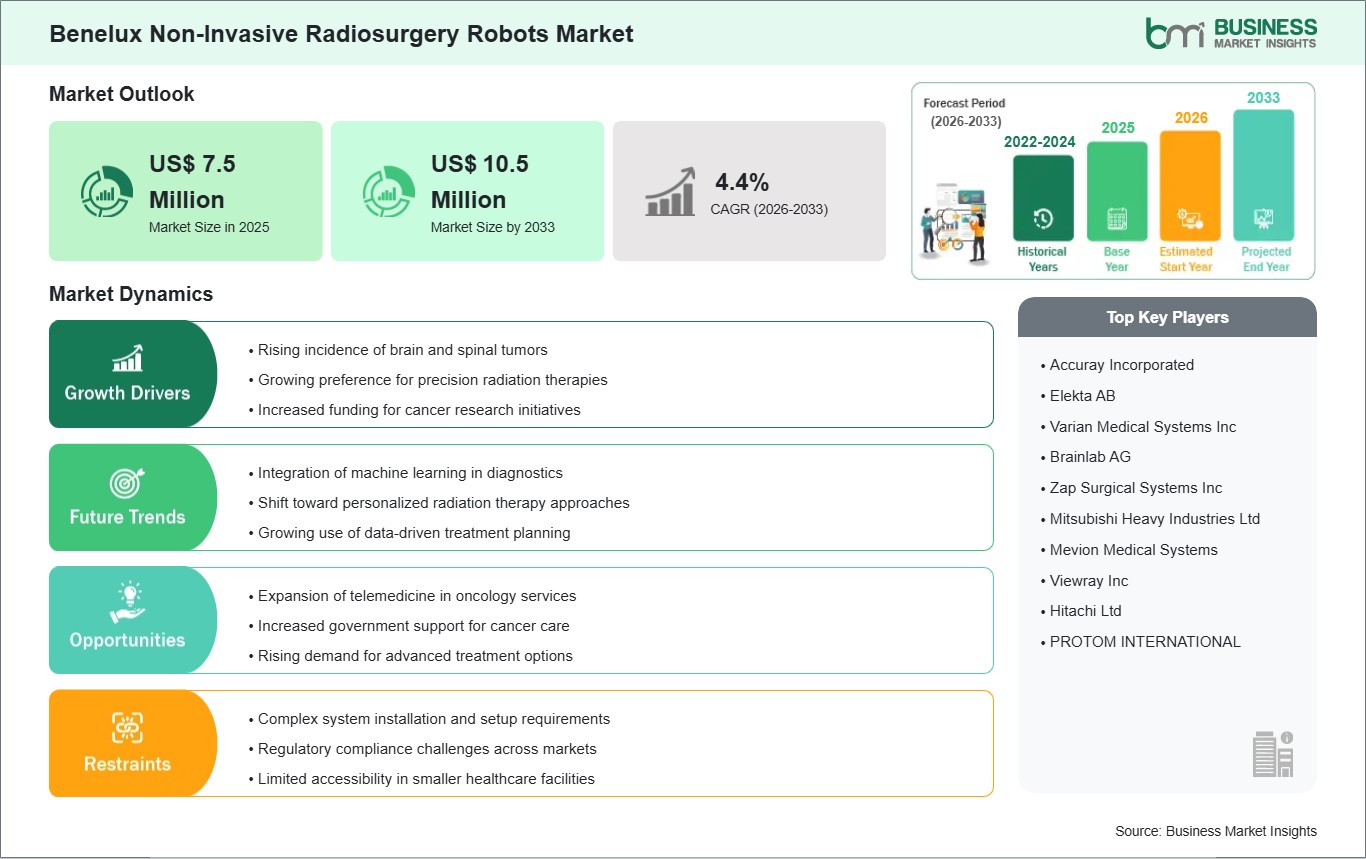
The Benelux Non‑Invasive Radiosurgery Robots market is positioned at the intersection of advanced medical technology adoption and high-value healthcare delivery, reflecting the region’s commitment to precision oncology and minimally invasive interventions. Hospitals and specialty centers in Belgium, the Netherlands, and Luxembourg are increasingly adopting robotic radiosurgery systems to address growing demands for targeted cancer treatment and neurosurgical procedures with minimal patient downtime. The market is primarily driven by the need to improve procedural accuracy and optimize clinical outcomes, particularly in complex neurological tumors, spinal lesions, and radiosensitive oncological cases. Advanced imaging integration, AI-assisted treatment planning, and automated patient motion compensation are central differentiators among vendors, allowing healthcare providers to offer highly precise therapies that reduce collateral tissue damage. The competitive environment features a blend of global medical robotics manufacturers and regional technology integrators, focusing on system reliability, treatment versatility, and post-sale service networks as core differentiators. Adoption patterns in Benelux reflect both public and private healthcare dynamics: leading university hospitals and specialty cancer centers have been early adopters, leveraging their research capabilities to trial new robotic systems, while private hospital groups are increasingly investing in advanced robotics to attract patients seeking premium care. Challenges persist, however, including high capital investment requirements, a limited pool of trained radiation oncologists, and complex regulatory approval processes that vary across the three countries. Despite these barriers, the market demonstrates a strong strategic potential for growth as hospitals and healthcare investors recognize the benefits of robotic radiosurgery in enhancing patient throughput, optimizing treatment schedules, and positioning institutions as leaders in precision oncology. Overall, the Benelux region offers a technologically sophisticated environment for the adoption of non-invasive radiosurgery robots, with early investment yielding both clinical and reputational returns for healthcare providers.
Segment Analysis
Benelux Non-Invasive Radiosurgery Robots Market Segmentation
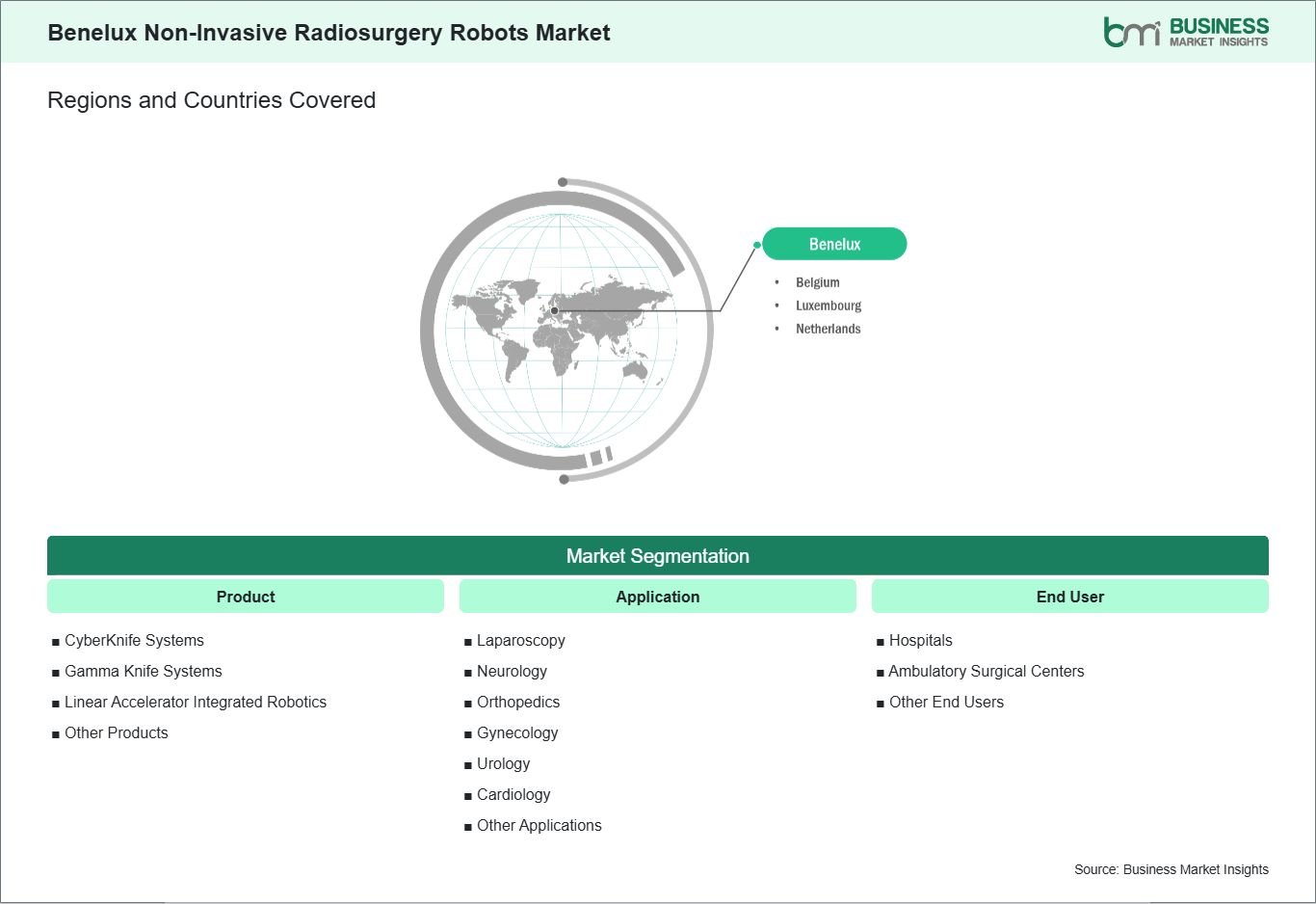
Key segments that contributed to the derivation of the Benelux non-invasive radiosurgery robots market analysis are product, application, and end user.
- By product, the non-invasive radiosurgery robots market is segmented into cyberknife systems, gamma knife systems, linear accelerator (linac) integrated robotics and other products. The medication cyberknife systems segment dominated the market in 2025.
- In terms of application, the non-invasive radiosurgery robots market is categorized into laparoscopy, neurology, orthopedics, gynecology, urology, cardiology and other applications. The laparoscopy segment dominated the market in 2025.
- Based on end user, the market is classified into hospitals, ambulatory surgical centers and other end users. The hospitals segment dominated the market in 2025.
Market Forces
Benelux Non-Invasive Radiosurgery Robots Market Drivers and Opportunities
Advancements in imaging and targeting technologies
The Benelux non-invasive radiosurgery robots market is evolving alongside rapid advancements in imaging and tumor-targeting technologies. Healthcare systems in Belgium, the Netherlands, and Luxembourg are widely recognized for their focus on precision medicine and technologically advanced treatment infrastructure. Hospitals in the region are increasingly integrating radiosurgery robots with high-resolution diagnostic imaging tools to improve treatment accuracy and planning. These systems allow clinicians to visualize tumors in greater detail and develop more targeted treatment strategies. The integration of advanced imaging technologies with robotic radiosurgery platforms enables physicians to deliver radiation therapy with improved precision while protecting surrounding healthy tissue. As a result, healthcare institutions across the Benelux region are emphasizing technological solutions that support more accurate and minimally invasive oncology treatments. A key development supporting this market trend is the use of real-time imaging and motion-tracking capabilities within radiosurgery robots. Tumors located in areas affected by natural body movement, such as the lungs or abdomen, require highly responsive treatment technologies that can adapt during therapy. Advanced targeting systems allow robotic platforms to monitor tumor position and adjust radiation beams accordingly throughout the procedure. This dynamic targeting capability helps maintain treatment accuracy even when patients move slightly during therapy sessions. Healthcare providers in the Benelux region are increasingly interested in such technologies because they support improved clinical confidence and allow treatment of tumors that were previously difficult to address with conventional radiation methods. Academic hospitals and cancer research centers within the Benelux healthcare ecosystem also play a significant role in driving innovation in imaging-guided radiosurgery. These institutions actively participate in clinical research programs that evaluate new imaging software, treatment planning tools, and robotic navigation systems. Through collaboration between clinicians, engineers, and technology developers, hospitals in the region are continuously refining techniques that improve tumor localization and treatment delivery. The strong emphasis on medical research and clinical innovation within the Benelux region contributes to ongoing improvements in radiosurgery technology. As imaging and targeting capabilities continue to evolve, healthcare providers are expected to further integrate robotic radiosurgery systems into their oncology treatment programs.
Subscription-based service models for hospitals
Subscription-based service models are becoming an increasingly attractive approach for hospitals in the Benelux region seeking to adopt non-invasive radiosurgery robots. Advanced robotic medical technologies typically require substantial capital investment, which can create financial barriers for some healthcare institutions. Subscription-based arrangements offer an alternative model where hospitals gain access to radiosurgery systems through structured service agreements rather than large upfront purchases. These agreements generally include equipment usage, software updates, technical support, and maintenance services. By distributing costs over time, this approach helps hospitals adopt advanced treatment technologies while maintaining financial flexibility and stable operational budgets. Healthcare administrators in the Benelux region are particularly interested in procurement strategies that support long-term sustainability and technological adaptability. Subscription models allow hospitals to upgrade or modify their equipment more easily as new developments emerge in robotic radiosurgery technology. This flexibility is valuable in a field where technological innovation is continuous and treatment techniques are frequently refined. Hospitals that adopt service-based models can maintain access to the latest system capabilities without undergoing complex procurement processes each time a technological improvement becomes available. As a result, subscription arrangements support a more adaptable healthcare environment in which facilities can respond quickly to advancements in oncology care. The adoption of subscription-based models also encourages stronger collaboration between healthcare providers and technology developers. Instead of one-time equipment transactions, these arrangements often involve long-term partnerships focused on system performance, workflow optimization, and clinical training. Technology providers may offer continuous technical support and training programs that help hospital staff effectively operate radiosurgery robots and integrate them into daily treatment routines. This cooperative approach helps healthcare institutions maximize the value of their technological investments while ensuring consistent treatment quality. As hospitals in the Benelux region continue to modernize their oncology infrastructure, subscription-based service models are expected to play a growing role in supporting access to advanced non-invasive radiosurgery technologies.
Size and Share Analysis
Benelux Non-Invasive Radiosurgery Robots Market Size and Share Analysis
The Benelux non-invasive radiosurgery robots market demonstrates steady growth, with size and share analysis highlighting evolving trends and competitive dynamics among key players. The report examines subsegments categorized within product, application, and end user, offering insights into their contribution to overall market performance.
By product, the medication cyberknife systems segment dominated the market in 2025, driven by their ability to deliver highly precise, real-time image-guided radiation to tumors anywhere in the body with minimal damage to surrounding healthy tissue.
In terms of application, the laparoscopy subsegment dominated the market in 2025, driven by the growing preference for minimally invasive procedures that enable greater surgical precision, smaller incisions, and faster patient recovery.
Based on end user, the hospitals subsegment dominated the market in 2025, driven by the availability of advanced oncology infrastructure, multidisciplinary expertise, and financial capacity required to install and operate high-cost radiosurgery robotic systems.
Report Coverage
Benelux Non-Invasive Radiosurgery Robots Market Report Coverage and Deliverables
The "Benelux Non-Invasive Radiosurgery Robots Market Size and Forecast (2022–2033)" report provides a detailed analysis of the market covering below areas:
- Benelux Non-Invasive Radiosurgery Robots Market size and forecast at regional and country levels for all segments covered under the scope
- Benelux Non-Invasive Radiosurgery Robots Market trends, as well as drivers, restraints, and opportunities
- Benelux Non-Invasive Radiosurgery Robots Market analysis covering key trends, regional framework, major players, regulations, and recent developments
- Industry landscape and competition analysis covering market concentration, heat map analysis, prominent players, and recent developments for the Benelux Non-Invasive Radiosurgery Robots Market
- Detailed company profiles, including SWOT analysis
Geographic Insights
Benelux Non-Invasive Radiosurgery Robots Market Geographic Insights
The geographical scope of the Benelux Non-Invasive Radiosurgery Robots Market report is divided into Belgium, the Netherlands, and Luxembourg. The Netherlands held the largest share in 2025.
The Benelux Non-Invasive Radiosurgery Robots market demonstrates differentiated adoption patterns across Belgium, the Netherlands, and Luxembourg, shaped by healthcare investment priorities, hospital infrastructure maturity, and clinical research capabilities. The Netherlands emerges as the dominant market within the Benelux region, supported by a highly advanced healthcare ecosystem, strong government emphasis on innovation in oncology care, and the presence of well-established academic medical centers. Major hospitals in cities such as Amsterdam, Rotterdam, and Utrecht are increasingly integrating robotic radiosurgery technologies into multidisciplinary treatment frameworks, particularly for complex neurological tumors, spinal lesions, and precision radiation therapy programs. Dutch healthcare providers also benefit from well-structured reimbursement mechanisms and strong collaboration between clinical research institutions and technology developers, which accelerates the evaluation and implementation of advanced robotic systems. Additionally, the Netherlands has a well-developed digital health infrastructure and strong clinical training programs, enabling physicians and radiation oncologists to rapidly adopt sophisticated radiosurgery platforms and optimize treatment workflows. Belgium represents a significant but slightly smaller market within the Benelux region, characterized by high-quality tertiary hospitals and strong academic research centers in cities such as Brussels, Leuven, and Antwerp. Belgian hospitals have demonstrated growing interest in robotic radiosurgery systems, particularly in oncology and neurosurgical departments seeking to improve treatment precision and expand non-invasive therapeutic options. The country’s collaborative healthcare environment, combined with active participation in European clinical research initiatives, supports technology experimentation and gradual adoption of advanced radiosurgical solutions. However, procurement cycles can be slower due to complex hospital funding structures and careful evaluation of long-term clinical value. Luxembourg, while the smallest healthcare market in the Benelux region, plays a complementary role in the regional ecosystem. Hospitals in Luxembourg are selectively exploring advanced radiosurgery technologies to enhance specialized treatment capabilities, though adoption remains limited compared with its neighboring countries. The country frequently leverages cross-border healthcare collaborations with Belgium and the Netherlands, allowing patients to access advanced radiosurgery procedures in larger medical centers. As a result, Luxembourg’s market growth is expected to be gradual and closely linked to regional healthcare partnerships and shared clinical expertise.
Industry Activity
Recent Developments
The Benelux Non-Invasive Radiosurgery Robots Market is evaluated by gathering qualitative and quantitative data post primary and secondary research, which includes important corporate publications, association data, and databases. A few of the key developments in the Benelux non-invasive radiosurgery robots market are:
- In January 2026, ZAP‑X Gyroscopic Radiosurgery System was announced for installation at Haaglanden Medical Center, becoming the first hospital in the Netherlands to adopt this dedicated non-invasive brain radiosurgery platform. The system provides sub-millimeter precision stereotactic radiosurgery for brain tumors and neurological disorders. Its vault-free and cobalt-free design reduces infrastructure requirements and enhances safety. The center expects to begin clinical treatments after installation and commissioning later in 2026.
- In November 2025, Zap‑Axon Radiosurgery Planning System developed by ZAP Surgical Systems received European CE-mark certification, allowing commercialization and clinical deployment across EU countries including Benelux. The planning software enhances treatment workflow and integrates with robotic radiosurgery systems for highly precise dose planning. CE approval enables hospitals in the Netherlands, Belgium, and Luxembourg to adopt the system for cranial radiosurgery procedures. This regulatory milestone supports broader expansion of non-invasive radiosurgery technologies in Europe.
Trust & Transparency
Research Methodology
The market analysis combines proprietary research with secondary data from government agencies, company disclosures, regulatory filings, industry databases and expert interviews. Market estimates are validated through data triangulation, cross-market benchmarking and analyst
review.
View Full Research Methodology
Key Sources Referred:
World Health Organization (WHO)Organisation for Economic Cooperation and Development (OECD)The World Bank GroupWorldometerThe LancetInternational Bar AssociationInternational Trade Administration